{{ 'now' | timezone: 'America/New_York' | date: '%b %d, %Y' }} |
|
|
|
Welcome back to What I’m Hearing, now coming to you on Tuesdays without the + attached.
Same Eriq Gardner, same behind-the-scenes analysis of the biggest disputes and legal machinations in entertainment, just no brand confusion.
Tonight, Eriq takes stock of the growing anti-WarnerMount movement, including the tactic likely to be employed by the newly emboldened state attorneys general. Plus, the Village Roadshow–Warner Bros. settlement number. All yours, Eriq (and send him tips at Eriq@puck.news).
Not a Puck member yet? Never too late. Just click here.
Mentioned in this issue: Pedro Pascal, Phil Weiser, Jason Bateman, Taylor Swift, Brendan Carr, Nicholas Hill, Florence Pugh, Norm Eisen, Ted Sarandos,
Rob Bonta, Denis Villeneuve, Jonathan Skrmetti, Jeffrey Kessler, Ben Stiller, J.J. Abrams, Stephen King, Jason Kilar, and more…
Let’s begin… |
|
|
|

| Eriq Gardner
|
|
- The Village–Warner Bros.
settlement, revealed: The sprawling legal fight over The Matrix Resurrections is finally over. Warner Bros. and Village Roadshow, its decades-long co-financing partner, have been warring over a soured relationship that produced more than 100 films, including Sherlock Holmes, The Lego Movie, Happy Feet, and the Ocean’s franchise. At one point, Village had more than $100 million reserved for potential Matrix 5 liability, with
appeals and counterclaims still in play. Instead, after arbitrators issued their final Matrix award last month, Village agreed to pay $57 million—an amount that was quietly disclosed to a Los Angeles judge last week.
The feud began during the pandemic, when then–WarnerMedia C.E.O. Jason Kilar made the now-infamous decision to simultaneously debut the studio’s entire 2021 slate in theaters and on HBO Max, including Matrix Resurrections. That move
threatened Village’s backend economics and set off a chain reaction: Village refused to fund its share of Matrix while complaining that it was being sidelined on Wonka and a proposed Edge of Tomorrow TV series. Warners forced the dispute into arbitration and won a key ruling that Village had breached its contract. Then Warners objected when Village subsequently filed for bankruptcy and sold off significant library and derivative rights—including the ability to
co-finance future projects, like the upcoming sequel to Practical Magic—to Alcon Entertainment. A bankruptcy judge declined to unwind that transaction, leaving the parties fighting over damages.
In the end, it appears that the two parties came to terms. The settlement will be folded into Village’s Chapter 11, which a Delaware bankruptcy court has already approved, finally bringing to a conclusion one of Hollywood’s more consequential financing partnerships. - An NBCU legal whodunnit: There’s always an oddball legal mystery brewing in Hollywood. UCLA law professor Eugene Volokh just tipped me off to a “John Doe” complaint filed against NBCUniversal by a self-described “prolific musician, record producer, and musical director” who says he was fired from a TV series after 15 years when another musician on the show, Dory Lobel, allegedly made false accusations against him. ChatGPT’s best guess is Paul Mirkovich, a former musical director on The Voice whose résumé includes helping Taylor Swift rerecord Red. (Mirkovich, Lobel, and counsel didn’t respond when I reached out.)
Anyway, the plaintiff’s identity is arguably less compelling than the legal theory in play. The complaint leans into “coerced self-publication”—meaning the plaintiff claims he was effectively forced to repeat the alleged falsehoods about
himself. That’s not a claim you see every day. So why not just bring a straight wrongful termination case? He may be trying to sidestep a contractual waiver or arbitration clause, though the pleading doesn’t say.
The plaintiff’s lawyers may also have gotten a little too cute in their attempt to keep things vague. California requires defamation plaintiffs to plead the actual words, or at least the substance, of what was said. This complaint doesn’t really do that. Unless it’s amended, it’s
hard to see it getting far. And if it is amended, the allegations will be on the public record.
|
|
|
|
Suspicions are building inside Paramount and beyond that Netflix is astroturfing Hollywood’s
“Block the Merger” campaign and engaging with regulators about the deal. Netflix denies it all—but the growing push to kill WarnerMount is very real. |
|
|
|
It was a banner week for state attorneys general. First, a federal jury found that Live Nation and
Ticketmaster operated as an illegal monopoly. Then a federal judge in California halted the Nexstar–Tegna merger, giving credence to states’ claims that the deal would diminish competition in local TV markets. More than a few people are now asking whether the newly emboldened A.G.s will make a run at Paramount–Warner Bros. Discovery. The answer is: Almost certainly.
For years, the Justice Department set the pace on competition enforcement. But in the more transactional
Trump era, state A.G.s are learning that it’s no longer enough to sign on to a federal complaint and call it a day. If there’s a void, they’ll have to fill it themselves. To their credit, they’re adapting quickly. Tennessee’s Jonathan Skrmetti and Colorado’s Phil Weiser have been quietly organizing along these lines. And where state offices lack in-house firepower, they’ve shown they can punch above their weight by bringing in outside
counsel, as they did with Jeffrey Kessler in the Live Nation trial.
Both Live Nation and Nexstar have vowed to appeal, but the recent run of favorable results is clearly buoying state enforcers and sharpening their instincts. In the Live Nation case, for example, the states prevailed by showing that the company’s promises to not retaliate against venues that strayed from Ticketmaster were hollow. That same sort of skepticism is likely to follow David
Ellison, whose incessant assurances that “Warners will be Warners”—that theatrical output will be preserved, licensing continuity maintained, talent commitments honored, etcetera—could face a tougher, less credulous hearing.
Meanwhile, state A.G.s have also learned from the Nexstar battle that they’ll need to move fast. After the Justice Department and F.C.C. chairman Brendan Carr waved through the merger—creating a new local-broadcasting colossus
without so much as a commission vote at the agency—Nexstar raced to close the deal. The states, alongside DirecTV, did manage to secure a preliminary injunction, but only after Nexstar argued that layoffs and other irreversible steps were already underway. That sequence will not be forgotten. If anything, it will amplify the mistrust between state and federal regulators.
Both lessons point in the same direction for Paramount–WBD, and the drumbeat is getting louder. Exhibitors, guilds, and
Hollywood professionals are urging state A.G.s to take a closer look. That message may resonate with ambitious enforcers like California’s Rob Bonta, whose office, I’m told, has begun scouting for outside counsel. Indeed, a state-led preemptive strike—regardless of its ultimate merits—looks increasingly inevitable as regulators navigate the political overtones and a rising appetite for action. |
Meanwhile, you’ve surely seen the “Block the Merger” open letter circulating through
Hollywood, signed by more than 3,000 actors, writers, and directors, including Jason Bateman, Joaquin Phoenix, J.J. Abrams, Florence Pugh, Denis Villeneuve, Ben Stiller, Kristen Stewart, and Pedro Pascal. Efforts like this don’t materialize out of thin air, of course—backers here include the Democracy Defenders Fund, the Committee for the First
Amendment, and the Future Film Coalition, which are planning a protest outside CBS during the network’s White House Correspondents’ Dinner party. But I’m also hearing that there’s some suspicion inside Paramount and beyond that Netflix is astroturfing the glitzy campaign as a way to either delay the deal—remember, the Ellisons have to pay WBD shareholders a ticking fee of roughly $650 million per quarter if the closing drags past September 30—or kill it outright.
So is this groundswell as
organic as it looks? The Democracy Defenders Fund, run by veteran Washington operative Norm Eisen, strenuously denies that Netflix is meddling backstage—and Netflix also insists it has nothing to do with the letter or protest. That said, I’ve heard Netflix has been quietly shopping for public affairs operatives to help oppose the deal, and has retained economist Nicholas Hill—a former D.O.J. Antitrust Division official who testified for the plaintiffs in the
Live Nation trial—to engage with regulators about the Paramount–WBD merger. I also spoke with a senior government official who told me his staff has fielded multiple complaints in recent weeks from Hill and others connected with Netflix, focused on the transaction and the prospect of attaching licensing conditions. “Frankly, I am surprised at how aggressive they’ve been with me,” he told me. Netflix denies hiring Hill (who didn’t respond to inquiries) and tells me it’s
not interfering in the ongoing regulatory review in any way. |
The Stephen
King Strategy
|
Despite the rallying cries for regulators to rush and block ParaBros, this won’t be
an easy antitrust case at all. Meanwhile, anyone in Hollywood—hello, Mark Ruffalo—agitating for the government to step in doesn’t actually have to wait. The Clayton Act conveniently comes with a private right of action, which allows individuals and businesses threatened by anticompetitive conduct to seek an injunction through litigation.
When a case does inevitably arrive, expect it to center on one or both of two fronts: streaming video-on-demand, via the consolidation
of HBO Max and Paramount+; and the theatrical market for wide-release films. The twist is that challengers may have an easier time than usual getting through the courthouse door. In most merger cases, market definition is half the battle. Here, Paramount has actually already done much of that work itself.
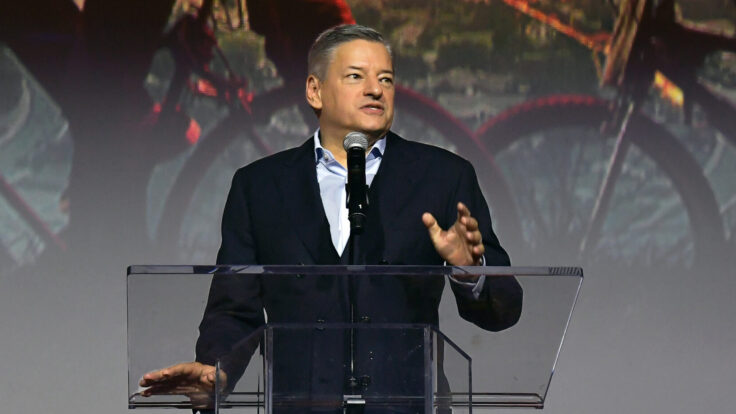
When Ted Sarandos and Netflix were circling WBD, Paramount argued—loudly—that such a deal would “further cement [Netflix’s] dominance in streaming
video-on-demand,” while dismissing efforts to stretch that market to include YouTube or TikTok as something “no serious regulator would ever accept.” Paramount also warned that vertically integrating WBD’s studios into Netflix would increase leverage over exhibitors and creative talent. Read now, those submissions look like a draft complaint just waiting to be repurposed. Oops.
Paramount will have its rebuttals ready, though. For starters, the company will argue that a combined
WarnerMount would command nowhere near Netflix’s scale in streaming, with just 20 percent of the market by its own math. More broadly, it will note that, unlike Netflix, Paramount and WBD have historically licensed plenty of content to third parties. It will also push back on any attempt to carve out a submarket for blockbuster films. On vertical leverage—the choke-point logic that helped sink Live Nation—Paramount will insist there is no credible threat. Not when David Ellison is showing
up at CinemaCon and personally assuring exhibitors that the combined company will produce at least 30 movies a year, release each one theatrically, preserve a minimum 45-day window, and wait 90 days to toss them on S.V.O.D.
Theater owners and Hollywood guilds may not be persuaded, but skepticism is not proof. To prevail, challengers will need more than open letters and ambient industry anxiety. They will need economists, internal documents, and credible witnesses. Behind the scenes, the
guilds are already commissioning white papers for regulators. Eventually, someone will try to dust off the playbook that allowed government prosecutors to block Penguin Random House’s bid for Simon & Schuster. In that case, the D.O.J. put Stephen King on the stand to embody the theory of future harm. King argued that while less competition among publishers probably wouldn’t hurt his own bottom line, it would be career-ending for many writers. Signing a letter is easy. Offering
to be the star witness in a merger challenge is something else. |
Thanks, Eriq. I’ll see everyone on Thursday.
Matt |
|
|
|
Puck founding partner Matt Belloni takes you inside the business of Hollywood, using exclusive reporting and insight to explain
the backstories on everything from Marvel movies to the streaming wars. |
|
|
|
A professional-grade rundown on the business of sports from John Ourand, the industry’s preeminent journalist, covering the
leagues, players, agencies, media deals, and the egos fueling it all. |
|
|
|
Need help? Review our
FAQ page or contact us for assistance. For brand partnerships, email ads@puck.news.
You received this email because you signed up to receive emails from Puck, or as part of your Puck account associated with {{customer.email}}. To stop receiving this newsletter and/or manage all your email preferences, click here. |
Puck is published by Heat Media LLC. 107 Greenwich St., New York, NY 10006 |
|
|
|
|