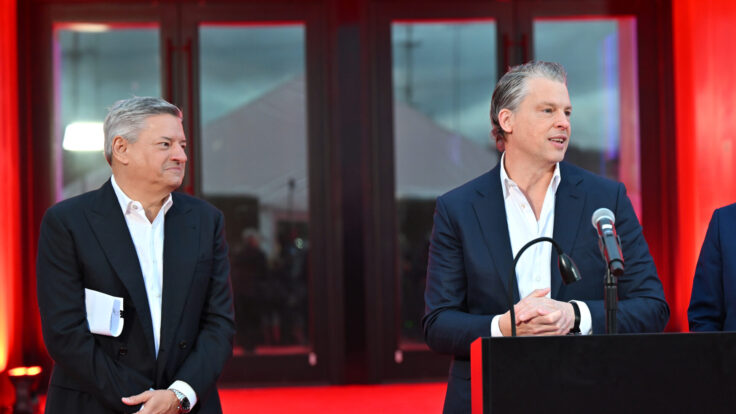
Welcome back to What I’m Hearing, coming at you from the New York Public Library and the Prime Video portion of the TV upfronts—a triggering event for those with strong B.S. detectors. Today an Amazon V.P. claimed ads are “extensions of the entertainment experience, not interruptions,” Fox’s Rob Wade touted the “emotional connectivity” of his fall lineup (a lineup with exactly two scripted dramas), and NBCUniversal promised, with a collective straight face, “the greatest two years in the history of any media company.” That was day one.
It’s making me regret not going to Cannes, though the film fest is doing its best to compete on pure ridiculousness. Both Kevin Spacey and James Franco are shopping movies, Lauren Sánchez will receive something called the “Global Gift Empowerment Award,” and the festival just banned nudity on the red carpet for “decency reasons.” (Where was the “decency” rule last year during the Jon Voight erection scene in Megalopolis?) Actually,
I’d pay several euros to watch one of those snooty Cannes high-heel monitors try to enforce the nudity rule if a big star—say, Bella Hadid last year, or Florence Pugh at a Rome event—shows up in a see-through top.
🚨🚨 Event news: I’m happy to announce more of the lineup for our big Stories of the Season Emmys event next Tuesday in Hollywood. We’ve got showrunners Craig Mazin ( The Last of Us), Charlie Brooker ( Black Mirror), and Ashley Lyle and Bart Nickerson ( Yellowjackets) discussing how they built the unique worlds of their shows with Puck’s Julia Alexander; and Eric Kripke ( The Boys), Eric Tuchman and Yahlin Chang ( The Handmaid’s Tale), and documentarian Lauren Greenfield ( Social Studies) talking politics with Peter Hamby. More to come! Guild and TV Academy members can reserve a spot by emailing Fritz@puck.news.
Programming note: This week on The Town, Lucas Shaw and I parsed Q1 earnings from streaming growth to Disney succession, Scott Mendelson ranked 16 films on our Summer Movie Confidence Scale, and NRG’s Ray Subers explained why Zendaya and Margot Robbie matter to moviegoers. Subscribe here and here.
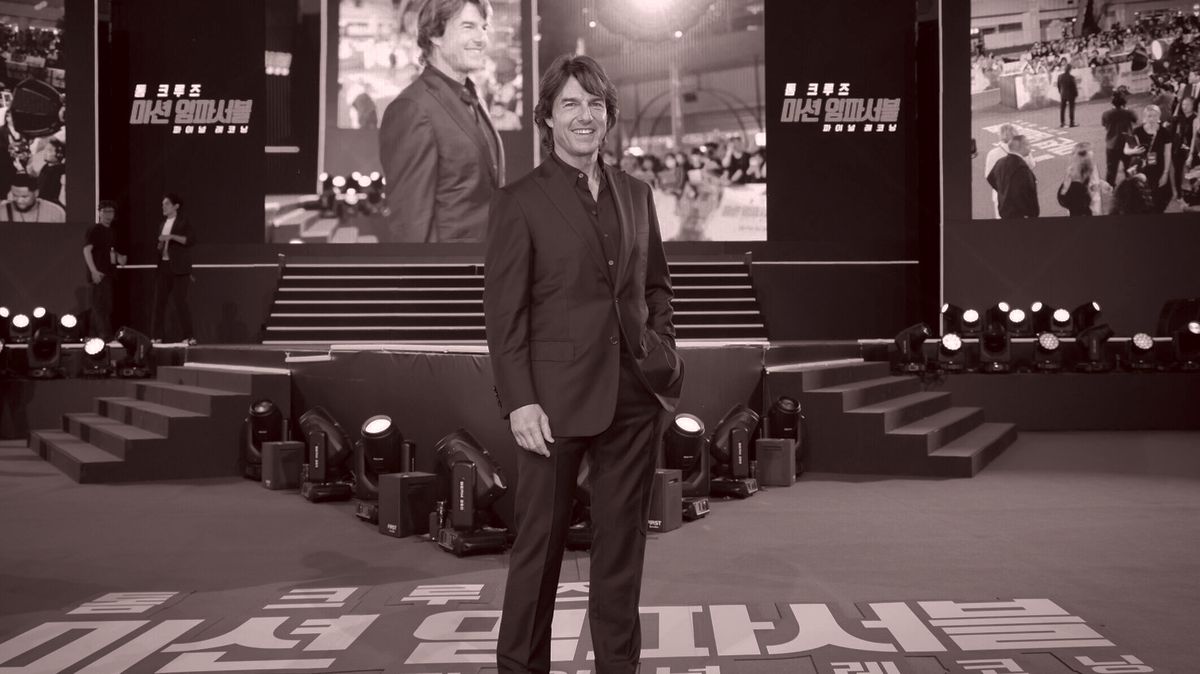
Tonight, Kim Masters is here with a dispatch on everyone’s favorite topic: Tom Cruise. Enough said…
Not a Puck member yet? Just click here. Got a news tip or an idea for me? Just reply to this email or message me on Signal at 310-804-3198.
Discussed in this issue: Bela Bajaria, Tom Cruise, Tim Cook, Ted Sarandos, Seth Rogen, Bryan Freedman, Tom Quinn, Steven Spielberg, Barry
Diller, Shari Redstone, Sumner Redstone, Amanda Lundberg, Jamie Patricof, Zendaya, Scott Rudin, Blake Lively, Nazanin Boniadi, Anna Sawai, Jon Feltheimer, Pat Kingsley, and… the official Cannes restaurant guide.
But first…
|
Who Won the Week: Jerry Bruckheimer and Dick Wolf
|
|
Together, two 80-ish producers are making close to half of the dwindling number of dramas on broadcast TV, with Bruckheimer controlling a three-show Friday night block on CBS and Wolf handling seven series across CBS and NBC.
Honorable mention: Bela Bajaria, the Netflix content chief, for passing on Suits L.A. despite the original becoming a sensation on the platform. Bela could smell a turd, and indeed, the reboot was canceled after one limp season on NBC. Gotta be consequences at the network for this totally wasted opportunity, right?
Second honorable mention: Naming consultants. Comcast’s SpinCo is now Versant, Fox’s streaming service is Fox One, Patrick Whitesell’s post-Endeavor NFL spite store is WIN Sports, and ESPN’s streamer is… just ESPN. Great work, everyone.
|
“They asked if we could use Tim Cook instead, and we said no.”
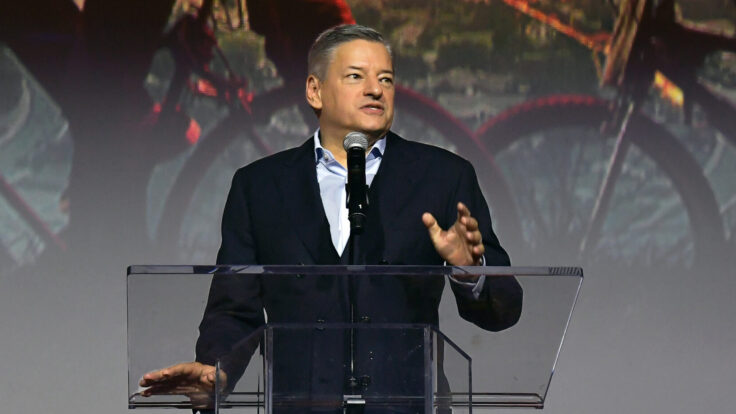
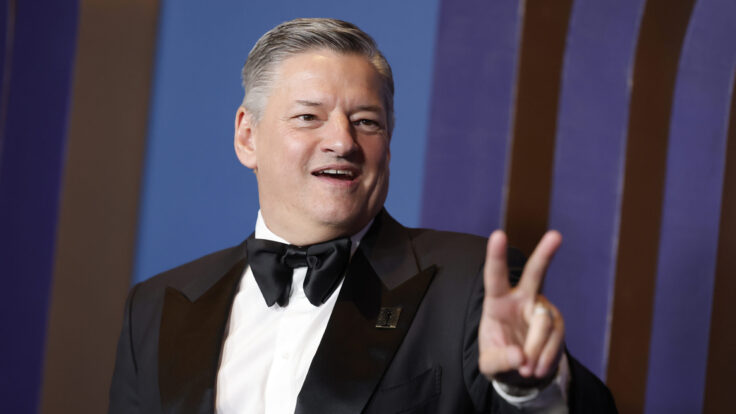
— Seth Rogen, telling Business Insider about the note he got from Apple on the Studio episode set at the Golden Globes and co-starring Netflix’s Ted Sarandos.
Runner-up: “Hold the deposition at MSG, sell tickets or stream it, and donate every dollar to organizations helping victims of domestic abuse.”
— Bryan Freedman, the Justin Baldoni litigator, helpfully offering People an appropriately circus-like idea for how Blake Lively could testify in the case against his client.
|
Welcome to a new recurring feature of WIH highlighting the numbers that mattered this week in entertainment…
45 percent
Share of U.S. studio movies in 2024 that hit streaming platforms less than 90 days after their theatrical release, down from about 75 percent in 2022. [ Ampere Analysis]
7 percentage points
Growth of ad-supported subscription streaming plans in March from the same period last year, up to 46 percent of all subscribers. [Antenna]
$9.5 million
Initial investment in George Clooney’s Good Night and Good Luck, which the play recouped in just seven and a half weeks. [ Broadway World]
97.8 million
Daily Roblox players, up 26 percent year over year. [ Roblox earnings]
Okay, now on to Kim’s column…
|
|
|
|
Twenty years since he jumped on Oprah’s butterscotch-yellow couch, a retrospective on the season in which Tom Cruise nearly lost his career—and the brain trust that helped him save it.
|
|
|
|
On Wednesday, Tom Cruise will return to the Croisette for the premiere of Mission: Impossible—The Final Reckoning, the eighth film in a truly remarkable, nearly 30-year run for perhaps the world’s most dedicated movie star. With a price tag that is said to start with a 4 (as in, hundred million), Mission 8 is in contention for the most expensive movie ever made—the consequence of pulling the final installments in the series through a pandemic that involved multiple locations and forced location changes, as well as several shutdowns due to covid outbreaks. (One of which put unvaxxed director Chris McQuarrie in the hospital, sources say. Asked for comment, his attorney Matt Galsor responded, “Don’t believe everything you wrote.”)
Add in two strikes and the fact that Cruise and McQuarrie are pretty much impossible to control, especially when it comes to this franchise and the pressure they undoubtedly feel to keep going bigger. (When Paramount owner Shari Redstone pushed to hurry the seventh film onto Paramount+—even announcing in February 2022 that it would stream after a 45-day theatrical run—Cruise angrily called his lawyers and blocked it.) And trying to get him to move faster was futile. “It’s not always in the best interest of the budget, but Cruise is incredibly detailed and willing to put in an enormous amount of time and effort on every aspect,” a studio insider told me.
When these last Mission movies were conceived, Paramount was in such a weakened position, with few franchises to its name, that then-studio chief Jim Gianopulos greenlighted the seventh and eighth films on the basis of a treatment and Cruise’s salesmanship in a pitch—but without scripts. As filming went on and on, Cruise even persuaded Paramount’s then-new studio chief Brian Robbins to give him more money to finish the seventh and make the eighth, arguing (with some justification) that inflation had driven up expenses. The result is an eighth Mission movie that needs to gross a staggering amount to break even—far more than any of the previous films has grossed and certainly more than the seventh film, which fell a bit short with $571 million in box office. (The 2018 installment, Fallout, did $792 million.) The consolation is it will perform very well once it moves through the theatrical window, juicing up Paramount’s streamer, for example.
Is this really the last Mission: Impossible? Remember, the title was tweaked from Mission: Impossible–Dead Reckoning, Part Two to Final Reckoning, so it seems likely that this reckoning really might be the final one (though you can never say never with Cruise)—and perhaps a fitting end to the Redstone era. Thanks to F.C.C. chairman and Trump superfan Brendan Carr holding the Paramount-Skydance deal hostage, both Redstone and David Ellison can share the opening weekend anxiety. (Ellison’s Skydance has invested in the films since the fourth in the series.)
That Cruise, 62, is still in this game, after all these years, is in part a tribute to one of his most exceptional stunts: salvaging his own career. In May 2005—20 years ago, almost to the day—Cruise appeared on The Oprah Winfrey Show and unwittingly put at risk the thing he seems to love most in the world. No one who saw it has forgotten it. Dressed in black, Cruise bounded onstage, pumped his fist, went down on one knee and pounded the floor. “What has happened to you?” Oprah asked. “I’m in love!” Cruise replied. And then he did it. He jumped onto Oprah’s butterscotch-yellow couch. It was one small hop for man, but one giant leap into career limbo for one of the world’s biggest movie stars. The moment went viral before Twitter even existed.
What followed was a series of appearances that only dug the hole deeper as the public watched in fascination. “People can sense weirdness,” said
an executive who was involved in what we’ll call the Tom Cruise Reclamation Project of the mid-2000s. Cruise had made himself an extremely intense poster boy for Scientology, and before that phase was over, Paramount had not only forced him to renegotiate his very rich deal, which had enabled him to make millions even when the studio lost money, but fired him after a 14-year relationship, with Sumner Redstone telling The Wall Street Journal, “His recent conduct has not been acceptable to Paramount.” (The Cruise camp claimed that he had quit.) Cruise had even managed to kick off a years-long feud with Steven Spielberg, who had directed him in Minority Report and War of the Worlds.
But thanks largely to a series of interventions by executives who understood what was at stake for Cruise better than he did at that time, he dug himself out again through a process in which I had my own, very small cameo. Now, he has taken on the mantle of industry hero for having dragged the seventh Mission: Impossible through multiple Covid shutdowns in an undeniably heroic effort to preserve the theatrical experience. The cherry on the Cruise revival sundae was his promotion of Barbenheimer. When was the last time you saw a star promote someone else’s movie?
|
“Has Tom Cruise Lost His Marbles?”
|
Ever since he lip-synced his way into America’s heart in the 1983 hit Risky Business—and revealed to the world that winning, megawatt smile—Cruise had been the very model of a movie star. He did the work, he was polite and professional, and he was devoted to his fans. His first wife, Mimi Rogers, introduced him to Scientology, and it’s now part of the lore that Cruise drifted from the group during his 11-year marriage to Nicole Kidman. But when it ended in 2001, Scientology worked to bring him back to the fold, and over the course of the next few years his enthusiasm built to a fever pitch.
In spite of his marriages, Cruise was dogged by speculation about his sexuality. Perhaps in response to that—who knows?—he started, at age 42, to conduct a search for a girlfriend. Or rather, Scientology did. It became known that, in 2004, actress Nazanin Boniadi, a fellow Scientologist, had been selected for the role of Cruise’s significant other. When that didn’t work out, Leah Remini has alleged, Scientology punished Boniadi by forcing her to perform menial labor such as cleaning toilets with a toothbrush. (The church denies all such allegations but did not respond to requests for comment.)
As Cruise’s search continued, it made its way onto the Hollywood gossip wires. Cruise was said to have considered potential partners including Scarlett Johansson, Jessica Alba, and Jennifer Garner. His interest in Garner worked out well for J.J. Abrams, creator of her series, Alias. After watching the show, Cruise gave Abrams his first film-directing job with M:I 3. (That installment remains the lowest-grossing in the series.)
Of course, Katie Holmes, then 26, eventually emerged as the future Mrs. Cruise. Meanwhile, the War of the Worlds marketing campaign was underway and Spielberg watched in despair as Cruise went very public about his religion. As I reported in a 2005 cover story for the short-lived Radar magazine, reporters who approached the actor expecting canned quotes about the movie instead got sermons about the church’s successful detoxification, prison rehabilitation, and education programs. “It certainly took some of the emphasis away from where we would have liked it,” Marvin Levy, Spielberg’s longtime (and recently deceased) spokesperson, told me at the time. Spielberg sent a recorded message to run during the Oprah appearance. “Talk a little bit about War of the Worlds,” he pleaded, “because we’re opening really soon!”
Ultimately, Spielberg concluded that Cruise’s public behavior had cost War of the Worlds about $30 million in box office. But there was another, more damaging episode that happened in private. At a dinner with Cruise, Spielberg praised a psychiatrist who he said had helped a family member. After that, representatives from Scientology staged a protest at the doctor’s office. Although Cruise told Spielberg that he wasn’t behind the incident, it infuriated the director and (perhaps more importantly) his wife, Kate Capshaw. A source close to Spielberg told me recently that the filmmaker had pretty much nothing to say to Cruise until that Academy Awards Nominees Luncheon in 2023, after Top Gun: Maverick had grossed a stunning $1.5 billion. “You saved Hollywood’s ass!” Spielberg told him. “And you might have saved theatrical distribution. Seriously. Maverick might have saved the entire theatrical industry.”
Earlier in his career, Cruise’s powerful, old-school publicist, Pat Kingsley, had shielded him from queries about Scientology and discouraged him from talking about it. But in early 2004, she was fired in favor of Rogers & Cowan’s Paul Bloch. As Scientology began to be aware of Cruise’s dropping popularity, a source involved with the reclamation project says they blamed Bloch and fired him. (Bloch, who died in 2018, was nothing if not devoted to his clients.) They then replaced Bloch with Cruise’s sister and fellow Scientologist Lee Anne DeVette, who obviously was not going to constrain her brother, and who didn’t think he needed reclamation. “It was Tom’s sister and the church, so you had to walk on eggshells” when trying to work with Cruise at the time, this source said. (After the reclamation project got underway, Amanda Lundberg was hired to represent Cruise and does to this day.)
In May 2005, Cruise appeared on Access Hollywood and criticized Brooke Shields for revealing that she had taken medication to combat postpartum depression, saying any problems in that regard could be fixed through exercise and vitamins. On Today, he memorably went at Matt Lauer when questioned about Scientology’s hostility toward psychiatry. “Matt. Matt, Matt, Matt, Matt. You’re glib,” Cruise said, with trademark intensity. A tape from a Cruise church event, in which he spoke with wild enthusiasm about the joys of Scientology, found its way onto the internet and went viral. The impact was perhaps best summed up by the cover line on Vanity Fair’s August issue: “Has Tom Cruise lost his marbles?”
|
The Cruise Reclamation Project
|
|
After all that, Cruise’s career cooled. (Remember Knight and Day, with Cruise and Cameron Diaz? Neither do I.) “His numbers with women were dreadful,” said a source who was in Cruise’s orbit at the time. (Cruise’s appeal with women still appears to lag behind men, according to tracking for the latest Mission.)
“There was a series of conversations with him,” said a source involved with the project, which really got rolling in the run-up to the 2008 release of Valkyrie. According to this person, Cruise “had no idea” that his image had suffered, because Scientology shields important members from negative news. (That would be “entheta on his lines,” in Scientology-speak.) “Any email that Tom Cruise gets is retyped by Scientologists,” this source continued. “[But] he had to understand the level of damage he had done to his career.” Cruise was told that he needed to “decide if he was a movie star who happened to be a Scientologist,” or a proselytizer for the faith. There were also meetings, according to this source, in which the message was conveyed to Scientology officials that if the behavior continued, “you’ll have a damaged movie star on your hands.”
The message also landed with Cruise. “He said, ‘Tell me what to do.’ And he did exactly what we told him to do,” this source explained. Said another: “He’s very good at taking direction.” The redemption tour kicked off with Oprah in early May 2008. She got what was billed as a no-holds-barred interview with Cruise at his home in Telluride, and a few days later, Cruise appeared in-studio for a celebration of the 25th anniversary of Risky Business, with affectionate recorded messages from such celebrities as Will Smith to refresh memories of Cruise’s erstwhile popularity.
Cruise then publicly apologized to Lauer and went to Shields’s home to express his regrets. He did a profane and hilarious cameo in Tropic Thunder, with some Hollywood insiders speculating that the performance was inspired by Sumner Redstone, while others saw a send-up of Harvey Weinstein. In December 2008, he went on Late Show With David Letterman to read the “top ten craziest things people say about Tom Cruise on the internet”—and there were a couple that hit pretty close to home. Number four: “I believe all emotional and psychological disorders can be cured with Vicks VapoRub.” Number two: “After jumping on her couch, Oprah hammer-locked me ’til I coughed blood.”
Cruise didn’t owe me an apology for anything, but I think I caught a little of the reclamation-project action. I had written and spoken more than I care to remember about him and Scientology, including that 2005 story, headlined “The Passion of Tom Cruise.” While I was working on that piece, I reached out to the church for comment, and the church disputed pretty much everything, describing fallen-away Scientologists, who were on-the-record sources, as liars and “apostates.” Then Scientologists turned up at my office, and it’s probably just as well I wasn’t in. They settled for leaving me some literature. In June 2006, I followed up with a piece for Slate about the delicate state of Cruise’s career. The headline was “The Cootie Factor,” a reference to a term used by a prominent agent.
But after Cruise began the apology tour, I wrote again, this time in a May 2009 piece for The Daily Beast, recognizing his work to resurrect his career. It began, “I have started to admire Tom Cruise. I think.” The evening of publication, I was watching TV with my then-5-year-old when there was a knock on my door. I opened the little window and saw a young woman on the steps. “I’m from Lee Anne DeVette’s office,” she said. I made something of a display of rolling my eyes, opened the door, and she handed me an envelope. The card inside, embossed with the entangled initials T.C., read, “Dear Kim, Thank you. Best, Tom Cruise.”
|
|
There were no Mission: Impossible installments from 2006 to 2011. I remember when the late Brad Grey, then chairman of Paramount, boasted to me in 2009 about a laying-down-the-law meeting he had just had with Cruise and Abrams, who was producing the fourth Mission. Grey said he told Cruise there would be no Scientology tents on the set, as there had been on War of the Worlds. And Cruise would not be dipping into the gross until Paramount broke even. (Grey claimed Abrams was hiding under a chair while this lecture went on.)
But Cruise had the last laugh. The stars fell into alignment on Ghost Protocol, which grossed $695 million. “After Sumner’s power play, the studio realized that this guy was the cornerstone of one of their biggest franchises,” said an insider with knowledge of the situation. “He had his original deal, even with some improvements. Well done, Sumner.”
With Final Reckoning’s eye-watering price tag—Paramount won’t comment on the number and can you blame them?—we’re almost surely back to the
days when Cruise could make millions while the studio loses millions. But one insider said that’s okay: “It’s a big, expensive movie—no doubt—but it has enormous value [beyond theatrical revenue]. I’m sure we’d do it all over again.” As for Cruise, “This guy’s worked his ass off to keep the business alive. He deserves some respect for that. The work ethic, the knowledge of how to make a film, the charisma—I just look at him and I say, ‘Thank God for Tom Cruise. Thank God.’”
As for Scientology, Cruise is as zealous as he was on the day he stepped onto the couch, according to Tony Ortega, a leading Scientology skeptic who has tracked the organization closely for years. “Although the tabloids continue to fantasize the opposite, Tom Cruise is actually still as dedicated a Scientologist today as ever,” Ortega said in an email. “Each autumn, Scientology leader David Miscavige travels to the U.K. for a big annual event that honors the church’s biggest donors. In both of the last two meetings, Cruise not only showed up (he lives in England now), he took selfies with his fellow Scientologists that the church allowed to be posted to social media. This was highly unusual for Scientology, and I think it was an indication that Miscavige wanted it very well known that his best friend, Cruise, is as gung-ho as ever.”
|
The U.S. Copyright Office mostly sided with creators against the A.I.-loving tech companies—right before Trump fired Register of Copyrights Shira Perlmutter. For real. [ Copyright Lately]
Bill Cohan has an update on the Warner Discovery debt ratio, which explains why the stock price continues to languish. [ Puck]
The Writers Guild narrowly upheld punishments beyond what its own tribunal found appropriate for strike violators including Julie Bush, whom I wrote about a couple weeks ago and who lost by just 59 votes. [ THR]
Lionsgate completed its Starz split, in case C.E.O. Jon Feltheimer calls you, your friends, or your friends’ mothers trying to get someone to buy the company. [ Press release]
Scott Rudin’s calculated return to public life continues with a quote in Maureen Dowd’s column on Barry Diller’s “coming out” in his memoir. [ NY Times]
Tree Paine remains undefeated in public statements. [ CNN]
Inkoo Kang explains why The Studio and Hacks feel fresher than the usual showbiz satires: Hollywood sucks now. [ New Yorker]
Lauren Sherman gave out her Met Gala awards and explained how Zendaya and Anna Sawai ended up wearing nearly identical outfits. [ Puck]
|
Finally, One Fun Cannes Thing…
|
|
Jamie Patricof, the producer and creator of the influential food, politics, and culture newsletter, Jamie’s List, is back to share his Cannes dining tips ahead of the 78th festival…
With Roofman—my latest film with Derek Cianfrance—still in the editing room, I unfortunately won’t be at Cannes. But that hasn’t stopped the texts from rolling in: Where should we eat? Cannes isn’t exactly overflowing with hidden gems, but here are the favorites from my crew: Da Laura, La Môme, Le Maschou, Hotel Belle Rives, La Colombe d’Or, and Fred L’Écailler. I also called in the unofficial king of Cannes and winner of five Palme d’Or’s, Neon C.E.O. Tom Quinn, for some tips. “While everyone heads to La Pizza, I go the opposite way—to Le Vesuvio. And if you’re up for venturing out of town, I highly recommend Le Bistrot du Port in Juan-les-Pins. It’s run by two brothers who serve amazing seafood and love talking NBA playoffs.”
|
|
Have a great week,
Matt
Got a question, comment, complaint, or an over/under on how many actual appearances Michael Jordan will make on NBC as its “special correspondent” for NBA coverage? Email me at Matt@puck.news or call/text me at 310-804-3198.
|
|
|
Need help? Review our FAQ page or contact us for assistance. For brand partnerships, email ads@puck.news.
You received this email because you signed up to receive emails from Puck, or as part of your Puck account associated with . To stop receiving this newsletter and/or manage all your email preferences, click here.
|
|
Puck is published by Heat Media LLC. 107 Greenwich St, New York, NY 10006
|
|
|
|