Welcome back to What I’m Hearing, slowing down a little for this final week of summer. Thanks
again to the Edinburgh TV Festival and the nice people of Scotland for a great week. I’ll post videos of my panels if/when they go online.
Tonight, Julia Alexander is here to analyze the Peacock release strategy for the upcoming Office spinoff and a new wrinkle in the battle over binge drops. Plus, a few thoughts from me on Netflix’s reverse-jujitsu box office move, and some interesting feedback on Thursday’s Lorne
interview.
Programming note: This week on The Town, Lucas Shaw and I debated why Netflix put KPop Demon Hunters in theaters, Fox One C.E.O. Pete Distad previewed his new service, and Traitors producer Stephen Lambert explained why so many reality formats originated in two small countries. Subscribe here and
here.
Not a Puck member yet? Just click here. Got a news tip or an idea for me? Just reply to this email, text me, or message me on Signal at 310-804-3198.
Discussed in this issue: Brendan Carr, Dana
Walden, Brian Roberts, Casey Bloys, Scott Stuber, Ted Sarandos, Mike Hopkins, Kevin Hart, Rupert Murdoch, Pete Davidson, Eric Adams, Adam Aron, Greg Daniels, Noah Sacco, Jeffrey
Katzenberg, Rich Greenfield, Aziz Ansari, Seth Meyers, and… Disney Adult ”shoulder plushies.”
But first…
|
Who Won the Week:
Maggie Kang and Chris Appelhans
|
It’s gotta be the KPop Demon Hunters filmmakers, who accomplished what even Oscar winners like
Guillermo del Toro, Noah Baumbach, and Kathryn Bigelow could not: get Netflix to put their movie in 1,700 theaters, where it grossed nearly $20 million in two days, after having been available on the service for more than two months.
Runner-up: Scott Stuber. Netflix keeps touting KPop Demon Hunters and Happy Gilmore 2 as the movies of the summer, and both were gifts left behind by its
former film chief.
Second runner-up: Brendan Carr. Trump’s F.C.C. chairman and self-described baseball nut happened to get himself invited to throw out the first pitch at the Yankees game on Saturday and join the broadcast booth. It probably had nothing to do with Carr’s potential role
in upcoming negotiations between the team’s YES Network and Comcast.
|
A little more on this weekend’s ‘KPop’ numbers…
Netflix co-C.E.O. Ted
Sarandos might think that movie theaters are “outmoded” for most people, but there were many reasons to put KPop Demon Hunters in multiplexes this weekend: marketing for the sing-along version, of course, which is now available on the service; a nice bone to throw the filmmakers (though, as I have noted, neither the talent nor producer Sony
Pictures will earn anything from the box office haul); a middle finger to my buddy Adam Aron and his AMC Theatres, which continues to boycott Netflix films even as rivals Regal and Cinemark set aside their windowing principles to accept some needed cash; and, perhaps the biggest reason: franchise-ification.
|
|
|
A MESSAGE FROM OUR SPONSOR
|
|
|
At this point, Netflix is looking at Demon Hunters as a multifilm, multiplatform, Disney-style piece
of intellectual property to be managed and exploited for the next decade or more. And the best way to help I.P. feel meaningful to consumers is still to make it feel theatrical. For thousands of families, Demon Hunters is now an entertainment experience they have attended in person, rather than simply pushed play on at home—even if they pushed play over and over again. This movie was already primed to become a franchise via Netflix views, but even a two-day theatrical stunt
helped further that process. And for Sarandos, that is worth temporarily suspending his religion around theaters.
|
$650 million
Worldwide box office revenue estimate for wide-release comedies
(about 18 films) in 2025, down nearly 84 percent from $4 billion (across 50 films) in 2005. [LA Times/Franchise Re]
8
Spec script sales in August, the highest monthly total since March 2017 and a sign that more film studios are looking for original material.
[ Dailies]
35 percent
Share of viewers outside of South Korea who say they watch Korean TV series or films “sometimes” or “very often,” a 13 percent increase from 2020.
[ Ampere Analysis]
$701 million
Dividends paid to OnlyFans owner Leonid Radvinsky ahead of a potential sale of the platform.
[ Bloomberg]
47.3 million
Concurrent players on Roblox, breaking the record for the most users on any platform, beating Steam’s record of 41.2 million from March.
[ Dexerto]
Now, here’s Julia…
|
|
|
Peacock’s decision to change its Office spinoff, The Paper, from a weekly
release to an all-at-once drop reflects the latest scholarship on streaming viewer habits—and, of course, a chance to control the media narrative.
|
|
|
More than a decade into the streaming era, it’s almost funny that we’re still debating whether to
binge or not to binge. But Peacock’s change of the release schedule for The Paper—the follow-up to The Office created by Greg Daniels and Michael Koman—from a weekly cadence (following the first four episodes dropping in one batch) to a Netflix-style binge release has recently rekindled the age-old debate around release strategies: Should a platform release episodes all at once, once a week, or something in between? Does it
depend on the audience? Or the budget of the show? Or an executive’s own ulterior motives?
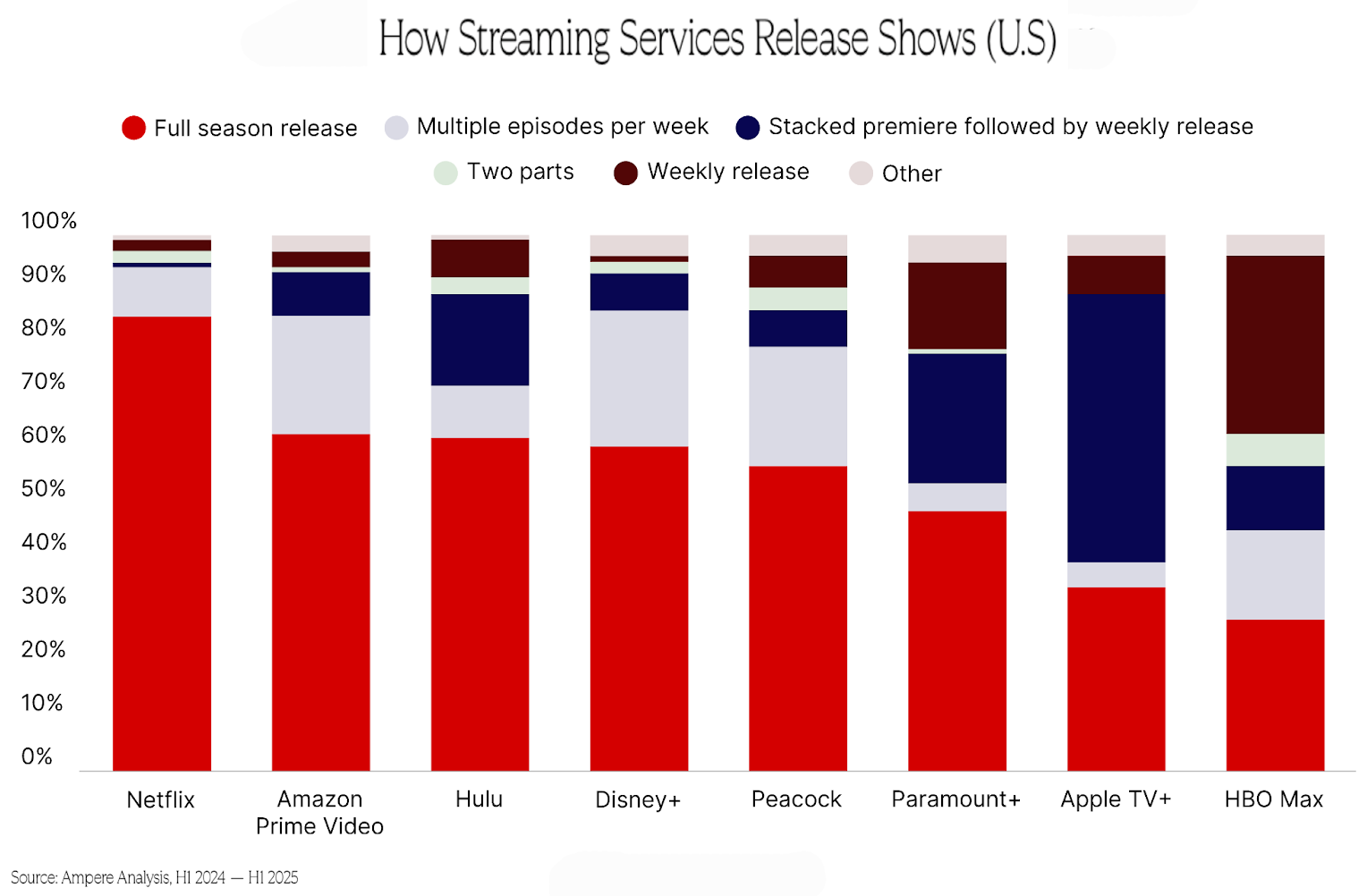
After a robust debate during the early days of the streaming wars, the different platforms have largely settled into patterns that work best for them. For a pure-play streamer like Netflix, where dozens of new TV shows and movies are released every week, the constant flow nearly eliminates the need to release any individual title in a piecemeal fashion. For that reason, Netflix leads the pack in
binge releases: 84 percent of its original titles between the first half of 2024 and the second half of 2025 were dropped all at once, according to Ampere Analysis. (Among the outliers, Netflix released Love Is Blind weekly, while tentpoles like Bridgerton dropped a half-season at a time.)
At the other end of the spectrum is HBO Max, which has built its platform (after various fits and starts) around HBO’s on-demand release cadence. A streaming division within a larger
legacy media company, it typically builds quarterly slates around one or two I.P.-driven shows or returning series that constitute event viewing. HBO C.E.O. Casey Bloys has evangelized weekly drops because they implant a show deeper into the cultural zeitgeist as word of mouth spreads. (Also, frankly, he just doesn’t have as much content as Netflix—or as big a budget.) Apple seems to be emulating the HBO formula—the binge-drop rate for both platforms hovers around 30 percent.
Meanwhile, Dana Walden and Alan Bergman at Disney, and Mike Hopkins at Amazon have demonstrated more openness to experimentation: Prime Video, Hulu, and Disney+ all released around 60 percent of their shows all at once.
|
Against that backdrop, The Paper, a potential breakout on a subscale streamer owned by a telecom
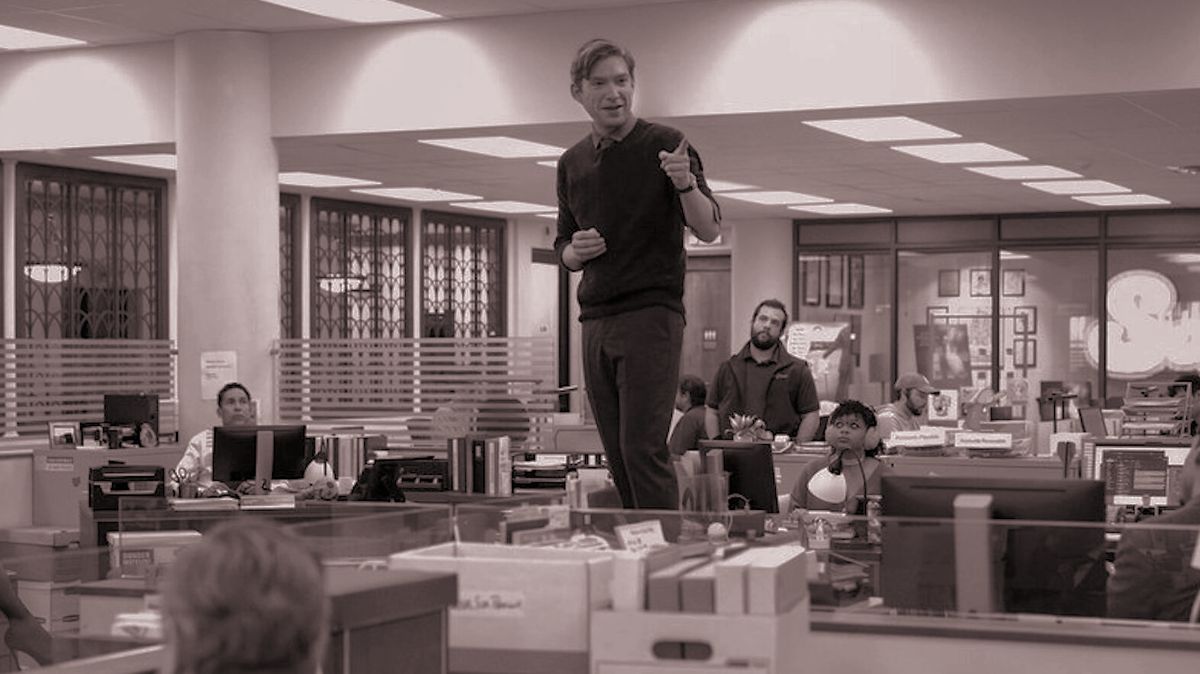
conglomerate, should make for a fascinating bellwether on the current state of release strategies. The show, which stars Domhnall Gleeson as the leader of a small-town newspaper (with The Office’s Oscar Nuñez providing a connection to the Dunder Mifflin crew), seems like the exact sort of event series that you’d want to parcel out over 10 weeks. But The Paper also has a binge heritage. The Office was, after all, once
the most watched show on Netflix, before NBCU bought it back for $500 million in 2021, and is now one of the most watched on Peacock, per a person familiar with the data.
So the expectations for the spinoff are high. I’m told that the platform decided to pivot to a binge release after early audience feedback indicated that, as with the original, viewers would prefer to watch the episodes all at once. Peacock, which has been mired at around 41 million subscribers for the past six months,
might have benefited from a microdose release schedule. But a couple recent case studies firmly support the binge decision.
|
On the
Andor–Pitt Spectrum
|
Non-Netflix streamers have all kinds of incentives for binge-dropping a show. Earlier this year, Disney+
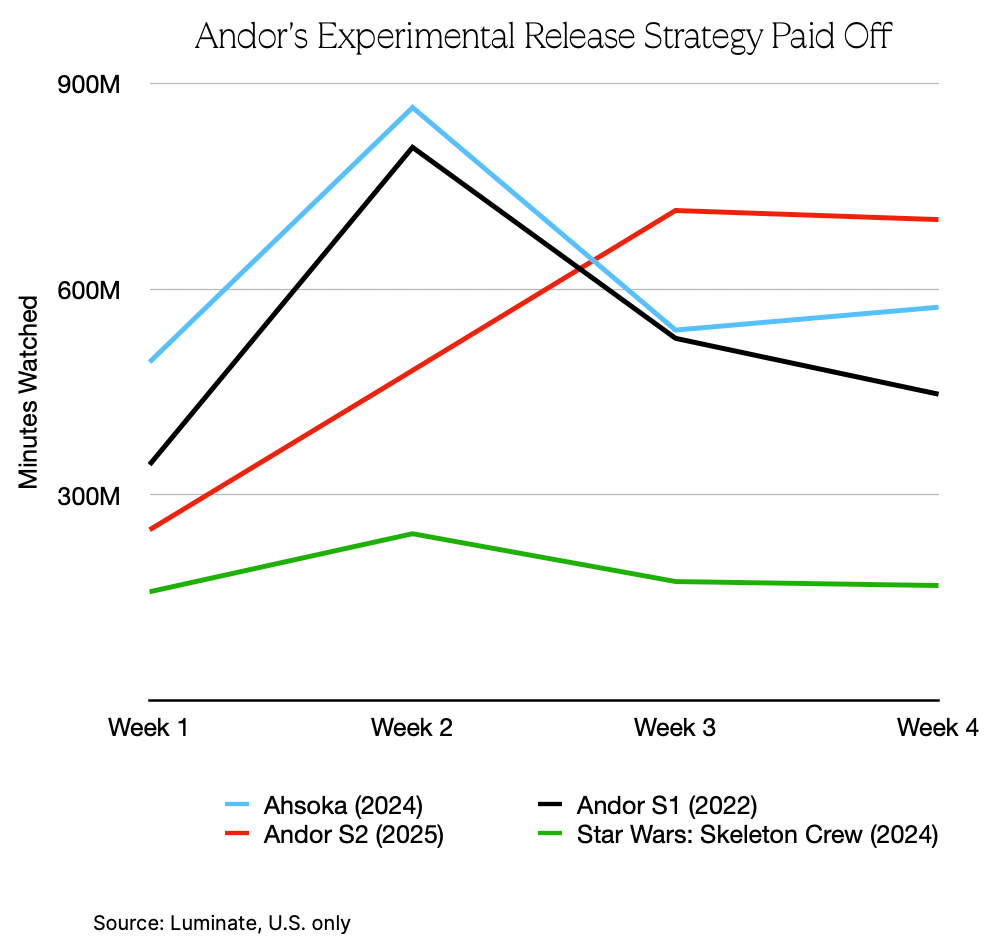
switched things up for the second season of Andor, transitioning from a weekly release to a hybrid drop in which three episodes were released every week for four weeks—a slightly more binge-friendly variation on Disney’s usual approach in which a couple of episodes are released at first, and the rest weekly.
While binge-releasing a show with a built-in fan base might seem unnecessary, the pivot worked: Viewership rose each week, whereas it had cooled off for previous Star
Wars series—including Ahsoka, Skeleton Crew, and Andor Season 1—that were released on weekly schedules. (Those shows all saw their viewership peak during the second week.) Ahsoka, like Andor S1, lost viewers between its second and third week, while Andor S2 actually increased its viewership by a similar percentage over that same period, and then sustained its audience through the finale, per Luminate.
|
|
|
A MESSAGE FROM OUR SPONSOR
|
|
|
Everything comes down to ensuring that engagement rates are high and churn rates remain relatively low. If a
show can sustain a continuous build over eight to 10 weeks, like The White Lotus, weekly releases help in both areas. But if the dropoff of a show is higher, then it’s better to find a healthy balance between incentivizing audiences to stick with a show by giving them a few episodes at once without leaning fully into a binge format. For Andor, the question for Disney+ executives was whether to drop a batch of three episodes each week for a month and juice engagement for a
shorter period of time, or extend that potential audience interest for a few more weeks. Executives had data from the show’s first-season performance—hence the decision to not drag out the show and risk alienating the audience early on.
|
Not every show has the same burden. HBO Max’s The Pitt, for instance, cost less than $6
million an episode and carried lower expectations. Indeed, the series didn’t really start making waves until the vast majority of the season was available to stream, when it broke into Nielsen’s top 10, with 466 million minutes, and steadily grew each week as word of mouth spread—something that wouldn’t have been possible with a binge drop. Since its windfall of Emmy nominations, viewership for The Pitt has increased by more than 200 percent, according to Luminate, marking the highest
post-nomination viewership of any major nominated drama. In other words, it behaved like an HBO show, only on streaming.
So where does The Paper—which is neither a Star Wars project nor a hospital procedural, but is derived from historic I.P.—fit into this evolving spectrum? Comedies naturally lend themselves to binge formats since, unlike with dramas, there are rarely cliffhangers or narrative developments that spur audiences to return. Also, since The
Office is routinely one of the most binged shows on Peacock, the same audience will be able to queue up The Paper right after. Even if The Paper takes half a season to find its footing, leaning into a format that incentivizes stronger audience engagement offers a higher chance of success. And if the show is just plain bad—I personally didn’t find anything compelling about the trailer Peacock released—this is one way to achieve meaningful viewership out of the gate.
|
From a slate perspective, Peacock is less reliant on a show like The Paper this fall than in seasons
past. After all, its strategy is built around Sunday NFL games, about 50 new and exclusive NBA games, and the return of established hits like The Traitors. The Paper isn’t an Andor-sized bet—it’s shoulder programming that’s mostly designed to give current Peacock subscribers one more thing to watch, creating incremental perceived value following its recent nearly 40 percent price hike.
And, as the Andor case study demonstrated, there’s
another reason that executives tend to like binge releases—they avoid embarrassment and can also juice media buzz. Since every streamer not named Netflix refuses to share weekly viewership data, Nielsen’s top 10 lists have become important. (Yes, the data is imperfect: Nielsen’s measurement system benefits longer-running shows, or binge drops, because there are more minutes to watch.)
The lists generate headlines, which create the perception that people are watching something
and enjoying it. Maybe that makes all the difference for Peacock and a show like The Paper, which could use some help—less than two weeks before it premieres on September 4, search traffic for the show has fallen by more than 75 percent from its peak in early August, per Google Trends. But if The Paper can break into Nielsen’s top 10, it would give Strauss something to talk about besides Love Island and the NBA.
|
Apple TV+ raising its price 30 percent while keeping its annual fee and Apple One bundle the same suggests
this is all about pushing users to a yearly plan and reducing its industry-leading churn rate. [LA Times]
The latest sign that the enigmatic, above-it-all Old A24 is gone: a full-participation, fawning magazine feature with film chief Noah Sacco as the on-the-record hero of the narrative.
[ New Yorker]
Rich Greenfield and the LightShed analysts had a total meltdown over the “cluttered” and “frustrating” ESPN app experience. [ LightShed]
Related: Twice in a month, guys?? We should all love someone as much as Disney executives love ringing stock market bells. [ YouTube] [ Also YouTube]
The list of top comics taking Saudi blood money to perform at the “Riyadh
Comedy Festival” is hilariously long: Kevin Hart, Pete Davidson, Aziz Ansari, Sebastian Maniscalco, Fluffy, Whitney Cummings, Jo Koy, Andrew Schulz, Jim Jefferies, Bill Burr, and many more.
[ Humorism]
So much for those deathbed rumors: Rupert Murdoch was spotted with the prime minister of Greece at a fish taverna on the island of Tinos. [ Greek City
Times]
“Shoulder Plushies” dolls are the latest way Disney Adults are warning normal people to stay far away from them. [ NY Times]
Serious question: Is the Russia-censored version of And Just Like That… actually smarter and funnier than the original?
[ NY Times]
The former top aide to NYC Mayor Eric Adams allegedly traded political favors for perks including a guest spot on Hulu’s Godfather of Harlem. Did Only Murders pass?
[ NY Post]
Jeffrey Katzenberg’s first post-Quibi media investment is… a drone entertainment company with Elon Musk’s brother. [ Financial Times]
The smartest think piece you’ll ever read about Labubus. [ New Yorker]
|
Thursday’s interview with Lorne Michaels sparked a lot of people to read between the lines of his
comments…
“Gotta love Lorne. Everything he says is strategic. Best wishes to Brian [ Roberts, Comcast C.E.O.] trying to cancel Seth [ Meyers] now that he’s been called a ‘man of integrity’!” — A former NBC executive
“Great interview. Lorne’s genius is knowing exactly how to manage up (Brian) and down (his own cast). Even at that age, does anyone doubt he will make the right decisions?” — An
executive
“The fact that Lorne did [this interview] shows how proud he is of the 50th shows. He will do SNL until they drag him out of [Studio 8H], but that was the apex [of his career].” — An SNL alum
“I kept coming back to that word ‘emotion.’ Lorne mentioned it a bunch, and it’s clear his goal [with the SNL50 special] was to show how much the show has mattered, to the culture, to even politics, and to the people who have started their careers
there. In the process he revealed how much the show has mattered to him.” — An actor
|
Have a great week,
Matt
Maya Tribbitt contributed research for today’s
issue.
Got a question, comment, complaint, or fantasy football secrets? Email me at Matt@puck.news or call/text me at 310-804-3198.
|
|
|
Puck fashion correspondent Lauren Sherman and a rotating cast of industry insiders take you deep behind the scenes of this
multitrillion-dollar biz, from creative director switcheroos to M&A drama, D.T.C. downfalls, and magazine mishaps. Fashion People is an extension of Line Sheet, Lauren’s private email for Puck, where she tracks what’s happening beyond the press releases in fashion, beauty, and media. New episodes publish every Tuesday and Friday.
|
|
|
Puck’s daily art market email, anchored by industry expert Marion Maneker, offers unparalleled access to the mega-auctions and
galleries, elite buyers and sellers, and the power players who run this opaque world. Wall Power also features Julie Brener Davich, a veteran of Christie’s and Sotheby’s, who provides unique insights into how the business really works.
|
|
|
Need help? Review our FAQ page or contact us for assistance. For brand partnerships, email ads@puck.news.
You received this email because you signed up to receive emails from Puck, or as part of your Puck account associated with {{customer.email}}. To stop receiving this newsletter and/or manage all your email preferences, click here.
|
Puck is published by Heat Media LLC. 107 Greenwich St, New York, NY 10006
|
|
|
|