Welcome back to What I’m Hearing. I hope you’re enjoying some downtime this
Passover/Easter week. Feels like the weekend started at sundown yesterday…
Tonight, another reason to fear the content recession, and its name is Roger Goodell. Plus, J.J. Abrams’s sad wind-down, Jeff Shell’s Paramount exit, Oscars news, and the answer—finally—to the question: Are movies getting way longer? Plus…
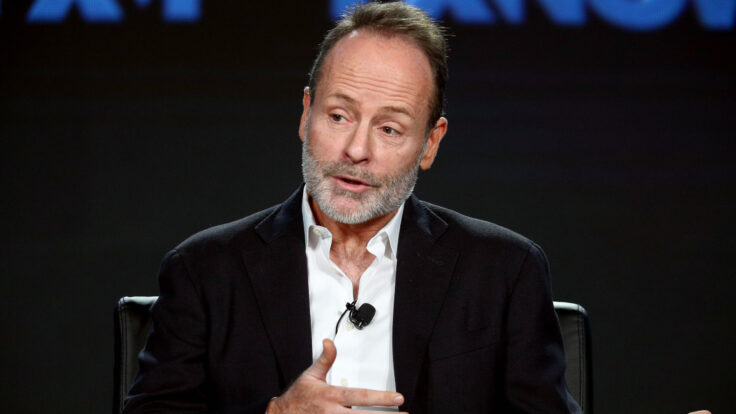
💫💫 Vegas, baby, with Favs: I’m interviewing Mandalorian and Grogu filmmaker Jon
Favreau at CinemaCon on April 16. If you work in movie exhibition (or you’re just a fan of old-school Hollywood buffets), secure your CinemaCon pass here, join us and check out all the innovations in Icee flavors and vibrating recliners. See you there!
Mentioned in this issue: David Zaslav, Rupert Murdoch, J.J.
Abrams, Jeff Shell, Andy Gordon, David Ellison, Roger Goodell, Minnie Driver, Gunnar Wiedenfels, Rupert Murdoch, Stephen Follows, Todd Goldstein, Brendan Carr, Lachlan Murdoch, Bruce Campbell, R.J. Cipriani, Larry Ellison, Tom Brady, Gerhard
Zeiler, Hans Schroeder, John Mara, JB Perrette, and… Mr. Taylor Swift.
Not a Puck member yet? Just click here. Got a news tip or an idea for me? Just reply to this email, text me, or message me on Signal at 310-804-3198.
Let’s begin… |
- Shell won’t be Paramount president much longer: I broke the news earlier today that Jeff Shell has begun to negotiate his exit as Paramount president amid the fallout from claims made by that professional gambler R.J. Cipriani. Not a surprise after Cipriani generated another round of press today with multiple media
interviews. This doesn’t mean the internal investigation, which is expected to wrap up within a week, will ultimately fault Shell, or that he will cut ties entirely with the company (though I think he will). But given the distraction of the Cipriani litigation over allegedly disclosed Paramount secrets, Shell won’t be president or sit on the board regardless of the findings. A bizarre situation, and a lesson to mind the company you keep.
- So…who’s gonna be
Ellison’s No. 2?: That’s the question bouncing around the studio today. David Ellison could choose to fly solo, but with the anticipated integration of Warner Bros. Discovery, a designated co-pilot seems more than justified. Andy Gordon, the RedBird dealmaker turned C.O.O., has been taking on a bigger role, but he hasn’t operated a media company before. If that Warner Discovery deal closes, Ellison could ask one of Zaslav’s lieutenants to
stay on. Ellison is said to especially like C.F.O. Gunnar Wiedenfels and Bruce Campbell, the revenue and strategy leader. Gerhard Zeiler, the president of international, has apparently been cozying up to the Paramount people. And streaming chief JB Perrette possesses key expertise if the next few years will be all about merging Paramount+ and HBO Max. The problem, of course, is that the Zaslav guys are about to
make so much f-ing money if the deal closes, they may not want—or need—to work ever again.
- Is “moved to New York” the new “winding down”?: Seems that way, as J.J. Abrams spun the decimation of his once-high-flying Bad Robot as simply a refocusing as he spends more time on the East Coast. No shame, entertainment companies—especially filmmaker-driven companies—rise and fall all the time, especially amid all the industry
challenges. And Bad Robot definitely had its moment as the “It” producer, with one of the fattest deals at Warner Bros. and the coolest office space in town (sold, incidentally, last fall). The truth is that Abrams and wife/partner Katie McGrath have been talking for a while about paring back to just “make stuff” (his words), which proved surprisingly difficult at Bad Robot during his post-Star Wars years. Maybe it was the weight of all those announced plans to scale
production, “revolutionize” gaming, build a George Lucas–style VFX player in-house, and so on. Now he’s still got a Warners first-look, a movie he directed in the can (The Great Beyond, November 13), and, maybe, a fresh start.
- The Oscars’ $100 million glow-up: Enthusiasm isn’t exactly overwhelming for the recently announced move of the Oscars ceremony from Hollywood to the food court-adjacent Peacock Theater in downtown L.A.
in 2029. Overlooked in the coverage of the move is that AEG, which owns the Peacock and surrounding L.A. Live complex, has committed to spend more than $100 million to glamorize the theater and area, per two sources. They’re planning to replace all the seats, revamp the drab lobby and hockey venue–style concessions, create a new red carpet and arrival area, and glow up the adjacent JW Marriott, which will host the Governors Ball. Plus, while the Peacock will continue to host concerts and other
awards events, the Oscars will take over a month in advance of the show. “We control millions of square feet of space,” Todd Goldstein, chief revenue officer of AEG, told me today. “Working with the Academy, we can guarantee that night will feel different and bigger.”
More: It hasn’t been announced yet, but the plan is to move the Governors Awards, the annual nontelevised honorary Oscars, to that same JW Marriott before the actual Oscars relocate, and
possibly as early as the 2027 event. (The Academy declined to comment.) - Yes, the big movies are getting longer…: The success of Project Hail Mary, which clocks in at 2:36, is certainly not gonna convince filmmakers to shorten their movies anytime soon. In fact, researcher Stephen Follows just crunched the runtimes of more than 36,000 films from 1980 to 2025, and while the average movie has remained about 102 minutes for
decades, the wide releases, meaning the titles that gross more than $10 million at the box office, have gotten about 15 minutes longer over the past 20 years—from 107 minutes to more than 120 minutes. Makes sense that in the age of the I.P.-driven C.G.I. spectacular, action movies (116 minutes for all titles, including streaming exclusives) are driving that increase, with comedies (100 minutes) and horror (95 minutes) holding steady, and dramas (106 minutes) actually getting
shorter. Movies with budgets of more than $100 million now run a butt-numbing 129 minutes, compared with 122 minutes two decades ago. And in the Hail Mary category, movies over two and a half hours exploded from just 2 percent of wide releases in the ’80s to 10 percent today. (Here’s Follows’ full report, and we’ll discuss it on The Town tomorrow.)
- Box office over/under: Tracking for Universal/Illumination’s Super Mario Galaxy Movie was only at about $175 million for the holiday weekend, well below the first movie. But given the early numbers, the real question now is, will it cross $200 million for the five-day period? I’ll take the over.
|
Now, on to the NFL and a giant sucking sound… |
|
|
|
For TV networks, NFL rights have never been less affordable or more vital. The
league now has its partners over a $16 billion barrel, likely forcing them to cut film and TV spending just to stay in the game. Unless Brendan Carr decides to put Roger in his place… |
|
|
|
Nobody in town seems to want to talk about this, but one of the biggest threats to the
film and TV industry maybe isn’t A.I. or YouTube or whatever studio Larry Ellison is consolidating today. It’s football.
Are you following the NFL’s latest shakedown attempt? You should be. The league’s current broadcast partners—that’s CBS, Fox, NBC, ESPN, and Amazon Prime Video—together pay more than $10 billion per year in rights deals that run through 2033, with an opt-out after the 2029-30 season. (Sunday Ticket on YouTube TV and a few games on Netflix contribute a
couple billion more.) That $10 billion rents the most consistently popular programming on TV, but it also represents a decent chunk of those broadcasters’ overall content budgets. You see where this is going.
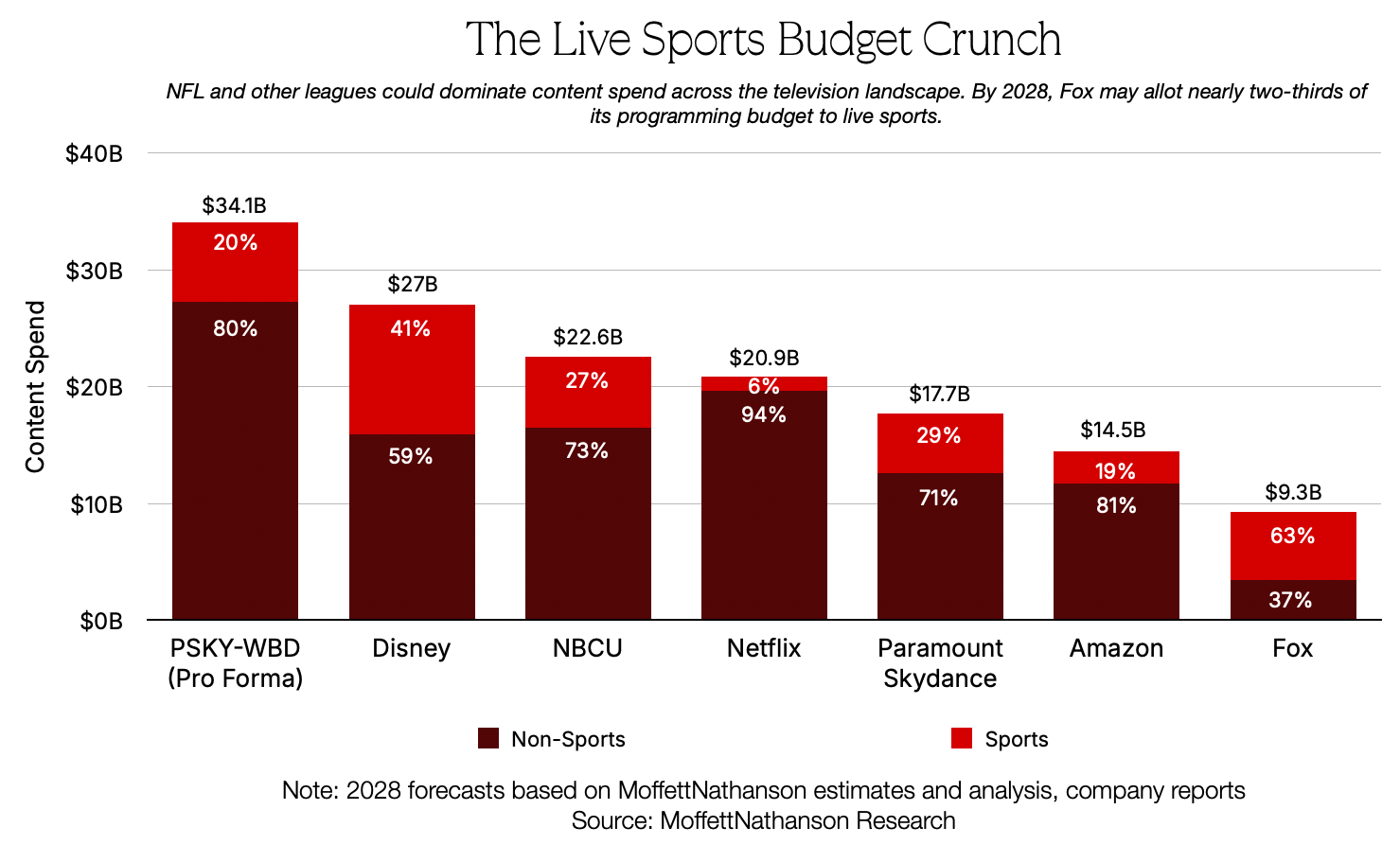
Fox, for instance, pays $2.3 billion a year for NFL rights, and that’s not including its hefty production costs. (Tom Brady alone makes $37.5 million a year to smile and look pretty in the broadcast booth.) Fox’s total content spend was estimated at
$8.1 billion in 2024, though it rose to $9.2 billion in 2025 because of the Super Bowl. So the NFL gobbles up more than a quarter of what Fox spends on all its content each year—for a few hours of programming on Sunday afternoons.
Now the NFL wants—and will almost certainly get—more, citing its outsize ratings compared to other sports leagues like the NBA, which scored $6.9 billion per year from TV partners in its 2024 deals. To secure basketball, NBC/Peacock, for
instance, agreed to pay $2.5 billion per year, about 25 percent more than the $2 billion it shells out annually for Sunday Night Football. The NBA provides many more hours of content, of course, but SNF averaged 23.5 million viewers last season, while NBA games on NBC this season are averaging about 2.6 million viewers. Given the value disparity, the NFL argues, NBC shouldn’t be paying less to the dominant league.
So the NFL has begun to renegotiate, starting
with CBS owner Paramount, whose acquisition by Skydance triggered a “change-of-control” clause that allows the league to start talks now. Those are heating up, I’m told, with the NFL effectively leveraging the deep-pocketed streamers—Netflix, Prime Video, and YouTube—all of which would love to have more NFL. And right on cue, MoffettNathanson is out with a new report predicting the average annual value of NFL rights deals will rise to $15.9 billion after renegotiations—including the carve-outs
of additional smaller packages, likely to sell to Netflix or YouTube. That’s 58 percent higher than the current deals, and here’s the key line: “We expect media companies will be forced to offset higher NFL costs through a reallocation of content budgets mitigating the EBITDA impact.” That’s analyst-speak for, Do you hear that giant sucking sound? It’s film and TV cash being hoovered up by the NFL.
Yes, the NFL, that collection of billionaire monopolist team owners like
Jerry Jones, Stan Kroenke, and John Mara, has always wielded enormous power over the entertainment conglomerates. But now that power is dwarfing everything else in Hollywood, especially since the league has helped strong-arm Nielsen into expanding out-of-home viewing measurements in its “Big Data” reports, resulting in tons of recent “record high” ratings. So the 30 owners can hide behind commissioner Roger Goodell and
his media rights hammer Hans Schroeder as they bleed the TV partners for cash right up to the point where they almost but don’t quite go out of business.
It’s a fine line, because until even your survivalist cousin in Montana subscribes to Netflix and Prime Video, the NFL also needs these over-the-air broadcast partners to exist. They still deliver the largest audience in this country and make local games available for free to the most people. But if the
broadcasters subsist on NFL content and not much else, that’s totally fine for Goodell. And that’s kinda the direction the networks are headed. Look what happened at ESPN, which once programmed a ton of sports-related entertainment and paid its SportsCenter anchors like movie stars. Now it’s live games and basically the sports equivalent of MTV playing Ridiculousness on repeat.
Rupert and Lachlan Murdoch are certainly aware of this
tightrope. Their Fox Corp, with its focus on news and sports, is probably the most exposed to the coming extortion. No disrespect to The Faithful: Women of the Bible, a real show starring Minnie Driver that is currently airing on Fox, what is that network without the once-a-week NFL cocaine bump that lasts five months each year? Disney and Comcast, with their lucrative theme parks, and Amazon, with its reliable toilet paper sales, are much more able to weather the
rights increases. But Fox and Paramount, with its $80 billion in debt thanks to the pending WarnerMount deal, less so. |
Both David Ellison and the Murdochs seem to be fighting back, or at least their
favorite Trump official is fighting on behalf of their respective conservative media empires. Brendan Carr, the F.C.C. chair, said this week on Fox News—where else?— that he’s “looking into” the antitrust exemption that allows the NFL to do league-wide TV deals only if it protects customer access. If the league continues to shift games from “free” TV to paywalled streaming services, Carr might pounce, and “there could be actions at other portions of the government, and Congress
as well,” he warned. It’s not hard to see who would benefit from those kinds of “actions.”
At the same time, Murdoch’s Wall Street Journal
warned in an editorial yesterday that team owners “should consider the backlash building against the antitrust exemption they retain from another era.” Goodell, the missive continued, “thinks he can get more money from Big Tech’s streaming services than he can from his longtime TV partners. That would hurt the networks, especially local stations, that rely on the NFL for ad revenue.” And Fox News is giving airtime to an amusing poll showing
that majorities of both sports fans (72 percent) and non-fans (60 percent) think big sporting events should be required to stay on broadcast TV. The results may be accurate—of course people prefer “free,” though they probably aren’t familiar with the retrans fees CBS and Fox receive from distributors that are then passed on to consumers—but they also reinforce Carr’s position, which is also the Murdoch and Ellison position: Watch your step, Roger.
It’s particularly
ironic to see this argument coming from Rupert, normally a free-market conservative who famously overpaid for an NFL package back in the early ’90s precisely to help build an audience for his fledgling Fox TV empire, just as Prime Video and Netflix are doing in streaming today. The NFL has always leveraged competition among platforms to extract ever more numerous pounds of flesh. The difference is, in the linear TV era, that competition supported the same channel bundle that included all sorts
of networks—and their robust programming—that football fans paid for but maybe never watched. (And vice versa; your aunt who thinks of Travis Kelce only as Mr. Taylor Swift continues to fund Robert Kraft’s massage therapists via her DirecTV bill.) The unique NFL content allowed those channels to keep raising carriage and retrans fees, not to mention ad rates.
But now the NFL is basically the only thing propping up these linear networks,
and carriage fees are stalled or even declining, thus making football more valuable and less affordable for their owners, who, for the most part, are not growing their overall businesses to match the expected rights fees—at least not yet. Losing football entirely might irreparably harm their businesses, but participating in a bidding war with deep-pocketed streamers might also drive them off a cliff. Unless… they cut their content budgets elsewhere.
Hence what will
likely be a major retrenchment from both lesser sports leagues—not great news for MLB or NASCAR or PGA golf—and, crucially, entertainment content. Balancing these budgets “can be achieved by pulling back spending on other areas of content like scripted entertainment and films,” the analysts wrote. Which likely means less money for Hollywood at a time when so many disruptions are already siphoning money away from Hollywood.
How much? We’ll see, and obviously there are risks to outlets that
reduce their entertainment offerings—namely, non–sports fans could tune out or unsubscribe. But even a few billion in annual spend would be felt throughout the community. It’s enough to make people in Hollywood root for the Murdochs and Ellisons in this fight. Will political pushback from the government stop the NFL from doing what the NFL does—extracting billions more from its partners? Probably not. But the Trump administration certainly isn’t afraid to align itself with media players it deems
allies.
The conservative-friendly TV station merger of Tegna and Nexstar got the greenlight from Carr despite an F.C.C. rule explicitly forbidding it. We know what happened in the run-up to the Skydance-Paramount deal. My colleague John Ourand reported last week that executives at certain networks are weighing whether to hold off on renegotiating now and pressing their luck when the opt-outs arrive in four years. That’s
probably the first salvo in this negotiation war, and given the potential high-stakes fallout, all of Hollywood has a vested interest. |
See you Monday,
Matt
Got a question, comment, complaint, or a box of Peeps? Email me
at Matt@puck.news or call/text me at 310-804-3198. |
|
|
|
Puck founding partner Matt Belloni takes you inside the business of Hollywood, using exclusive reporting and insight
to explain the backstories on everything from Marvel movies to the streaming wars. |
|
|
|
Ace media reporter Dylan Byers brings readers into the C-suite as he chronicles the biggest stories in the industry:
the future of cable news in the streaming era, the transformation of legacy publishers, the tech giants remaking the market, and all the egos involved. |
|
|
|
Need help? Review our FAQ page or contact us for assistance. For brand partnerships, email ads@puck.news. You received this email because you
signed up to receive emails from Puck, or as part of your Puck account associated with {{customer.email}}. To stop receiving this newsletter and/or manage all your email preferences, click here. |
Puck is published by Heat Media LLC. 107 Greenwich St., New York, NY 10006 |
|
|
|
|