Welcome back to What I’m Hearing...
Happy Sunday, hope Santa brought you what you wanted. If not, how about a Puck membership? Remember, you get access to me and a bunch of other authors covering the inside conversation in Hollywood, Silicon Valley, Washington and Wall Street.
Discussed in today’s email: Ryan Reynolds, Bela Bajaria, Reese Witherspoon, Tom Rothman, Ryan Murphy, Kevin Ulrich, the Murdochs, Shelly Miscavige, and the worst holiday card of the year.
In this issue, we're continuing my year-end takes. And for more, I broke down 2021 with Kim Masters and Lucas Shaw on The Business. Listen here.
Sponsored by Amazon Studios 
Who Won the Year: Ryan Reynolds
Anyone else check these boxes? Starred in the no. 1 Netflix movie of all time (Red Notice). Starred in and produced the top-grossing non-franchise movie of the year (Free Guy, $331 million). Reaped millions from the sale of his marketing agency, Maximum Effort, which seems to go viral once a month. (His $660 million deal for gin brand Aviation was last year, but still impressive.) Endorsements, a corporate board seat at Match, and he bought a soccer team with texting buddy Rob McElhenney. Setting the standard for the modern movie star.
Runners up: Kevin Feige, Hwang Dong-hyuk, Reese Witherspoon, David Zaslav, Taylor Sheridan, Scarlett Johansson, Adele, Mathew Rosengart, Awkwafina, Aryeh Bourkoff, Bruce Springsteen, Roger Goodell, the Manning brothers, and the TikTok algorithm.
Quote of the Year: “I want to thank Lorne, who went to go take a dump. Perfect.” —Jason Sudeikis, accepting his Emmy for Ted Lasso in September and name checking his SNL boss in absentia
Runner up: “These streaming services have been making something that they call ‘movies.’ They ain’t movies. They are some weird algorithmic process that has created things that last 100 minutes or so.” –Barry Diller at Sun Valley in July
On Thursday, I revealed that he Hollywood Villain of the Year is AMC Entertainment C.E.O. Adam Aron, for reasons explained here. Today it’s the Hero of the Year. This is not who won (see above). This is the person most influencing what the future of entertainment will look like.

Love her or hate her (and she’s got her share of detractors), Bajaria has been key to turning Netflix’s international content into globalized hits. You don’t need me to tell you that Squid Game was the biggest piece of professionally-created entertainment this year. Those staggering numbers—sampled by 142 million accounts in 90 countries (and finished by 87 million of them) in its first 23 days; 1.5 billion hours viewed in its first 28 days; the kind of global fandom usually reserved for soccer stars and Avengers movies—speak for themselves. The nine-episode, South Korean sci-fi thriller that Netflix bought for $22 million has created $900 million in value, according to internal documents that were revealed in October by Bloomberg, and its stars became subjects of everything from TikTok memes to Halloween costumes to a talent agency frenzy to sign them.
What’s most interesting to me isn’t that Squid Game happened, it’s that this kind of foreign super-breakout was inevitable, and that television success in the future will be defined mostly on these global terms. Anyone paying even casual attention can see what happened in 2021 as a flashing signpost of where this is all headed: Huge investments in local-language programming lead to mainstream-able hits that can be algorithmically promoted to a global audience that’s trained to embrace subtitles and foreign actors; that, in turn, will create nearly instant, exponential growth in consumption of that content. In other words: Massive f-ing hits. And hits translate into subscribers, perpetuating the virtuous cycle.
That’s not breaking news. In some ways, this has always been the TV business: big, broad hits pay for all the busted pilots and wasted overall deals, eventually spraying cash across the entire industry. But now, with truly scaled platforms, and paying customers willing to sample whatever is served directly to them, it’s all happening way faster, way bigger, and without the various middlemen. The entire lifespan (and revenue waterfall) of a TV show can be compressed into a few months on one platform.
And don’t forget, Netflix keeps all the upside here. Imagine if Squid Game were, say, a Warner Bros. show created by someone like Chuck Lorre or Greg Berlanti. Hundreds of millions of dollars would fly out the door. But not here. Creator Hwang Dong-hyuk has said he didn’t make much from Season 1, and the Netflix deal provides for a second season. He and the cast got bonuses, of course, and I’m not saying this is great for the overall health of the talent ecosystem, but the windfall for Netflix on this show is just massive.
That was the Netflix vision from the beginning–the justification for billions and billions in content investment (plus buying out backends), and the narrative that caused Wall Street to go all in on streaming. It has been buying and making international shows since at least 2015. In 2021, the strategy produced Squid Game. There will be many more.
ADVERTISEMENT
Amazon Studios presents BEING THE RICARDOS. Writer/Director Aaron Sorkin examines one production week of I Love Lucy— from table read through taping — as Lucille Ball (Nicole Kidman) and Desi Arnaz (Javier Bardem) face personal and professional crises that threaten their show, careers, and marriage. Featuring J.K. Simmons, Nina Arianda, Alia Shawkat, Tony Hale, Jake Lacy, Linda Lavin, Ronny Cox, and John Rubinstein. 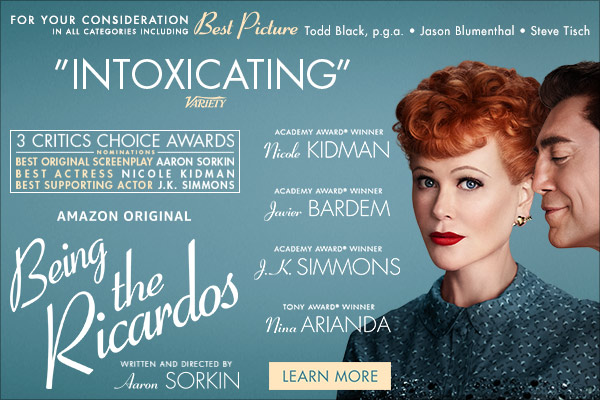
BEING THE RICARDOS is in theaters and streaming now on Prime Video.
There’s no better avatar of this strategy than Bela Bajaria. Love her or hate her (and she’s got her share of detractors), as V.P. of global TV for a service with 214 million subscribers, only a third of which are in the U.S., Bajaria has been leaning into international scripted shows and exportable reality formats since she joined the company in 2016 after getting fired from NBC Universal. Local-language stuff was her specialty until last fall, when she replaced Cindy Holland in the top TV job under co-C.E.O. Ted Sarandos. A lot of people were pissed about that move because Holland had built the Netflix TV ethos with pricey shows like Stranger Things and The Crown. She’s great, but now the shift seems obvious. Holland had great taste and threw money at people like Ryan Murphy and Kenya Barris because, in its formative years, Netflix needed to show it could compete with FX and HBO and ABC, the outlets that its target customers were watching.
But that game has changed. Netflix and Amazon Prime Video, and to a lesser extent, Disney+ and the others, are finding that the U.S. streaming market is fully penetrated and oversaturated. Domestic sub growth is slowing at almost all the services, dragging down share prices with it. In fact, until Squid Game appeared in the early fall, Netflix was in the same boat, actually losing North American subs in the second quarter, its stock down for the year. Then it rebounded in Q3 and is forecasting a big Q4, mostly from international. The Squid Game effect. These services know the growth is coming from outside the U.S., and supporting that growth is the priority. Netflix just has a massive advantage here: Scale, consistent branding, no legacy entanglements, and, of course, shit-tons of money.
I’m sure you’ve seen at least some of these Netflix numbers: $1 billion spent on Korean programs alone, including $500 million this year on films and series there. That’s on top of $1 billion in the U.K. and $400 million in India in 2019 and 2020. Latin America is similar. Netflix is making shows in 40 different countries, it subtitles content in 37 languages, and it dubs in 34. Nobody except Disney is close, and Disney has all those pre-branded franchises.
In response, viewing of non-English titles by Netflix members has more than tripled between 2018 and 2021, with 97 percent of U.S. members watching at least part of one non-English title in the last year. It’s normal now for regular, non-industry people to discuss at dinner parties shows like Sweet Home and Alice in Borderland from East Asia; La Casa de Papel from Spain, Sex Education from the U.K.; Lupin and Call My Agent from France; and, my favorite, Fauda from Israel (disclosure: my wife manages the creators).
Netflix isn’t alone in investing overseas, of course; HBO, for instance, makes tons of great foreign shows, and its executives get annoyed when people talk about how amazing Netflix’s output is. “We’ve been doing this for years!” they say. But that’s sort of my point. Everyone is doing it, but at least for now, Netflix’s scale and focus gives it the best path to creating global hits. (HBO Max, for instance, doesn’t even exist yet in key markets like Germany and the U.K. due to wholesale agreements, something new Warner Bros. Discovery C.E.O. David Zaslav needs to fix.) The hierarchy of global platforms will be built on global content, and Bajaria has to be considered the leader right now.
ADVERTISEMENT 
A rumor reached my inbox last week that Netflix is planning big layoffs in its U.S. television group in the new year, re-deploying development resources from domestic to international. Netflix denied it when I asked, but this shift seems almost inevitable. The company has bulked up on L.A.-based D-people for the past five years, and that’s just not where the business is heading.
Bajaria knows this. It’s probably why she focused on the less flashy genres of TV, international and unscripted, in the first place. Big, global hits is where the money is in streaming, even if they’re not as fun to talk about over lunch at the Bungalows as, say, Succession. A hero is someone you follow into battle, and in the Streaming Wars of 2021, the Netflix international strategy seems pretty damn heroic.
Netflix’s Squid Game windfall got me thinking about other fortunate beneficiaries of the overheated content economy. Hence…
5 Biggest Hollywood Windfalls of the Year
5. Morgan Creek Plenty of heads spun around in July when Universal announced a $400 million deal to make three Exorcist movies for theaters and streaming. Horror hit factory Blumhouse made sense as a producer, but Morgan Creek? Simply for being the rights holder (the 33 year old outfit, which hasn’t made a movie since 2017’s All Eyez On Me, previously did two films and a series), Morgan Creek will pocket more than $125 million, I’m told. Go ahead and vomit green.
4. The Kevin Mayer Targets Even if it’s not really a $900 million deal, the cash thrown at Reese Witherspoon’s Hello Sunshine this summer by the Blackstone-backed entity fronted by Mayer and Tom Staggs was still the jaw-dropper of the year. Until the same team dropped $3 billion on CoComelon owner Moonbug Entertainment, with more deals to come. Nobody thinks this will end well, which probably means they’ll all make billions.
3. Kevin Ulrich Yes, it’s real, you didn’t imagine that MGM’s hedge funder chairman Ulrich convinced Amazon in July to pay $8.4 billion for the James Bond franchise, which it doesn’t control, and whose value has been purposely not fully exploited by the Broccoli family, and a bunch of library titles. The deal was so good (if it’s approved), Ulrich actually closed his Anchorage Capital fund this month after 18 years. Can’t top this deal.
2. The SPAC Lawyers The majority of these media and entertainment attempts to go public are failing in embarrassing fashion, but hey, they attorneys usually get paid regardless.
1. The Warner Bros. Profit Participants WarnerMedia C.E.O. Jason Kilar started 2021 as the Grinch who stole Hollywood’s exclusive theatrical releases. But the HBO Max payout deals he was forced to broker made a lot of talented people a lot of money, most of whom wouldn’t have made that money with theater-only releases. Take your pick of beneficiary: Margot Robbie on The Suicide Squad ($167 million worldwide gross); Jon M. Chu and Lin-Manuel Miranda on In the Heights ($43 million worldwide); Will Smith on King Richard ($26 million worldwide); and perhaps the guy with the most lopsided backend buyout to box office ratio, Hugh Jackman on Reminiscience ($15 million worldwide). Now call him Santa Jason.
My Reading List
The Feedback I knew that naming Adam Aron the Villain of the Year would generate opinions (some below). I didn’t expect Aron would call me Friday for a long, mostly productive chat about the future of movie theaters. Sadly, it was off the record (and, ironically, I ended it because I was late for Sing 2… at an AMC theater), but I do appreciate his willingness to debate.
“You nailed it. What’s going on at AMC is shameful—shame on Adam Aron for cashing out at the expense of the Apes, and shame on the S.E.C. for allowing it.” –A lawyer
“Feeding off theaters gasping for fresh air is disgusting and deserving of exposure.” –An executive
“Villains have victims, so explain to me who the victim is here? If the Apes want to throw away their money, I don’t feel bad for them. And Aron has been 100 percent transparent. if I was in his situation, I’d also profit off their stupidity.” –Another executive
“You missed a nuance of this situation: The studios have mostly tied the hands of the theaters on innovation, especially prices. Theaters would love to transform into subscription businesses (“movies as a service”), but the studios will continue to charge them film rentals based on attendance, meaning the theaters would lose tons of money. I’m not saying Aron should be dumping stock, but this issue is very complicated.” –Another executive
“AMC was going bankrupt. The Apes saved it. Adam A. encourages them to keep it alive. He should be called a hero not a villain. What am I missing?” –An agent
And Finally…
Christmas is over, but I’m still celebrating Reese Witherspoon’s appearance in the Blackstone holiday video. Throughout the pandemic, president and C.O.O. Jonathan Gray has addressed the staff via weekly video messages dubbed Blackstone TV, or BXTV. So of course the private equity shop’s fourth annual holiday card video would parody its nascent media tool. This 6 and a half minute clip has it all: terrible acting, someone doing a pirate voice, parodies of The Office and Bill Nye the Science Guy, and a fake “Emmys” interrupted by C.E.O. Stephen Schwarzman. Then, at the 3:40 mark, it gets really good.
Witherspoon appears, reading what is presumably a selection from her book club, the same book club that prompted the Blackstone-backed Mayer-Staggs entity to acquire Hello Sunshine earlier this year. “What is BXTV? Who is Jon Gray?” she asks. In the background, you can almost hear the P.E. masters of the universe whispering to each other: Is there nothing we can’t own? No, there is not.
Watch at your own risk.
I’ll be operating at half speed this week, but I’ll see you Thursday with some predictions for 2022, Matt
Got a question, comment, complaint, or a festive holiday greeting? Email me at Matt@puck.news or call/text me at 310-804-3198.
FOUR STORIES WE'RE TALKING ABOUT 
AMC's C.E.O. was given an extraordinary lifeline—which he used to benefit himself, mostly. MATT BELLONI 
Joe Biden's staggering unpopularity among younger voters suggests that Democrats don't have any idea what matters to their kids. PETER HAMBY 
Many of the hopes for a resurgent 2021 in the media business didn’t come to pass, but the year was hardly a disaster. BRIAN MORRISSEY 
The C.E.O. of Morgan Stanley dishes on Goldman and succession, among other topics, over bespoke sushi. WILLIAM D. COHAN 
You received this message because you signed up to receive emails from Puck.
Was this email forwarded to you?
Sent to {{customer.email}}
Puck is published by Heat Media LLC.
For support, just reply to this e-mail. For brand partnerships, email ads@puck.news |


SHARE