Welcome back to What I’m Hearing, coming from my bleacher spot at the Little
League 10U championship game. Wish the Brewers luck.
Tonight, it’s part two of my peek at a new study on ballooning executive pay in entertainment. Plus, Julia Alexander is here with an analysis of the burgeoning “romantasy” genre in streaming. And much more…
Programming note: This week on The Town, Lucas Shaw and I
unveiled the Jealousy Draft, Rich Greenfield offered his TV upfronts takeaways, and David E. Kelley
explained why he likes to hire lawyers as writers. Subscribe here and
here.
Not a Puck member yet? Just click here. Got a news tip or an idea for me? Just reply to this email, text me, or message me on Signal at 310-804-3198.
Discussed in this
issue: David Zaslav, Lupita Nyong’o, Bari Weiss, Nate Bargatze, Sumner Redstone, Marc Toberoff, John Wells, John Oliver, Tom Dooley, Jeremy Culhane, Curry Barker, Philippe Dauman, Elon Musk, Sam Altman, Beyoncé, Elliot
Page, Gina Carano, Les Moonves, Byron Allen, Mark Ruffalo, Jordan Firstman, Chris Nolan, Ronda Rousey, David Letterman, Stephen Colbert, Anderson Cooper, and… Kelly Bush Novak.
But first… |
Who Won the Week: John
Wells
|
The Pitt showrunner finishes Season 2 with viewership up 82 percent over its first season, per
Nielsen. The reigning Emmy champ is now the only HBO Max series to hit number one on the originals chart (though other big HBO linear chart-toppers like The White Lotus and The Last of Us count as “acquired” shows).
Runner-up: Curry Barker, the 26-year old Obsession filmmaker, who graduates from digital creator to studio horror auteur with a surprise $17.2 million opening, great reviews, and a deal to reinvent Texas Chainsaw
Massacre for A24.
Second runner-up: Jordan Firstman, F.K.A. the guy from I Love LA, whose filmmaking debut, Club Kid, became the toast of Cannes and sold to A24 in a bidding war.
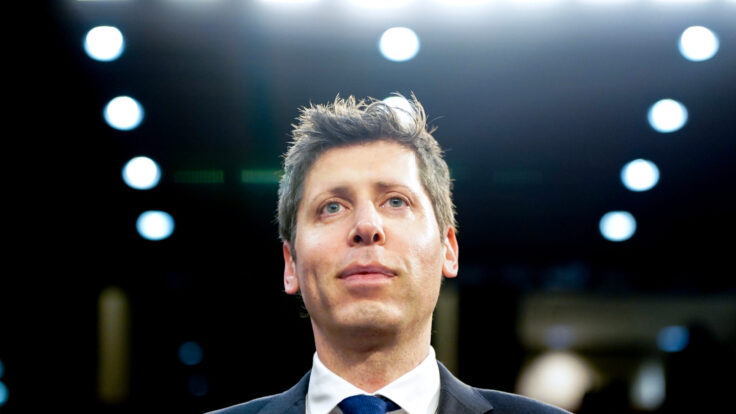
Dishonorable mention: Marc Toberoff, the copyright termination lawyer that Elon Musk hired for some reason to bring a $150 billion suit alleging that Sam Altman “stole” OpenAI by attaching a
for-profit enterprise to the former nonprofit. The advisory jury quickly ruled against Malibu-based Toberoff on statutory limitations grounds. He’s now vowing to appeal, but why, exactly, was a Hollywood lawyer handling this case in the first place?
Speaking of Elon…: No, I have nothing to say about his dumb culture war crusade against Chris Nolan’s
The Odyssey over the casting of Lupita Nyong’o and Elliot Page, except it’s weird that notorious publicist Kelly Bush Novak’s firm represents all three. Have fun, Kelly! (And no, I don’t think Twitter/X vitriol will hurt the movie at all.)
Now a little follow-up to Thursday… |
Rise of the Media C.E.O.
Golden Parachute
|
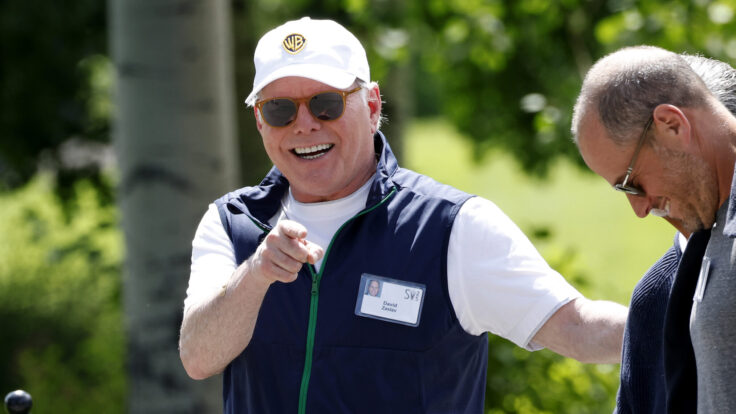
Everyone in town soiled themselves when Warner Bros. Discovery disclosed a potential $886 million windfall
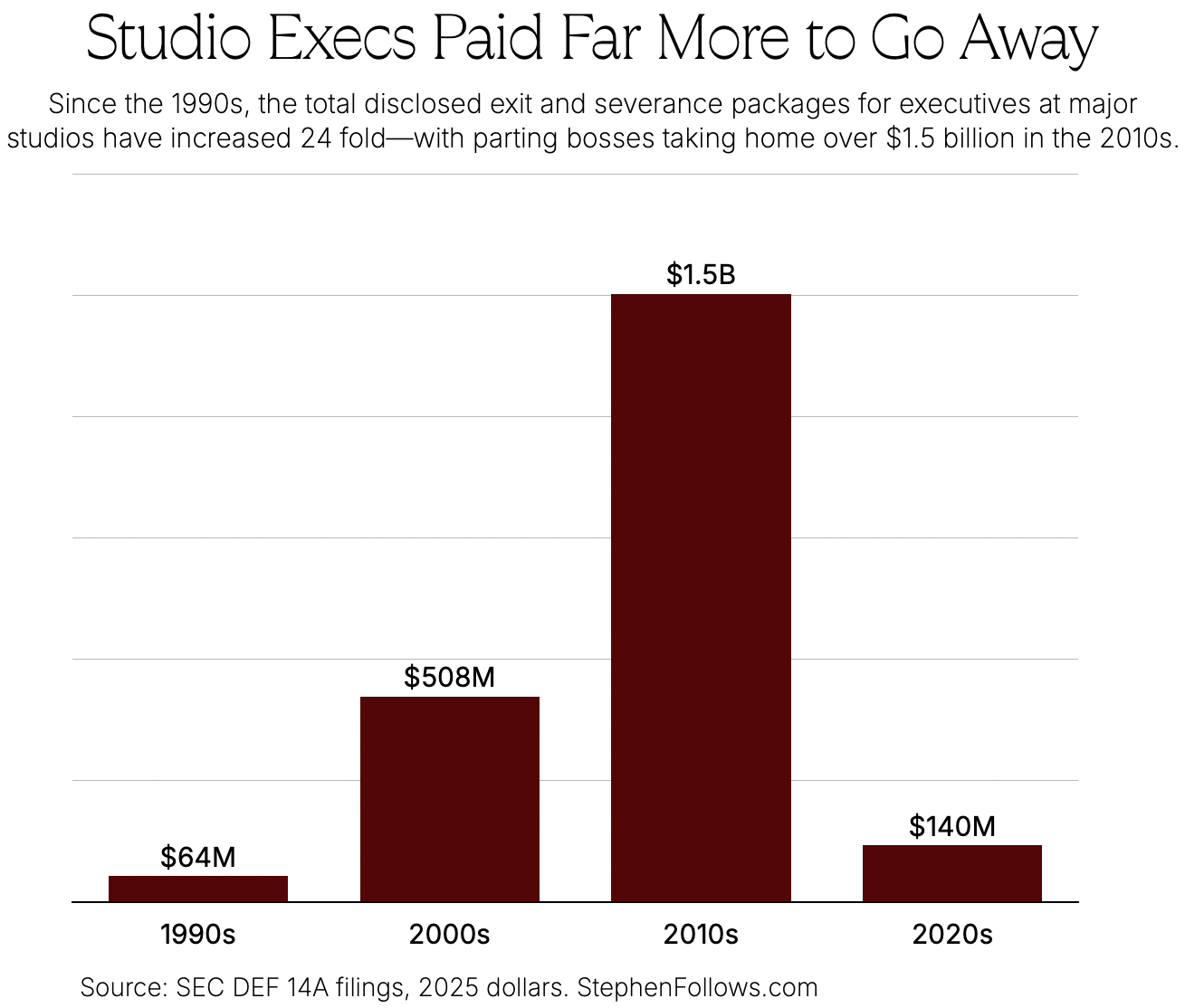
for C.E.O. David Zaslav upon the close of the pending sale to Paramount. It is indeed jaw-dropping! But Zaslav’s extreme go-away profiteering isn’t new. Media and entertainment executive golden parachutes exploded in the 2010s, according to that new study I wrote about on Thursday from researcher Stephen Follows. They grew
from $64 million from six reported exits in the 1990s to more than $1.5 billion from 27 exits in the 2010s, judged in 2025 money. |
In fact, according to the study, disclosed exit packages ballooned by 24 times in real terms from the ’90s to
the ’10s. Some of that is due to more rigorous reporting requirements (before 2007, companies weren’t forced to reveal “potential payments”). But most of the gains are from bigger packages, and the impact of larger media deals—like Comcast buying NBCUniversal, AT&T acquiring Time Warner, and especially late-stage Sumner Redstone’s CBS and Viacom parting with their leaders Les Moonves, Tom Dooley, and Philippe Dauman, who alone
walked with a $72 million package in 2016. |
Quote of the Week (David
Ellison’s Soon-to-Be Employees Sniping at Him Edition)
|
“Good night, and good luck, motherfuckers!”
—John Oliver, the HBO Max
host, invoking CBS’s Edward R. Murrow (and David Letterman from a few days earlier) as his Sunday sign-off after asking viewers to “please enjoy Colbert’s final shows.”
First runner-up: “These are some vindictive motherfuckers, the Ellisons.”
—Mark Ruffalo, HBO’s Task star, quoting what he said was “one prominent agent” and speculating that he’s “already on a list” of those who will be blackballed for
opposing the WarnerMount merger.
Second runner-up: “I think the independence of 60 Minutes has been critical. … And I think the trust it has with viewers is critical to the success of 60 Minutes.”
—Anderson Cooper, signing off from 60 and alluding to Ellison’s supposedly forthcoming revamp of the show under CBS News chief Bari Weiss.
Speaking of Weiss…: Looks like she’s
about to get a polite demotion disguised as “shifting her focus to the news division’s digital growth,” Dylan Byers reports. A rep says Weiss “has the full support of Paramount and David Ellison” to continue overseeing CBS News and 60 Minutes, so let’s see how this plays out. I’m betting Ellison recognizes Weiss is over her skis but wants to be careful not to give Donald Trump the impression that he’s retreating from the new MAGA-friendly CBS. Here’s
Dylan’s full report. |
50 percent
Share of the projected $81 billion global connected TV ad market that will be
controlled by Google, Prime Video, and Netflix by 2030. [Omdia/MPN]
60 percent
Film incentive on eligible expenditures offered by Saudi Arabia, up from 40 percent, which comes just after the recent $150 million Saudi production Desert Warrior bombed in theaters.
[Screen]
2 million
Tickets that comic Nate Bargatze is in line to sell for his current tour. By comparison, Beyoncé sold 1.6 million tickets as the top-grossing music act of 2025.
[WSJ]
17
Seconds it took Ronda Rousey to knock out Gina Carano in Netflix’s inaugural M.M.A. fight.
Now here’s Julia… |
|
|
|
Hollywood keeps trying to mine the red-hot genre for adaptations with built-in female
fandoms. So why haven’t Amazon or Netflix cracked the code? |
|
|
|
If you’ve spent any time in “BookTok”—the bibliophilic TikTok subculture with millions of tagged posts—you’re
likely already familiar with Fourth Wing. Rebecca Yarros’s dragon-riding wartime adventure novel is one of the defining texts of the romantasy genre, a portmanteau repackaged with a sexier marketing thesis that’s suddenly attracting plenty of interest from Hollywood. |
|
|
|
A MESSAGE FROM OUR SPONSOR |
|
|
|
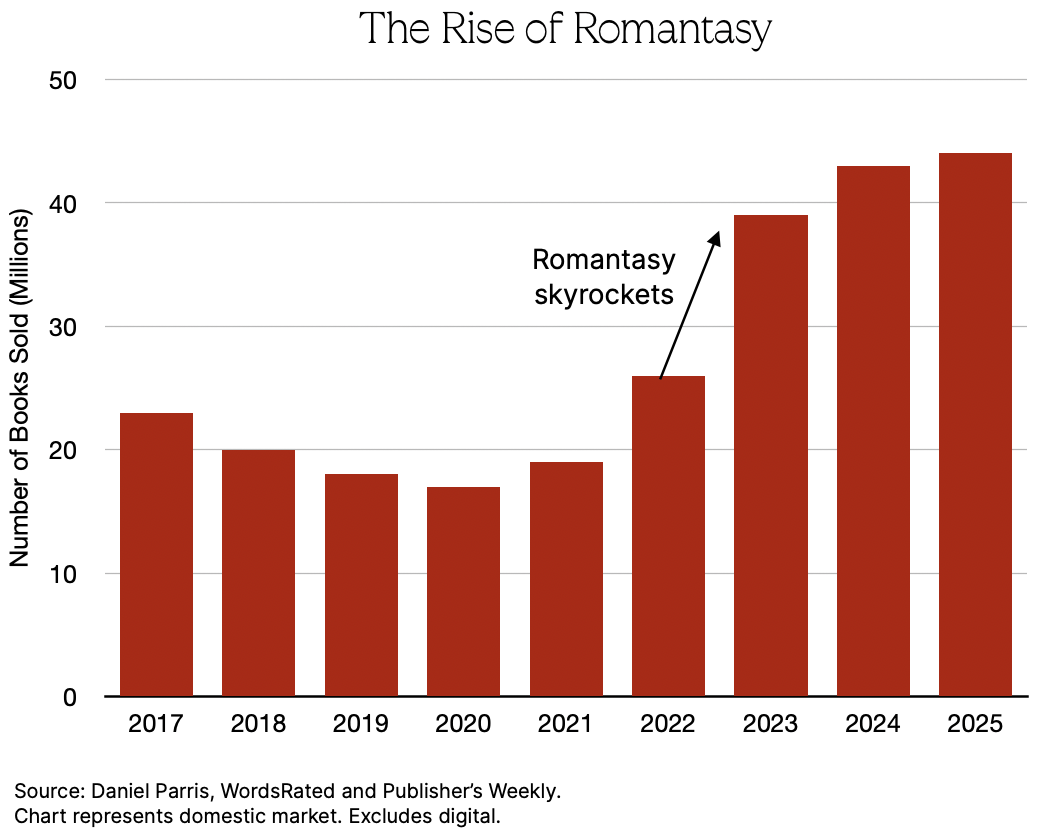
Romantasy itself barely existed as a measurable category until recently. Google Trends data shows almost no
meaningful search interest before late 2023, perhaps because the term itself hadn’t yet been popularized. But by mid-2024, Circana, the market research firm, was estimating that romantasy fiction would generate roughly $610 million in book sales that year, up 34 percent year over year. Last year, romantasy reportedly accounted for roughly 15 percent of all romance book sales. According to Google Trends data, demand for the genre spiked between March 1 and April 30 of this year. |
On some level, it was only a matter of time before the genre invaded Hollywood. Last week, Amazon announced
it had greenlit a series based on Fourth Wing, to be produced by Michael B. Jordan’s Outlier Society shingle. Also coming to Prime Video are adaptations of Elise Kova’s Dragon Cursed (as a film) and Jennifer L. Armentrout’s Lux (a series). Meanwhile, Netflix is working on a film adaptation of Callie Hart’s spicy and otherworldly “enemies-to-lovers” book Quicksilver.
Nicole
Morganti, Amazon’s head of originals for Southern Europe, recently touched on this trend while describing the company’s effort to attract younger female viewers—Prime’s counterweight to the Reacher and The Boys audience. Amazon has started to lean into Wattpad, the Webtoon-owned self-publishing platform popular with young women globally, which helped the company adapt Love Me Love Me. The movie debuted on Prime in February, with a sequel announced the
following month. Reading “is getting back to being a huge trend,” she said, and partnerships with companies like Wattpad helped Prime Video executives “understand the communities that are behind these I.P.s.”
None of this is surprising: Every streamer has been trying for years to reverse-engineer their own Game of Thrones-esque fantasy blockbuster. And executives already know that romance works on streaming. Shonda Rhimes’s Bridgerton, based on
the popular Julia Quinn books, occupies two spots on Netflix’s list of most watched English-language series. HBO Max turned the Heated Rivalry novels into an online fixation. Amazon scored big with author Jenny Han’s The Summer I Turned Pretty and may be trying to replicate Heated Rivalry pandemonium with its new hockey romance series, Off Campus. Even It Ends With Us, Sony’s ill-fated adaptation of
Colleen Hoover’s young-adult novel, was a box office sensation thanks to its rabid built-in fan base.
But budgets have a tendency to spiral out of control quickly when you start adding dragons, C.G.I., and expensive world-building to romantic plotlines. And despite the book genre’s popularity, no one has quite nailed the romantasy formula onscreen. Arguably, Netflix’s adaptation of Leigh Bardugo’s romantasy-adjacent Shadow and Bone—which
was envisioned as a young-adult franchise play but was abruptly canceled after two seasons—might have come closest. Soon after, Hulu abandoned its in-development adaptation of Sarah J. Maas’s six-book series A Court of Thorns and Roses—another foundational romantasy text and BookTok obsession—even with Outlander’s Ron Moore attached as showrunner. (Rights have reverted to Maas, who is reportedly shopping the project elsewhere.)
Both projects looked foolproof on paper—massive fandoms, fantasy spectacle, multiple books, plenty of spinoff potential—but the economics told another story. |
The audience math makes executives understandably anxious about fantasy projects and, ergo, romantasy.
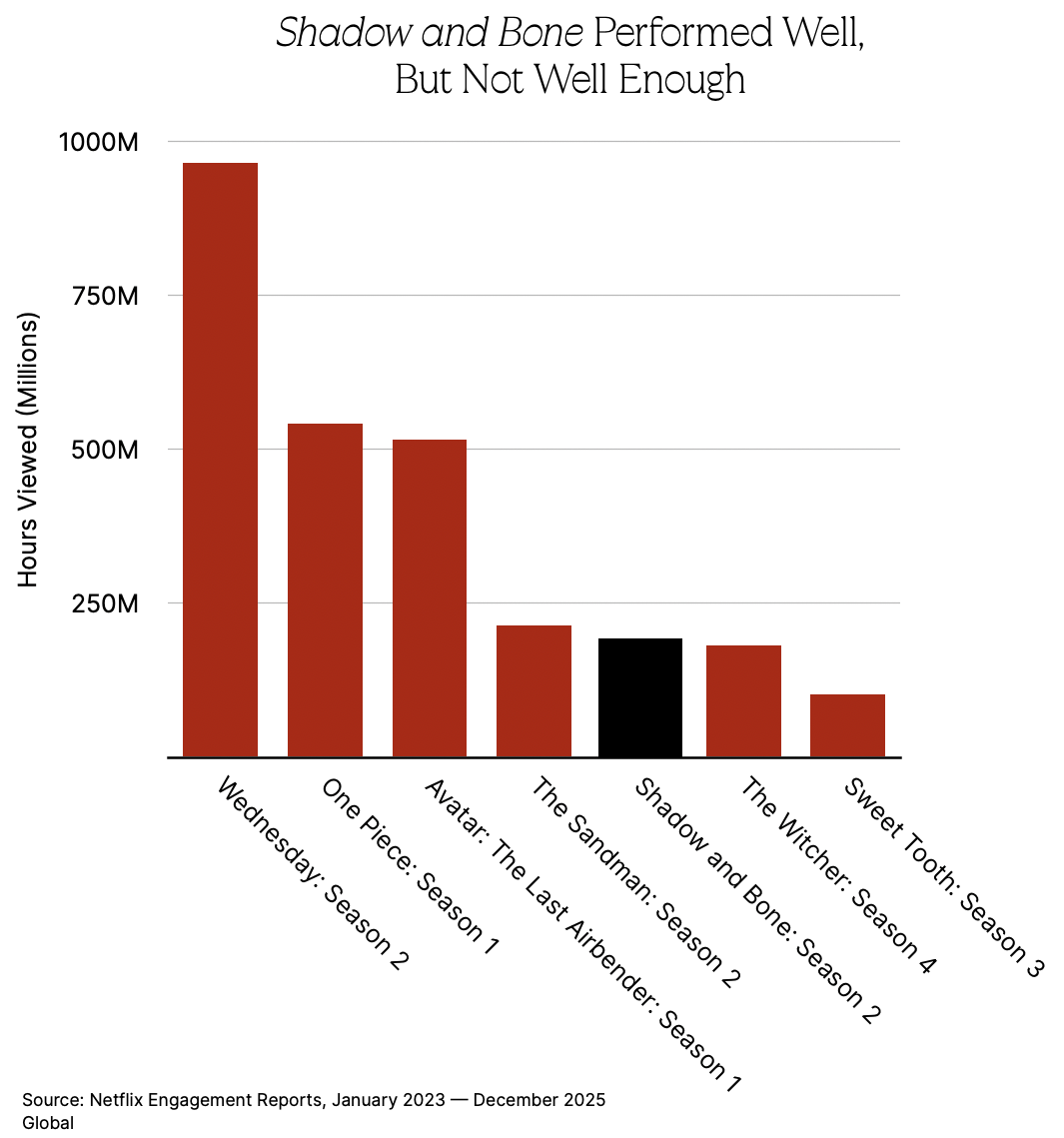
Netflix launched Shadow and Bone in 2021 to strong initial engagement. The show topped the platform’s weekly charts and landed among its 30 most watched series in its first Engagement Report back in 2023. The second season sat atop Netflix’s weekly global top 10 for five weeks, but hours viewed dropped 50 percent between the second and third weeks. That’s nothing to scoff at, but streaming economics depend less on raw viewership than on efficiency, and Shadow and Bone
ultimately performed more like a middle-tier fantasy than a defining franchise. Using Netflix’s Engagement Reports to compare Shadow and Bone’s second season to other top fantasy shows, Shadow and Bone does okay, but not good enough. It pales in comparison to other recent seasons of top fantasy shows like Wednesday and Avatar, and even the fourth season of The Witcher, which saw Liam Hemsworth sub in for
Henry Cavill. The efficiency metrics don’t exactly work. |
As a film and TV genre, romantasy faces the same obstacles as normal fantasy I.P. on overdrive. For starters,
Luminate estimates that scripted streaming original premieres have dropped around 35 percent domestically between 2022 and 2025. Amid that trend, it’s harder for executives to justify giant fantasy bets—even those with added sex appeal—especially when fandom expectations are so outsized. HBO Max’s Casey Bloys couldn’t plausibly greenlight a Harry Potter series, say, only to stop after the fourth novel. Writer-producer Eric Heisserer said in 2021 that he
only agreed to adapt Shadow and Bone because Netflix committed to adapt another book in the “Grishaverse.” Netflix treated the property as a long-term franchise investment. But when Shadow and Bone failed to perform, Bardugo confirmed the planned spinoff disappeared alongside it.
One measurable second-order effect of this dynamic has been that romance I.P., by comparison, is less risky. According to Owl & Co. analyst Hernan Lopez, the genre represented
14 percent of viewing hours in 2024, while accounting for only 11 percent of content amortization—meaning there is plenty of opportunity for Netflix to pursue more projects within the genre. So why bother with dragons and elves at all? For Netflix executives, this is a valid question. Netflix hits like Emily in Paris, Virgin River, and Nobody Wants This deliver strong engagement and don’t require armadas of visual-effects artists or fantasy production
infrastructure.
But for Amazon—which controls Prime’s bookstore ecosystem, Kindle reader data, Goodreads participation, and its own publishing division—the calculation extends beyond streaming ratings. Amazon has unusually detailed visibility into emerging reader behavior, including which subgenres suddenly accelerate, and romantasy now sits squarely in the “hot” category. K-lytics, which analyzes Kindle trends, estimates that genre waves typically persist for five to 10 years once they
take hold. If Amazon can successfully identify books that are beginning to trend and option them before its rivals, that’s a powerful competitive advantage. |
|
|
|
A MESSAGE FROM OUR SPONSOR |
|
|
|
Netflix’s Ted Sarandos and Amazon’s Andy Jassy both want some version of
Disney’s flywheel—stories that drive merchandise, books, fandom, playlists, subscriptions, and repeat engagement. Netflix just launched a self-promotion website describing how series like Bridgerton and Heartstopper boost Spotify streams and book sales. The difference is that Netflix doesn’t own those downstream businesses. Amazon often does.
In that context, Amazon’s Fourth Wing is more than just another television adaptation—it represents a coordinated attempt
to bring a deeply engaged female fandom into the Prime ecosystem. Even though previous efforts haven’t always worked, the opportunity has become difficult to ignore. After years of romantasy fandom building in the background, Amazon and Netflix now appear determined to produce the first defining adaptation of the genre’s modern era. But Hollywood’s recent history with algorithmic certainty offers a warning. TikTok engagement, Goodreads enthusiasm, Kindle data, and social media obsession can make
a project appear invincible on paper. But the cameras still have to roll. |
Netflix has entered its “advocacy” era, pushing out propaganda showing how it has spent $135 billion to
“support communities” with content production over the past decade… just as concerns about its dominance threaten future M&A plans. [Netflix Effect]
Netflix also doesn’t want you to call its new INKubator a “GenAI-native animation studio,” which is exactly what its job listings say it is.
[Cartoon Brew]
Funny to see L.A. mayor candidates, some of whom ignored Hollywood for years as city regulations made filming here so tough, now falling all over themselves to be pro-showbiz.
[L.A. Times]
Letterman gave Colbert “his Bette Midler show,” writes Bill Carter.
[Latenighter]
SNL’s pre-finale media blitz was a lot (even I don’t care about Jeremy Culhane’s
preferred flavor of Uncrustables), but this piece on pretaped shorts was cool. [N.Y. Times]
Byron Allen is selling the idea of turning the dead website BuzzFeed
into a video “super-app,” which sounds about as plausible as his very public bid for Paramount. [N.Y. Times]
“Hot washing”: When the actors in the book adaptation are too attractive for the source material. [Literary
Hub] |
My Thursday charts on executive pay, and the consulting firms responsible for the rise, drew spirited
comments. (Personal attacks omitted)…
“The executive comp report is this side of nauseating. I wish Stephen had been able to look at the number of layoffs all of those executives have implemented under the guise of ‘reducing redundancy’ and ‘streamlining operations.’ A 45-to-55-year-old longtime employee making $150,000 to $300,000 sustains serious, life-changing hurt with narrowing job opportunities, while another $30 million isn’t going to change the lives of any of those
C.E.O./N.E.O.s.” —A publicist
“These compensation consultants are such a joke. They know the only way they continue to source work is to enable exactly what the executives on these boards want. There is literally no practical check on the back-scratching.” —An executive
“Now do the agencies!” —An agent
“We get it, man. Zaslav sucks. Find a new topic!” —Another agent |
Have a great week,
Matt
Maya Tribbitt contributed research for this issue.
Got
a question, comment, complaint, or restaurant recs in Austin on a Tuesday night? Email me at Matt@puck.news or call/text me at 310-804-3198. |
|
|
|
Puck fashion correspondent Lauren Sherman and a rotating cast of industry insiders take you deep behind the scenes of this
multitrillion-dollar biz, from creative director switcheroos to M&A drama, D.T.C. downfalls, and magazine mishaps. Fashion People is an extension of Line Sheet, Lauren’s private email for Puck, where she tracks what’s happening beyond the press releases in fashion, beauty, and media. New episodes publish every Tuesday and Friday. |
|
|
|
Ace media reporter Dylan Byers brings readers into the C-suite as he chronicles the biggest stories in the industry: the future
of cable news in the streaming era, the transformation of legacy publishers, the tech giants remaking the market, and all the egos involved. |
|
|
|
Need help? Review our
FAQ page or contact us for assistance. For brand partnerships, email ads@puck.news.
You received this email because you signed up to receive emails from Puck, or as part of your Puck account associated with {{customer.email}}. To stop receiving this newsletter and/or manage all your email preferences, click here. |
Puck is published by Heat Media LLC. 107 Greenwich St., New York, NY 10006 |
|
|
|
|