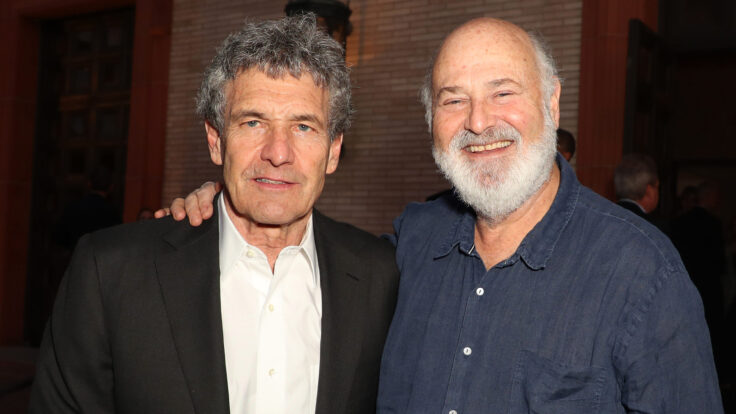
Welcome back to What I’m Hearing, a little early tonight because I’m at the
Mandalorian & Grogu premiere, where Jon Favreau just thanked the California Film Commission for the tax breaks that allowed this to be the first Star Wars movie filmed in L.A. That line got applause from a crowd including new Disney C.E.O. Josh D’Amaro, who I can report was not adhering to the event’s requested “Mandalorian Chic” dress code.
Speaking of dress codes…: Cannes is in full swing, but I will not be calling
out the annual atrocity of Penske trade publications giving the stopwatch treatment to standing ovations. First off, THR seems to have curtailed the practice, only a few years after I first vented industry frustration at the silly tradition. And second, given the state of the indie market and Hollywood’s soft boycott of this year’s festival, people at Cannes need the laughs.
💫💫 PSA: I’m moderating the Hot Ones F.Y.C. event for YouTube on June
9 in Hollywood. Yes, the tables will be turned on host Sean Evans, and I’ll be going wing-for-wing with him until one of us passes out (or my uncalloused tongue immediately catches fire). TV Academy members can join the lottery for tickets here.
Discussed in this issue: David Ellison, Makan Delrahim, David
Zaslav, John Malone, Rob Bonta, Andy Jassy, Jon Feltheimer, Jason Statham, Larry Ellison, Gavin Newsom, Haim Saban, Reed Hastings, Bob Iger, Stephen Follows, Lucian Grainge, Donna Langley, Philippe Dauman, Ted Sarandos,
Elliot Grainge, Teresa Ribera, Bobby Kotick, Michael Eisner, and… Spencer Pratt.
Not a Puck member yet? Just click
here. Got a news tip or an idea for me? Just reply to
this email, text me, or message me on Signal at 310-804-3198.
Let’s begin… |
- Ellison’s eyes on the Europrize: David Ellison quietly slipped away to Brussels and London this week with his chief lawyer, Makan Delrahim, for additional meetings with regulators, I’m told. Ellison sat with European Commission competition commissioner Teresa Ribera as part of the WarnerMount merger review, though it’s unclear if they discussed potential concessions to get clearance for the $110 billion deal. (Paramount
declined to comment.) At this point it’s hard to imagine how many times these people can hear Ellison’s pitch for 30 movies a year in theaters, and how a merged WarnerMount will finally be able to take on Netflix, without cutting to the chase: What “remedies” is Ellison willing to concede to get a greenlight?
Same issue back home, where California Attorney General Rob Bonta keeps teasing a potential antitrust suit, and Gov. Gavin Newsom today revealed
plans to increase the state’s antitrust litigation fund to $14.3 million in next year’s budget. Message sent. Bonta is now under political pressure to sue, and Ellison certainly doesn’t want to tip his hand on what he’s willing to promise to make Bonta stand down, but it will likely be something bigger than what the E.C. demands. Ironically, the A.I. boom in Larry Ellison’s beloved Silicon Valley is giving Newsom additional tax resources to fund a potential antitrust battle
against the entertainment merger engineered by… Larry Ellison. - Who’s in the Pratt Pack?: Yes, that was Universal Music’s Lucian Grainge; his label head son, Elliot; former Activision C.E.O. Bobby Kotick; and media mogul turned Democratic kingmaker Haim Saban listed among the Hollywood backers of MTV reality douchebag Spencer Pratt in
his quixotic campaign for L.A. mayor, as reported by my colleague Peter Hamby. (Read Peter’s no-B.S. breakdown of the race here.)
Not a total shock, given that the old guard of industry Democrats has drifted rightward in recent years, especially after the Joe Biden debacle. But if my emails and texts are any indication, the Pratt-curious crowd could be growing, especially since so many Palisades Fire victims blame Karen Bass for the city’s lack of preparation and the slow rebuilding. DealBook reported today that Nicole Avant, Obama’s ambassador to the Bahamas and wife of
Netflix’s Ted Sarandos, is backing Pratt, if not publicly yet. (Her rep declined to comment.) An endorsement from Hollywood’s first couple, fresh off a brunch last weekend with pretty much every working comedy star, would be even more newsworthy than when Ted backed Rick Caruso against Bass last time around.
- Speaking of Pratt…: I’m told Warner Bros. lawyers took a close look at that A.I.-generated
Pratt campaign ad featuring the candidate as Batman and Bass as the Joker, and decided not to send a takedown notice. The fair-use case is borderline, and they didn’t want to give the stunt more attention.
|
|
|
|
A MESSAGE FROM OUR SPONSOR |
The Daily Beast calls Only Murders In The Building “TV’s most joyful
offering.” Emmy nominees Steve Martin, Martin Short and Selena Gomez are joined by an all-star cast including Meryl Streep, Christoph Waltz, Renee Zellweger, Dianne Wiest and more to crack the case of their beloved dead door man. Only Murders In The Building is for your Emmy consideration in all eligible categories including Outstanding Comedy Series, Outstanding Lead Actor in a Comedy Series for Martin and
Short, and Outstanding Lead Actress in a Comedy Series for Gomez. |
|
|
|
- And just for fun…: Yes, that was NBCUniversal content chief Donna Langley lunching with Netflix’s Sarandos at the Peacock Grill on the Universal lot earlier this month. Which means nothing, of course, but…
- Box office over/under: Three wide releases (In the Grey, Is God Is, and Obsession), none of which is expected to reach double digits, so let’s pass. I do think Michael will
return to No. 1 in its fourth weekend, which would be quite a flex.
|
Now to the question of Hollywood exec pay… |
|
|
|
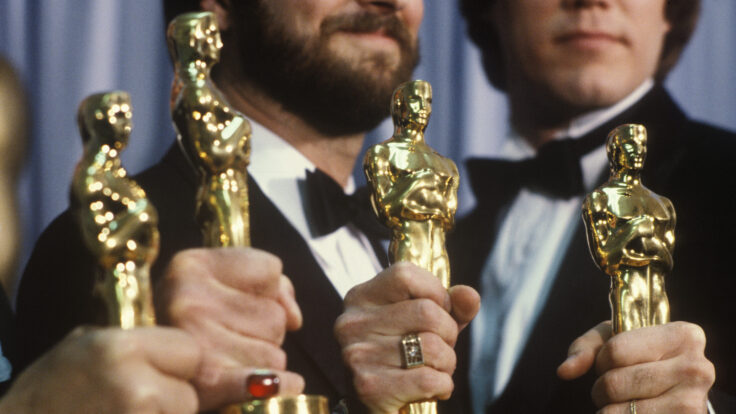
Executive compensation in media has exploded in the past 30 years, even
in a period of steady decline for the industry and a generally stagnant stock market. An eye-opening new study ranks the boom’s victors and their jaw-dropping spoils. |
|
|
|
How the hell do these guys make so much money? That’s usually among the first
questions in any discussion of the leadership at the Hollywood studio conglomerates—or the media industry in general. The answer, at least in my experience, has always been some version of a shoulder shrug or a, Welp, media people are just insanely overpaid.
At this point, C.E.O. gluttony is viewed as a baked-in industry custom—a quirk of showbiz we all accept, like how TV stars can renegotiate their contracts in success despite being locked in for seven years, or how a
Jason Statham movie will invariably hit theaters each January, and nobody really knows why. The outsize pay kinda made sense during the cable TV and DVD boom eras, when the growth trajectories in Hollywood were generally strong and guys like Les Moonves and Michael Eisner were considered masters of the universe for presiding over the sexiest companies in corporate America. But why, we all ask, have the compensation packages for entertainment
C.E.O.s and C-suite executives continued to soar as “legacy” entertainment has been vanquished by the tech monopolies—sorry, the fully integrated advertising platforms—and the Disney stock has been flat for the past decade, and Comcast is hemorrhaging cable and internet subscribers, and Warner Bros. Discovery and Paramount continue to shrink, etcetera?
That question became even more pressing during the just-concluded earnings season, when the major media companies revealed that
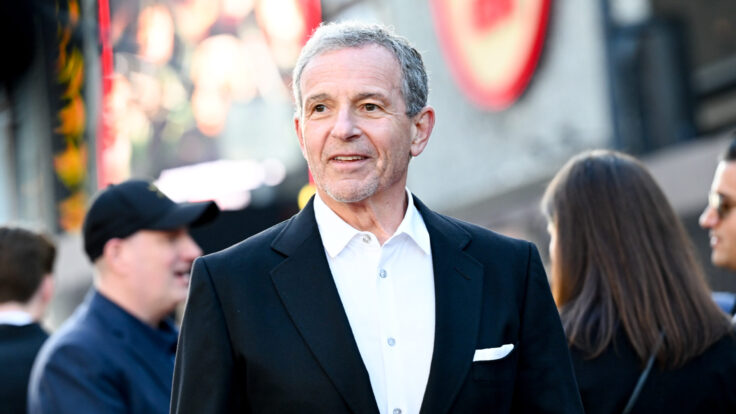
C.E.O. pay spiked again in 2025 despite languishing share prices and the content recession. ISS, the proxy advisory, charted a median rise of 117 percent in media and entertainment C.E.O. pay last year among large S&P 500 companies, while their median total shareholder return was down 28.6 percent. Bob
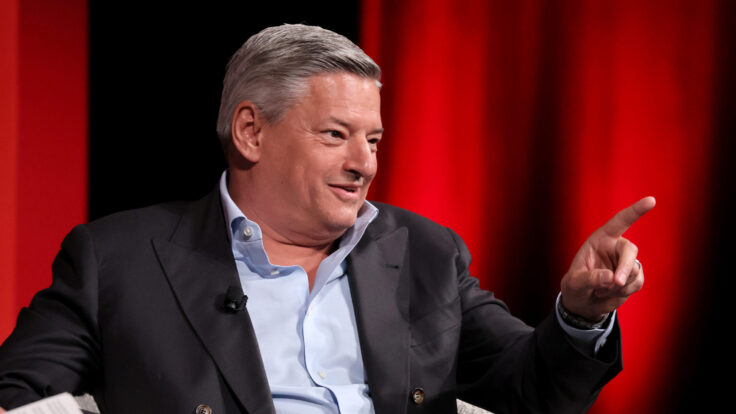
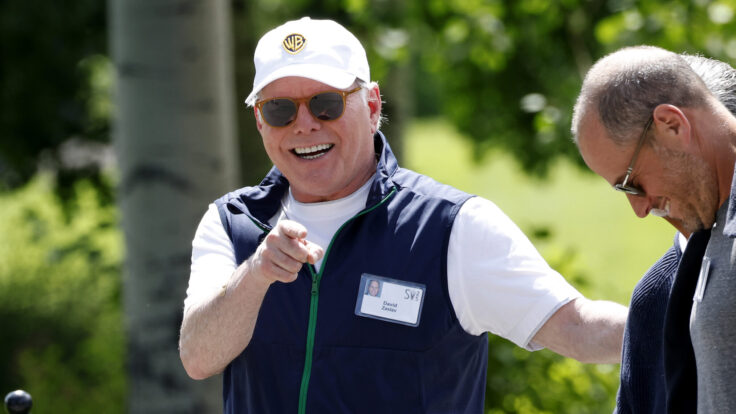
Iger, who didn’t grow Disney’s share price at all in 2025, earned an 11 percent raise, to $45.8 million. Paramount Skydance’s lawyer, Makan Delrahim, earned nearly $64 million for just three months of work, thanks to a generous stock award that will accrue over five years. Our guy David Zaslav, the most grotesquely overpaid of them all, whose Warner Discovery was in such bad shape that he’s offloading it to Paramount, tripled his pay package,
to $165 million.
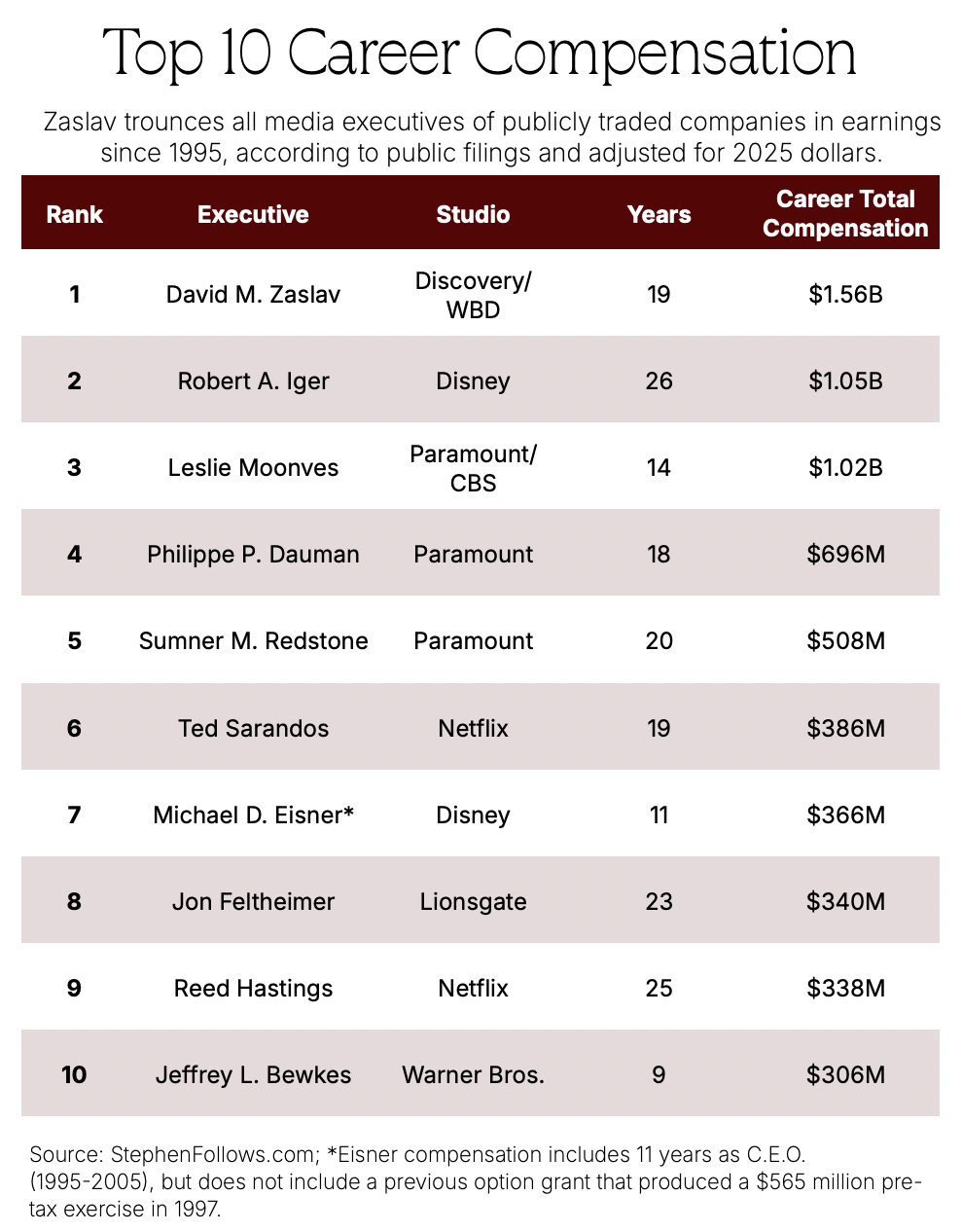
Those numbers come with caveats, of course. Stock options are just that—options that may or may not vest in the money. (They also sometimes provide far more value than the initial contract indicates.) And boards consider more than just overall earnings when determining the value of a top executive. Still, my jaw dropped a little when I saw a new chart of C.E.O. pay put together by the researcher Stephen Follows, who crunched every public proxy
filing from 1992 to 2005 and came to some fascinating (and alarming) conclusions about media executive pay over the past three decades. |
A few select executives have extracted more than $1 billion in comp packages from their
companies. No shock here: Zaslav takes the top spot, and this doesn’t even account for his upcoming golden parachute if Warner Discovery completes its sale to Paramount, which could bestow upon him between $500 million and nearly $900 million in go-away money. (Usual disclosure: Through our acquisition of Air Mail, Zaslav is a de minimis investor in Puck.) Among the top 10, there are a couple founders (Reed Hastings, Sumner Redstone), respected managers
(Ted Sarandos, Moonves… until he wasn’t), a guy whose company is much smaller than the others yet has somehow been paid like a major C.E.O. (Jon Feltheimer), and one straight-up value destroyer (Philippe Dauman, Redstone’s personal lawyer turned Viacom chief executive). |
Remember, this chart measures only publicly disclosed compensation, usually of the top
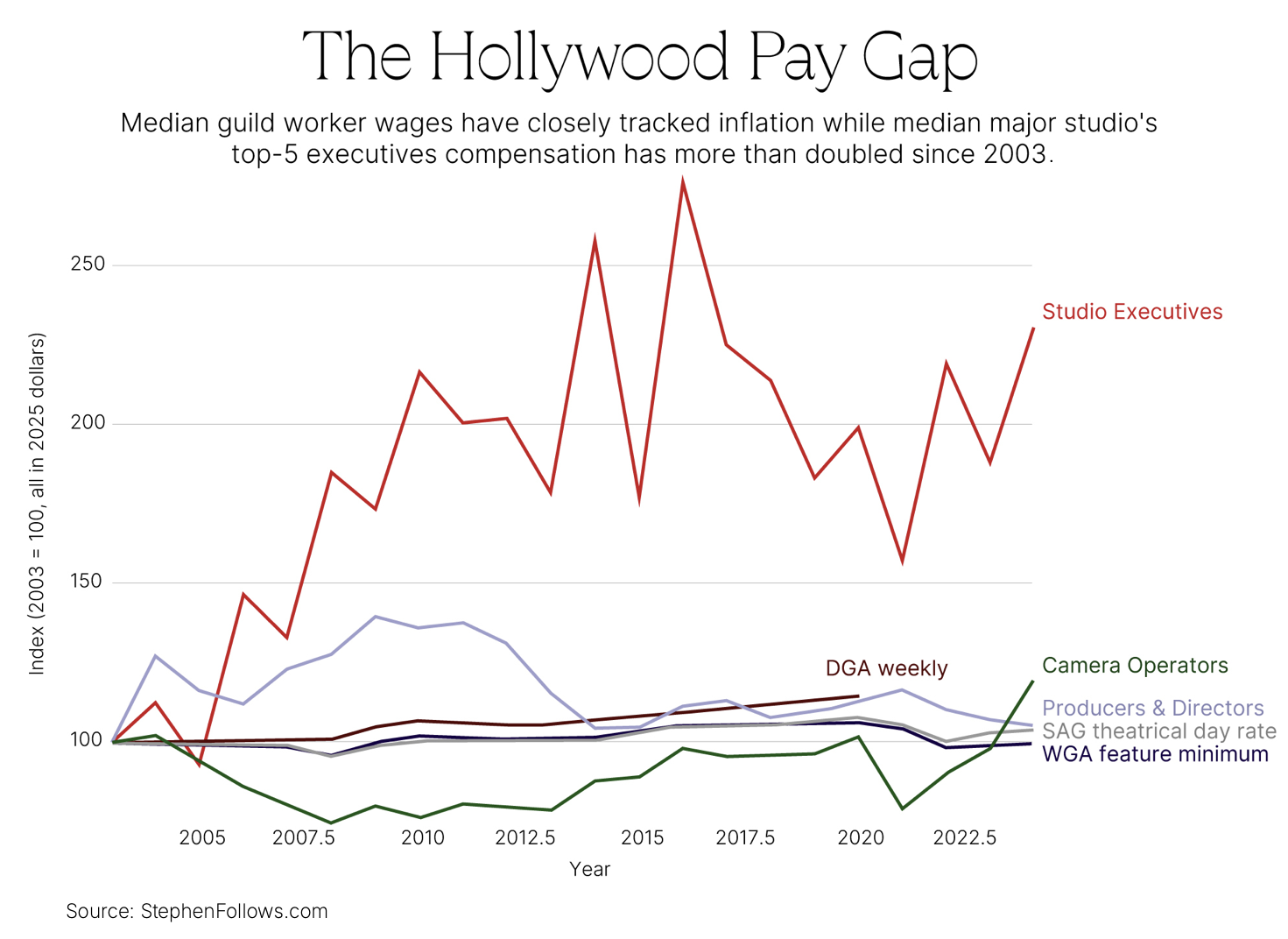
five executives at a company, and the Eisner comp at Disney is skewed by only showing 1995 through 2005. All pay earned in other roles or at other companies is excluded. According to Follows, top executive compensation is up 131 percent in real terms since 2003. And it’s not just the C.E.O.s: Comp for the so-called “N.E.O.s”—named executive officers, the other C-suite execs whose pay must be disclosed publicly—is up 62 percent over that period. “Two things have happened to the studio
C-suite over 30 years,” Follows wrote. “The cost of running it has fallen sharply. The pay of the people running it has more than doubled in real terms.” |
|
|
|
A MESSAGE FROM OUR SPONSOR |
From Emmy-winning creator and star Quinta Brunson, Abbott Elementary is ABC’s
award-winning comedy about a group of dedicated teachers doing their best with what they’ve got. “Still at the top of its class,” says Collider, Abbott Elementary continues to charm audiences with its sharp writing, unforgettable ensemble, and emotional depth. For your Emmy consideration in all eligible categories including Outstanding Comedy Series. |
|
|
|
And before you wag your finger, yes, elite movie stars and top TV creators can also
make a lot more today than they used to, at least up front. (I’d argue that the demise of backends has eliminated much of that long-tail wealth generated by the biggest hits.) But that rise in C.E.O. pay has coincided with stagnant wages throughout most of the rest of the industry. During that same time period, the Bureau of Labor Statistics reports that inflation-adjusted wage growth in the entertainment industry was just 6 percent. Writers Guild minimums are up 0 percent above inflation, and
SAG-AFTRA day-player rates are up 4 percent. Not great. |
More caveats: This chart is based on guild minimums, and most working members have
agents who negotiate for more. If we’re being totally fair, we’d need to compare the inflation-adjusted growth in compensation for the top five stars/creators at each studio to the pay for the highest-level executives, which isn’t possible. But this chart is a useful expression of how wage growth for the basic rank-and-file Hollywood community has been flat or only slightly above inflation while the C-suite has enjoyed fabulous gains. If, for instance, top executive pay had grown at the rate of
WGA minimums since 2003, the median studio’s top five would today earn about $43 million between them. According to the study, they earn $99 million. |
Yes, the System Is Rigged
|
So back to the initial question: Why? After all, the ingrained compensation
system in all of corporate America does not explain the outsize pay in the media industry specifically. We can say that John Malone, a powerful media mogul for decades now, has always overpaid his C.E.O.s, including Zaslav. And that purely self-interested executives like Zaslav must be massively incentivized to pursue strategic moves like generating cashflow to pay down debt, rather than simply because it’s the right thing to do. But the task
technically falls to the compensation committees of the boards of these companies, and one by one, the proxy statements usually offer some kind of vague justification for overpaying. Disney, for instance, wrote in its recent filing that “there is a limited pool of talent with the set of creative, technological and organizational skills needed to
run a global creative organization” and that such executives “have career options with compensation opportunities that normally exceed those available in most other industries.”
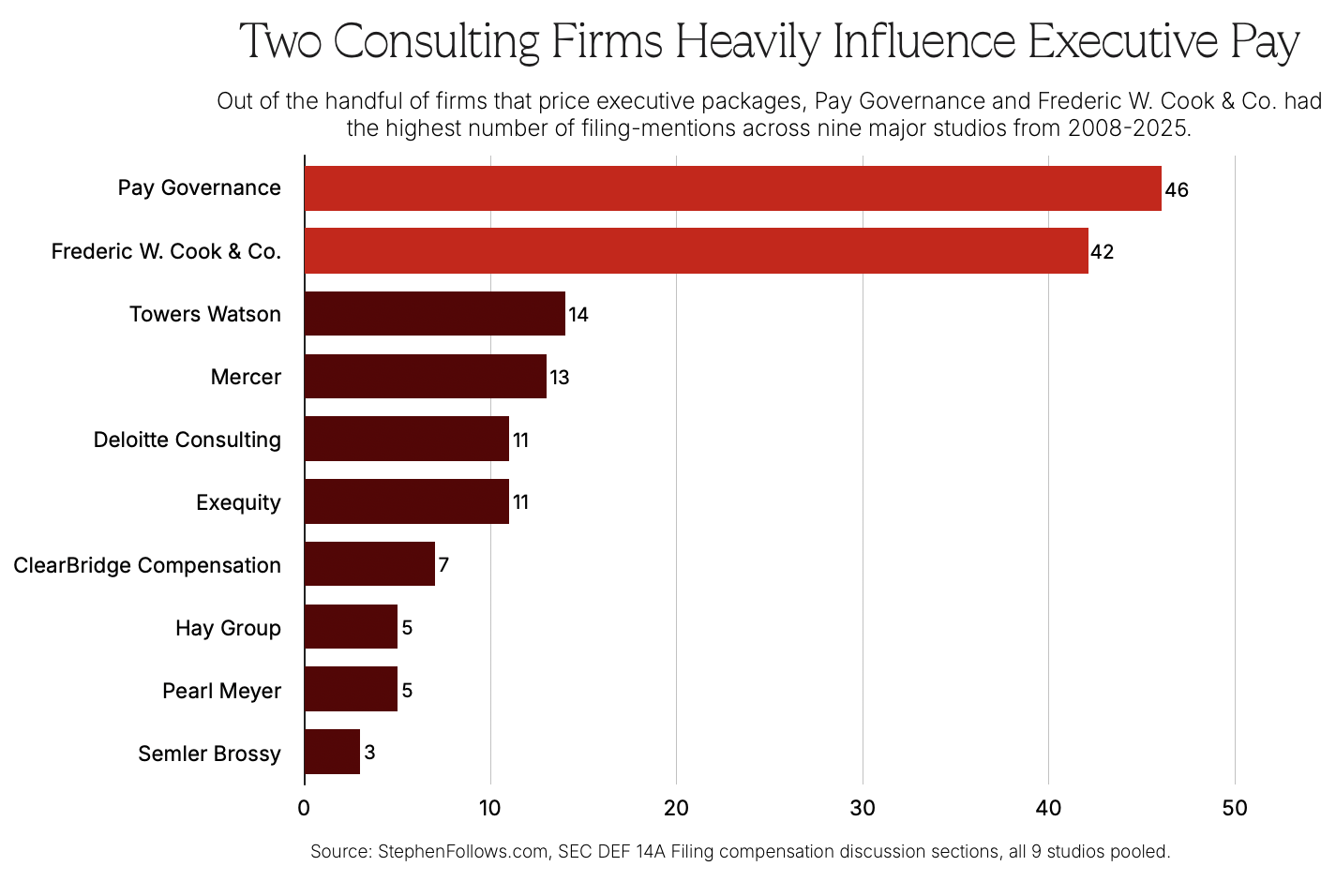
From there, they adhere to comps and benchmarks that perpetuate the upward trajectory, taking their cues from specialized consultants that are engaged specifically for this purpose. I’ve given some shit to the Warner Discovery comp committee for the ongoing Zaslav grift, but they’re following the advice of
consultancies like Pearl Meyer. Follows’ study looked at these firms, too… |
As in other industries, these consultants benchmark to “peer-group” medians, including a
subset of “media industry peers,” and then try to aim for the 50th to 75th percentile of those peers. (The explanation/excuse is usually that the company risks losing the executive if he or she is offered less than the median.) This means the pay packages are heavily influenced by whatever is deemed a “peer” company—and these days, those “peers” are often high-flying tech powerhouses, not other legacy studio conglomerates struggling to future-proof their business models.
In 2025, for
instance, Disney’s “media peer group” included Alphabet, Amazon, Apple, Meta, and Netflix, along with Comcast, Paramount Skydance, and Warner Bros. Discovery. Many of those are companies with market caps and overall businesses far bigger than Disney’s. So no wonder Iger’s pay package for that year totaled more than $40 million—about the same as Andy Jassy’s at Amazon, which generated $59.2 billion in net profit that year, compared to about $5 billion for
Disney.
Warner Discovery dropped Apple and Amazon but included as “peers” Meta and Netflix (I know… don’t laugh), in addition to Comcast, Electronic Arts, Activision Blizzard, Paramount, Fox, Liberty, and yes, Disney. So if Iger’s peers include the most celebrated tech titans in the world, and Warner Discovery’s peers include Disney, then Zaslav, by extension, should basically be paid like Jassy, right? Despite the fact that Warner Bros. Discovery is a fraction of the size and actually
lost money that year?
The comps seem off, but the system is set up to steer the committees there. And remember, while shareholders can vote to reject those pay packages—as happened at Disney in 2018, Netflix four times, and Warner Discovery three times, including 82 percent thumbs-down on Zaslav in April—those are nonbinding votes. The potential conflicts become even worse if these consultancies perform other services for the companies whose executive pay they are influencing, as
critics have long contended. Though Warner Discovery’s proxy filing this year was careful to note that Pearl Meyer “performed no other services” for the company in 2025 beyond the independent comp consulting work.
Depressed yet? Coming Monday: The Golden Parachutes. |
See you Monday,
Matt
Got a question, comment, complaint, or a $600
animatronic Grogu? Email me at Matt@puck.news or call/text me at 310-804-3198. |
|
|
|
Puck founding partner Matt Belloni takes you inside the business of Hollywood, using exclusive reporting and
insight to explain the backstories on everything from Marvel movies to the streaming wars. |
|
|
|
Ace media reporter Dylan Byers brings readers into the C-suite as he chronicles the biggest stories in the
industry: the future of cable news in the streaming era, the transformation of legacy publishers, the tech giants remaking the market, and all the egos involved. |
|
|
|
Need help? Review our FAQ page or contact us for assistance. For brand partnerships, email ads@puck.news. You received this email
because you signed up to receive emails from Puck, or as part of your Puck account associated with {{customer.email}}. To stop receiving this newsletter and/or manage all your email preferences, click here. |
Puck is published by Heat Media LLC. 107 Greenwich St., New York, NY 10006 |
|
|
|
|