 |
|
Welcome back to a jam-packed What I’m Hearing, en route home from my underground lair. I’ll be in L.A. for most of the summer—let’s get together if you are, too. And FYI, WIH is dark on Thursday for the holiday, I’ll be back next Sunday.
Programming note: This week on The Town, Lucas Shaw and I conducted the first (and maybe last?) Executive Draft, former Ticketmaster C.E.O. Nathan Hubbard broke down how Taylor Swift’s tour will blow past $1 billion, and analyst Matthew Liebmann explained what Gen Z wants in movie theaters. Subscribe here and here.
Discussed in this issue: Harvey Mason, Jr., David Ellison, David Zaslav, David Corenswet, Kathy Kennedy, Duncan Crabtree-Ireland, Jerry Jones, Fran Drescher, Todd Boehly, Karen Horne… and Ari Emanuel’s big CAAN’T-iversary.
But first…
|
| Who Won the Week: Jerry Jones |
|
| The first rule of media: The NFL always wins. A docuseries about Jerry Jones and the heyday of the Dallas Cowboys just sold to Netflix, and the price is just under $50 million, according to two sources familiar. The deal isn’t done, but Netflix emerged as the winner of a bidding war with ESPN, after Amazon and a couple others showed early interest. (Netflix declined to comment on the deal.)
A couple interesting storylines here: It’s a big flex for NFL Films as it ramps up a new partnership with David Ellison’s Skydance Sports. That price for a Jerry Jones show surprised me, given it’s about an owner, not a star player, and NFL football isn’t popular globally. But it’s 10-episodes, and Apple TV+ is paying $20 million or more for some player-and-musician-driven documentary films. The Jones project includes never-seen footage and interviews with Cowboys stars like Troy Aikman, Michael Irvin, and Emmitt Smith. And it has already drawn comparisons to The Last Dance—and that show’s heavy dose of 1990s nostalgia—since it focuses on the Cowboys’ rise as “America’s Team,” with their three Super Bowls in the early ’90s under Jones’ hands-on, star-powered ownership. It’s another sign of the booming market for premium sports docs, which is likely to grow hotter the longer the writers (and possibly actors) are on strike.
It’s also another big move in sports-adjacent content for Netflix, which has resisted live sports but now has the F1 Drive to Survive show, Full Swing with the PGA, and Break Point with pro tennis players, plus Quarterback, also with NFL Films, coming out next week. It’s also, if we’re being honest, a portrait of two media companies going in opposite directions. ESPN bid aggressively for this project, I’m told, and the money was about the same as what Netflix offered (though Netflix did outbid). Ten or even five years ago, ESPN probably would have closed the deal, especially since ESPN/Disney is already an NFL partner. But here, Netflix was apparently considered the more appealing global platform—and Netflix isn’t suffering from cratering carriage and dozens of on-air talent layoffs just this week.
Another interesting news item here… |
| Grammys Join Globes in Looking to For-Profit Future |
|
| If you’re running an organization whose financial health depends mostly on television rights fees, you’ve gotta be thinking about alternative revenue streams. The NFL and other sports leagues are cashing in with the streamers. And while many winced when Golden Globes owner Todd Boehly turned the Hollywood Foreign Press Association from a non-profit into a for-profit endeavor, the move will better position the troubled organization to exploit the Globes brand around the world (while also allowing Todd and current BFF/co-owner Jay Penske to fire former HFPA members, a fun perk).
Now I’ve learned the Grammys are taking a major step in that direction. The Recording Academy, the non-profit that bestows the annual awards and supports artists, has created a for-profit arm that it intends to use to better exploit the Grammys brand and, crucially, to raise money in a way that’s not possible as a non-profit. It’s called Grammy Global Ventures, it’s being overseen by Academy president Panos Panay, and he’s currently looking for a seasoned executive to run it.
The reason, as I mentioned, is pretty obvious: The Grammys are nearing the end of a 10 year broadcast deal with CBS, and when that pact expires in 2026, there’s little chance the next deal will approach the same price. About 12.5 million viewers tuned in to watch February’s Grammys on CBS, a spike from the Covid telecasts but about half the audience for the show in 2016, when the current extension was signed. Neither CBS nor the Recording Academy has revealed the value of that arrangement, but in 2022, the Academy reported $63.3 million in “program service revenue,” which includes TV license fees for the Grammys, Latin Grammys, and other programs. A couple people I talked to believe CBS pays about $50 million a year for the main show.
Regardless, that number is likely coming down when talks begin in 2024, so Academy C.E.O. Harvey Mason Jr. is being proactive, launching what is essentially an investment/growth division in Grammy Global Ventures, and LionTree is said to be advising. “In the last few years, the Recording Academy has prided itself on listening, learning, and continuously evolving in order to best serve our music community,” an Academy rep told me in a statement. “Grammy Global Ventures is a wholly owned Recording Academy affiliate created to explore our future as it relates to our brand, our intellectual property holdings, and most importantly, the expansion of the mission of the Academy.”
It’ll be interesting to see if this move is controversial in the music community. The Academy, after all, says its mission is to “recognize excellence in the recording arts and sciences, cultivate the well-being of the music community, and ensure that music remains an indelible part of our culture.” That mission statement doesn’t include raising millions of dollars from God knows who. The Grammys itself could even transfer over to the for-profit entity, just like the Globes, which might change the perception of “music’s biggest night.” But Mason can’t just sit around as the TV golden goose dies and it’s unclear whether awards shows will be popular on streaming. And others in his position—I’m looking at you, motion picture Academy C.E.O. Bill Kramer—might be wise to explore options, if they aren’t already.
Now our strike contributor Jonathan Handel has exclusive details on what SAG-AFTRA and the studios are haggling over… |
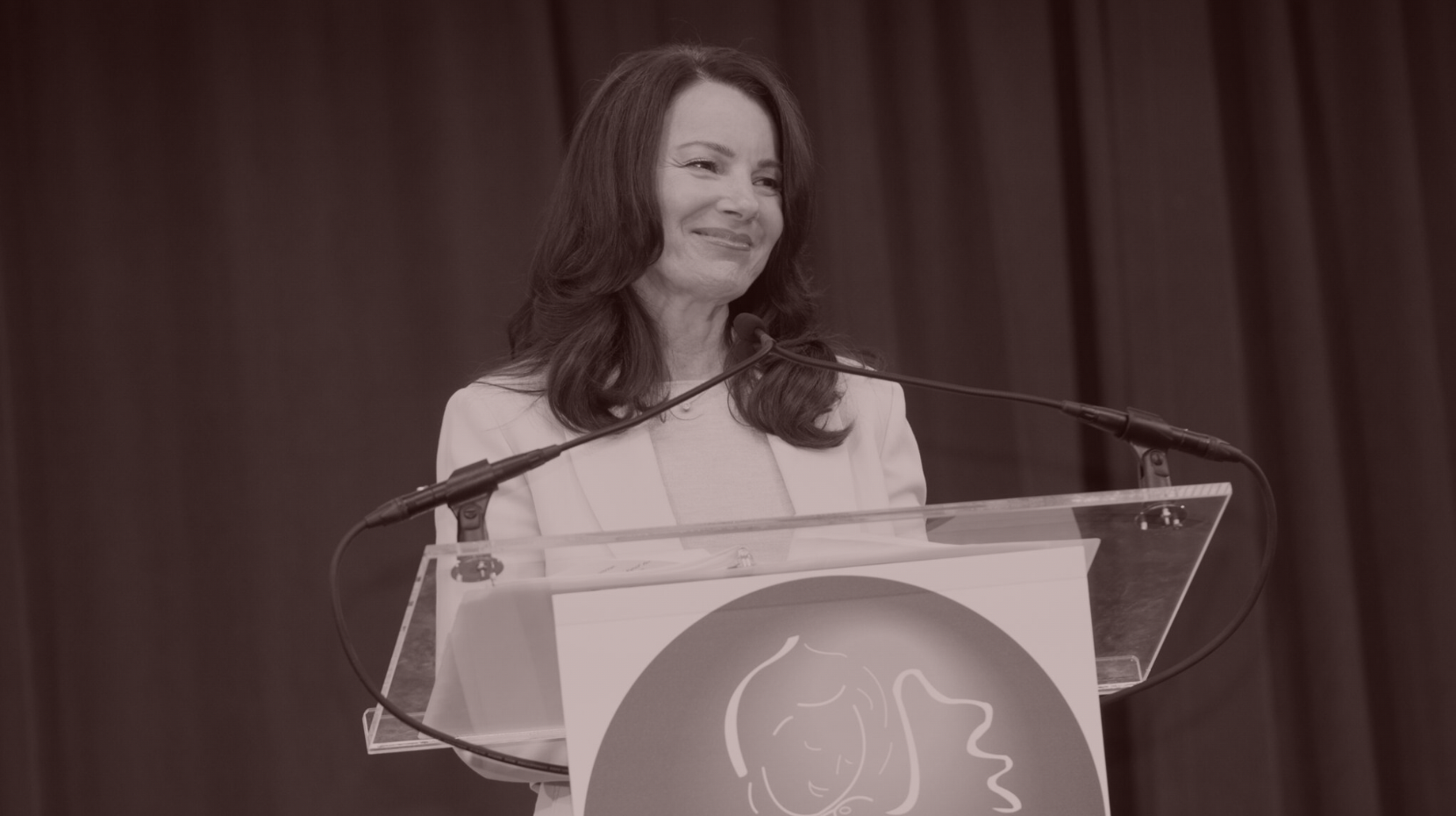 |
| Inside the Actors’ Strategy |
| Dissecting the latest SAG-AFTRA moves amid a last-minute deadline extension and Hollywood’s “hot labor summer.” |
|
|
|
| On Friday, as everyone knows, SAG-AFTRA and the studios agreed to stave off their deadline and continue negotiating a renewal of the union’s TV/theatrical agreements until July 12. In the end, according to everything I’ve been hearing, it all came down to a couple tactical and practical issues. The putative expiration of the deal two days ago—without a contract in place, heading into a holiday weekend—would have forced a strike on July 4th weekend, a time when union members and the media are in vacation mode. (In fact, any Friday night would be suboptimal. Hence the extension to July 12, a Wednesday.) |
|
|
| But with July 4th falling on a Tuesday, resulting in a three-business-day week, the extension to July 12th means only six or so additional bargaining days. That’s enough for the union to say that it tried everything reasonable to reach a deal. If there isn’t one by then, don’t expect a second extension, sources tell me. As it is, though, the union gets to exert additional leverage via an extended threat of a strike, then—if necessary—exercise further leverage via an actual walkout.
Will it come to that? I’m hearing it’s all about the clock and the calendar. Negotiations started June 7, and three weeks was never going to be enough to reach a deal on the union’s six key issues, as well as a big package of secondary concerns. The issues and union positions boil down to:
- Basic Wages: I’m hearing the union wants a 12 percent scale increase in the first year of a new three-year contract, and 5 percent adjustments in years two and three. While that first-year number is more than double the 5 percent bump that the Directors Guild achieved in its just-ratified contract, the large initial increase is a reasonable catchup payment—especially considering the back-to-back 7 percent and 6.5 percent inflation in 2021 and 2022 during which the union saw only 3 percent annual bumps. And 5 percent in years two and three amounts to about 1 percentage point above projected inflation, which is consistent with the 1 percent to 1.5 percent margin that the parties have agreed to in previous cycles.
- Steaming (SVOD) Residuals: The DGA achieved a significant increase in foreign streaming residuals, but only a small increase in the domestic residual—and, crucially, no additional residual based on a show’s performance. SAG-AFTRA is looking for a success metric and may also be looking for a stronger domestic residual. In foreign, I’ve heard that the DGA formula might be acceptable to the actors.
- Ad-supported Streaming (AVOD) Residuals; Pattern Bargaining: The DGA achieved a first-ever residual for high-budget content made for AVOD services, including free ad-supported streaming television (FAST), on platforms such as Tubi, Amazon Freevee and Roku. The residual is calculated as 2 percent of the license fee, which is on the higher end of percentage residuals. (Most are 1.2 percent and only a few are 2 percent.)
The practice of pattern bargaining implies that the studios would also give the writers 2 percent (whenever they do a deal), and that the actors would be offered three times as much, or 6 percent, shared by all principal performers (i.e., non-extras) on an episode. That customary 3x ratio is intended to reflect this sharing, but this time SAG-AFTRA may push for a higher ratio, here and in other percentage residuals contexts, as an actor’s share of the pool is sometimes quite small. Discussing negotiations generally, the union has publicly said (and numerous sources have reiterated to me) that SAG-AFTRA will not be bound this time into a pattern-bargaining straightjacket.
- Artificial Intelligence: As already presaged by deepfake technology, generative A.I. may soon be usable to create a performance without an actor. That’s what various people hope, fear or anticipate. The key issue for the union appears to be compensation—certainly if a lookalike is created, and perhaps some compensation even if the thespian is completely synthetic, since even synthetic output is generated by training on actual examples, such as other people's text, artwork, photography or in this case the performances of actual actors. Some actors also want to have an approval right, so that their voice and likeness could not be used for a lookalike (or perhaps even for training) without the performer’s consent; but it’s not clear that the union is pushing for this.
In any case, the issues are complex: the existing contract already has restrictions on reuse of footage that may or may not cover some generative A.I. scenarios; and meanwhile, the right of publicity—a general legal framework protecting one’s name, voice and likeness—remains relevant but is undercut by contractual grants in the agreements between producers and actors.
- Pension & Health: The union’s P&H funds, like those of the other unions, are funded by a surtax, paid by the employer, on a member’s earnings. However, this levy, currently about 20 percent, only applies to earnings up to certain caps. These designated thresholds haven’t increased in decades, depriving the benefit plans of revenue they would otherwise receive, and SAG-AFTRA is looking for a significant increase in the caps. For what it’s worth, the DGA achieved $25,000 to $50,000 increases in the caps in its new deal.
- Self-Tape Auditions: As I wrote last October, virtual auditions, or “self-tapes”—the new normal—may save gasoline (no more driving across town) but they have brought many pressures: the pressure to shoot and edit multiple takes to get it right; pressure to infuse auditions with high production values; and pressure to hire readers and camera operators (expenses that are not generally tax deductible)--all to compete against other actors. The union is seeking guardrails to moderate the worst of this.
- And there’s more: An unofficial “study guide” prepared by union activists for this negotiating cycle listed some two dozen issues, such as increasing penalty amounts for contract violations (many are laughably low), providing residuals to stunt personnel (only some of whom currently receive them), other residuals concerns, and further improvements to option and exclusivity provisions under which performers are held between seasons of a series.
So… there’s a lot to work through. There was simply no way that the major issues, let alone an entire package, were going to get settled in three weeks of negotiation. In 2020, bargaining took seven weeks; in 2017, five weeks; and in 2014, a particularly heavy lift as the parties merged SAG and AFTRA TV agreements, nine weeks. |
|
|
|
|
| And will they walk? Consider the approximately 98 percent strike authorization vote SAG-AFTRA achieved with almost 48 percent turnout (twice the usual); the “ready to strike” letter signed last week by at least 2,000 actors; and the unprecedented unity ticket for this summer’s union elections, headed by current SAG-AFTRA president Fran Drescher, that signals a leadership more interested in battling the studios than in perpetuating factions and internecine grievances. (Whether that unity will hold beyond this negotiating cycle is a fascinating question for another day.)
Consider, too, the existential angst animating both labor and the companies, driven by technological change and economic headwinds. And consider the climate in Hollywood—the writers are on strike, as you may remember—and the worker discontent and union activism across the city (the hotel workers struck earlier today), state and nation as a whole. Consider, finally, that my sources close to the situation are uniformly expecting a walkout, some with certitude and others with the caveat that a deal is still possible.
Considering all that, yes, there likely will be an actors strike. And if so, that will buttress the writers’ resolve. If the studios and streamers hear the message and respond, a second set of picket lines could actually lead to a quicker resolution of both strikes. If not, well, “It’s gonna be a hot labor summer,” predicted SAG-AFTRA national executive director Duncan Crabtree-Ireland at a WGA solidarity rally. That was two weeks before the actors’ talks even started. But May gray and June gloom are gone now. Stay tuned for labor summer, likely commencing July 12.
Julia Alexander’s What I’m Hearing+ is dark this week, but she sent me an interesting item on the Great Streaming Purge… |
| How to Value the Streaming Afterlife |
|
| I’ve spilled a lot of ink on the financial reasons that companies like Warner Bros. Discovery, Disney, and others purge low-performing content from their streaming platforms. But an adjacent, equally fascinating question is how these removals affect the performance of these series after they’ve been purged. The answer underscores just how complex the streaming wars have become.
Consider Infinity Train, an animated series that was one of 60 titles removed from HBO Max in 2022. Although they weren’t well-watched individually, these shows collectively made up the same “demand share”—meaning people wanted to watch them—as Game of Thrones, according to Parrot Analytics, where I work as director of strategy.
Infinity Train stayed in the top 100 TV chart on iTunes for months. Although search traffic died down significantly, the top related searches on Google in the U.S. still include: “how to download Infinity Train” and “Infinity Train streaming where?” These searches have remained top related queries by more than 200 percent (compared to other searches) since the removal last year. That same quarter, demand share for HBO Max’s catalog dropped from 11.5 percent to 10.8 percent, likely because of the collective removals.
The reality is that without licensing shows elsewhere, more viewers are pushed to piracy or purchasing through digital stores. That said: certain shows, like Paramount+’s recently purged Star Trek: Prodigy, are being shopped. The question is which streamers are best suited for content that has failed on other streaming platforms? For Prodigy, there is stronger audience overlap with Disney+ than Paramount+. In fact, Paramount+ ranks fourth behind Disney+ (20.1 percent), Hulu (18.75 percent), and Max (16.5 percent) when it comes to recent overlap. This means a show like Prodigy could find more success on Disney+ than it did on Par+ despite being tied to Paramount’s Star Trek franchise. As more shows are sent to the TV graveyard, the question is whether something is more valuable to someone else and, in return, whether it is more valuable to license, hold, or disappear entirely. —Julia Alexander |
|
|
| Another brutal weekend at the box office, down 35 percent from last summer. Here’s this week’s official What I’m Hearing Fail Rankings (trademark pending)…
4. The Flash, for failing to crack $100 million domestic after three full weekends…
3. No Hard Feelings, for plunging 50 percent in its second domestic weekend.
2. Indiana Jones and the Dial of Destiny, for its $60 million domestic debut on a $295 million(!) production budget—failing to open to half of the previous installment, when adjusted for inflation. Lucasfilm’s Kathy Kennedy must be weirdly relieved that nothing is working like normal for Disney this summer.
1. Ruby Gillman, Teenage Kraken, which opened to an incredible-sounding $5.2 million, less than a tenth of the DreamWorks Animation movie’s $70 million budget. [Indiewire]
Awful working conditions on Korean shows isn’t just a Netflix problem, it’s a problem for any outlet that buys these shows. [LA Times]
Carina Chocano argues The Bear is “compelling not because of how it recreates a kitchen but because it captures something about modern work in general.” [NY Times]
Showrunner David Simon posted a great thread about affirmative action and the late producer David Mills. [Twitter]
As David Corenswet becomes the new Man of Steel, let’s pour one out for Nicholas Hoult, who has now screen-tested unsuccessfully for Superman: Legacy, The Batman, and Rooster in Top Gun: Maverick; he was Bryan Singer’s pick for a Superman that never happened; and he had to drop out as the villain in Mission Impossible: Dead Reckoning due to TV commitments. [LAT]
The recent exodus/bloodletting of D.E.I. executives at studios continues with Karen Horne at Warner Discovery. [LAT]
Caitlin Flanagan has some suggestions for better Harry & Meghan podcasts, including: Two Girls Talking: Meghan and Gwyneth Get Real About Italian Vogue. [Atlantic]
And finally, Happy 10th Anniversary to CAAN’T, maybe the silliest/most brilliant agency prank ever, wherein Ari Emanuel blanketed Century City and the Today show with a bastardized CAA logo to highlight its client David O. Russell allegedly screaming, “They should be called CAAN’T! CAAN’T CAAN’T CAAN’T!” Man, those were simpler times. [THR] |
|
|
| Less feedback this week, thanks to the holiday, but my item on the influx of Netflix executives in the Academy sparked some interesting messages…
“No one will say it publicly, but who the hell are these people the Academy is letting in? I’m IN THE BUSINESS and very active, and I have no idea who most of these 400 people are. … We’re gonna wake up with an Academy in a few years that doesn’t know how a movie is actually made.” –A producer
“DAVID ZASLAV? They’re adding him to the academy when he is actively destroying film and television for the sake of his investors? WTF! He doesn’t care about the creatives at ALL—he has no business being in the academy.” –An executive
“Do you realize that when they invite less than 50 percent women, the percentage of women may actually shrink (unless balanced by deaths by men, which is possible).” –Another executive
“The number of foreign invites [to the academy] is getting to the point where the whole point of the Oscars—promoting Hollywood to the world—is turning into the opposite. And viewers of the Oscars will have more reason to tune out.” –A lawyer |
|
|
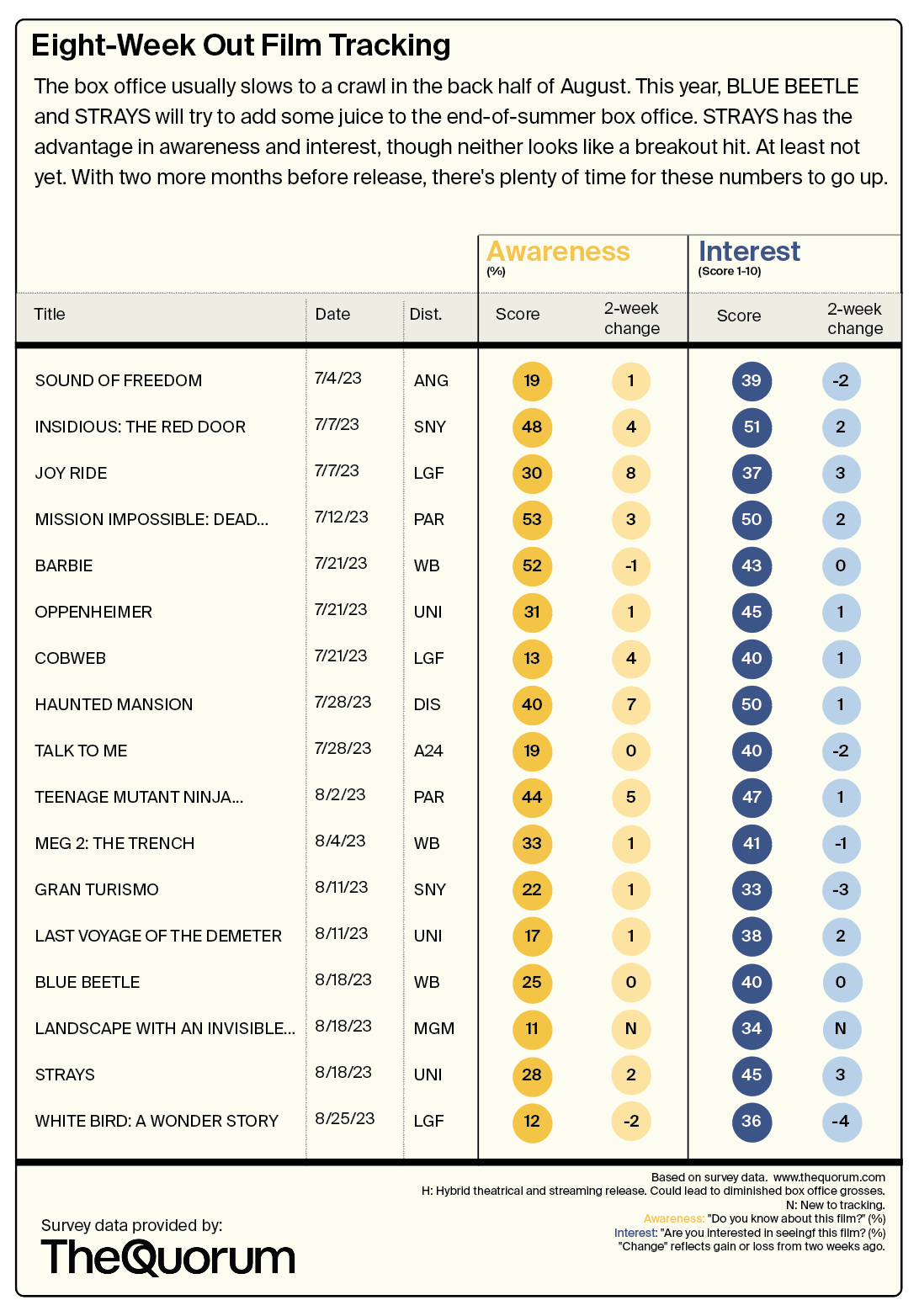
| The battle for the doldrums of August is taking shape, with DC-light entry Blue Beetle and the potty-mouthed pets comedy Strays both appearing with OK numbers on The Quorum’s early film tracking chart… |
|
|
| Have a great holiday, see you next Sunday,
Matt
Got a question, comment, complaint, or title suggestions for the Jerry Jones show? Email me at Matt@puck.news or call/text me at 310-804-3198. |
|
|
|
| FOUR STORIES WE’RE TALKING ABOUT |
|
|
|
|
|
 |
|
|
|
Need help? Review our FAQs
page or contact
us for assistance. For brand partnerships, email ads@puck.news.
|
|
You received this email because you signed up to receive emails from Puck, or as part of your Puck account associated with . To stop receiving this newsletter and/or manage all your email preferences, click here.
|
|
Puck is published by Heat Media LLC. 227 W 17th St New York, NY 10011.
|
|
|
|