Welcome back to What I’m Hearing, finishing up a week of big news before everyone leaves town… and
no news bigger than this: UTA signed a cheese.
I feel a little bad that everyone in town is laughing about this, considering that odd brand clients are now pretty common at the talent agencies, and the Parmigiano Reggiano people—not the agency—announced the signing. (UTA actually tried to get THR
to take down the story. Guys, just own it!)
Just for fun, I asked a few reps and writers to give me their best answer to this question: UTA’s first priority for Parmigiano Reggiano should be…?
Some highlights: |
- “Get Timothée Chalamet to eat a 50-pound wheel of Parm on a livestream.”
- “Recurring arc on The Bear.”
- “Book an A24 movie opposite Tilly Norwood.”
- “Get a Sopranos reboot off the ground.”
- “Attach to all Spaghetti Westerns.”
- “Tip off the paps that Parm is with Sydney Sweeney in Central Park.”
|
Finally, the winner comes from a WME agent: |
- “We were conflicted because we rep Brie Larson.”
|
Anyway, tonight I’ve got an analysis of why Netflix would pledge to put Warner Bros. movies in theaters. Is
it more than just a shameless ploy to win friends and allies in the battle to acquire the studio?
Discussed in this issue: Ted Sarandos, Taylor Sheridan, Eduardo Acuna, Donna Langley, Chris McCarthy, Guillermo del Toro, Larry Ellison, Benjamin Swinburne, Adam Aron, Bryan Lourd, Greta Gerwig,
Hernan Lopez, Bob Iger, David Ellison, Rob Bonta, Jonathan Kanter, Teddy Schwarzman, David Glasser, and… Byron Allen.
Not a Puck member yet? Just click here. Got a news tip or an idea for me? Just reply to this email, text me, or message me on Signal at
310-804-3198.
Let’s begin… |
- Sheridan
gets his own network exec: How badly did NBC Universal’s Donna Langley want to lure Taylor Sheridan from Paramount? Langley has generously gifted Sheridan his old boss, Chris
McCarthy, the recently ousted Paramount co-C.E.O. whose willingness to indulge Sheridan’s whims—and whose idea it was to franchise-ify Yellowstone in the first place—has endeared him to TV’s most prolific creator. And while Sheridan won’t start making shows for NBC and Peacock until 2029, McCarthy will move over early next year, when he can start working with David Glasser’s 101 Studios, Sheridan’s go-to studio, which is also shifting to
NBCU.
This reunion seemed inevitable once CAA’s Bryan Lourd started orchestrating the Sheridan move. I thought maybe Amazon would bring them all over to serve the Reacher and Jack Ryan audience on Prime Video. The only question now is how long it will take McCarthy to use his famously sharp elbows to start amassing power in his new role. - More…: Something is up at NBC Universal, right? You don’t commit hundreds
of millions of dollars to the full Taylor Sheridan posse, and $27 billion over 11 years for the NBA, and another $200 million or so a year for MLB games to program a U.S.-only streaming service with 41 million subscribers—unless you’ve got a plan to supercharge the service. Comcast is going after HBO Max, of course, which would instantly take Peacock content global. But if that doesn’t happen? There’s gotta be another play. Langley and the Philadelphia crew have been awfully
quiet about their activities lately.
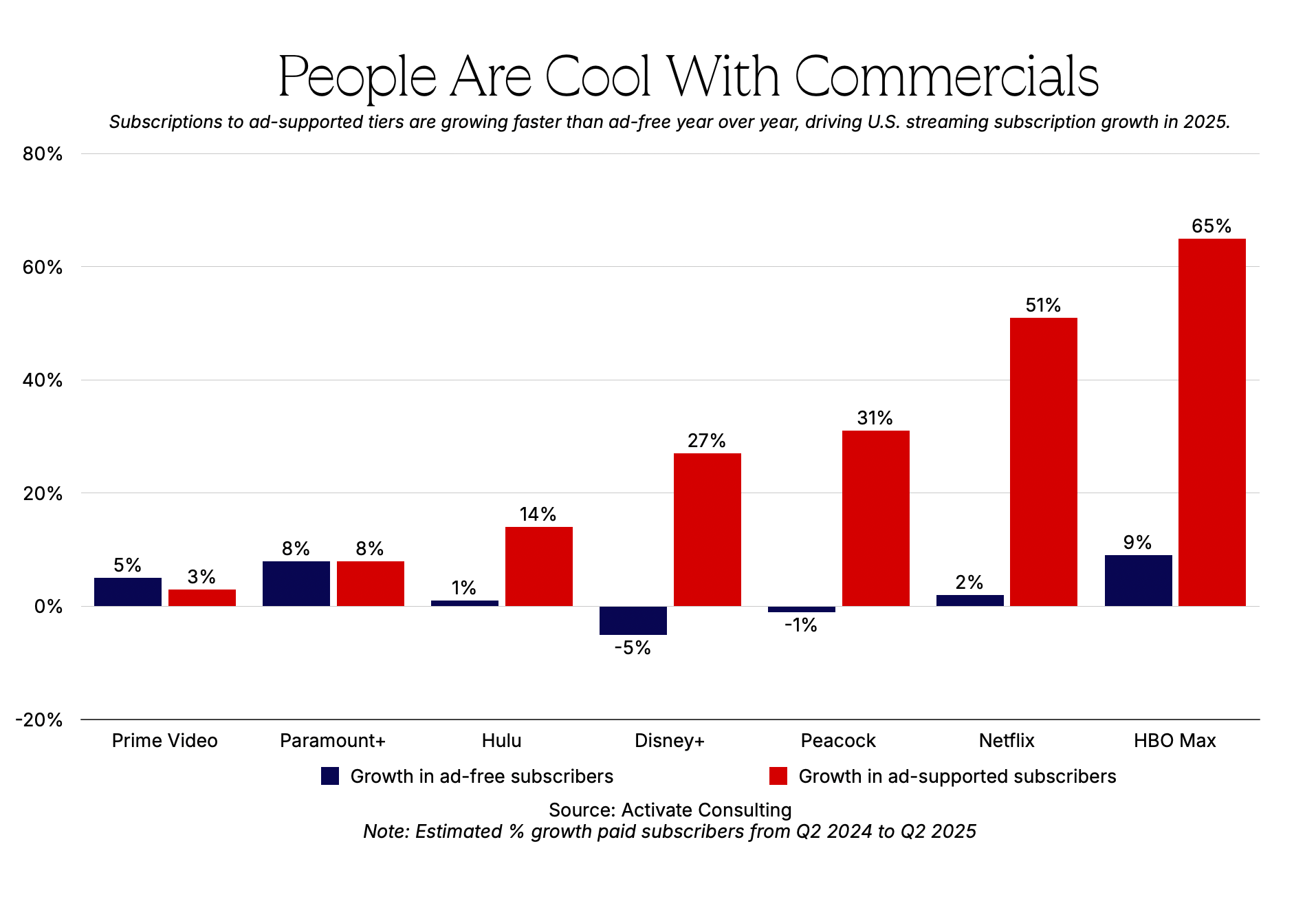
- Ad tiers may have won the year: I’m starting to put together my best/worst of 2025 columns. (Villain of the Year is gonna be a tight race!) But one undeniable trend is evident in a new chart that tracks the explosive growth in advertising tiers of subscription streaming services. It’s almost like people would rather pay less for their shows and movies…
|
- Box
office over/under: Universal’s Wicked: For Good tracking had been sitting at $125 million for a few weeks, per NRG. Yet presale numbers keep getting better, so I’ll take the over.
|
Okay, now to the Netflix angle on the Warners sale… |
|
|
As bids for Warner Bros. Discovery come due and exhibitors prep an antitrust challenge, Ted
Sarandos has pledged to play Warners movies in theaters. Is this just a shameless wet kiss to the town and regulators, or another sign of his company’s ability to pivot? |
|
|
If you peeked just outside the main ballroom of the Governors Awards on Sunday night, Netflix co-C.E.O.
Ted Sarandos appeared to be deep in conversation with one of his chief nemeses: Eduardo Acuna, C.E.O. of the Regal Cineworld theater chain. Sarandos, of course, has spent the past decade attempting to kneecap Acuna’s business, and the windowing system that has allowed theaters to survive through the advent of television, the VHS tape, and digital downloads. Acuna has returned the favor by refusing to play most Netflix movies on his 8,000 screens
worldwide.
Neither Sarandos nor Acuna would tell me what they were discussing in their tuxes, other than that the chat was “friendly.” But I’m betting that Warner Bros. came up. Netflix is chasing the 102-year-old studio alongside Paramount and Comcast and whoever else submitted a bid by today’s deadline. (Amazon? The Saudis?? Byron Allen???) And if Sarandos succeeds, the assumption among exhibitors is that Warner Bros., which currently gives nearly all its movies at
least a 45 day theatrical window, will pivot to a streaming-first strategy—if it allows wide releases in theaters at all. Ted and co-C.E.O. Greg Peters have repeatedly declared theatrical is “not our model,” and earlier this year, Sarandos agreed with an interviewer’s suggestion that the moviegoing experience is “outmoded for most people.” As outmoded as a business can be while still generating $30 billion in worldwide ticket sales last year, I guess.
That’s why it was
fun to see Bloomberg report yesterday that Netflix told Warners “it will keep releasing the studio’s films in theaters if it’s successful in buying the company.” I know, it feels like a wolf trying to enter a pen of bunny rabbits by telling them he’s a vegetarian. Specific promises were not made regarding how many
movies per year would appear in theaters, or how many screens, or how long those windows might be, I’m told. All of which are… important.
After all, Sarandos would argue Netflix already puts many of its movies in theaters. Some get a nominal debut in a few arthouses for awards qualification or to win a competitive project. The recent Frankenstein played in 700 theaters in North America for three weeks exclusively, just to placate
Guillermo del Toro. Similarly, Greta Gerwig is getting a global Imax release and a month of exclusivity for next year’s Narnia, an arrangement Sarandos fought for months like it was his personal Waterloo. (For reference, a typical big-budget fantasy film from del Toro or Gerwig would debut on 3,500 or even 4,000 screens in the U.S. and Canada, and thousands more overseas.)
So… is Ted, the enemy of theaters, really ready to drop his decade-long
war on windows for the Warners movies? You’re probably already shaking your head and wailing “Noooooo….” But the argument, at least, is that Netflix has repeatedly proven itself able to pivot as it has grown, whether it’s from DVDs to streaming, library titles to originals, no ads to ads, or no sports to sports. It’s now a nearly $500 billion company, about two and a half times the size of Disney. If Netflix were to spend the $60 billion or so on Warner Bros. and HBO Max—assuming the
government and Larry Ellison don’t object—the company would not only secure the rich film and television library and I.P. trove that it does not currently have, but it would also instantly inherit businesses in markets it does not currently compete in. Namely, global theatrical distribution of 10 to 15 movies a year and content licensing of both film and TV titles. B2B, not D2C. Netflix could simply shut down those units… or it could expand Netflix to absorb
them.
Essentially, Ted could use the acquisition of Warner Bros. as an excuse to evolve his business yet again. “Not our model” could become “It wasn’t our model, but we bought into it”—and, in the process, lure the A-level stars and directors that currently rebuff Netflix over the theaters issue. The market doesn’t seem to love the Netflix flirtation with Warners. The stock dropped today on the news of offering theaters, and analyst Benjamin Swinburne has complained that
absorbing Warner Bros. would distract Netflix and not lead to many synergies. But others are downright excited about theaters. “If owning WB allows Netflix to attract more talent and monetize windows beyond streaming, theatrical releases become a natural outcome,” analyst Hernan Lopez, founder of Owl & Co., suggested on LinkedIn today. “The
irony is delicious: the company that built its empire on convenience might rediscover the power of scarcity.” |
“Everyone Is Gonna Say the Right
Thing”
|
Or not. The most likely explanation is that Netflix is simply making shameless pro-theater statements to get
a deal done. After all, Ted and Greg really need allies in this effort. Paramount and the Ellisons have the Trump machine, as evidenced by Republican politicians already coming out against Netflix. Comcast/Universal is at least a traditional entertainment company, with a streaming service, Peacock, that desperately needs a boost. Netflix not only doesn’t need Warner Bros. or HBO Max; to many in town, it’s still a Silicon Valley invader that breached the
thirty-mile zone in a Trojan horse of DVDs by mail and quickly remade the industry in its own image.
No, once he captures Warner Bros., Sarandos would more likely honor whatever existing contracts he inherits, then shift to a varying theatrical window—day-and-date for most movies, and up to two weeks for the bigger-budget, I.P.-driven tentpoles. In meetings with talent and the media, Sarandos often notes that Netflix would love to put more movies in theaters… if only the damned
theater owners would allow simultaneous releases on the service, or tiny slivers of exclusivity. He’s known to argue that Netflix research shows a two-week window does not hurt theatrical grosses, and the value of a new title to Netflix diminishes significantly if the theatrical window is longer than that.
Of course, research by the legacy studios and exhibitors shows the exact opposite: Shorter windows do hurt theatrical, and movies that perform well during a robust
theatrical run tend to do better on streaming platforms. The whole problem with the post-Covid box office is that Netflix and HBO Max and Disney+ trained audiences during the pandemic to expect first-run movies at home, and others—most notably Universal—have since shortened their windows to push titles to premium video-on-demand, where they collect a bigger share of revenue.
Currently, the major chains won’t play Netflix movies if the window is two weeks—especially if the title will go to
subscription streaming, rather than P.V.O.D. Theater sources have told me that customers complained about Red One last year because it was “free” on Prime Video so quickly after hitting theaters—and that movie had a 30-day window. Despite Sarandos’s recent détente with my friend Adam Aron at AMC Theatres, the majors are unlikely to nuke their relationships with the studios that do adhere to a longer window just to get Frankenstein or Jay
Kelly.
But maybe, Sarandos might be thinking, Acuna, Aron, and the other exhibitors would reconsider if shunning Netflix meant missing out on The Batman: Part II or the next Minecraft movie. Two weeks of The Batman generated $500 million globally in 2022, about half of which flowed to those struggling theaters. Maybe, rather than making a concession to exhibitors with theatrical releases for the Warners movies, Sarandos could use the top-tier
tentpoles to essentially force the theaters to accept his preferred model: Most movies go exclusively to Netflix, except for a few from A-list talent or featuring top I.P.—those would play in theaters for two weeks, after which they continue in theaters but also go to Netflix.
If that happens, Netflix could claim to be supporting what top filmmakers want—theaters! A wide release!—while also directing most of the value to Netflix, which is what Ted ultimately wants. In
response, the other theatrical-driven studios might consider shortening their windows and further bending the entire industry to the preferences of Netflix. Just like what happened with the elimination of backends.
The theater owners are already seeing where this may go if Netflix beats Paramount and Comcast. “We will oppose anything that consolidates legacy studios, but Netflix is potentially the biggest problem of the three for theaters,” Michael O’Leary, the
head of Cinema United and the industry’s chief lobbyist, told me today. O’Leary admits it’s still early, but the theater owners are prepping for a fight. “We need to determine what they intend to do with the studio,” he added. “Everyone is gonna say the right thing, but what does that mean on a practical level?”
Exactly. There’s little reason to believe Paramount, either, of course. David Ellison keeps saying his plan is to keep Warners separate and churn out 10 to 15
theatrical releases each year. I’ve raised an eyebrow about that statement before, mostly because Disney made similar comments about 20th Century Fox in 2017 and 2018. Bob Iger and Rupert Murdoch asked the theater owners not to oppose the merger because Disney supported robust windows. Back then, that was the biggest issue, not the number of releases, and Fox was making noises about shortening its exclusivity period. Disney wasn’t, so many in the theater
community thought Fox-Disney might be better. Cut to this year, when 20th Century is releasing just five movies in U.S. theaters. Fox released double that number in 2018, not including Fox Searchlight. Pre-merger, Disney charged the highest film rental rates of any studio, and Fox was among the lowest. Now—you guessed it—the former Fox labels charge those higher Disney rates, so releases have gone down and prices have gone up.
If it sounds like I’m making an antitrust argument,
that’s what the theater owners are about to do—even if the buyer is Paramount and the Trump administration isn’t listening. I had Jonathan Kanter, Biden’s antitrust guru at the Department of Justice, on The Town this week, and he noted that both foreign and state regulatory review could be important. Remember, Mexico and Brazil were the last
jurisdictions to approve Disney-Fox, and California Attorney General Rob Bonta is making vague noises about opposing Warners-Whoever.
Netflix, the leader in streaming, would offer a pretty clear target, too, as would Comcast. One outcome could be the government forcing Netflix, as a condition of a Warner Bros. deal, to commit to do what it is likely just pretending it wants to do now: Namely, to release 10 to 15 movies wide each year with a minimum 45-day window. Would
Sarandos agree to that if it was a dealbreaker? Would Brian Roberts at Comcast? The Ellisons? Because of that uncertainty, the theater owners will spend their holidays checking Wicked and Avatar grosses and posing a heightened version of the question being asked all over Hollywood: Which of these Warner Bros. buyers would be least disastrous for our business? |
See you Monday,
Matt
Update: The buyer who paid $31 million for J.J.
Abrams’ tricked out Bad Robot headquarters in Santa Monica was revealed today as Teddy Schwarzman’s Black Bear production company and distributor.
Got a question,
comment, complaint, or a cheese signing to report? Email me at Matt@puck.news or call/text me at 310-804-3198. |
|
|
Puck founding partner Matt Belloni takes you inside the business of Hollywood, using exclusive reporting and insight to explain
the backstories on everything from Marvel movies to the streaming wars. |
|
|
The industry’s go-to source for unflinching reporting on the trillion-dollar business of artificial intelligence - perhaps the
single most important technology of our time. Ian Krietzberg, the powerhouse journalist behind The Deep View, delivers twice-weekly insights into the latest dealmaking and breakthroughs in A.I., and how the intersecting worlds of finance, entertainment, media, and politics are being transformed in its wake. |
|
|
Need help? Review our FAQ page or contact us for assistance. For brand partnerships, email ads@puck.news. You received this email because you signed up to receive emails from Puck, or as part of your Puck account associated with {{customer.email}}. To stop receiving this newsletter and/or manage all your email preferences, click here. |
Puck is published by Heat Media LLC. 107 Greenwich St, New York, NY 10006 |
|
|
|