 |
|
Welcome back to What I’m Hearing, coming at you from Sundance, where I just hosted a fantastic Puck private dinner/High West whiskey tasting with a great group of producers and executives. Thanks to John Sloss for co-hosting and Spotify/The Ringer for sponsoring.
🚨🚨 Apologies to those who remain waitlisted for our live taping of The Town. We will let you know via email if a ticket becomes available tomorrow.
Programming note: This week on The Town, Lucas Shaw and I debated the NFL playoff game ratings on Peacock, and author James Andrew Miller peered into the SNL succession crystal ball. Subscribe here and here before tomorrow’s big 2024 Box Office Draft episode.
Was this email forwarded to you? Click here to become a Puck member. Got a news tip or an idea for me? Just reply to this email.
Discussed in this issue: Kevin Costner, Jenn Levy, Ari Emanuel, Jeffrey Katzenberg, MrBeast, George Clooney, Shari Redstone, Steven Soderbergh, Brandon Riegg, Shari Redstone, Adele, Jen Salke, David Ellison, Nelson Peltz, and the only Saltburn review that matters.
But first…
|
| Who Won the Week: Jesse Eisenberg |
|
| Points for the first major sale at Sundance. The actor/filmmaker’s Poland road trip dramedy A Real Pain scored a $10 million deal for worldwide rights with Searchlight that guarantees a theatrical release.
Just curious: I asked our box office guy, Scott Mendelson, to name the last Sundance pickup to gross $50 million domestic. It’s nuts: You’ve gotta go back to Little Miss Sunshine in 2006 ($60 million, not adjusted for inflation), and before that, Saw ($55 million) in 2004. Obviously, the streamers have taken some of the hottest titles off the table in recent years, and Scott notes several acquisitions have topped $40 million, including Napoleon Dynamite ($46 million in 2004), Precious ($48 million in 2009), Manchester by the Sea ($48 million in 2016), and The Big Sick ($43 million in 2017). Just last year, A24 paid about $7.5 million for the horror pic Talk to Me, and it earned $48 million domestic and $92 million worldwide. Not bad!
Now for some interesting news for digital creators… |
| Amazon’s Pivot to YouTube |
|
| One of my predictions for 2024 was the further blending of social media and traditional entertainment. And just like that, I’ve learned that Amazon Studios is now closing a deal for a MrBeast television show. Beast, a.k.a. 25-year-old prankster Jimmy Donaldson, is the most-subscribed individual on YouTube, with 233 million subs. So when his team took the show out to the streamers last week, it made sense that Amazon’s Jen Salke, who is looking for more populist entertainment, emerged victorious. One source pegs the deal, if it closes, at nearly $100 million, though that’s not confirmed. (Amazon declined to comment). It’s a competition show—no surprise, given Beast’s frequent contests and giveaways—and the first episode will air on his YouTube channel before continuing on Prime Video. There will also be brand partners included, of course, which could offset some of the cost for Amazon (and hopefully add to Beast’s chocolate bar empire). The D’Amelios are now on Season 3 of their Hulu show, and I’m betting we will see more of these deals this year.
Speaking of the unscripted world: A few people (including some at Netflix’s own documentary film party today on Main Street) asked what happened to Jenn Levy, the Netflix V.P. of nonfiction who was abruptly let go last week. Levy is super close to the top unscripted exec, Brandon Riegg, who worked with her way back at VH1 before bringing her in from Bravo, and the Netflix reality slate has been strong, with hits like Love Is Blind and Selling Sunset. But Reigg is telling colleagues that things have been going well but not super well, so he’s gonna bring someone in to manage reality programming above Levy and Nat Grouille, V.P. of unscripted series. So she’s out and Grouille will remain. Such is the Netflix way.
Now for my take on the news from both Park City and Cupertino… |
 |
| Apple’s Quest to Revolutionize the Home Theater |
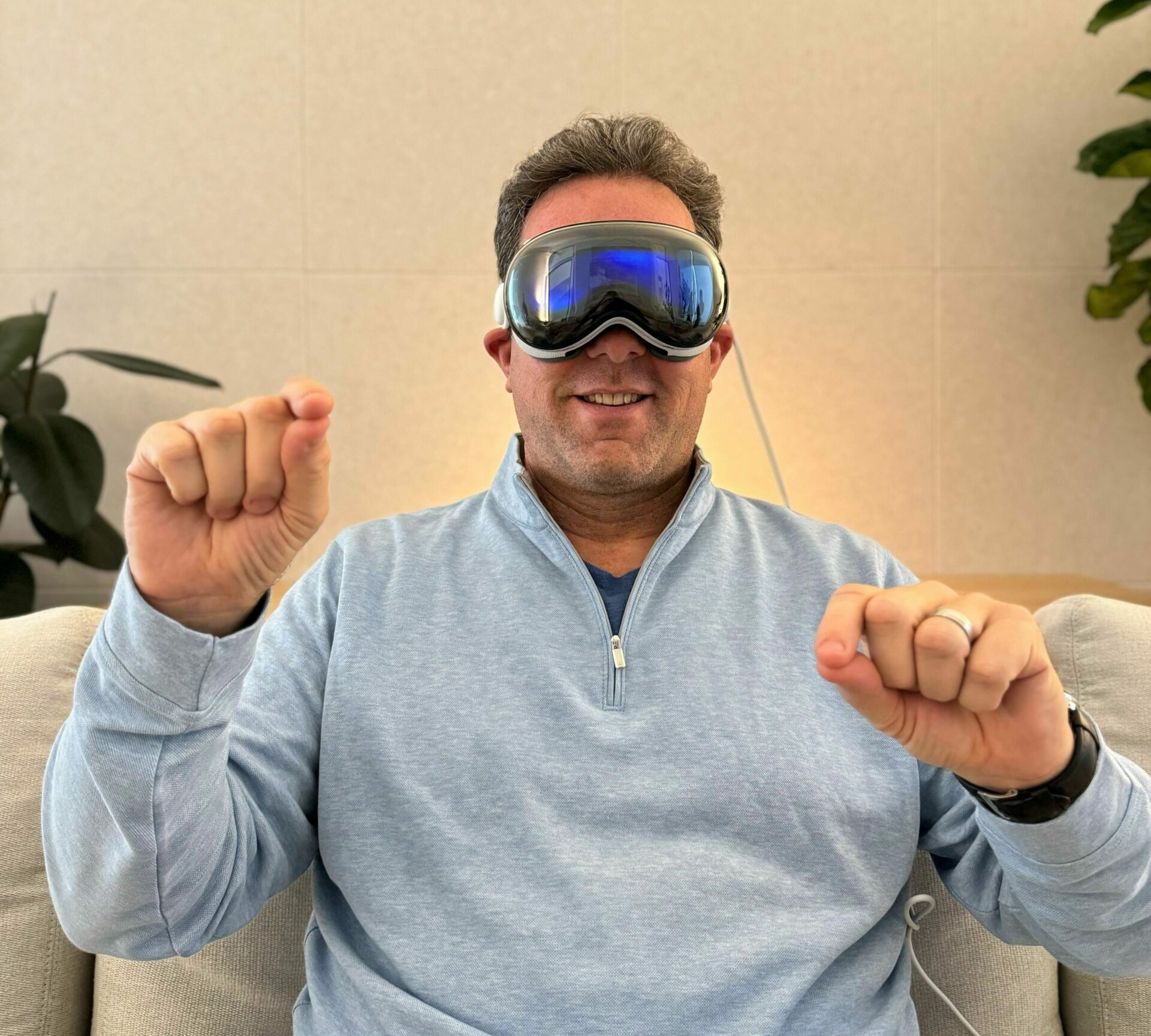
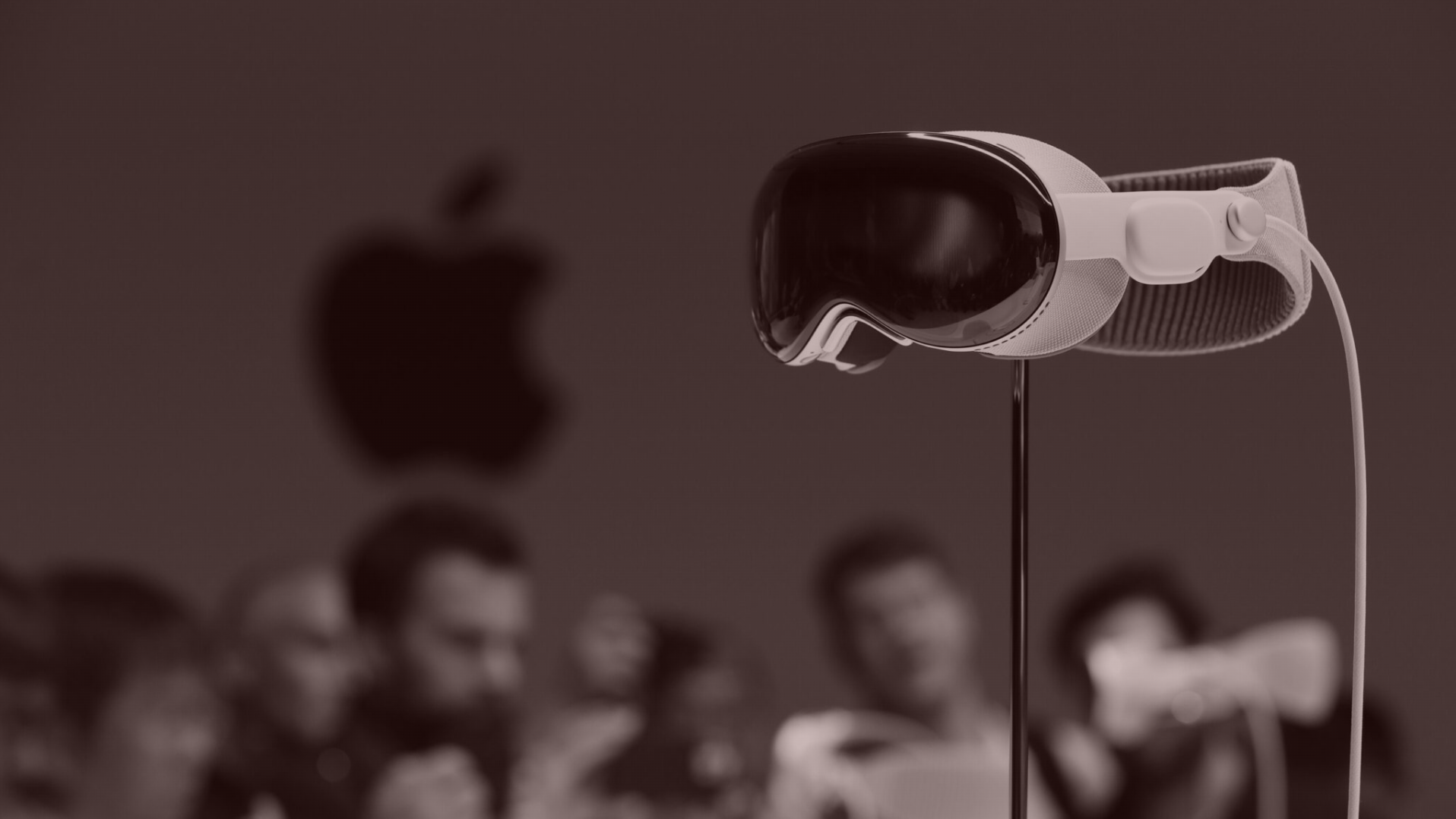
| Tim Cook’s fancy new $3,500 V.R. headset, which I recently (reluctantly) sampled, may seem like a gimmick—until you imagine the future of at-home theatrical. Take Steven Soderbergh’s latest movie as an example. |
|
|
|
| Last week I did something I never do: a hardware demonstration. I’m usually not too interested in the latest tech, and, as a relatively late adopter, nobody cares what I think about it anyways. But many of the initial reactions to the new Apple Vision Pro have focused on how cool it is for watching movies, so my attention automatically perked up.
The fancy VR/AR headset, which is available Feb. 2 at an initial $3,500 price, is being marketed as a next-generation platform for video and other entertainment. It’s launching with apps for Disney+, Max, ESPN, Amazon Prime Video, and Peacock (though not Netflix or YouTube, which is a bit of a surprise; they’re telling people to just use the web). And the Apple publicist was both nice and persistent. So on Tuesday afternoon, I found myself sitting on a designer couch in the old Beats offices in Culver City, ready to have my mind blown.
Well, I shouldn’t say blown. Like most people in Hollywood and elsewhere, I’m pretty cynical about V.R. and mixed reality. I just don’t think regular people want to wear a clunky headset, at least not yet, no matter how cool the experience. And most devices, up until now, have been not that cool. Meta sent me the latest Quest a year or two ago—I tried it once and never again. Like most headsets, I don’t think Quest has answered the Why? question for non-gamers. But Meta is not Apple, of course, and for me, a longtime Apple person, Tim Cook gets the benefit of the doubt on everything except The Morning Show. So there I was, sitting for the full Vision Pro experience.
I’ve gotta say, it was pretty damned impressive. I’ll leave the tech reviews to the experts, who seem to like the visual display and Apple-style intuitiveness, while noting some drawbacks like the weight of the headset and a clunky battery pack. (That’s probably why Apple insisted on taking the photos of me and others; you won’t see the battery in any of those shots.) The ability to use your eyes to accurately direct the “cursor” and pinch your fingers to select stuff is pretty seamless. There’s even a virtual keyboard you type in the air, and scrolling feels similar to an iPhone. Maybe the most amazing element is the immersive experience of spatial photos and videos. You can relive a European vacation inside your pics or “sit” at a dinner table with a relative who may no longer be alive. Crazy stuff. |
|
|
| But it’s the professional content that interests me most, of course. And I must say, the Vision Pro could represent an evolution in the experience of watching movies, TV shows, and sports on an individual headset (or a “personal theater” if you want to call it that). I watched the trailer for Star Wars: A New Hope via the optimized Disney+ app while it felt like I was sitting in a drive-in theater on Tatooine. The Super Mario Bros. Movie took on the feel of the old video game, albeit massive, in crisp 3D, and with Seth Rogen trouncing across my entire plane of vision as Donkey Kong. The Ted Lasso scenes played like I was attending an AFC Richmond game, as did the quick glimpses they showed of real sports action. Imagine watching an MLB game—from the perspective of front-row seats behind the dugout. What they showed was brief, but very cool.
Who knows whether my small demonstration will translate into somewhere I’d want to spend hours a day. There’s a micro-OLED display with audio speakers embedded in the headset, but by the time my 45-minute demo ended, my head felt a little tired, like I was on the verge of a headache. Still, the Apple slickness and the ease and integration into the App Store felt like a familiar and easy place to watch movies.
Will regular people pay $3,500 for a personal home theater to consume content they can already watch on their big screens? Maybe not, or at least I’m not sure they will right now. But that’s not the question Hollywood should be asking. Watching movie clips in that Apple office suite, I wanted to see more. The experience felt fresh and elevated. And most importantly, when I asked myself, Will people watch movies in this format? I think the answer is, eventually, yes. |
|
|
| Three days later, I got major Vision Pro vibes from Steven Soderbergh’s new film, Presence, which premiered at the Library theater here in Park City on Friday night. Soderbergh, the rare experimental filmmaker who’s also a studio franchise creator (Ocean’s 11, Magic Mike), made a haunted house movie told from the ghost’s perspective. For 85 minutes, we see only what the “presence” does, and the story unfolds in part based on how the characters interact with that unseen eye.
It sounds gimmicky, but the conceit totally works, and critics are noting how much the first-person perspective—something Soderbergh never thought would be possible—actually adds to the storytelling (while also diverting from some clunky dialogue). “I’ve been very vocal about the fact that [visual reality], one-person point-of-view V.R., doesn’t work, is never going to work as a narrative. Nobody wants this thing on their head,” Soderbergh told us during the post-screening panel with festival director Eugene Hernandez. “Then I’m like, ‘The only way to do it is you never turn around.’ I’ve been saying for years, ‘You have to turn around or it doesn’t work.’ And now I’m like, or…”
Or… it does work, with a talented filmmaker who figured out how to make the first-person perspective a compelling narrative device. It’s funny that Soderbergh, a big critic of virtual reality in storytelling, is now among the first to actually pull it off, and at a time when everyone here at Sundance seems to be terrified for the future of the film business. The rise of global streamers and the decline of the international territory model has thrown the entire business into disarray. Now streamers are going more commercial. But do modern audiences, trained on social media and video games, even want two-hour narrative features? I mean, even Marvel movies don’t automatically work anymore.
But watching Presence, I kept thinking how cool it would be to experience it on an Apple Vision Pro, like a first-person shooter game but a movie, with real characters and suspense. The first-person movie seems tailor-made for the new era of personal theater, the merging of video games with narrative storytelling, all in the service of making the audience feel something. It’s something exciting in the sea of same-old at Sundance. (Note to Apple: Presence is still for sale here, though I’ve heard there are a few buyers in the mix.)
Bigger picture, while everyone in Hollywood seems to see Big Tech as the enemy, the truth is that tech and content have kinda always evolved together. Like the Imax boom or what’s going on in live music with the Sphere, there will likely be a future in personal theaters, powered by sophisticated V.R./A.R. headsets, with content like Presence tailor-made to exploit the format. That’s why those traditional entertainment companies were smart to launch on the Vision Pro. Sure, they might end up like all those print magazine publishers who created iPad versions that nobody read. But if Apple doesn’t figure out personalized V.R. theaters, someone else will, and it’s at least comforting to know that Hollywood films and shows will almost certainly be along for the ride. |
|
|
| What to make of the holiday box office hangover? Wonka crushed Aquaman 2, Clooney’s Boys in the Boat is crossing $50 million domestic, The Color Purple flatlined after a huge Christmas Day opening, The Iron Claw got to $30 million domestic (with an Adele on-stage endorsement!?), and the sexy people rom-com Anyone But You crossed $100 million worldwide. [IndieWire]
Kevin Costner posed for a cute photo with a close adviser to Saudi Crown Prince M.B.S., which couldn’t possibly have anything to do with the mystery financier of his Horizon movies, could it? [Twitter]
Will generative A.I. finally kill I.P. protections that make the entertainment industry possible? Louis Menand weighs the arguments. [New Yorker]
Jeffrey Katzenberg’s high-profile role in Biden’s reelection effort “has top Democrats in Hollywood and Washington worried that maybe the campaign isn’t self-aware, and doesn’t understand what sort of optics voters are picking up on.” C’mon, what’s more relatable to Americans than drinking 10 Diet Cokes a day? [NY Mag]
Will Spotify ever consistently make money when music labels get 70 cents of every dollar? Maybe a sale to Microsoft or even Netflix makes more sense than trying. [WSJ]
Ari Emanuel’s Endeavor stock popped on reports that majority shareholder Silver Lake will buy out minority investors and sell off assets, though not the WME agency. [Bloomberg]
Oscar noms are Tuesday morning, and Saltburn has a slim shot at becoming the dumbest movie to score a best picture nomination since at least Extremely Loud and Incredibly Close in 2011. This woman’s review best sums up my feelings. [Twitter] |
|
|
| My ongoing coverage of Shari Redstone’s auction for all, or part, of Paramount Global and/or parent National Amusements drew an interesting little analysis from a strategy exec, who points out that the Ellisons aren’t exactly the usual buyers, who might wait for a bankruptcy or a more dire situation…
“Listening to your conversation with Bill Cohan about National Amusements and thinking about the Amazon/Diamond deal [for a stake in regional sports networks], I wonder if maybe we’re overlooking something. Larry (and David, by extension) are not traditional distressed investors. Neither are any of these large-scale tech companies. Could any one of them pay substantially less by waiting for a covenant trip or bankruptcy filing? For sure. Do any of these players have any real experience pursuing, structuring (née battling), and closing deals for distressed/insolvent assets? No.
“When you have that much money, it’s just easier to overpay and avoid the fight/risk of uncertain outcome. Amazon easily could have let the Diamond bankruptcy play out, let rights revert to the leagues/I.P. owners, and then partner directly to acquire rights that are more aligned to their strategy. But what if another buyer emerged? What if the bankruptcy proceedings fragmented the market even more? These players didn’t get so big/rich by casually getting sucked into quagmires with control in the hands of creditors and courts with billions of dollars at stake.
“Being rich and self-assured enough to believe you can enter a new industry and succeed regardless of the existing industry dynamics? Sure, look no further than Nelson Peltz’s “man on the street” visit to Disney World. Getting in the muck and going up against distressed investors, bankruptcy lawyers, shareholder/creditor lawsuits, public filings, etc.? No f-ing way. It’s not overpaying—it’s a safeguard-the-manicure tax that they can very much afford to pay.
“If an Ellison purchase of National Amusements would constitute a change-in-control for Paramount Global’s creditors, what happens in a workout/default scenario? It’s a fucking disaster, even if you could get the assets ‘on the cheap.’” |
| Finally… the Chart of the Week |
|
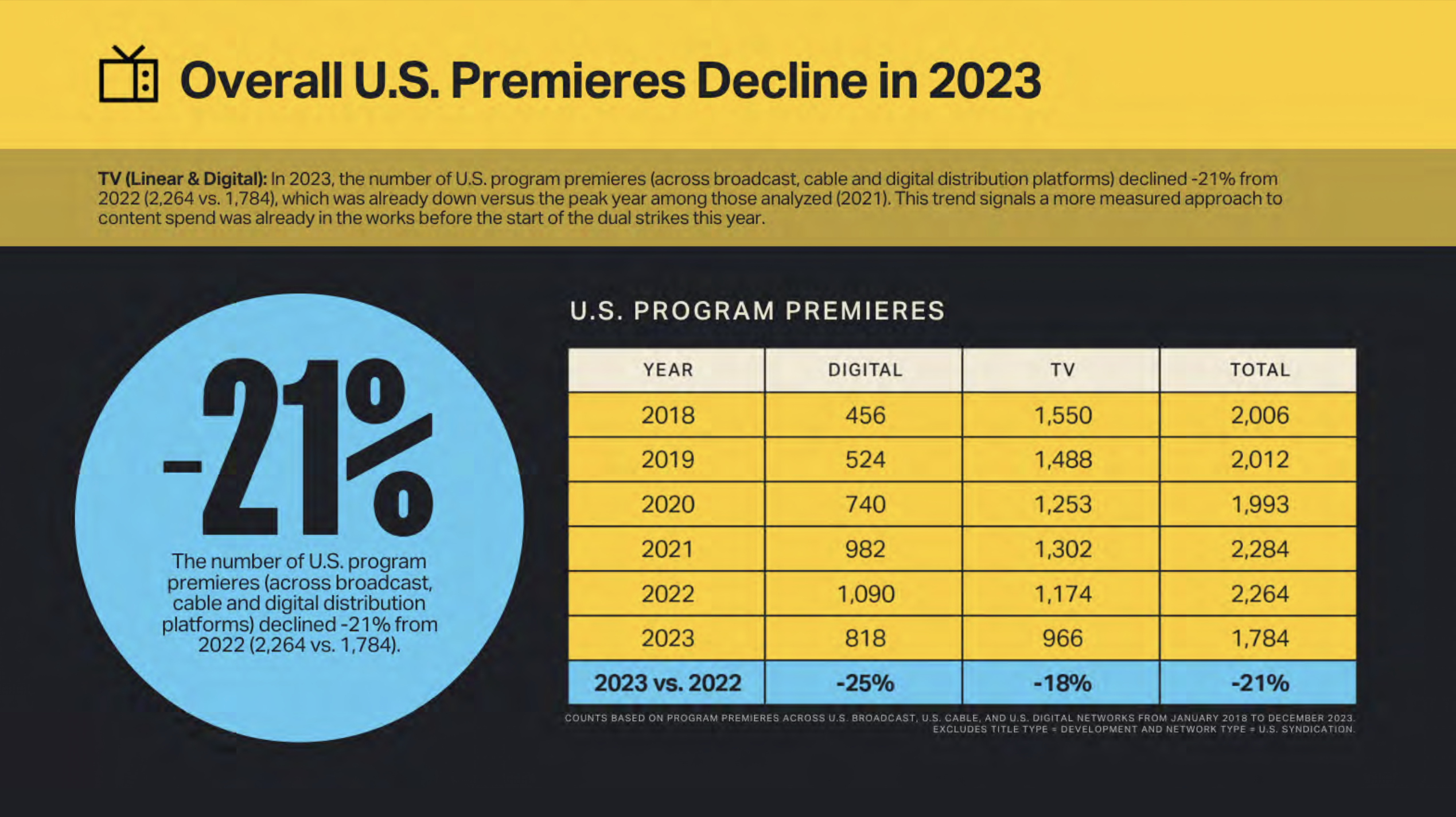
| Anatomy of a burst bubble: TV series premieres dropped 21 percent year-over-year in 2023, per Luminate’s year-end report. The strikes played a role, but the numbers were declining pre-strikes and peaked in 2021 at 2,284 U.S. premieres. |
|
|
Have a great week,
Matt
Got a question, comment, complaint, or a Sundance rec that won’t make me suicidal? Email me at Matt@puck.news or call/text me at 310-804-3198. |
|
|
|
| FOUR STORIES WE’RE TALKING ABOUT |
 |
| DeSantis Fugue State |
| Is the former wunderkind candidate experiencing political delusions? |
| TARA PALMERI |
|
 |
|
 |
|
 |
| The CNN Manifesto |
| A close look at Mark Thompson’s mission statement for the network. |
| DYLAN BYERS |
|
|
|
|
|
 |
|
|
|
Need help? Review our FAQs
page or contact
us for assistance. For brand partnerships, email ads@puck.news.
|
|
You received this email because you signed up to receive emails from Puck, or as part of your Puck account associated with . To stop receiving this newsletter and/or manage all your email preferences, click here.
|
|
Puck is published by Heat Media LLC. 227 W 17th St New York, NY 10011.
|
|
|
|