 |
| Welcome back to What I’m Hearing, and thanks to Puck sponsor Hermes for inviting me to Friday’s very fashionable kickoff of its On the Wings of Hermes exhibition in Santa Monica.
Programming note: It was a special four-episode week on The Town: Lucas Shaw and I asked whether Jen Salke is safe at Amazon Studios, Evan Goldberg explained how to get R-rated comedies made, Jonathan Handel parsed Day 1 of the actors strike, and SAG-AFTRA’s Duncan Crabtree-Ireland revealed how talks broke down. Subscribe here and here.
And if you’re still not a Puck member, click here.
Discussed in this issue: François Pinault, Dwayne Johnson, Barry Diller, David Zaslav, Margot Robbie, Ike Perlmutter, Cheryl Hines, Carol Lombardini, Al Pacino, Ted Sarandos, Ben Platt, Ari Emanuel, Tom Cruise, Michael Sugar, and Bob Iger’s second superyacht.
But first… |
| Who Won the Week: Fran Drescher |
|
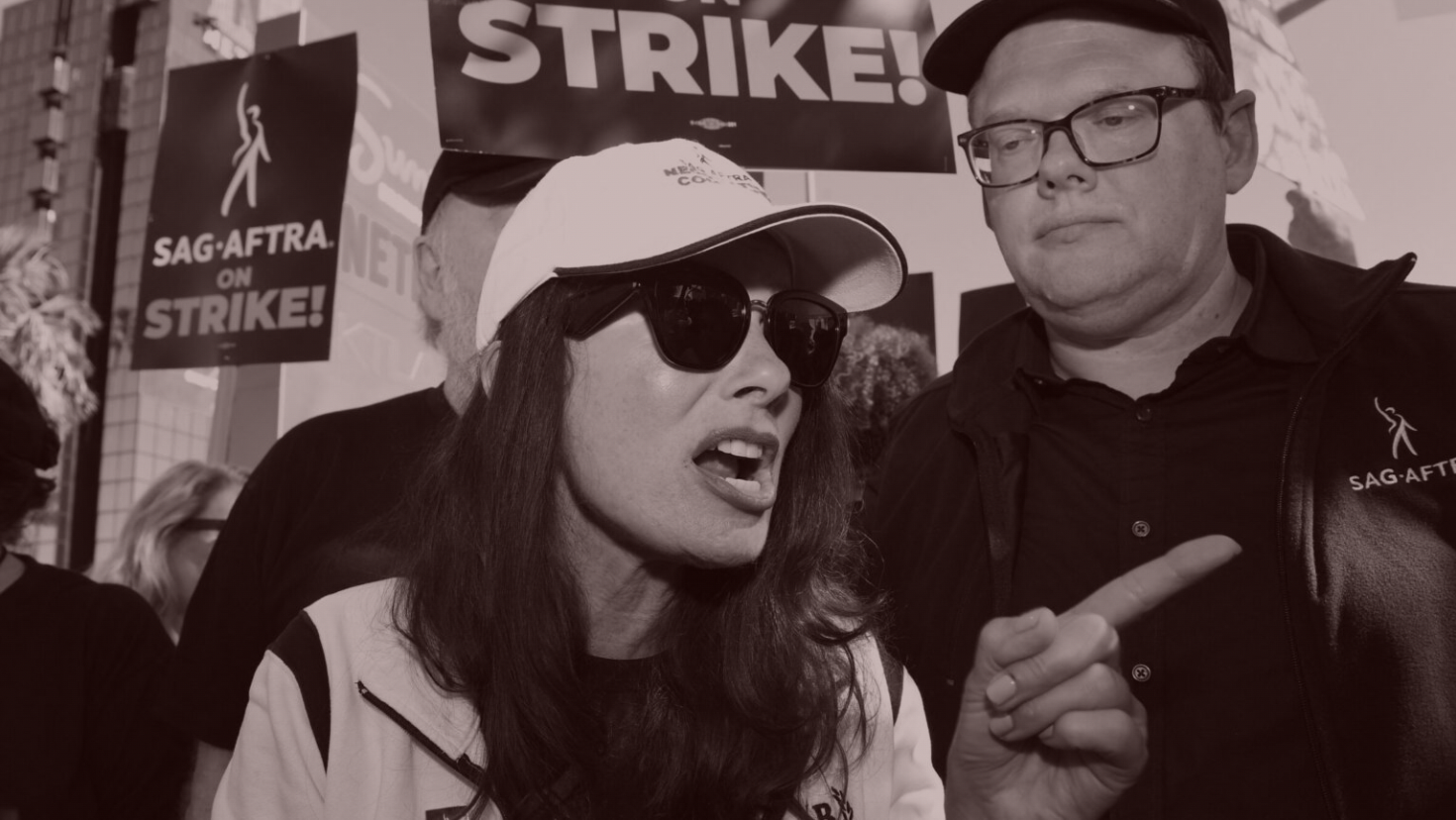
| Gotta be her, right? It’s early days of the strike (see my take below), but the SAG-AFTRA president galvanized her members and turned herself into a folk hero for organized labor with Thursday’s impassioned speech, generating headlines worldwide and a front-page Times story.
Runner up: Casey Bloys. Remember the Emmy nominations happened this week? Bloys’ HBO/Max blew Netflix away and became only the third outlet (CBS in 1973, NBC in 1992) to score four drama series nominees. Hopefully this will help us all forget The Idol.
Second runner up: All the corporate communications advisors who convinced their media C.E.O.s not to do CNBC interviews at Sun Valley. |
|
|
| Puck’s excellent new fashion writer Lauren Sherman provided a good background piece this week on Francios-Henri Pinault and the challenge that his luxury conglomerate, Kering, faces in “regaining its foothold on the zeitgeist.” (Sign up for her private email, Line Sheet, here.) As I first broke in May, and followed up Thursday, Pinault acquiring CAA, the premier pure-play Hollywood talent agency, would be a great way for him to do just that.
But at a valuation of more than $7 billion!? That’s what TPG thinks CAA is worth, and I’m very curious how they settled on it. In 2014, when the private equity firm increased its stake in CAA to 53 percent, the deal valued the agency at $1.1 billion. Bryan Lourd and crew have grown the Death Star significantly since then, and last year they added rival ICM Partners and its five clients that matter, in a $750 million deal. But amid a wobbly entertainment industry and the end of TV packages, did CAA grow its value by seven times in a decade?
As a privately held company, CAA doesn’t publicly disclose revenue numbers. But Endeavor, which owns the CAA rival WME, is publicly traded and has a market cap of about $11 billion for the whole parent company as of Friday, when the stock popped on the CAA news. And Wall Street values Endeavor, a smorgasbord of assets, mostly on the strength of the UFC, as well as other non-representation businesses. Endeavor C.E.O. Ari Emanuel plans to combine UFC with WWE, which he agreed to buy in April, and spin them into a new company, TKO, which Endeavor would control. That would leave WME and the other assets in Endeavor without their cash cow MMA league, though Endeavor would still benefit from TKO’s success.
My point: The higher the valuation for CAA, likely the better for WME—and Endeavor. Ari likes to say that his hated CAA rivals were given a Tiffany brand and “they made it Walmart”—which is a good line, even if it’s not really true. But perhaps nobody wants that hefty CAA valuation more than Ari, himself. (Usual disclosures: TPG is an investor in Puck; WME represents Puck but not me personally.) |
|
|
| “The one idea I had is to say, as a good faith measure, both the executives and the most-paid actors should take a 25 percent pay cut to try and narrow the difference between those who get highly paid and those that don’t.” –Barry Diller, the IAC founder and frequent Hollywood bomb-dropper, on Face the Nation this morning.
A little more on this…
No offense to Barry, but he never would have agreed to this when he actually mattered in Hollywood, and actors (and their agents) would never give studios a windfall that definitely would not be shared with their fellow actors. I do think that a smart move right now would be for the studio and streamer C.E.O.s to forgo or defer their part or all of their salaries during this strike.
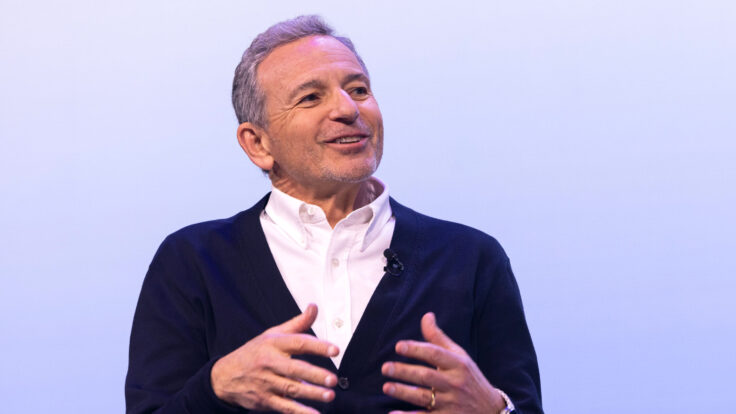
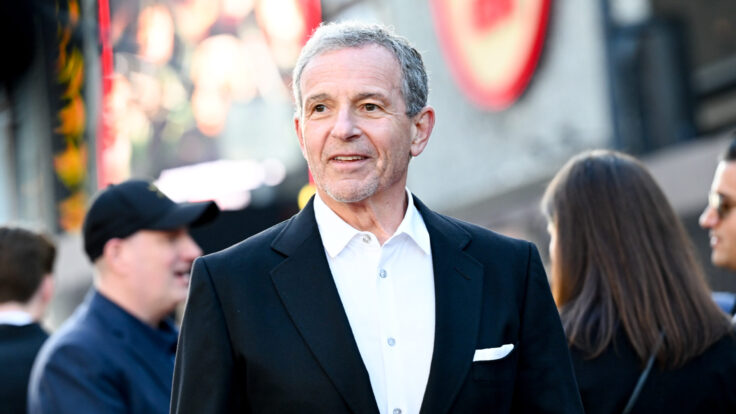
Imagine if Disney’s Bob Iger quietly stopped taking his base pay and bonus. Don’t announce it, just do it, and reveal it only in an S.E.C. filing, where the media will eventually find it. If they ask, just say he’s sensitive to the hardships endured by his out-of-work creative partners. A big gesture, and Iger doesn’t need the $5 million or so (he can keep the stock grants and contingent compensation that makes up the bulk of his pay).
I know, it’ll never happen, but the first C.E.O. to do so would win huge points industry-wide. And given how Iger has been beaten up in the press lately, he seems the most likely to recognize the value in the sacrifice.
Now to some burning questions of week one of this historic dual strike… |
|
|
| We’re answering some of the most urgent questions from readers about the various strikes locking down Hollywood into a previously unfathomable situation, one unseen in modern times. We’ll probably revisit this format as the strike drags on (no, we don’t know when it will end), so feel free to hit us up with questions you can’t get answered elsewhere. Herewith… |
|
|
| Good for Fran Drescher, I loved her on The Nanny and she’s earned her reputation as a fighter. But has anyone actually analyzed the substance of her speech? She goes on and on about how the C.E.O.s get “hundreds of millions of dollars” without mentioning that big-name actors and other creators have been the primary beneficiaries of the content bubble of the past decade?
We heard this sentiment a lot this week, even from agents and lawyers that represent the striking talent. The reps know it’s true that a lot of upper-tier, and even mid-tier, talent got very rich off the Netflix revolution that Drescher was complaining about. And for many, they got way richer than they would have under the pre-streaming model, because Netflix and the others paid upfront premiums to talent regardless of success. No backends, and thus no “home runs”—like, say, The Nanny—but also no nail-biting about whether a show or film would perform, and no need to audit or even sue to get the money owed by a studio. Now that the bubble has burst and talent has realized their backends are often nonexistent, nobody’s volunteering to give those upfront premiums back.
Consider Dwayne Johnson. (We do… more than we’d like to admit.) According to several sources, he’s getting more than $50 million guaranteed to make Red One, a Santa Claus movie with Chris Evans that Amazon hopes to release around the holidays next year as a quasi-commercial for Prime. These sources say that the movie is way over budget and sort of off the rails (add this to Jen Salke’s headaches at Amazon), but Johnson is getting his fee anyway. That kind of guaranteed money wouldn’t have happened in the old system.
But remember, those outsized star salaries are negotiated by agents (in Johnson’s case, WME), aided by lawyers and managers, and they are outside the union’s control or purview. They exist, of course, and should be part of the discourse about fair pay, but it’s scarcely realistic to expect Drescher to alienate her high-profile members at the outset of a strike.
Entertainment and sports are the only sectors of the U.S. economy that feature both unions and agents, collective bargaining agreements and individual deals, and scale wages and princely sums. It is awkward. A scale player on a six-week movie would make around $25,000 for the gig, while a star in the same scenes could make $25 million. Other unions—nurses, auto workers, even I.A.T.S.E.—have nowhere near this disparity. In fact, the somewhat analogous concept of merit pay for unionized teachers is often controversial even though the pay scale for “star” educators under such frameworks is typically only 10 percent higher than what the rank and file earn—a far cry from the 1000x ratio between a star actor and a journeyperson.
Drescher and SAG-AFTRA have done a good job positioning this strike as being about the middle-class and working class actor, with maybe a few issues that apply to the upper-middle class. Stars don’t depend on the union for pay, or even for protection against A.I. But the union depends on the stars: the solidarity and support of “high pros” (high-profile actors) is a key tool for attracting press coverage and garnering public support.
So much has been written about TV disruption, but how long until studios start delaying movie releases?
We’re told Monday will be a big day on movie studio lots as release schedules are discussed. For finished films, the question is how much will the lack of star promotion hurt the opening? For instance, Warners thinks the megashark is the star of The Meg 2 (sorry, Jason Statham), but execs did consider pushing August’s Blue Beetle to next year, ultimately deciding not to do so. A Sony rep similarly says it is keeping Equalizer 3 in September, even if Denzel isn’t available to promote. We’ll see what happens to the festival movies; Zendaya is a great actress, but she’s making $10 million for the adult dramedy Challengers in part because she can generate tons of attention on red carpets and social media. I’ve heard director Luca Guadagnino has suggested pushing the film, but Amazon has made no decision. (It declined to comment.)
The bigger problem for the film studios is the stuff that’s not finished. For instance, Disney has Deadpool 3 dated for May 3, but director Shawn Levy is nowhere near done shooting, so if the strike lasts more than about a month, Disney will be left without its traditional Marvel movie to kick off summer. Some other tentpole will swoop in on that date, and we could soon see the entire Summer 2024 reshuffle and lose some big titles, which would hurt theaters as well as studios. Not great when box office is still rebounding.
If truly independent productions are allowed to continue, and stars can promote them on festival red carpets, doesn’t this give the indie film business a big boost over the studios, especially this fall and awards season?
It sure seems that way…with caveats. As SAG-AFTRA’s Duncan Crabtree-Ireland explained to us on Thursday, the guild is granting “interim agreements” to indie productions—no financing or distribution by a struck company—if those shoots abide by the most recent guild proposal. We texted with a producer this afternoon who had just sent a letter that promises he will sign the interim agreement when it’s ready, and that will allow him to finish shooting his movie. This guy’s cast is on board, but there’s a risk, of course, that some actors won’t want to work, given the strike. Let’s see if that happens. And hey, if Deadpool 3 gives up that May release date, maybe a smartly-positioned indie can take the spot and make a fortune. (Good luck.)
As for promotion, the signatories would be allowed to bring stars to a junket or a festival—and, given the lack of stars promoting studio movies, I’m guessing these movies will get outsized attention—but festivals could be tricky because many of them are backed by studios. Toronto, Venice, and Telluride are trying to figure this out right now because all enjoy some level of support from struck companies. “It’s a disaster,” the producer texted. “No one has any idea what can happen, so I think at this point I would be surprised if the cast will support.”
With the actors and writers out, should the Directors Guild regret making their deal? Now they can’t work anyway.
That’s for them to decide. Remember, 87 percent voted for the deal, with a higher-than-usual (41 percent) turnout. The mathematically agile might notice that these totals mean more members failed to vote for the deal than voted for it, but that tells us nothing. Some non-voters might have been disheartened; others too indifferent to bother; and others no doubt thought the deal would pass (as most do) and wanted that.
The DGA deal is solid but not without flaws: directors achieved a significantly improved foreign streaming residual that will probably be acceptable to the actors and writers; a 5 percent first-year increase in minimums that might pass muster with the writers (who want 6 percent) but enrages the actors (who want 11 percent as an inflation catchup); somewhat muddy language on A.I. that won’t work for the other two unions; and didn’t even try for a streaming residuals success bonus, which is something that both of its sister guilds are demanding. With all that in play, some DGA members who voted against the deal do wish the current dual-guild strike were a trifecta. Possibly related to this—or perhaps not—we’re told that DGA associate national executive director Danny Bush, a key lieutenant to its leader, Russ Hollander, departed the guild this weekend; it’s unclear why and the DGA declined to comment beyond confirming the exit.
If the actors or writers get better terms than the DGA, will the better terms automatically apply to the directors?
No. Pattern bargaining applies to certain terms (such as residuals formulas and sometimes basic wage increases across the unions), but it’s not a rule or contractual guarantee. The DGA Memorandum of Agreement—the document that expresses this year’s deal—includes no cross-guild guarantees, or even any provision that would reopen DGA negotiations. So if SAG-AFTRA or the WGA gets something the directors didn’t, the DGA would probably have to wait until 2026 to level up the issue.
A lot of primetime TV is now game shows starring big-name SAG-AFTRA members like Will Arnett and Elizabeth Banks. Will actors host these shows for networks this fall?
Probably yes. Those shows (hosts, at least) are covered by a different SAG-AFTRA contract called the Netcode. That deal doesn’t expire until next year. Remember, technically the networks aren’t struck, only the production-side entities, which are sometimes co-owned. If the stars refuse to perform their hosting duties, they’ll be in breach of contract.
What will spark the beginning of the end of the strikes?
The 2007-08 WGA strike ended, in part, when the Oscars loomed in March. We’re beginning to fear that may end up being the driver for an end to the current walkouts, too. Unless someone steps up earlier to bridge the divide and restart talks, it could get that bad.
More: Jonathan is moderating a panel of entertainment mediators on July 28 at 10 a.m. PT called “Mediating the Strike(s): Can Neutrals Help Resolve Hollywood's Labor Strife?” Free Zoom signup details will be posted on the Beverly Hills Bar Association website here. |
|
|
| So much for that Tom Cruise Top Gun halo. Mission: Impossible 7’s $56.2 million for the 3-day weekend is seventh among summer movies, and down from the previous installment. Its $80 million for the 5-day, and $235 million globally, is fine, but short of expectations (including mine, dammit!). I still think Dead Reckoning Part One will beat 2018’s Fallout ($791.6 worldwide) but $1 billion is now—say it with me—impossible. [WSJ]
Irony alert: Noted Scientologist Cruise likely lost U.S. paying customers to the crazy success of Sound of Freedom, which is aimed at another mysterious cult, QAnon. [Forbes]
My Puck colleague Dylan Byers parses Bob Iger’s upcoming TV “fire sale.” Disney’s networks are about to become newspapers: No-growth businesses that will be starved of resources and milked for profit by some vampire private equity firm. [Puck]
Lucas Shaw asks a scary and related question: If a diversified company like Disney is bailing on its cable networks, what does that mean for Paramount Global and Warner Bros. Discovery? [Bloomberg]
Still more Disney: Bill Cohan suggests Comcast as the right strategic partner for ESPN. [Puck]
At least Iger is consoling himself with a second yacht that “is expected to be 30 feet longer than Iger’s first superyacht, the 180-foot Aquarius.” [WSJ]
The Orange is the New Black cast complaining publicly about their compensation pretty much sums up how Hollywood has turned on the Netflix model. [New Yorker]
Margot Robbie and a bunch of other celebs have switched their stylists lately. Why? [Puck]
Manager/producer Michael Sugar argues that blue-chip brands should be pouring money into Hollywood and producing their own films and TV shows. These days the “pouring money” part sounds good. [Fast Company]
Maureen Dowd remembers the prescient 2002 Al Pacino movie Simone, in which an uppity actress is replaced by A.I… with disastrous results. [NY Times]
42 West publicists for Ben Platt, son of producer Marc Platt, became this week’s Streisand Award winners, bringing more attention to his Nepo Baby status by objecting to a reporter’s question about his Nepo Baby status. [Rolling Stone] |
|
|
| Between the strike and Bob Iger re-upping, what a week for people with opinions about industry news. Apologies to everyone whose emails, texts, and DMs I didn’t get to…
“So now what, Mrs. Lincoln?” –A lawyer
“It seems like the inequality of SAG income distribution should be a bigger issue than what studio C.E.O.s are making, and in dollar terms it presents a bigger opportunity to improve the livelihoods of most actors. If the A-listers are publicly supporting the strike and its goals, how do they justify making tens of millions per project while their colleagues struggle to get by?” –Another lawyer
“Iger has become the greatest and most problematic manifestation of this business. When I started, 25 years ago, everyone running everything was under 50—that’s inclusive of agencies, management companies, studios, etc. Those in power from that era got completely consumed and never left, and literally NO ONE has been groomed. My era has produced two studio presidents—Nicole Brown and Jesse Ehrman. Succession is the biggest issue across ALL parts of this business, and there’s probably a potential coup around the corner.” –A manager
“Thank you for calling B.S. on that Deadline story—as I told people as soon as I saw it, it never would have made it past the editors at any legitimate publication.” –Another lawyer
“I’m no big exec like that Deadline nincompoop claimed to be, but as a member of an I.A.T.S.E. household who sees a lot of long-range plans, I’m worried that 25 percent of people in media and entertainment will be moving to other fields by the end of 2024. That’s everyone: above the line, below the line, and corporate. Everyone is fucked; the strike is just pulling the pain forward.” –A below the line worker
“We’re in a new era if Bob Iger, of all people, is making unforced errors on CNBC. He really seems lost, like for the first time he doesn’t know how to help the company.” –A publicist
“Zenia [Mucha, Iger’s former communications chief] never would have let Bob do that interview.” –An executive
“While Salma [Hayek-Pinault] and Cheryl [Hines] are on strike, their husbands sure are busy! Spending $7B on CAA and spreading racist Covid misinfo, don’t expect either one on the picket line this week!” –A manager |
|
|
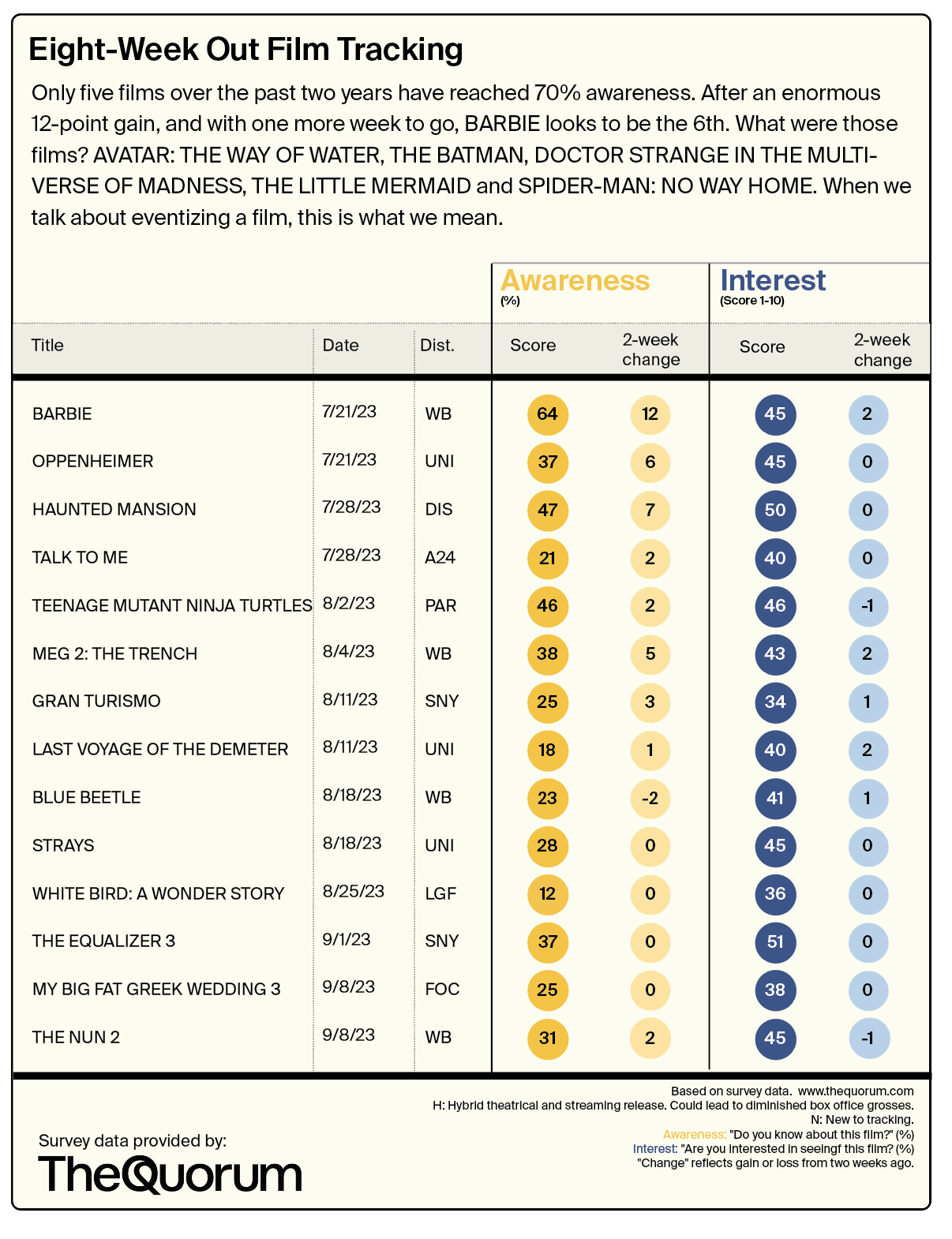
| We knew Barbie was spiking, but how much it’s spiking surprised me in this week’s film tracking chart from The Quorum… |
|
|
| Finally finally… some fun stuff… |
|
| Recently-shitcanned Marvel chairman Ike Perlmutter showed up at Donald Trump’s Turning Point rally on Saturday, days after Ike’s rep told CNBC that he plans a “meaningful” contribution to Trump 2024. Per my Puck colleague Tina Nguyen, Trump even shouted out Ike from the podium as a “guy who doesn’t like woke Disney.” … Speaking of politics, the Hollywood donor crowd seems to like Elissa Slotkin, the congresswoman who is running for U.S. Senate in Michigan. Filmmaker Paul Feig, showrunners Greg Daniels and Matt Selman, and writer Chris Roessner all popped up on campaign disclosure forms in recent months, which is amusing because Slotkin’s primary opponent is Hill Harper, an actor from The Good Doctor. … Ted Sarandos was spotted at Holly Robinson Peete and Rodney Peete’s star-studded gala to fight autism and Parkinson’s on Saturday, proving actor-driven charity events are still kosher for struck company C.E.O.s. (Naomi Campbell received an award named after Jacqueline Avant, Sarandos’ late mother in law).
See or hear fun stuff around town? Email me at Matt@puck.news. |
|
|
| Have a great week,
Matt
Got a question, comment, complaint, or an amazing Fran Drescher Nanny impression? Email me at Matt@puck.news or call/text me at 310-804-3198. |
|
|
|
| FOUR STORIES WE’RE TALKING ABOUT |
|
|
|
|
|
 |
|
|
| Need help? Review our FAQs
page or contact
us for assistance. For brand partnerships, email ads@puck.news. |
| You received this email because you signed up to receive emails from Puck, or as part of your Puck account associated with . To stop receiving this newsletter and/or manage all your email preferences, click here. |
| Puck is published by Heat Media LLC. 227 W 17th St New York, NY 10011. |
|
|
|