Welcome back to What I’m Hearing, and a joyous NFL kickoff to everyone in media whose businesses
are now totally and hopelessly dependent on that audience. I’m in Toronto this weekend for TIFF, and then NYC for a few days. Say hello and share some fantasy football tips (I’m terrible) if you see me.
🚨🚨 A contest!: It’s been seven full days since the revelation that David Zaslav and Jim Dolan are digitally face-swapped onto munchkins in the A.I.-powered Wizard of Oz, and nobody has posted a single screengrab or even claimed publicly
to have spotted the diminutive duo at the Sphere. So… I’m now offering a status-defining Puck hat or tote bag to the first person to email me a pic of the offending scene. Get to work!
Reminder: We’re launching a new segment on publicists, so email your news tips to SpinDoctors@puck.news.
Tonight, the stink of Rotten Tomatoes wafts over awards season, plus the economics of the
talent business that led to a major defection, The Rock hard-launches a dubious rebrand, a major agency poach, the new power structure at Prime Video, and the person who dared say no to Spielberg…
Discussed in this issue: Phil Sun, Dwayne “The Rock” Johnson, Noah Baumbach, David Ellison, Adam Sandler, Jay Marine, Ari Emanuel,
Michael B. Jordan, Dawn Olmstead, Jimmy Horowitz, Pete Hammond, Brendan Fraser, Jeremy Allen White, Steven Spielberg, Albert Cheng, Bryan Lourd, Laurene Powell Jobs, Greta Gerwig, Charles King, John Malone, Jeremy Barber, and… the worst awards
pundits.
Still not a Puck member? Just click here. Got a news tip or an idea for me? Just reply to this email, text or message me on Signal at 310-804-3198.
Before we start, I was off on Monday so let’s do a little catch-up…
Quote of the Week
(Delayed)
“A lot of times, it’s harder for us—or at least for me—sometimes to know what you’re capable of when you’ve
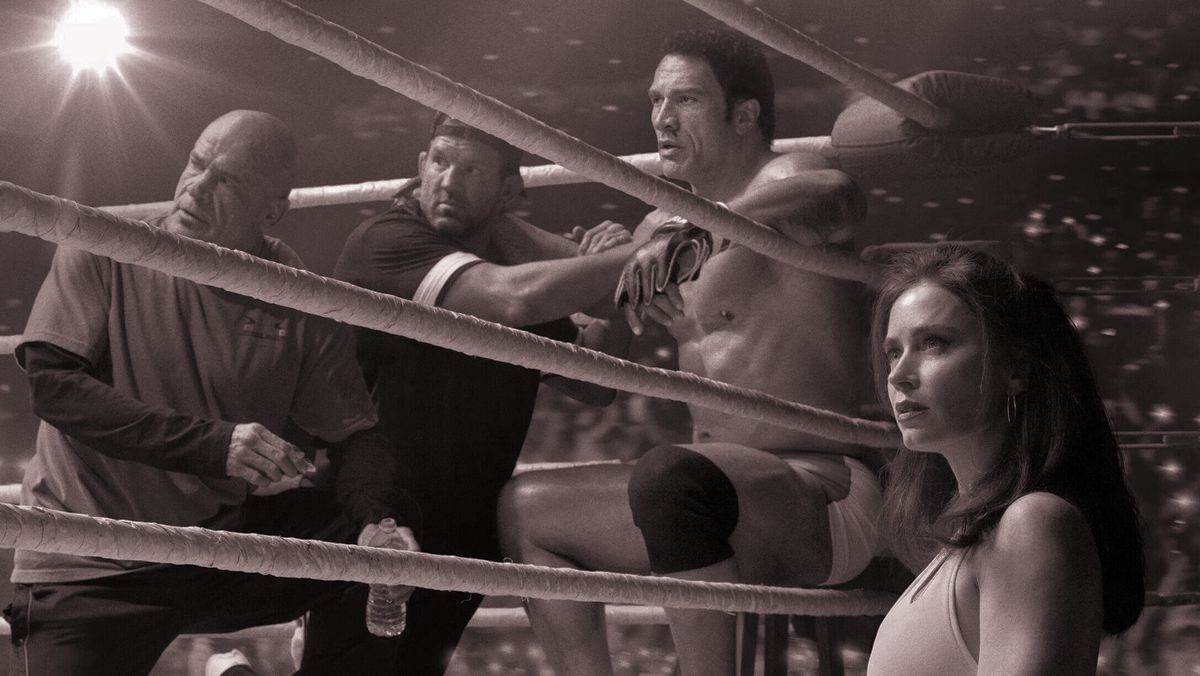
been pigeonholed.” —Dwayne “The Rock” Johnson, tearfully working to reinvent his image at the Venice premiere of The Smashing Machine, painting himself as a victim of Hollywood stereotyping rather than the calculating career architect that everyone knows he is.
A little more on this…:
Seriously, could you smell what The Rock was cooking at Venice? Amazing stuff. This is the same guy who empowered Ari Emanuel to get him extraordinary paydays on literally dozens of full-freight studio extravaganzas, regardless of filmmaker or quality. Since 2010, he’s reeled off an all-time run, including Jungle Cruise, G.I. Joe: Retaliation, Rampage, Red Notice, San Andreas, Journey 2, Tooth Fairy,
Central Intelligence, two Jumanjis, multiple Fast & Furiouses, and, most recently, Red One. This is the guy who tried to leverage Black Adam into taking over the entire DC Comics franchise. No shame—it’s show business. But now we’re told to forget all that? He’s a slimmed-down A24 artiste (in glasses!) who has finally “overcome” the scourge of Hollywood stereotyping?? It’s gonna be a looooong awards
season…
Still more…: This is basically the same playbook that A24 ran successfully with Brendan Fraser and The Whale, which also launched with tears at Venice. Johnson has worked with more voters than Fraser had, but Fraser had done prestige work in Gods and Monsters and Crash. And remember, A24 came up short with a similar he’s-an-actor-now campaign for Adam Sandler in Uncut Gems. Let’s see if the
Netflix machine can push Sandler to a nomination for Jay Kelly; they cajoled him into a tux at Venice, though it was probably a miss to let him on the carpet without glasses. Regardless, the Academy is likely thrilled to have two legit movie stars (plus Leo? And Michael B.? And Timmy?) in the Oscar race.
Even more…: Can Johnson stop Disney from Norbit-ing him with the live-action Moana? The remake is
set for next summer, so a trailer will likely appear in front of Avatar: Fire and Ash in the heart of awards season. Maybe Johnson can delay it until January 16, the end of Oscar voting, though if I were running the Disney awards campaigns, I’d deploy it strategically to remind everyone that Johnson has been a paycheck actor in dreck for 20 years, thus boosting Jeremy Allen White in the Springsteen movie.
Thursday Thoughts…
Bryan Lourd is good at poaching, auteur edition: I broke the news last night that Noah Baumbach fired UTA after two decades and went to CAA. Not totally surprising—Bryan Lourd has been after Baumbach for years now, and the ultimate prize is likely Baumbach’s partner in life and sometimes work, Greta Gerwig, though I’m told
she’s staying at UTA. But man, Jeremy Barber, Baumbach’s agent since The Squid and the Whale back in 2005, was standing by his side this week at both the Venice and Telluride premieres of Jay Kelly (which, amazingly, features a subplot about a longtime rep getting fired). I get that Baumbach wants to be a bigger player in TV. But CAA should at least reimburse Barber for his recent travel expenses, right?
A MESSAGE FROM OUR SPONSOR
STAR POWER High achievement. Higher adrenaline. With a twin-turbocharged V8, the Range Rover Sport delivers
heart-pounding intensity on every drive. EXPLORE
Speaking
of reps…: The promise of a major management company focused primarily on diverse talent took a big hit this week when Phil Sun, the former WME agent who triumphantly launched M88 in 2020 with star client Michael B. Jordan and broad proclamations about changing Hollywood, abruptly bailed on the company to go solo. The exit comes as Charles King’s Macro, the production and finance outfit that owns M88, has been under increasing pressure from
investors including BlackRock Alternatives, Laurene Powell Jobs’s Emerson Collective, several foundations, and funds managed by Goldman Sachs, I’m told. King has raised about $250 million in equity and debt financing since launching Macro in 2015 as a hub for underrepresented voices. And while it has produced films like the recent hit One of Them Days, and shows like Freaky Tales and Government Cheese, it’s kinda in that no-man’s land of not having
scale as a producer and not being especially small and nimble, either. The relationship with BlackRock, in particular, has become strained, according to one source familiar with the dealings. (King didn’t respond to my request to chat.)
Macro’s management unit, which in 2020 lured Sun and his clients, including Jordan, Gemma Chan, and Simu Liu, had grown to dozens of employees in Macro’s splashy offices on Sunset. But representation businesses are
challenged all over town amid the content pullback. (See, for example, Anonymous Content, another Jobs-backed management firm, which just cut 15 percent of staff and still doesn’t have a C.E.O. more than two years after Dawn Olmstead left.) And the overall climate is much different than in 2020, when studios and streamers were aggressively pledging to meet quotas for people of color in front of and behind the cameras.
Sun’s exit is sort of the nightmare scenario for all
these management companies backed by outside investment. Ultimately, the assets can walk out the door, and even the biggest stars tend to be more loyal to managers that go independent than, say, a WME client following an agent to a solo or smaller agency. Amid tough conversations about his spending and the company’s finances, Sun figured he could just take M.B.J. and other clients and operate without the overhead. Sucks for everyone at M88 that bought into his vision, but Hollywood in 2025 is
very different than in 2020. (Sun, who usually enjoys talking to the media, went silent today and had Jordan’s publicist call me with a decline to comment.)
Spielberg wanted to direct ‘Call of Duty’: Paramount is finally confirming what I reported last week: A Call of Duty movie is in the works via a new deal with Activision. But no talent is attached yet, which is very different from the Universal pitch for the project. Per three sources,
Steven Spielberg really wanted to direct the CoD movie, and his Amblin teamed with Universal dealmaker Jimmy Horowitz to present the filmmaker’s vision for one of the world’s biggest gaming franchises. (Spielberg is famously a big gamer and loves CoD in particular.) But with Spielberg comes the famous Spielberg Deal, which includes top-of-market economics, final cut, and full control over production and marketing. That spooked the team from
Activision, now owned by Microsoft, which instead went with David Ellison’s pitch that offered much more control over the process. Given the constraints, let’s see who Paramount gets to direct that movie…
Speaking of Ellison…: There’s really only one takeaway from John Malone’s recent comment that he’d met with Ellison in Sun Valley to “talk about further consolidation in the media industry”: David wants Warner Bros. We kinda already knew that from Kim Masters’ reporting, and WBD continues to operate like a company that would very much like to be acquired, but since Malone holds outsize sway over Warner
Discovery and C.E.O. David Zaslav, he’s probably not dropping that tidbit in the Times without hoping a deal with Paramount materializes.
Another aboard the Amazon exec merry-go-round: Last week’s elevation of sports and ads exec Jay Marine to run all of the U.S. business of Prime Video (and the accompanying banishment—sorry, reassignment—of Albert Cheng to the A.I. wilderness)
resurfaced the years-old question at Amazon: Who’s actually picking the shows? Marine has a big voice now, though it’s unlikely the sports guy will be reading scripts (though putting him in the greenlight room is indicative of the importance to Amazon of sports and big events, as well as power grabs amid the “flattening” of management). More likely, studio head Vernon Sanders will get buy-in from international exec Kelly Day, and now Marine (in for
Cheng), and then they go for greenlight approval from Mike Hopkins, the head of the overall unit, who wasn’t considered a particularly creative-focused executive until he assumed the top creative job for himself when Jen Salke was ousted last year. Rumors of Hopkins bringing in a Salke replacement seem to be false, and Hopkins’s recent lunch with HBO’s Casey Bloys doesn’t seem to be much more than a social meeting.
Box office over/under: Warners/New Line’s The Conjuring: Last Rites is tracking to about $50 million domestic. (NRG has it at $49 million but others are in the mid $50s.) I’ll take the over, based on unaided awareness being higher than Final Destination: Bloodlines, which opened to $51 million.
Now to my rant about everyone’s least favorite website…
At a time when everyone is suspicious of Hollywood, the industry’s
biggest arbiter of quality has become rigged, providing the assessment that Hollywood wants rather than the critical feedback that it needs.
Shh, don’t tell anyone, but none of the movies that just premiered at Venice or Telluride really
killed it. Not in the way that films in past years have announced themselves as the clear contenders to beat at the Oscars. Not if you’re reading the tea leaves closely and parsing the polite puffery or talking to the very few awards season veterans who have no material interest in the reactions to, or the best picture trajectories of, the films in question.
All this despite a steady cacophony of public praise coming out of the two highest-profile awards season launch pads. Indeed, if you
looked at the initial reviews and press reactions for movies like Noah Baumbach’s Jay Kelly or Chloe Zhao’s Hamnet or Benny Safdie’s The Smashing Machine, they’re downright euphoric. Historic, even! Rotten Tomatoes scores at, or near, 100 percent! Impressive stopwatch counts on premiere ovations!
But it’s all kinda become B.S. noise, a victim of the overall praise inflation that has terminally afflicted
late-stage Hollywood. Nobody believes the festival hype anymore because it’s all become just hype, and everyone seems to be in on the grift—from the media outlets seeking clicks to the journalists coveting access to the review aggregators chasing engagement. At the center of it all is Rotten Tomatoes, which is simultaneously the most influential arbiter of quality in the movie business and a misleading mess. How did that happen?
A Rotten
Game
At this point, most savvy moviegoers kinda know Rotten Tomatoes has been diluted and corrupted to the verge
of incoherence. Owned since 2016 by Universal and Warner Bros., the site and its binary grading system—reviews are categorized as either a tomato or a splatter, with no room for nuance—have always infuriated filmmakers and disserved users. But lately, studios have become even more aggressive in gaming the scores, both by strategically embargoing reactions and formal reviews, and doing their best to empower the writers whose opinions tend to serve their interests. (It’s always hilarious
to see the effusive praise of a mediocre movie from people invited to a splashy premiere dutifully aggregated by the media, followed the next day by a steaming crap sandwich from actual critics whom the studio doesn’t control—often at those same media outlets.)
It helps that the “Certified Fresh” rating is often generated by only a handful of reviews at echo chambers of enthusiasm like Sundance or Venice. Social media aggregator accounts with large followings then pick up the early high
scores as gospel, creating a false narrative of extreme quality. Recently, The Smashing Machine went viral with a “debut” score of 100 percent Fresh out of Venice, but it was quickly knocked down to 84 percent and falling, even before most of the mainstream critics have had a crack at it. That’s a strategy, not an accident.
A MESSAGE FROM OUR SPONSOR
STAR POWER High achievement. Higher adrenaline. With a twin-turbocharged V8, the Range Rover Sport delivers
heart-pounding intensity on every drive. EXPLORE
Perhaps most egregious, the site now aggregates the actual critics alongside dozens of random awards
pundits, fan accounts, and Substackers with opaque credentials or agendas, minimizing the influence of career writers who bring experience, transparency, and oversight from editors. Some argue this is an overdue democratization of the critical elites, which until recently were largely white and male and dismissive of the kind of popcorn fare that average audiences prefer. I get that. The reality is that the professional critic is a dying breed—many once-influential outlets, like The Chicago
Tribune and Vanity Fair, recently eliminated their critic positions precisely because opinion has become ubiquitous online. But the result is pretty obvious: Rotten Tomatoes has become a steaming tar pit of random takes, agenda-driven awards punditry, and press junket fluff, largely indistinguishable from the social media morass it purports to float above.
Plus, the whole thing is vulnerable to outright fraud. Studios can complain and get ratings switched if a lukewarm
review is deemed inappropriately negative. Two years ago, New Yorkreported on the P.R. firms that recruited little-known “critics” and paid them to write or change reviews that boosted RT scores. One film was elevated from Rotten (46 percent) to Fresh (62 percent) after the manipulation. It’s all very gross.
And yet… Rotten Tomatoes somehow remains the
industry standard for judging the quality of movies. It’s kinda nuts. No individual critic matters anymore, only the “Certified Fresh” score, which studios splay across TV and digital ads like a stamp of widespread approval. Kevin Goetz, the test-screening guru, now forecasts RT scores for upcoming movies—which makes sense because they can make or break a release plan. It’s a fake metric of quality that has become a real metric only because Hollywood collectively decided to buy
in. Like, say, the Golden Globes.
Grade
Inflation
That buy-in has led to pretty remarkable grade inflation that doesn’t get talked about enough. After
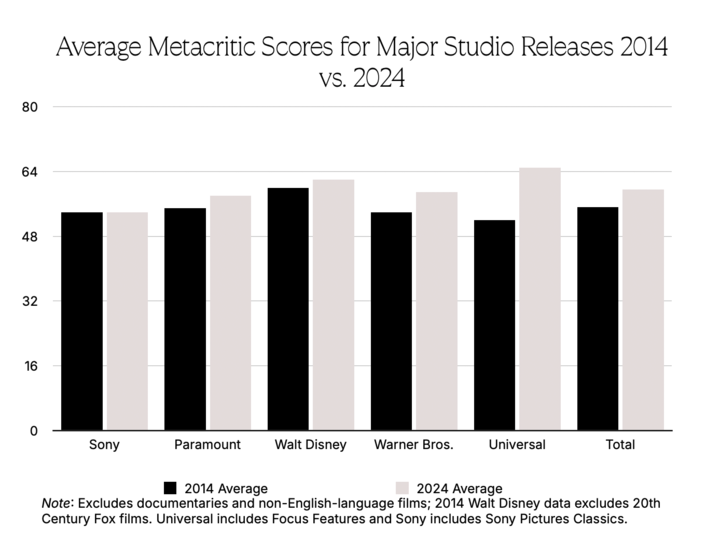
flinching at some of the recent Tomatometer scores, I asked Puck’s researcher, Maya Tribbitt, to aggregate all the studio-wide releases in both 2014 and 2024. Not surprisingly, the average RT score spiked about 13 percent over that period. Were the movies just better last year than a decade prior?
Doubtful. That argument might make sense for the audience score because studios now must clear a
higher populist bar to justify a theatrical release. But we’re talking about critics here, or what qualifies as critics these days. By comparison, look at the scores for the same set of movies on Metacritic, the rival aggregator site that assigns a numerical value to each review and thus provides a more nuanced aggregate score. The overall scores went up in that period too, but only by 5 percent.
So grade inflation is an overall problem, but it’s a bigger problem at Rotten Tomatoes. I’d argue the awards
industrial complex has a lot to do with it, especially this time of year. The rise of the awards journalist goes all the way back to the ’90s, when the first generation of bloggers appeared to chronicle the Oscars season—and, in many cases, to suck up to the campaigns. The trades and other media outlets that covered Hollywood realized they couldn’t really influence the critics, who often rained on the carefully orchestrated studio awards campaign parades, jeopardizing access to talent and
advertising budgets while providing a real service to readers. When I was running The Hollywood Reporter, our reader surveys consistently showed that our actual reviews by real critics—not the awards content—were valued most by awards voters.
But the publishers instead empowered the awards pundits, a new category of quasi-critics who would evaluate movies’ awards prospects rather than actually review them—which, of course, entailed judging the quality of the film, but from a less, uh, rigorous perspective. It was a semantic distinction, but an important (and lucrative) one that has led to big changes in the entertainment media landscape.
The real critics hated these awards people, but the studios loved them because they required access—to early screenings, to talent for their interviews, to parties for their coverage of the season—and could thus be influenced. Failing to toe the party line on a movie that the studio
had deemed a priority would result in ostracization. As an added bonus, these awards pundits were then invited to moderate Q&As with talent after screenings and at tribute events, services for which the pundits demanded their own fees.
Not everyone takes the fees, and there are some great journalists who cover Oscar season, but there’s an ickiness to the entire economy of the season. And at a certain point, the critics and the pundits started to blur—or at least they have at Rotten
Tomatoes. If you look at the list of critics, it’s a lot of writers for outlets like Awards Circuit or AwardsBuzz or Next Best Picture, many of whom are auditioning for access to talent via their reviews. Springsteen: Deliver Me From Nowhere is currently sitting at 100 percent Fresh from 13 reviews out of Telluride,
mostly from outlets dedicated to awards. Again, a strategy, not an accident.
Someone like Pete Hammond at Deadline can conduct dozens of softball Q&As with studio talent during film and TV awards seasons, then call himself a critic for the purpose of reviewing those same movies and shows. And Hammond is then aggregated by Rotten Tomatoes with the same weight as a critic at The New York Times. Everyone wins: The studios get the fawning reviews
and awards analysis they need to position their movies to voters, the pundits get paid, the outlets that employ them are rewarded with large advertising buys, and Rotten Tomatoes gets a steady stream of reviews to aggregate. The only ones who lose are the actual consumers of the media because they are served a constant diet of fluff and spin.
This culture of positivity isn’t particularly new, or unique to Hollywood. Kelefah Sanneh
lamented in this week’s New Yorker that critics in general have become too nice these days. Sanneh focused on the music world, but the economic incentives, and the fear of triggering stars or their fans online apply equally to film and TV critics.
It’s a bummer, but does any of this actually matter? Depends who you are. Hollywood
is nothing if not marketing and spin, so the stakes here are admittedly low for people who are savvy enough to see through the B.S. Personally, I go to Metacritic for at least a more accurate assessment of movies, and I’ve vowed to stop citing Rotten Tomatoes. Beyond that, the real issue is that the consumers lose. At a time when everyone is suspicious of the media and Hollywood, the industry’s biggest arbiter of quality is indeed rigged, providing the critical assessment that Hollywood wants
rather than the one it needs.
See you Monday, Matt
Maya Tribbitt contributed research for today’s issue.
Got
a question, comment, complaint, or Toronto restaurant recs? Email me atMatt@puck.news or call/text me at 310-804-3198.
You received this email because you signed up to receive emails from Puck, or as part of your Puck account associated with {{customer.email}}. To stop receiving this newsletter and/or manage all your email preferences, click here.
Puck is published by Heat Media LLC. 107 Greenwich St, New York, NY 10006
Didn't get an email? Check your spam folder and confirm the spelling of your email, and try again. If you continue to have trouble, reach out to fritz@puck.news.
Didn't get an email? Check your spam folder and confirm the spelling of your email, and try again. If you continue to have trouble, reach out to fritz@puck.news.
Member Exclusive
Get access to this story
Create a free account to preview Puck’s full offering, including exclusive articles, private emails from authors, and more.




_01K4BMP15E4SD42EX6PPPSJ0XM.png "Rotten Tomatoes scores 2014 2024")