{{ 'now' | timezone: 'America/New_York' | date: '%b %d, %Y' }} |
|
|
Welcome back to What I’m Hearing, still hanging on to the last vestiges of summer. I’ll be in
Vegas this weekend for Backstreet Boys at the Sphere (don’t ask), then I’m headed to Scotland next week for the Edinburgh TV Festival (you too? Hit me up), then the Town live show in L.A. on the 27th, Oasis at the Rose Bowl, then the fall film fest season is upon us.
Tonight, the full backstory on how Sony Pictures, producer of the summer sensation KPop Demon Hunters, will earn a comparative pittance on a movie that will become a billion-dollar franchise for Netflix.
Plus, new cuts at Pixar, the tug-o’-war over the Stranger Things guys, and some thoughts on the bicoastal New Paramount press tour…
Discussed in this issue: Tom Rothman, Bela Bajaria, David Ellison, Maggie Kang, Hannah Minghella, Ted Sarandos, the Duffer brothers,
Cindy Holland, Bob Odenkirk, Timothée Chalamet, Will Smith, Jim Morris, and… no disrespect to Millie Bobby Brown.
Still not a Puck member? Just click here. Got a news tip or an idea for me? Just reply to this email or message me on Signal at 310-804-3198.
Okay, let’s
begin… |
- Paramount
stock spike theories: Congrats to David Ellison and the New Paramount crew on becoming a meme stock. The PSKY share price is up 25 percent over the past week, and that’s down a bit from a spike a couple days ago. Maybe the surge is due to investors buying the We’re basically Oracle now narrative that Ellison is selling. Or maybe word is slowly leaking that the Ellisons not only will go after Warner Bros. next, they actually want to move quickly to buy all
of Warner Bros. Discovery and then figure out what to do with the TV assets. (I’ve heard the WBD whole-enchilada scenario twice this week from plugged-in financial sources; a Paramount rep declined to comment.) Or maybe traders are just big UFC fans and want to support a company that will soon tear down the pay-per-view wall and bring human cockfighting to the Tiffany network.
- Speaking of Ellison…: There really isn’t much more to say about yesterday’s
L.A. media feeding frenzy in the Paramount commissary. Ellison & Co. stuck to their prepared lines about “staying out of politics” (as if that’s possible these days), supporting “the best creators” (duh), and wanting a Top Gun 3 (double duh). The events in New York and L.A. were more notable as a P.R. strategy—namely, bringing all the media that covers the company inside the tent to ask whatever they want over La Scala salads and street tacos. Few substantive answers were provided, but
from a look around the dining patio, it appeared the desired goodwill was achieved.
- Netflix’s anti-theater stance strikes again: Netflix content chief Bela Bajaria took Stranger Things creators Matt and Ross Duffer to dinner the other night to try to prevent them from defecting to Paramount. As I broke online today, Cindy Holland and her Paramount studio partners have made a nine-figure offer to bring the Duffers over to make TV and, more importantly, big-budget movies for theaters—something Bajaria can’t offer, of course, thanks to her boss Ted Sarandos’s clinical allergy to multiplexes. How often does this need to happen before Ted blinks?
As the Duffers mull both offers, Holland, now armed with David
Ellison’s money, is expected to go after several top talents she worked with while running U.S. scripted TV for Netflix, before Sarandos axed her and gave Bajaria a much bigger job in 2020. And Ted and Bela have no interest in letting Holland and the Paramount people raid their roster. Given that Ellison has already dropped more than $9 billion on South Park and UFC, and opened his talent dealmaking with a Timothée Chalamet movie and a Will
Smith overall deal (still not announced, for some reason), I think we’d all enjoy a 2019-style arms race for creators between two spiteful exes. - Pay cuts strike Pixar: Some pretty upset people at Pixar this week as the company rolled out salary reductions for up to 100 mostly veteran employees at the Disney unit, while also giving those impacted a chance to take a payout to go away. It’s all due to a “new production compensation structure” for
leaders and supervisors who finish working on a specific Pixar title but have not yet been assigned to a new project. Since the company’s early days, those employees still got paid as leaders, even if not actually leading a project, but now, after a grace period, they will have their pay reduced to where they were before the promotion—until (and if) a new gig materializes. It’s effectively a pay cut, albeit temporarily for those who find a new project to lead. Pixar president
Jim Morris is telling staff the new framework has nothing to do with Elio, which just became the unit’s lowest-grossing non-Covid release ever. More likely, it’s just a sign of the (leaner, less fun) times all over town. (Disney declined to comment.)
|
|
|
A MESSAGE FROM OUR SPONSOR |
Primetime Emmy® Award Nominee Outstanding
Television Movie |
“BRILLIANT. A thoughtful, well-crafted movie.” - Newsweek
|
“Just as deliciously satisfying as the first
movie.” - The New York Times “What a joy it is to see Renée Zellweger’s Bridget back on our screens” - The Telegraph _____ |
|
|
- ‘The
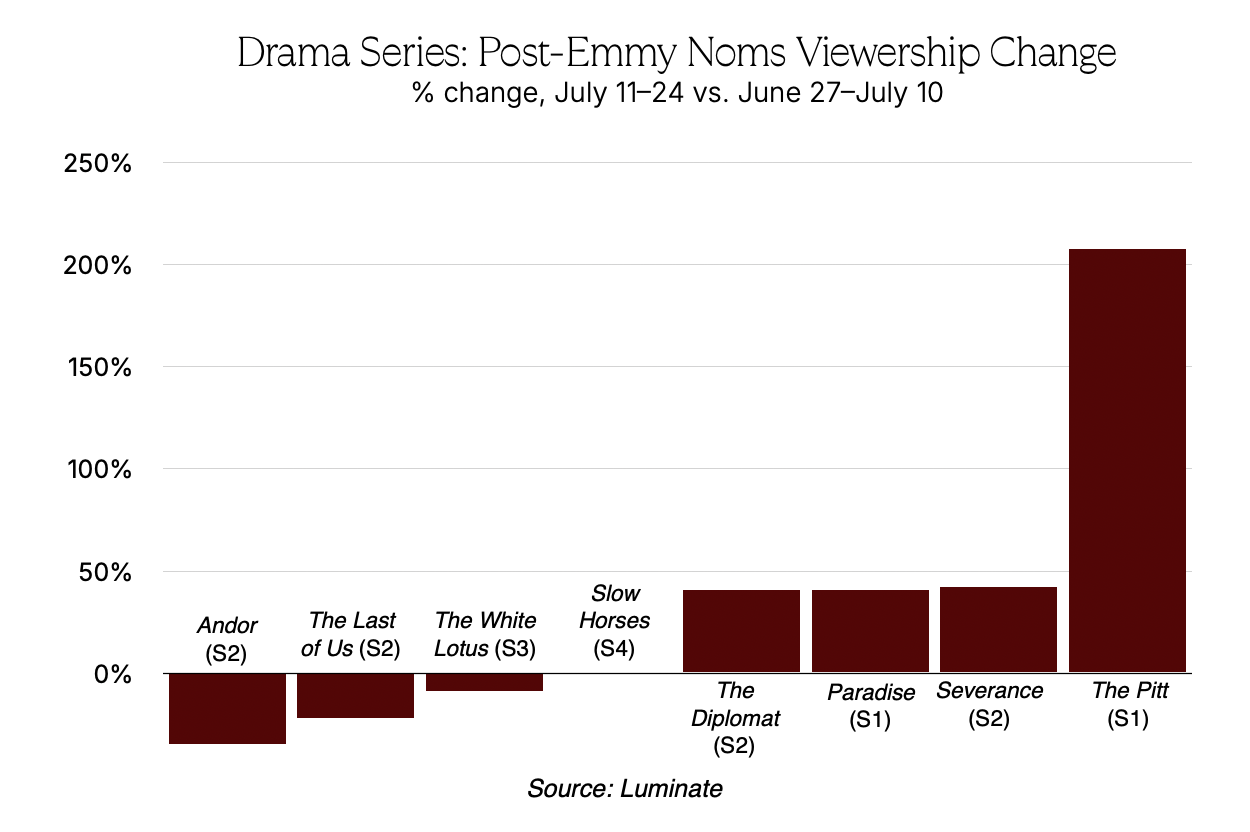
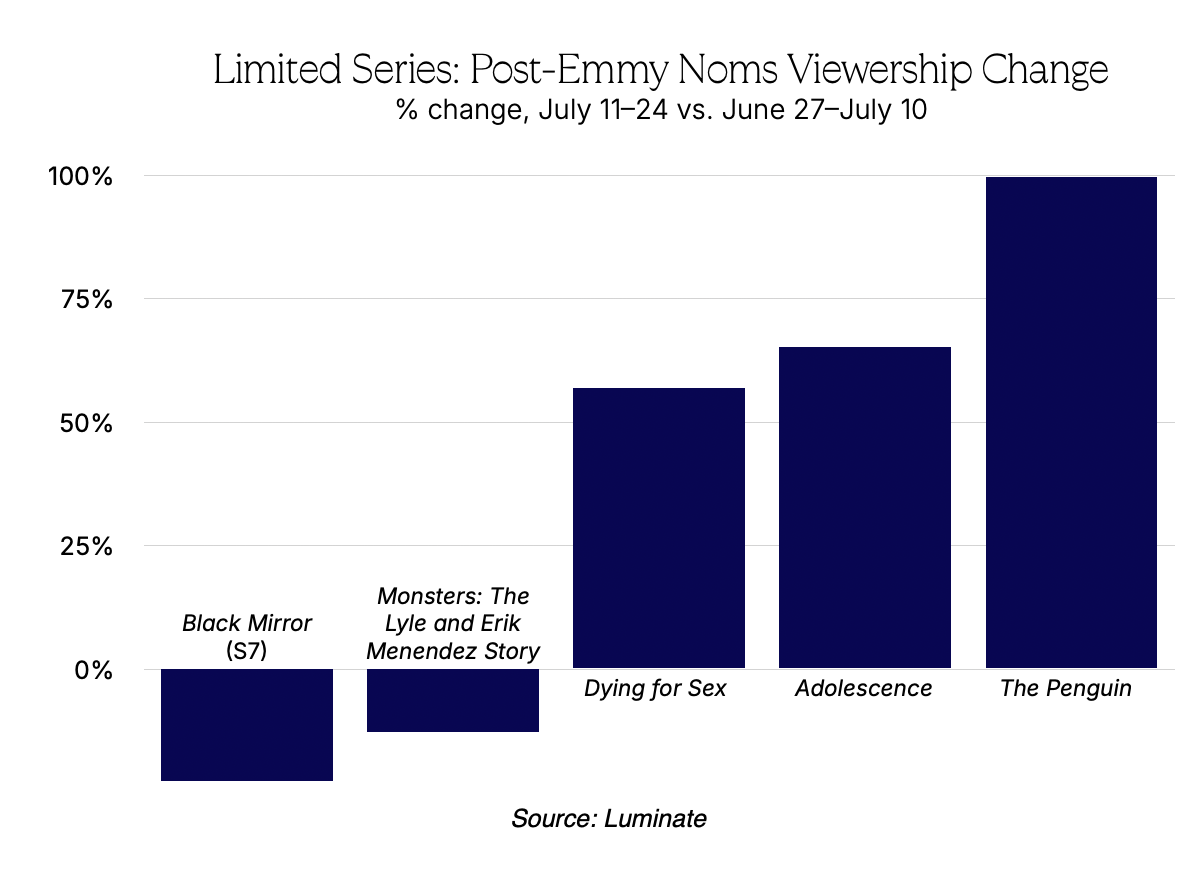
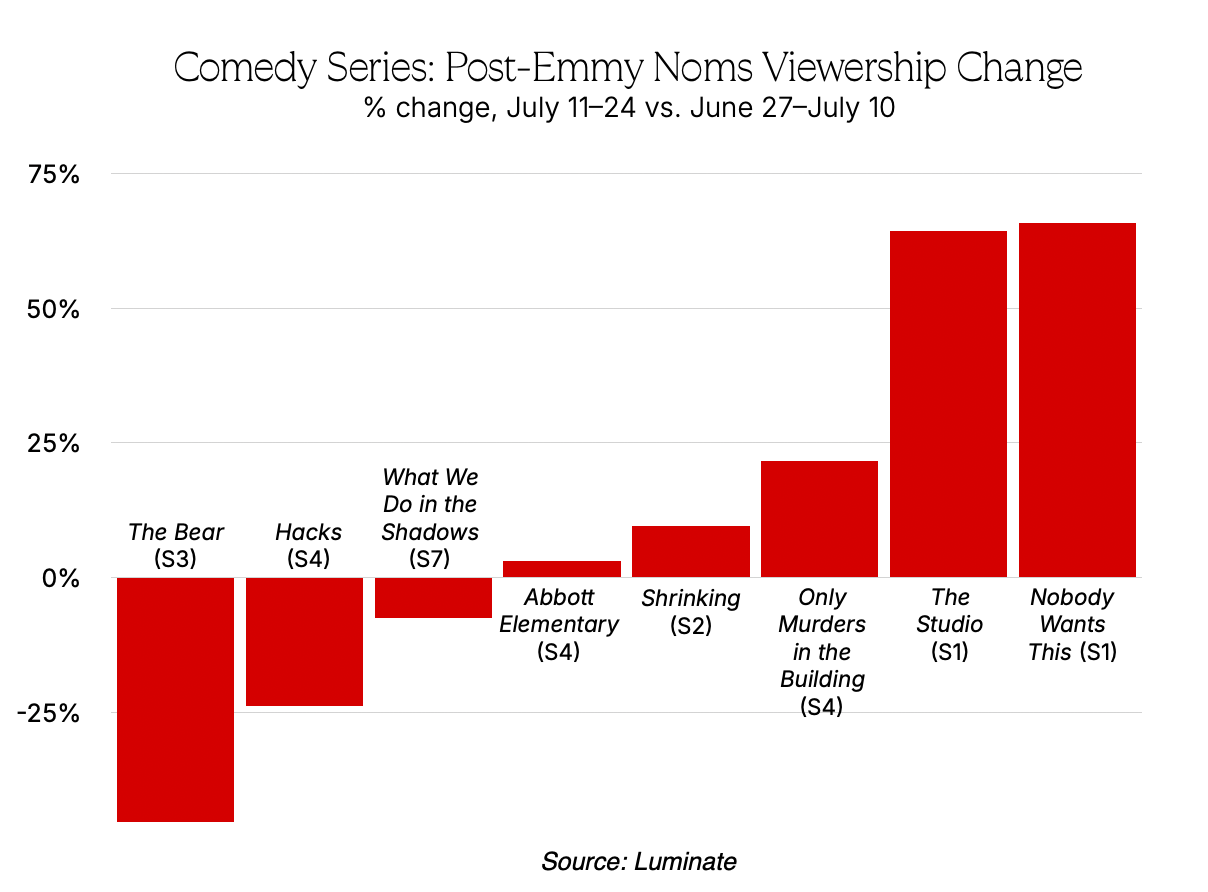
Pitt’ already won the Emmys: Final Emmy voting starts Monday, but I can report now that The Pitt has won the honor for most effectively leveraging nominations into viewers. The audience for the HBO Max medical drama spiked more than 200 percent in the week after it landed 13 noms on July 11, a far larger jump than other series in the top three categories, according to Luminate. Some, including The Bear, The White Lotus, and Hacks, actually lost
viewers after their nominations. The full charts:
|
- Box
office over/under: Nobody 2, a Universal-distributed sequel to a Bob Odenkirk action movie that I forgot existed, is tracking for about $13 million. I’ll take the under—as in under-awareness.
|
Now here’s the latest example of the perils of the streaming model… |
|
|
Sony Pictures really needed a big box office hit this summer. Instead, the studio sold the
sensation of the season to Netflix and will earn only a tiny fraction of what will likely become a billion-dollar franchise for the streamer. How did that happen? |
|
|
Man, Sony Pictures has suffered through a pretty brutal summer at the box office. It’s the only major
Hollywood studio that didn’t release a $500 million–grossing movie from May through August—and it wasn’t even close. The highest-earning Sony release for the entire year so far, 28 Years Later, has generated just $150 million worldwide. Ouch. Next summer’s Spider-Man: Brand New Day can’t come fast enough.
But Sony Pictures did make one of the biggest movie sensations of the summer—a project from its animation division that cost more than $100 million to
produce and will likely become a billion-dollar franchise, spawning sequels, spinoffs, music sales, Halloween costumes, and all the trimmings of a big fat Hollywood studio hit. It’s just that most of that value has and will accrue to Netflix because the movie is KPop Demon Hunters, and Sony offloaded it rather than develop it solo and release it in theaters. There are good reasons why Tom Rothman, the Sony film chief and self-styled king of the theatrical release, went
the streaming route here. But still, he’s gotta be kicking himself over this one. (Sony declined to comment.)
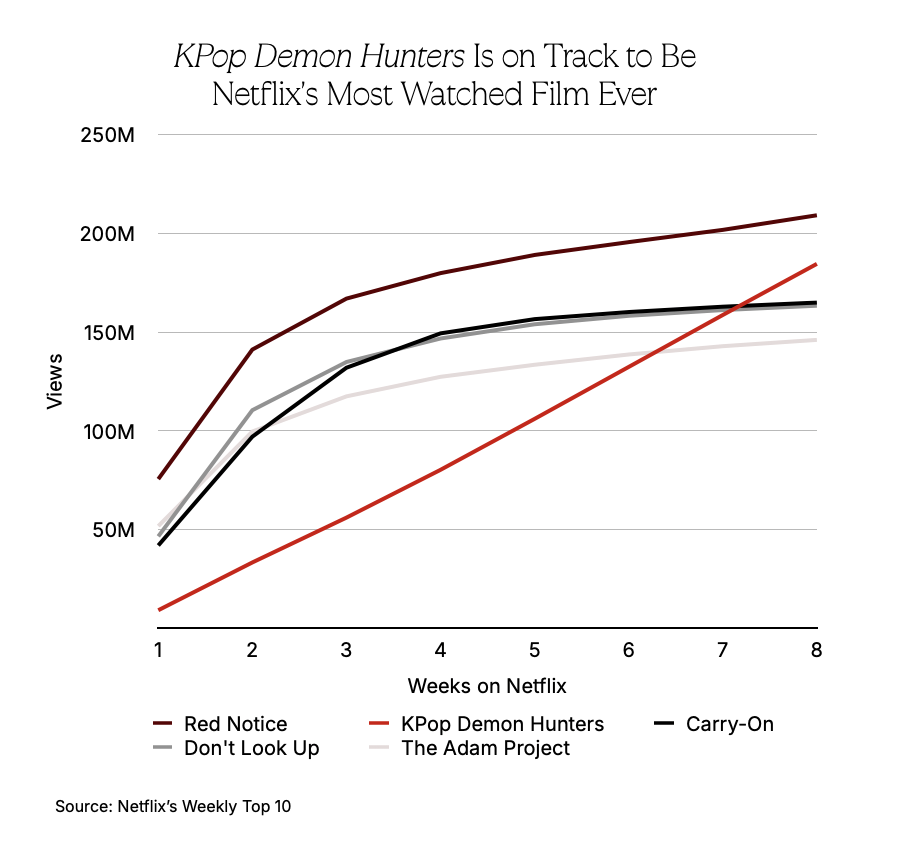
Have you seen the numbers? Released in June, the anime-style musical adventure about a K-pop trio who moonlight fighting underworld monsters generated another 25.9 million views this week, according to Netflix, and is now No. 2 on its all-time Top 10 list for English-language films. If this trajectory holds, as Netflix believes it will, Demon Hunters will soon pass
Red Notice and its 230.9 million views to become the most-watched original film ever on the platform. At the same time, the soundtrack, featuring the fictitious band HUNTR/X and real life K-pop group Twice, currently boasts seven songs in the top 20 on Spotify’s global Top 50 list. “Golden,” an insanely catchy anthem, just hit No. 1 on the Billboard Hot 100 chart.
If you have a kid at home, like I do, he or she is likely talking about nothing else. After more
than a decade in the movie business, this is arguably Netflix’s first animated megahit after many, many attempts. It’s still not quite as zeitgeisty as the biggest theatrical blockbusters, in my opinion, but it’s about as close as a movie can come without theaters. And, as we know, the animated hits can keep giving and giving. Disney favorites like Moana and Encanto still pop up in the weekly Nielsen charts thanks to rewatches. I asked John Mass,
president of Content Partners, which buys and sells film libraries, to estimate how much KPop Demon Hunters will ultimately be worth to Netflix. “It’s impossible to put a value on this franchise,” he told me, “but given the viewership numbers and plans for sequels and spinoffs, and the popularity of the music, it may end up being comparable to the Disney animated hits.”
Great for Netflix. Not as great for Sony, which is making only about $20 million on KPop Demon
Hunters, according to sources familiar with its deal. Not nothing, of course, but that’s less than many established movie stars make for Netflix films, and Sony actually conceived, developed, and produced the film. In addition, while Sony has the contractual right to produce any sequels or spinoffs—and, indeed, I confirmed that the studio has just started negotiating with directors Maggie Kang and Chris Appelhans to return for a
follow-up—it will make no additional money from the runaway success of the first film, except it has the right to release it in China, where Netflix doesn’t operate, if the government allows it in. There’s no backend, and Netflix has no obligation to renegotiate on the follow-up films. (Though I’m betting Netflix throws Sony a few bones here.)
The fee-for-service model in streaming is familiar to many frustrated producers, and the story of KPop Demon Hunters is a
variation on the Suits issue from last year, where Netflix acquired a property cheap and turned it into a phenomenon. But Sony isn’t just a production company, it’s a full-fledged studio with an experienced theatrical distribution apparatus. So why didn’t Sony release this movie itself? It came down to the timing of the deal. KPop Demon Hunters was in development at Sony Pictures Animation in 2021, when the company signed a massive “Pay One” output deal with Netflix for its
theatrical films. Concurrently, Sony forged a separate “direct-to-platform” arrangement with Netflix, agreeing to offer a first look at certain live-action and animated film projects, and Netflix guaranteed to greenlight a minimum number that the two companies would develop together and Netflix would release and control. Per the custom at the time, Sony would be paid a prenegotiated premium on top of the budgets for the films. Sources familiar with the deal tell me it was 25 percent of the
budgets, capped at $20 million per film. Netflix would keep all the rights and pay no profit participation. |
|
|
A MESSAGE FROM OUR SPONSOR |
Primetime Emmy® Award Nominee Outstanding
Television Movie |
“BRILLIANT. A thoughtful, well-crafted movie.” - Newsweek
|
“Just as deliciously satisfying as the first
movie.” - The New York Times “What a joy it is to see Renée Zellweger’s Bridget back on our screens” - The Telegraph _____ |
|
|
Back in 2021, this was a good deal for both sides. Remember, most movie theaters were still closed due to the
pandemic, decimating the theatrical business. Sony doesn’t have its own mass-market streamer, and as a so-called “arms dealer,” it aggressively offloaded movies it had made to the highest bidder—stuff like Tom Hanks’s Greyhound and the animated The Mitchells vs. the Machines. By making a guaranteed number of new movies for Netflix, Rothman was able to keep money flowing into the studio and avoid layoffs.
And even if the Netflix deal generated a hit or
two that might have been successful as a Sony theatrical release, the deal also included a mandate to buy movies that would not be “theatrical” and might not have found any audience, giving Sony guaranteed upside at perhaps the low point of the theatrical business. For instance, that Netflix deal generated a Lady Chatterley’s Lover remake that Sony probably wouldn’t have made for theaters. People We Meet on Vacation, a rom-com adaptation of a popular novel, is
coming next year. So by jumping into bed with Netflix, Rothman was taking the safer path.
And who knew KPop Demon Hunters would become… KPop Demon Hunters? The project was initially brought into Netflix by Melissa Cobb, a V.P. of original animation who has since left the company. Its director, Kang, worked on the project for years, even before she was joined by animation veteran Appelhans. Sony served as the producer on the film, with its Sony Pictures
Imageworks unit, run by Michelle Grady, actually generating the animation, and Netflix overseeing as the studio.
During the process, Hannah Minghella, who joined Netflix last year to oversee animation and family films (ironically, she once worked at Sony for 15 years), brought in Twice, a popular K-pop band, to perform a couple songs. (Twice is signed to Republic Records, a Universal Music label, meaning Sony’s music arm also missed out on
revenue from the music streams.) Minghella also oversaw tweaks to the beginning of the movie, which is crucial for Netflix, given the fickle streaming audience. The film tested very well with women, particularly younger females, but even Netflix executives have been shocked by the numbers on the service. |
The billion-dollar question: Would KPop Demon Hunters have actually been a hit in theaters? Most
film people I’ve spoken to over the past two weeks believe the answer is likely no, especially with that nine-figure budget. Original animation has struggled in theaters post-Covid, and with the exception of the SpiderVerse films, the edgier, anime-style look and feel of Demon Hunters typically does not resonate with a broad theatrical audience, especially in this country.
No disrespect to Millie Bobby Brown, but if you look at the Netflix all-time
Top 10, many of the films do not feel “theatrical” in the modern sense. Meaning what people will watch on Netflix for “free” isn’t what they will pay to see in theaters. Plus, the film started slow on Netflix and steadily built its audience via viral chatter, consumption of the music, and the platform’s algorithm—all of which, time after time, have proven able to create huge hits. The
younger Netflix audience adopted Demon Hunters as its own and is now rewatching it and rewatching it all the way to No. 1. I asked Kevin Goetz, the movie researcher and test-screening guru who counts both Netflix and Sony as clients, whether he thought Demon Hunters would have performed in theaters. “In hindsight, it seems like an obvious hit,” he told me, “but I would argue that Netflix is responsible for this movie entering the cultural zeitgeist.”
Not
sure I totally agree. The movie started slowly on Netflix, but a traditional Sony theatrical campaign could have sold the film on its catchy music and promoted it well to the target audience in advance. Remember, Sony gradually built a theatrical hit out of Sydney Sweeney and Glen Powell in short shorts in Anyone But You, so perhaps it could have turned Demon Hunters into a summer sleeper, especially since there was zero animated competition.
Disney’s Elio and Paramount’s Smurfs flopped, Universal’s The Bad Guys 2 had smaller aspirations, and both How to Train Your Dragon and Lilo & Stitch were “live-action” family films. That’s part of the reason Netflix picked June 20 as the release date. |
If Sony had put Demon Hunters in theaters, the more likely scenario is that it would have performed
okay—not great, maybe stronger in Asian territories—and then eventually exploded on Netflix in the Pay One window. But if that had happened, the inevitable sequel likely would have gone to theaters and—armed with a massive fan base—grossed hundreds of millions of dollars for Sony. Now, thanks to that 2021 deal, the follow-up movies will go directly to Netflix, barring the unlikely event of co-C.E.O. Ted Sarandos suddenly coming around on theaters.
For Netflix
film chief Dan Lin, this is a studio chairman’s dream: A relatively cheap superhit with a clear runway for exploitation across many businesses. Think about it: Netflix now owns a fictitious rock band with millions of fans. They don’t complain, they don’t owe military service, and many of the voice talents are not famous and don’t have much leverage for renegotiations. Again, great for Netflix. Not as great for Sony.
Sony likes to say that it “won” the streaming wars by
sitting them out and refusing to shovel money into the furnace of a mass-market service. But here’s an instance where the incentive to sell to the highest bidder ended up causing Sony to potentially leave massive amounts of money on the table, at least for this one title. Other vertically integrated entertainment companies would probably have held on to a theatrical window for a project that its execs believed could be successful, or hedged by sending it directly to its owned-and-operated
streamer. In either scenario, a direct-to-streaming sequel then could be elevated to theaters if desired. Remember, Disney developed Moana 2 as a Disney+ series, then refashioned it as a theatrical film and it grossed $1 billion.
In a twist, Netflix is now putting a “sing-along” version of KPop Demon Hunters in 1,100 theaters next weekend for a two-day special event. As of tonight, I’m told there are more than 300 sold-out showings, with theaters asking for additional
dates. No, Netflix is not sharing any of the box office revenue with Sony. |
See you Monday,
Matt
Julia Alexander and Maya Tribbitt contributed research for today’s
issue.
Got a question, comment, complaint, or your favorite fictitious band? Email me at Matt@puck.news or call/text me at 310-804-3198. |
|
|
Puck founding partner Matt Belloni takes you inside the business of Hollywood, using exclusive reporting and insight to explain
the backstories on everything from Marvel movies to the streaming wars. |
|
|
The ultimate fashion industry bible, offering incisive reportage on all aspects of the business and its biggest players.
Anchored by preeminent fashion journalist Lauren Sherman, Line Sheet also features veteran reporter Rachel Strugatz, who delivers unparalleled intel on what’s happening in the beauty industry, and Sarah Shapiro, a longtime retail strategist who writes about e-commerce, brick-and-mortar, D.T.C., and more. |
|
|
Need help? Review our FAQ page or contact us for assistance. For brand partnerships, email ads@puck.news. You received this email because you signed up to receive emails from Puck, or as part of your Puck account associated with {{customer.email}}. To stop receiving this newsletter and/or manage all your email preferences, click here. |
Puck is published by Heat Media LLC. 107 Greenwich St, New York, NY 10006 |
|
|
|