 |
 |
| Welcome back to What I’m Hearing, a little shorter tonight for your holiday weekend…
Programming note: This week on The Town, Lucas Shaw and I asked Jimmy Kimmel whether Disney execs apologized for the whole Aaron Rodgers/Jeffrey Epstein mess, Scott Mendelson did the scary math on the ’24 box office, and Neon’s Tom Quinn explained how he didn’t lose money on Ferrari. Subscribe here and here.
Was this email forwarded to you? Click here to become a Puck member. Got a news tip or an idea for me? Just reply to this email.
Discussed in this issue: Tom Rothman, Kim Godwin, Maverick Carter, Greta Gerwig, Bob Iger, Emma Stone, Bill Kramer, Hugh Grant, Dana Walden, Johnny Depp, Tom Hardy, Nelson Peltz, Messi the dog and… L.A.’s worst parking lots.
But first… |
| Who Won the Week: Jon Stewart |
|
| It’s not just that Daily Show ratings hit a six-year-high in Live+3 ratings for his first show back, or that the Daily Show YouTube channel saw its biggest week of subscriber growth ever. Stewart actually killed it, smartly eviscerating Biden as well as Trump to distinguish himself in late night (and boding well for repeat viewers on Mondays).Now for a little more data from our politics at the movies study... |
| Democrats Are Driving the Box Office |
|
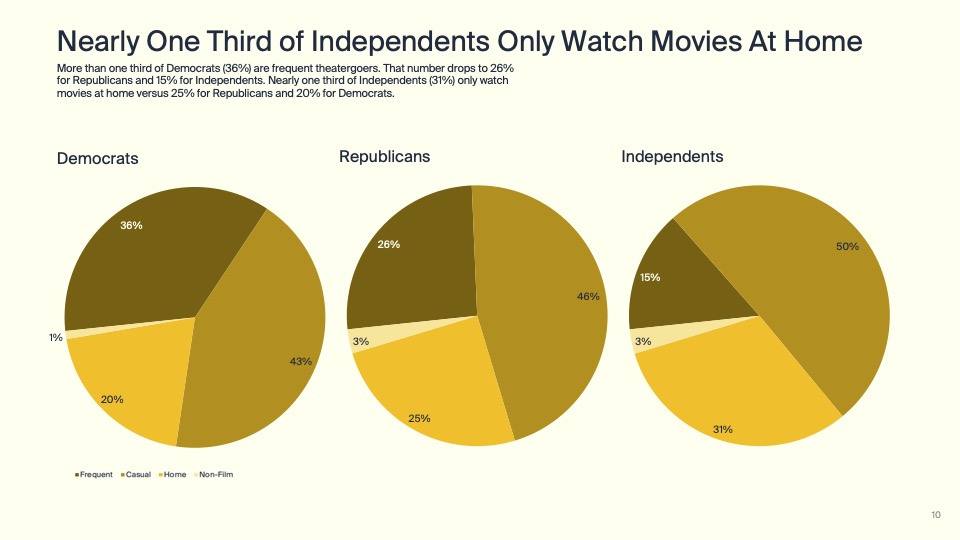
| Nearly four out of five Democrats say they’re either frequent movie theatergoers (36 percent) or casual theatergoers (43 percent). That’s the result of a new survey for Puck by The Quorum, which found that the numbers are lower for Republicans and independents. Surveying 2,000 people, about equally split among the three political affiliations, the study revealed that only 26 percent of Republicans say they are frequent theatergoers. (Frequent means more than once a month; casual is about once every couple months.) Only 15 percent of independents consider themselves frequent moviegoers. |
|
|
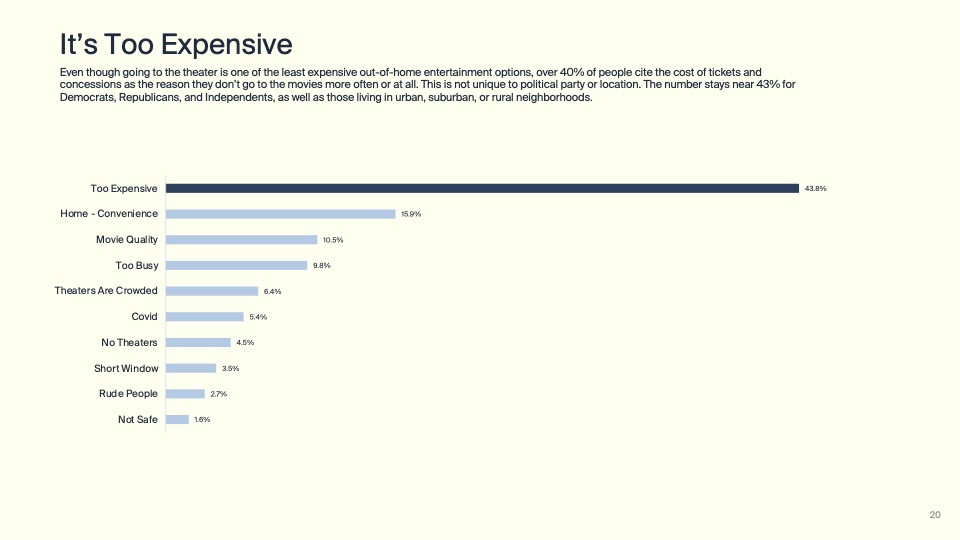
| You could argue that non-Dems are turned off by Hollywood and its liberal-leaning product—though as I discussed on Thursday, ideology has little stated effect on whether people go to the movies. Geography—namely, the fact that more Republicans live in rural areas—likely plays a bigger role. Nearly 5 percent of respondents cited “no theaters” as the reason they don’t go to cinemas. Pretty straightforward. Many theaters in rural areas closed during Covid and never reopened.No surprise, “cost” is the overwhelming reason people stay away from the multiplex. Other top reasons include the fact that home viewing is more convenient (16 percent), the “quality” of movies (10 percent), health risks of being in a theater (5 percent), and the fact that shrinking release windows means movies will be available at home sooner (4 percent). That last item is interesting given the industry-wide concerns that the rush to streaming is teaching moviegoers to wait for home video. |
|
|
|
|
| “MountCock+”
—Zack Bornstein, the Shrinking and SNL writer, suggesting a name on Twitter/X for a combined Paramount+ and Peacock upon news that their owners have discussed merging them.Runner-up: “Oompa loompa dumpity dong, most of these films were frankly too long.” —Hugh Grant, presenting at the BAFTAs.
Second runner-up: “Good thing Greta’s got director in the bag.” —Ryan Gosling, as Ken, in the very funny Oscars promo video featuring Jimmy Kimmel and the Barbie cast.
A little more on that…
I’m told that the Academy has heard from a couple Oscar campaigns that are angry over that Kimmel video highlighting Barbie. Traditionally, the Academy and ABC have stayed neutral on the nominees during Phase 2 voting, lest they leave the impression of an “endorsement.” But that’s shifted recently. Last year, Academy president Janet Yang caught some flak for posts on Instagram that basically endorsed Everything Everywhere contender Michelle Yeoh. Rival best picture campaigns also didn’t love last year’s promo that played off Top Gun: Maverick. And the Academy social accounts now regularly highlight nominees during Phase 2, which causes some to count mentions for signs of favoritism.
It’s a tough situation for Academy C.E.O. Bill Kramer, who is desperate to juice Oscars viewership but must be sensitive to industry politics. Dropping a star-studded video that leverages the biggest movie of 2023 seems like a promotional no-brainer (the main YouTube version has 2.6 million views), and an Academy source insists the studios were all given a heads-up about it (though two studio sources dispute that, saying the Academy only offered a general overview, and they had no idea the clip would be nearly five minutes long).
This all may seem trivial (and it is!), but given the stakes of the Oscars and the tens of millions of dollars spent on campaigns, I understand the annoyance. The Anatomy of a Fall campaign triggered rivals by sending Messi, the dog from the film, to the Nominees Lunch last week, which led to a raft of free media coverage. “It’s a promo prop,” one awards veteran texted, clearly pissed. “Should the Barbie people be allowed to bring dolls? Should the people who made Life of Pi be able to bring a tiger?”
I think that tiger was C.G.I., but whatever, we get the point. Maybe that Barbie video shouldn’t have highlighted the Greta Gerwig snub, which plays into the Warner Bros. campaign that is attempting to stoke outrage over the Gerwig and Margot Robbie exclusions to win in the categories where Barbie is nominated. But as the ratings situation grows more desperate and the Academy nears the end of its lucrative ABC deal in 2028, I’d expect more, not less, of this kind of promotion. |
|
|
| Disney TV chief Dana Walden separated herself from controversial ABC News head Kim Godwin by promoting Deb OConnell between them, which is… awkward for everyone, Dylan Byers notes. [Puck]Nelson Peltz, a billionaire, charged Wendy’s nearly $600,000 for “security-related expenses” in his role as chairman. In Nelson’s defense, armed marauders are constantly trying to obtain the secret Peppermint Frosty recipe. [NY Post]
Speaking of Peltz, my dude actually sold 7.3 percent of his fund’s stake in Disney during the fourth quarter, bringing his financial share down to $755 million. (He still has voting control over his BFF Ike Perlmutter’s 25.5 million shares.) That’s not something you do when you think your proxy war will ultimately boost shareholder value. It is something you do when you know you’re gonna lose that war and you want to reap some profits from the recently inflated stock, Bill Cohan notes. [Puck]
As another colleague, Eriq Gardner, predicted, the Justice Department is probing the “Spulu” sports joint venture. [Bloomberg]
Casey Newton goes deep on A.I. and the Taylor Swift deepfakes, and it’s a massive warning for every famous person who’s been the subject of a harassment campaign. [Platformer]
Early contender for barfiest magazine story of 2024: This sympathetic snapshot of Johnny Depp’s “bromance” with Saudi Arabia’s M.B.S. and his henchmen Prince Badr and Turki Al-Sheikh, who have recruited everyone from the Russo brothers to Maverick Carter to help whitewash the murderous kingdom’s image. [Vanity Fair]
Speaking of the Russos, the South Korean gaming company that plowed $400 million into their AGBO shingle says it had a crappy 2023 in part because of said investment in the Russos. [MSN]
If your spouse or a random guy on the ski lift asks why Paramount is in such trouble, show them Lucas Shaw’s new overview of the company’s long decline. [Bloomberg]
The L.A. Times’ list of worst parking lots really misses some gems. FWIW, my Top 5 worst: Dodger Stadium, ArcLight Hollywood (R.I.P.), Westfield Century City, Hollywood & Highland (or whatever they call it now), and Santa Monica Parking Lot 6 (on 2nd Street), where my car once got peed on. [L.A. Times]
Now our box office expert, Scott Mendelson, has a postmortem on Madame Web and the entire Sony Marvel-Lite franchise… |
 |
| Sony’s Hard Spider-Man Lessons |
| After decades of trying to expand the Spider-Verse into a true Marvel franchise, ‘Madame Web’ should be a wake-up call that it’s time for Sony to move on. |
|
|
|
| Madame Web, which has grossed merely $25.5 million this six-day weekend, isn’t the first big-deal superhero movie to tank at the box office. But the film’s critical and commercial rejection should be the final nail in the coffin for Sony’s failed attempt to fashion a cinematic universe entirely around Spider-Man, more than 20 years after Sam Raimi’s Spider-Man.We’ve had four already-released live-action spinoffs and two more set to open in 2024. In some ways, in fact, Madame Web is arguably the definitive example of every wrong lesson Hollywood (in general) and Sony (in particular) absorbed from The Avengers. And once Venom 3 and Kraven: The Hunter finish their theatrical runs later this year, it’s time for Sony to move on.
Directed by TV veteran S.J. Clarkson, the Dakota Johnson-starring Madame Web is about a young woman who receives psychic powers after a near-death experience and must protect three teen girls (Sydney Sweeney, Isabela Merced, and Celeste O’Connor) from a murderous spider-man (Tahar Rahim). The movie lacked marquee characters, butts-in-seats stars, or superhero action. Worse, it failed to deliver the one requirement of a superhero spinoff—familiarity. It was only tenuously connected to an undefined Spider-Man franchise—either the 2000s Tobey Maguire trilogy or the 2010s Andrew Garfield duology. |
| A MESSAGE FROM OUR SPONSOR |
 |
|
|
|
| After the success of The Avengers, in 2012, Hollywood convinced itself that audiences only wanted interconnected cinematic universes and superheroes in the abstract. But the data suggested otherwise. Universal’s “Dark Universe” closed shop after The Mummy. Warner Bros. spent a decade trying to make DC into an MCU-sized titan and got only endless bad press and periodic stand-alone hits (like Joker, Shazam, Wonder Woman, and Aquaman) for its trouble. Godzilla: King of the Monsters bombed in 2019. Meanwhile, a slew of glorified prequel-to-the-sequel films that were intended to expand into universe spinoffs (The Dark Tower, King Arthur and the Legend of the Sword) only harmed previously successful brands.In some ways, no studio misinterpreted the moment more than Sony. When the first Spider-Man reboot was announced in early 2010, it was sold as an under-$100 million, romance-focused Peter Parker melodrama. Marc Webb’s The Amazing Spider-Man became a $225 million-budgeted grimdark remake of the Raimi classic, garnering decent reviews—especially for Garfield’s chemistry with Emma Stone—and earning $757 million worldwide. But blinded by The Avengers, Sony crafted The Amazing Spider-Man 2 with an eye toward spinoffs and interconnected universe potential. |
|
|
| In the run-up to release and even soon after, there would be word of movies centered on Venom, Kraven the Hunter, and even a young Aunt May. The Amazing Spider-Man 2 earned poor reviews while grossing just $709 million worldwide (and killing off Stone’s character, a plot twist faithful to the comics that was intended to appease the hard-core fans). So focused was the discourse around Sony’s attempt to Avengers-ify Spider-Man that it tainted the entire studio, even amid a year with a prestige hit in American Hustle ($250 million global) and a rare blockbuster comedy sequel in 22 Jump Street ($331 million).By February 2015, Amy Pascal was out at Sony after The Interview mess (but retained to produce Spider-Man movies as a sweet kiss-off). Tom Rothman, with his reputation as a ruthless penny-pincher when making X-Men and Fantastic Four at Fox, was in. And one month later, Sony finished a deal to allow Disney’s Marvel Studios to take over a Spider-Man franchise it had essentially run into the ground. Tom Holland was cast as the new Spidey, with a supporting role in Marvel’s Captain America: Civil War set for May 2016, followed by a Sony-released Spider-Man: Homecoming in July of 2017, which would co-star Robert Downey Jr.’s Iron Man.
But a surefire new Spider-Man franchise wasn’t enough. By March of 2016, Sony was moving forward with seemingly discarded plans for a Venom flick, which presumably would be followed by other villain-centric or sidekick-centric movies. Sony would also announce the animated Spider-Man: Into the Spider-Verse, featuring alternate universe superheroes and centered on Afro-Latino Miles Morales. |
|
|
| Against all odds, the ploy initially worked. Released in October 2018 to poor reviews, audiences nonetheless gravitated toward Venom, one of the more popular Spider-Man villains being played as an antihero by Tom Hardy going full gonzo. It was a star turn that seemed like an attempt to win an Oscar and a Razzie at the same time. Couple that with a subtle queer reading within the “love story” between man and symbiote, and Venom legged out to $214 million domestic from an $80 million debut. And then, thanks to China, where it earned a jaw-dropping $264 million, it ultimately grossed $856 million worldwide. Into the Spider-Verse then earned rave reviews, beat out Incredibles 2 for the best animated feature Oscar, and grossed $384 million globally on a $90 million budget.And there would be more. We can only guess how Morbius would have been received had it opened in a non-Covid world as intended on July 31, 2020. However, it eventually debuted on April 1, 2022, to miserable reviews and a deluge of online mockery. “It’s Morbin’ time!” memes don’t sell tickets, so the film earned just $168 million globally on a $75 million budget. After all, just because audiences flock to Batman doesn’t mean they will show up to The Shadow. Audiences did not want to see Jared Leto as Morbius, the Living Vampire, or Dakota Johnson as Madame Web. We’ll see about Aaron Taylor-Johnson in what looks like a “What if X-Men Origins: Wolverine had an R-rating?” Kraven the Hunter movie, set for release on August 30. Then Venom 3 on November 8.
Yes, these films cost anywhere from $75 million (Morbius) to $110 million (Venom: Let There Be Carnage), which is a half to a third of what a typical MCU or DC epic costs. But whether general audiences see them as non-MCU Marvel movies or (as Disney surely fears) lesser entries eroding the quality of the overall Marvel brand, Rothman may not care about whether they are any good. We’re talking about four films that have Rotten Tomatoes scores of (in order of release) 30 percent (with an average critic score of 4.5/10), 57 percent (5.4/10), 15 percent (3.8/10), and 15 percent again (3.3/10).
Here’s the good news: Sony can walk away. A lucrative first-window pay TV deal with Netflix means Rothman has at least some financial incentive to make and/or release theatrical movies like The Woman King and The Book of Clarence, especially if these superhero flicks aren’t pulling in big-deal box office anyway. In recent years, Sony pushed Brad Pitt’s R-rated Bullet Train to $239 million worldwide and the R-rated rom-com Anyone But You to $200 million. Before Covid, the PG-13 Escape Room out-earned most of the Saw sequels, while the Jumanji sequels earned decent reviews, strong buzz and $1.76 billion on a combined $210 million budget.
The SSU is a relic from a pre-Covid misunderstanding of what audiences wanted. It’s just one of many examples of Hollywood trying to glean general lessons fr om specific successes. The buzzy success of Anyone But You positions Glen Powell and Sydney Sweeney as bankable lead actors, yet they’re merely being marketed as added value elements for Madame Web and Twisters. Ditto Twisters co-star Daisy Edgar-Jones, who headlined Sony’s $144 million-grossing Where the Crawdads Sing. Sony, more than any studio, is in a position to slowly rebuild the concept of the butts-in-seats movie star via reasonably budgeted, non-franchise crowd-pleasers that don’t have to break records to break even. They don’t need to keep embarrassing themselves with Marvel-lite movies that audiences don’t want. |
|
|
| Light feedback this holiday week, but I want to share a DM I got from a Disney executive in response to Thursday’s column on whether the politicization of the Disney brand impacts box office…“Everyone says ‘It’s the movies, stupid,’ which is an easy thing for people to say. More appealing movies are a great way to jump the political issues. But more and more, our audience (or the segment of the audience that has been politicized) equate the perceived messaging in a film as a quality issue. They won’t say they find female empowerment distasteful in The Marvels or Star Wars [the latest trilogy starring Daisy Ridley], but they will say they don’t like those movies because they are ‘bad.’ So ‘make better movies’ becomes code for ‘make movies that conform to regressive gender stereotypes or put men front and center in the narrative.’ Which is what you’re seeing now, and what Bob [Iger]’s pivot is about right now.” —A Disney executive |
|
|
| No chart this week, just good vibes: Jon Stewart used to walk out and greet the audience to Bruce Springsteen’s “Born to Run,” so of course the Daily Show crew surprised him with the same song for his return this week. |
|
|
| Have a great (short) week,
MattGot a question, comment, complaint, or a decent pitch for a Ziggy Marley movie? Email me at Matt@puck.news or call/text me at 310-804-3198. |
|
|
|
| FOUR STORIES WE’RE TALKING ABOUT |
 |
| Browne & Black |
| A candid chat with an American fashion success story. |
| LAUREN SHERMAN |
|
 |
| Catch-81 |
| The Cafe Milano crowd on the political topic du jour. |
| TARA PALMERI |
|
 |
|
 |
| Klein of Arabia |
| Why are the Senate and Saudis both after Michael Klein? |
| WILLIAM D. COHAN |
|
|
|
|
|
 |
|
|
| Need help? Review our FAQs
page or contact
us for assistance. For brand partnerships, email ads@puck.news. |
| You received this email because you signed up to receive emails from Puck, or as part of your Puck account associated with . To stop receiving this newsletter and/or manage all your email preferences, click here. |
| Puck is published by Heat Media LLC. 227 W 17th St New York, NY 10011. |
|
|
|