 |
| Welcome back to What I’m Hearing, en route to L.A. from a fun birthday weekend with family (and monitoring SAG-AFTRA progress) in Charleston.
Programming note: This week on The Town, Lucas Shaw and I broke down the strike-impacted ’24 movie calendar, former TV scheduler Preston Beckman predicted a retreat from streaming’s binge model, and Bethenny Frankel made the case for reality TV stars to join SAG-AFTRA. Subscribe here and here.
Was this email forwarded to you? Click here to become a Puck member. Got a news tip or an idea for me? Just reply to this email.
Discussed in this issue: Jeff Zucker, David Zaslav, Robert De Niro, Tim Cook, Taylor Swift, Michelle Williams, Gunnar Wiedenfels, Ted Sarandos, Fran Drescher, Casey Bloys, Robert De Niro, Dwayne Johnson, Ike Perlmutter, Viola Davis… and the Armie Hammer soft relaunch.
But first… |
| Who Won the Week: Shari Redstone |
|
| Don’t look now but Redstone’s Paramount Global, the red-headed stepchild of the Streaming Wars, is up 28 percent this week. Nobody totally knows why; it’s probably because the company only lost $238 million on streaming this quarter, down 44 percent from $424 million last quarter; but maybe not! Warner Discovery, Disney, Lionsgate, and other peer share prices also were up more than the S&P 500 this week. Maybe the market is realizing that the studios will spend dramatically less on content post-strike.More Shari: It’s not why they did it, but Paramount bumping the final episodes of the now Costner-free Yellowstone to November is a fitting kiss-off because it’s well after Kevin’s two-part Western opus Horizon hits theaters this summer, thus denying him the promotion that would have come with the return of TV’s No. 1 show.
Runner up: Britney Spears, for selling 1.1 million copies of her memoir, The Woman in Me, in a week. Those are close to Prince Harry numbers (1.6 million) and would’ve been great for Paramount’s book division, Simon & Schuster—if KKR hadn’t also closed on its $1.62 billion acquisition this week.
Related: A couple people asked me how Michelle Williams, of all people, ended up doing the Britney audiobook narration that’s gone viral. Williams’ publicist Mara Buxbaum is married to Spears’ lawyer Mathew Rosengart, but that had nothing to do with it. Williams was simply on a publisher list of potential “gets,” she read the book and related to it (she was legally emancipated from her parents at age 15), and she said yes. I’m told Williams’ husband Tommy Kail (Hamilton) was very involved in directing the recording. Amazingly, despite her five Oscar noms, Williams has won only the Emmy of the EGOT awards (for Fosse/Verdon in 2019). So now the Grammy for Best Audio Book, Narration & Storytelling Recording—the same award that just got Viola Davis her EGOT—will probably be Williams’ second on that path.
Now Jonathan has some exclusive details on the state of the SAG-AFTRA negotiations… |
| What’s Holding Up the Actors’ Strike Deal |
|
| Maybe one day robots will do deals, but tonight they’re the main reason there is no deal to end the almost-four month SAG-AFTRA strike. A.I. and streaming residuals remain the roadblocks to an agreement between the union and the studios and streamers—despite the recent participation of eight company C.E.O.s and top execs, and a supposed “last, best, and final” offer delivered yesterday. There will be no deal tonight, and the union is likely to counter the L.B.F. tomorrow, with uncertain results thereafter. So no, don’t chill the champagne yet.I’m hearing that the companies brought in a group of intellectual property attorneys to focus on the A.I. issue, but that they’re multiplying the issues rather than finding answers. (I reached out to the AMPTP for comment but have heard nothing back.) A core question at hand: What’s the definition of “generative A.I.”? The AMPTP companies and president/chief negotiator Carol Lombardini were comfortable with a loose definition in the recent Writers Guild deal, but these I.P. lawyers want precision. The union suggested using the definition from the White House’s recent batch of A.I. regulations, but the I.P. lawyers pushed back.
How about “digital replicas”? The I.P. attorneys want to distinguish between “employment-related digital replicas” and non-employment ones, whatever exactly that distinction may be. In any case, the companies want broader usage rights than SAG-AFTRA finds reasonable. And A.I. training on actors’ performances—which is the process of ingesting footage and learning from it—still appears to be an issue, as well.
On success-based streaming residuals, I can report that the union has dropped its revenue share and per-subscriber proposals and proposed a funding mechanism similar to the WGA deal—but sweetened, and with a twist. (Which sounds like a recipe for a much-needed drink.) The SAG-AFTRA approach would consolidate the money from bonus residuals in a jointly-administered company-union fund, with the disbursement formula to be discussed later. The exact details, such as the amount of money that would be generated, was not available to me.
Such funds are used with music residuals—and they actually carry an advantage for the companies, as the fund rather than the companies, themselves, shoulder the cost of processing payments to members. That sounds like it might be amenable to the studios and streamers and, indeed, I’m told that the C.E.O.s appeared comfortable with the union proposal—but that Lombardini has resisted this approach. That may sound confusing, since Lombardini works for the C.E.O.s, but she’s their adviser, expert and executive, not their servant. She understands guildworld far better than they do; she lives it every day, they don’t. Whether the SAG-AFTRA proposal is dead or not is thus unclear.
Finally, there has been major progress on basic wage increases. This started out with the companies offering 5 percent in the first year of the contract, same as the DGA and WGA achieved, and the union demanding 15 percent and then 11 percent, to account for recent inflation. The bid-ask narrowed in the past few weeks to 7 percent vs. 9 percent, and I’ve now learned that the parties, although not technically agreed, will have an agreed number contingent on resolving the other major issues.
And when will that be? Not tonight, but SAG-AFTRA is expected to respond or counter the offer as early as tomorrow. An L.B.F. isn’t necessarily last, best or final, after all—it’s better understood as a signal that from the studios’ perspective, things are getting down to short strokes. Hence the participation of all eight AMPTP negotiating members, as well. That doesn’t necessarily mean that a deal is imminent, nor that the situation will go nuclear if the union counters. What happens next is anybody’s guess.
Nonetheless, as the windows close for preserving the summer movie schedule and deploying scripted content for the latter half of the 2023-24 television season, it feels like we may see a deal soon—even as the union appears determined as ever to protect its members from the rise of the bots and the turmoil of streaming. |
| Quote of the Week (Zucker edition!) |
|
| “I felt that I had to go to the gym.”
—Jeff Zucker, the former CNN chief and current Redbird IMI media investor, sharing with the Financial Times his reaction to successor Chris Licht’s infamous Atlantic profile, and the 6 a.m. exercise session that featured the instant-classic line, “Zucker couldn’t do this shit.”Runners up:
On the relationship with subordinate Allison Gollust that got him fired: “I made a minor mistake in not disclosing [the relationship]. I own that. I regret that. In no way did I think the punishment fit the crime.”
On his 24/7 Trump coverage in 2016: “Did we make mistakes? Absolutely. Did we give too much unedited free airtime? Yes, of course. By the way, did our competitors do the same thing? 100 percent yes. Am I the one that takes the blame for that pretty unilaterally? Yes. But that’s OK. I get it.”
On whether he wants another big TV job: “If the right moment were there for me to do something again day in, day out like that, would I accept that? Yes, sure.”
Now my take on the continued Max-ification of Netflix… |
 |
| Maybe Don’t Sell Everything to Netflix |
| Is David Zaslav making a mistake by licensing so much top-shelf content to the industry’s 800 pound gorilla? Or has Netflix simply already won the streaming wars, and everyone else must simply attempt to ensure their own debt-servicing survival? |
|
|
|
| I joked a while back that Warner Bros. Discovery C.E.O. David Zaslav would auction Jack Warner’s antique desk if it helped pay down even a tiny sliver of the company’s crippling debt. A few months later, that humor now seems quaint. Zaslav actually is selling off the crown jewels—or at least renting his biggest I.P.-driven movies—to generate that needed cash, yes, but also while helping the industry’s 800 lb gorilla pull away from the rest of Hollywood. More proof that the Streaming Wars are over…If you missed it, Netflix announced a flex this week: 12 of the recent DC films from Warner Bros. will drop Dec. 1 on the service in the U.S., joining a growing trove of Warner Discovery’s HBO shows, like Band of Brothers and Insecure. These aren’t musty library titles, either, they’re pretty much all the recent DC Extended Universe extravaganzas, up to the 2022 films, The Batman, Black Adam, and DC League of Super-Pets (minus Aquaman and Joker, which is a bit weird because you’d think Zaz would want to drum up interest in their upcoming sequels; maybe the data shows people will instead sign up to Max to get caught up).
We know why they’re doing this: They really need the money. Everyone does. Hence the industry-wide price hikes and spending cuts—a strategy that is starting to be rewarded by Wall Street, if the current earnings season and jubilation over reduced streaming losses is any indication. (Disney reports its financials on Wednesday.) In that context, selling DC movies to Netflix is an easy move for WBD C.F.O. and reigning What I’m Hearing Villain of the Year Gunnar Wiedenfels, who’s repenting for the sins of former C.E.O. Jason Kilar and the scale-mongers that drove Hollywood off a cliff.
He’s not wrong. Success in the entertainment business has always been defined by extracting the most money from titles across formats and platforms, which is why Gunnar noted in September that warehousing valuable content is “incomprehensible”—a notion that I’m convinced Netflix will someday come around to accepting. Plus, these DC movies are co-exclusives, so if you really need to see what happens when a major star like Dwayne Johnson and his producing partner hijack and decimate a studio’s intellectual property, Black Adam will still be available for forensic study on Max. And it’s just in the U.S., where Netflix is making a major push to get new and existing subscribers into the ad tier. When Zack Snyder’s super pricey franchise hopeful Rebel Moon launches on Netflix on Dec. 22, many of his previous DC movies will now also be there as suggested viewing, no doubt allowing co-C.E.O. Ted Sarandos to flip on the Engagement Meter at the Montecito house, tap his fingers together and whisper “Excellent” in his best Mr. Burns voice.
The question for Zaslav: Is anything off limits? Especially when it comes to Netflix, which has become so frighteningly dominant, with a profitable business and nearly 250 million subs worldwide. At what point is Warner Discovery telling consumers that if you just wait a little bit, everything will be on Netflix, so there’s really no need for Max. Company sources say plenty is held back, including first-run HBO shows, the latest Warners movies, and more. (Meaning no Shazam 2 or The Flash…yet.) Plus, again, these are co-exclusives, so the value proposition of Max is still there, they argue. The internal data is telling WBD’s streaming chief JB Perrette which shows drive new subs and keep them there, and the numbers suggest there will be no negative impact to Max if even the bigger titles play elsewhere, generating cash and exposing the content to a new audience. “A small percentage of titles really drives the vast majority of viewership and engagement,” Gunnar said in September.
That’s certainly the conclusion of data that Bloomberg published today from Digital-I, one of the many analytics firms trying to measure streaming viewership. The data says only 5 percent of originals released on Netflix this year would have qualified for a streaming residuals bonus as defined in the recent WGA negotiations, meaning they were viewed by more than 20 percent of U.S. subscribers. 75 percent of Netflix originals are watched by less than 5 percent of users. And that’s on Netflix, which is pretty much the only platform that regularly creates mainstream hits.
So for the vast majority of titles, licensing makes sense. It’s just a return to the traditional TV model. DC movies play on WBD’s linear TNT, and they also play elsewhere throughout their cycles. HBO has trickled its shows down to other cable networks. That’s Windowing 101.
But… you don’t need to be a Kilar disciple to argue that streaming is different than linear TV, a mature business with full market penetration. This is a new business, and the players are building and defining their turf, much like the cable carriage wars of the ’80s and ’90s. Assuming WBD actually cares about Max being one of the three or four platforms that survive the coming era of bloodletting and consolidation, it might make sense to position its platform as the exclusive home of something, even if the data says the consumption of that something isn’t as high as the newest stuff.
Or at least don’t license it all to the dominant player, allowing that player to become even more dominant and thus able to outbid all others for that content. There are many analysts who love the Zaslav strategy. Rich Greenfield called the DC move “smart” on Lightshed’s podcast this week, and he has suggested that Disney should start putting Marvel and Star Wars shows first on Netflix, and later on its own platform. More people would see them, he argues, Netflix would pay a lot for them, and then they could live their afterlife on Disney+.
But Disney did that for years, and there’s a reason Bob Iger hasn’t yet returned to the strategy of, in his words, “selling nuclear weapons to a third world country” that would use them against Disney. Maybe recent Disney+ and Hulu originals will soon start popping up regularly on Netflix, but there’s a real danger in one platform becoming the catch-all for everything—the future of a handful of global entertainment outlets could easily become a future of one global network and a few niche also-rans. Netflix has clearly won the Streaming Wars, and now it has designs on world domination. Maybe Warner Discovery and the other Hollywood studios shouldn’t give them everything. |
|
|
| Schmuck Insurance (Taylor’s Version): Music labels are now trying to insert language in deals that prevent re-recording of masters for 10, 20, or even 30 years. [Billboard]Tim Cook bragged that Apple’s Services division grew 16 percent to $22.3 billion this quarter but didn’t say which services generated the spike. The Apple Music price hike? Apple Pay? Millions of Apple TV+ signups from the hilariously soft-lit Jennifer Aniston-Jon Hamm sex scene on The Morning Show? [CNBC]
Non-shocker of the week: Ousted Marvel malcontent Ike Perlmutter owns the majority of shares that Nelson Peltz is using to demand board seats for him and his son. [WSJ]
Troll-gate (Casey-gate?) seems to be winding down, so don’t forget to read Cheyenne Roundtree’s piece on HBO chief Casey Bloys’ secret Twitter campaign against TV critics. [Rolling Stone]
“Yeah, fine. I berated her.” Not a great admission on the witness stand from Robert De Niro about how he treated his assistant. But I haven’t heard any testimony so far that supports Graham Chase Robinson’s countersuit alleging discrimination. [People]
The Armie Hammer soft relaunch is… happening? Very curious who passed on appearing in the welcome back to L.A. photo (besides everyone). [Instagram] |
|
|
| Many readers were understandably bummed out by my Thursday email on the financial hellscape awaiting the end of the strike. Some reactions, plus Fran Drescher’s toy plushie, and Bob Iger vs. Brian Roberts… “Well this was a depressing read. My husband is an out-of-work TV writer, I’m a (non-TV) writer and podcaster, who used to be able to make a living from my podcast, which isn’t really the case anymore... it feels like the bottom is just falling out of everything. If he doesn’t get work in the next 6 months we’ll probably leave L.A.—we have a kid and I just don’t know if we can swing it. I feel like there are probably a lot of others in my same boat.” —A writer
“Your newsletter is sobering but smart. Actually it might be the opposite of sobering.” —A producer
“Hollywood replaced the cocaine and champagne of the good-time ’80s with edibles, microdosing and hard seltzers during the low-interest streaming bubble. Now that the bubble has popped, we are once again facing obvious consolidation so that there are bigger pieces of the revenue pie left for any company still standing. Entertainment industry trends are cyclical, it just takes some time to figure out how to graft whatever new distribution technology emerges in each generation with old but successful strategies. A new equilibrium will be reached, as it always is, with a couple key companies figuring out how to provide most of what consumers want in one simplified digital experience. But the pain and loss you mentioned will be felt for a good long while.” —An analyst
“You are exactly correct writing about the collateral damage of the two strikes. Not just L.A., N.Y., Atlanta, and many cities where movie makers went to escape the unions. My guess is many new and emerging creators will head to YouTube, TikTok and whatever other escape routes open for low-end, nothing-to-lose young’ns.” —A professor
“Fran Drescher has single-handedly done more to set back the cause of women’s equality in the executive suite than anyone in decades. If she wants to engage in ridiculous, unprofessional behavior at the negotiating table, that is her choice. Publicly trying to excuse her choices by contrasting her ‘style’ with the men across the table is an insult to every woman executive who has fought for a place at the table and succeeded in being taken seriously by her male peers and bosses. Whatever the over-under is for the first time a male executive in an unrelated negotiation demeaningly asks the woman across the table where her stuffed animal is, or jokes with his colleagues about when she is going to pull one out, I’m taking the under.” —A (female) executive
“Roberts bid up the price of Fox, forcing Iger to overpay for dubious assets. And now he’s forcing Iger to overpay for Hulu, which is another asset of dubious value to Disney. No wonder these guys hate each other.” —A lawyer |
|
|
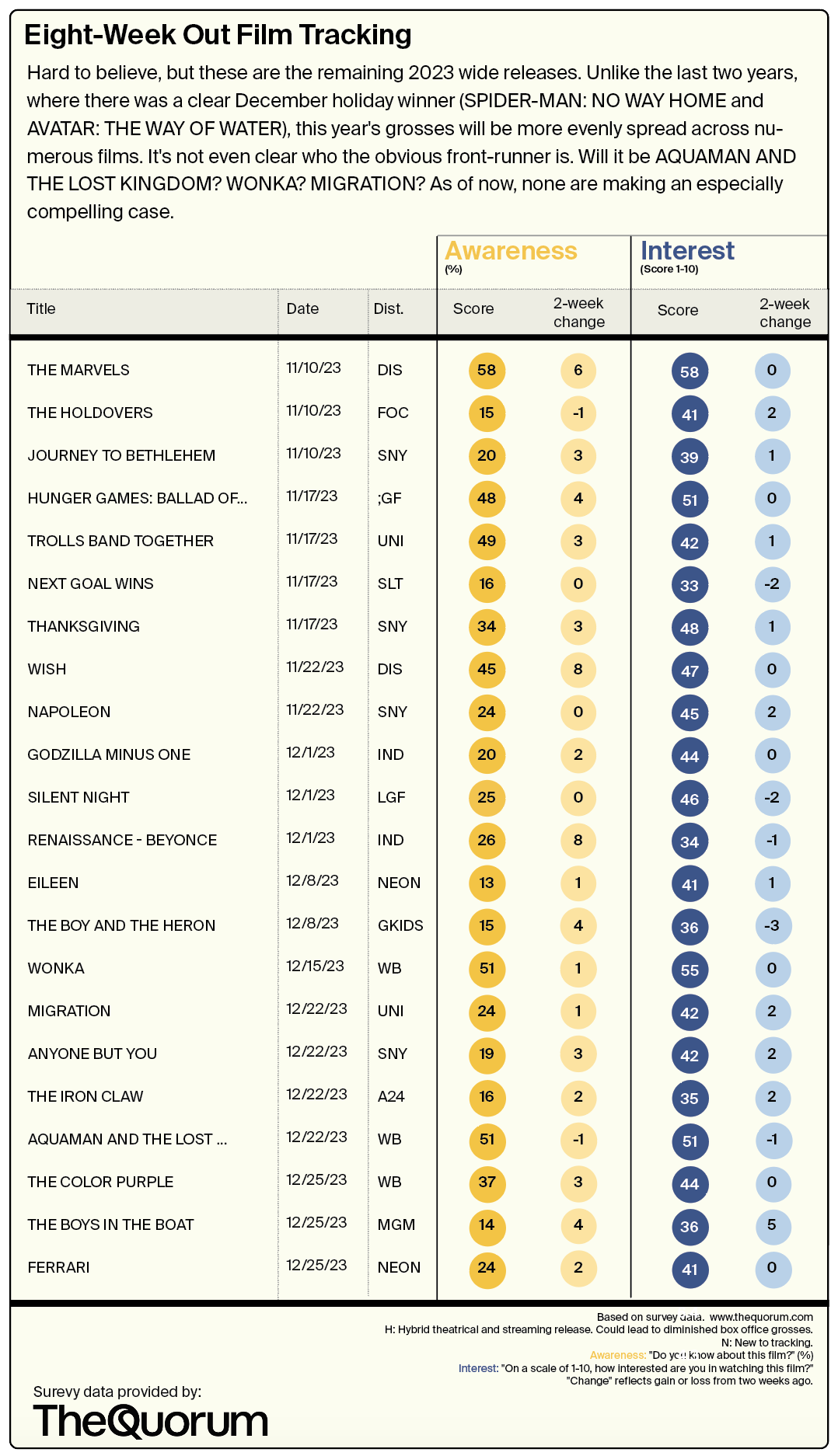
| All the year’s remaining movies are now posted on The Quorum’s early tracking chart… and unlike the past two years, there isn’t a single guaranteed massive hit among them… |
|
|
|
|
| I’ve let up on the fun stuff during the strikes, but congrats to Luber Roklin Entertainment and manager Randy Kiyan, who won the Entertainment Softball League championship yesterday in a stunning come-from-behind 16-12 victory against TBD Marketing. It’s LRE’s third title in the past five seasons. |
|
|
| Have a great week,
MattGot a question, comment, complaint, or a TV critic you’d like me to malign anonymously on Twitter? Email me at Matt@puck.news or call/text me at 310-804-3198. |
|
|
|
| FOUR STORIES WE’RE TALKING ABOUT |
|
|
|
|
|
 |
|
|
| Need help? Review our FAQs
page or contact
us for assistance. For brand partnerships, email ads@puck.news. |
| You received this email because you signed up to receive emails from Puck, or as part of your Puck account associated with . To stop receiving this newsletter and/or manage all your email preferences, click here. |
| Puck is published by Heat Media LLC. 227 W 17th St New York, NY 10011. |
|
|
|