 |
 |
|
Welcome back to What I’m Hearing, and happy long M.L.K./Emmys/NFL Wildcard weekend. It was great to see so many people at the Evening Before party last night, especially the woman who came up to me and said, “I loved you on White Lotus.” (I’m gonna pretend she thought I was Theo James… not Michael Imperioli or F. Murray Abraham.) Congrats to the M.P.T.F. and Bob Beitcher for raising $2.5 million in a very tough economic environment.
🚨🚨 Sundance event details! Come to our LIVE taping of The Town on Jan. 22 at 4 p.m. on Main Street in Park City, with a special guest and a little reception afterward. Tickets go on sale tomorrow, but What I’m Hearing readers can get them NOW by clicking here.
Programming note: I was on How Long Gone, the preferred podcast of bicoastal elites (listen here). This week on The Town, Lucas Shaw and I predicted how the Disney proxy war will play out, Ethan Strauss explained why ESPN can’t control Pat McAfee, and Bill Cohan questioned why anyone would buy Paramount Global. Subscribe here and here.
Was this email forwarded to you? Click here to become a Puck member. Got a news tip or an idea for me? Just reply to this email.
Discussed in this issue: Jon Feltheimer, Bob Iger, John Mulaney, Ava DuVernay, David Zaslav, Adam Fogelson, Timothée Chalamet, Jeff Sagansky, Eli Roth, Pat McAfee, Meghan Markle… and Binny the Disney World trash can.
But first…
|
| Who Won the Week: Tina Fey |
|
| She’s now made Mean Girls an improbable hit three separate times, with the 2004 movie, the stage musical, and the film based on the musical, which is opening to about $32 million domestic on a $36 million budget. Plus, she just sold The Four Seasons, a new comedy series created with Lang Fisher and Tracey Wigfield, to Netflix.
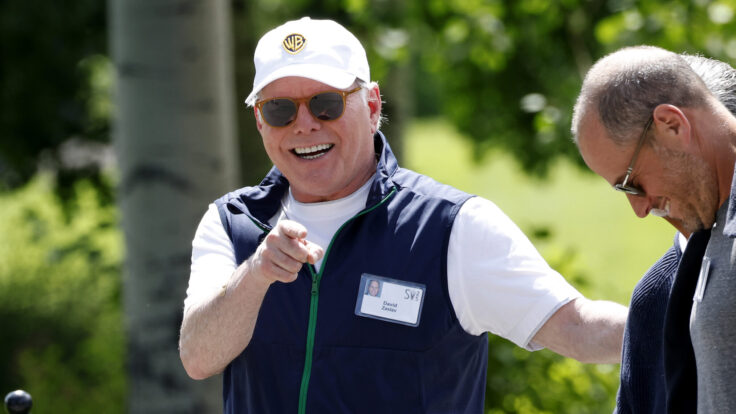
Runner-up: Terry Press and the team behind the TCM 30th anniversary event on Friday, for not letting Warner Bros. Discovery C.E.O. David Zaslav deliver remarks, which would have been super awkward considering he gutted the network (and then un-gutted it after outcry).
Second runner-up: Arthur Bochner, who managed to score the top communications job at News Corp. despite flaming out as Bob Chapek’s longtime P.R. guy at Disney. |
|
|
“It’s a disgrace.”
—Rep. Pat Ryan (D-N.Y.), ripping Saturday’s first streaming-only NFL playoff game in a letter to Peacock sibling NBC Sports and the league, adding: “Fans already face exorbitant prices to watch every game during the regular season; they don’t deserve to be squeezed even further by greedy corporations.”
A little more on this…
No disrespect to the grandstanding congressman and all the angry fans online, but this is kinda how the media business works: Pay a lot (in this case $110 million for one playoff game) for something people really want to see, then leverage it to get them to consume your product. This game, boosted by the subzero temperature and Taylor Swift, averaged 23 million viewers, per NBC Sports. That includes the linear audience in Kansas City and Miami, but it’s actually up from the Saturday primetime Wild Card game last year, and Peacock only has about 30 million subscribers. So this is by far the most people using Peacock since its launch in 2020. And the NFL takes only a minimal hit from its fans and opportunistic politicians, while dipping its toe further into the streaming future. Big upside, minimal downside.
Remember, everyone freaked out in 2014 when Disney put the first playoff game on ESPN, even though waaaay more people had cable back then, obviously, than have Peacock now. In the early ’90s, when Rupert Murdoch outbid CBS for the NFL, it was people in markets that didn’t have Fox who complained. We probably won’t know the Peacock sign-up number for a while—and Julia Alexander will crunch more numbers in Tuesday’s WIH+—but judging by the NBC stats, the Google Trends spike for Peacock, and its No. 1 spot on the App Store last night, I’m betting it’s a huge boost. Good for Peacock, at least for now; churn will be the key metric.
Now, an under-the-radar story in Hollywood M&A… |
| Lionsgate’s Long, Long Road to a Lifeline |
|
| Lionsgate replaced its film chairman Joe Drake with Adam Fogelson this week, which I don’t think surprised anybody who was paying attention. The small studio—what we used to call a “mini-major” until the majors became mini compared to the tech giants—had a good year, with new installments of John Wick, Saw, and Hunger Games. But C.E.O. Jon Feltheimer has been frustrated over the lack of new franchises to help lure potential buyers of the company, and recent efforts like Chaos Walking and Borderlands haven’t panned out. (Side note: Borderlands, a pricey video game adaptation from filmmaker Eli Roth, finished shooting back in 2021 with Cate Blanchett and Kevin Hart, and it’s been super troubled. It isn’t scheduled to hit theaters until August, more than four years after the green light.)
So when Fogelson, the former Universal and STX studio chief, joined Lionsgate in July 2022 to help with marketing, many saw it as a first step toward a new film leader. (Lionsgate’s spokesman declined to comment.) And it’s a particularly interesting time for the company. Everyone’s obsessing over the future of Paramount and Warner Discovery, but Lionsgate might be the more interesting company to watch this year. After trying various schemes to juice the stock, merge and/or sell the company, Feltheimer landed on a SPAC deal with industry veterans Harry Sloan, Jeff Sagansky, and Eli Baker that will make Lionsgate much more appealing to potential buyers. The film and TV studios will go public in a new entity called Lionsgate Studios, eventually leaving the loser Starz TV channel and streamer behind. If all goes according to plan, Lionsgate Studios will end up in the loving embrace of a tech or entertainment company looking to grow. Investors will get a much higher valuation, bankers will get paid, and shareholders won’t have to keep giving Feltheimer, who’s had this job since way back in 2000, his $21.5 million in annual compensation. Will that work?
Maybe. Given the realities of the business these days, is anyone in the market for a studio? But being so much smaller than some of the other challenged studios could actually help attract a suitor. Lionsgate has a pretty robust 20,000 title library, including all those Twilight and Hunger Games films and series like Mad Men, and it just picked up the eOne library in a fire sale from Hasbro, and that includes Grey’s Anatomy, among others. The company claims its studio business is worth $4.6 billion, though that’s about double the market capitalization of the entire company, including Starz. In May, Rosenblatt Securities put a $5.2 billion value on Lionsgate’s library, which shows just how much Starz is dragging down the rest of the company.
But even at that valuation, and with a big premium, Lionsgate Studios would be far smaller than, say, Paramount Global or Warner Bros. Discovery, and thus could be an attractive and affordable absorption for Apple, Netflix, or any of the others, and at a time when library movies that received wide theatrical releases seem to perform better than original films on streamers. Plus, unlike with Paramount, a buyer of New Lionsgate won’t need to deal with cratering cable TV assets or a subscale streamer. Those are being cleaved off, which Lionsgate can do because it makes most of its money on the content itself, not on carriage fees or ads.
Of course, that leaves poor Starz, whose C.E.O., Jeff Hirsch, is in a pretty tough spot. Maybe someone will come along and want to buy the unit and its 28 million linear and streaming subs. But Hirsch has certainly been out there pitching potential investors on anything and everything, from pure investment deals to larger roll-ups with other languishing streamers. So far, no takers. It’s a long way from 2016, when Lionsgate paid $4.4 billion for Starz and everyone thought the synergies between the studio and the channel/streamer were game-changing.
There’s a longer story in what happened to Starz, the years of trying to move beyond its mommy porn hit Outlander and the Power franchise with 50 Cent—who, incidentally, has turned against Hirsch, calling his team the “wrong people” and doing a development deal with Fox. Hirsch paid a fortune for little-watched prestige plays like Gaslit, with Julia Roberts and Sean Penn, and the dysfunction with the Lionsgate studio always bubbled below the surface. Lately, Hirsch has been gleefully canceling shows like he’s Warner Discovery C.F.O. Gunnar Wiedenfels. He’s eyeing some kind of lifeline, but few think he will find it.
More likely, this SPAC split will be far better for the Lionsgate side. Though for an industry already facing contraction and consolidation, the best-case scenario for Lionsgate would mean the purchase and shutdown of another Hollywood studio.
Now for Scott Mendelson’s take on an emerging trend at the box office…. |
 |
| Hollywood’s Dude Slump |
| Following the so-called #Barbenheimer phenomenon, the only big-deal domestic hits in the last five months of 2023 were female-driven or female-skewing films. Too bad Hollywood is still betting on male-dominated superhero I.P. |
|
|
|
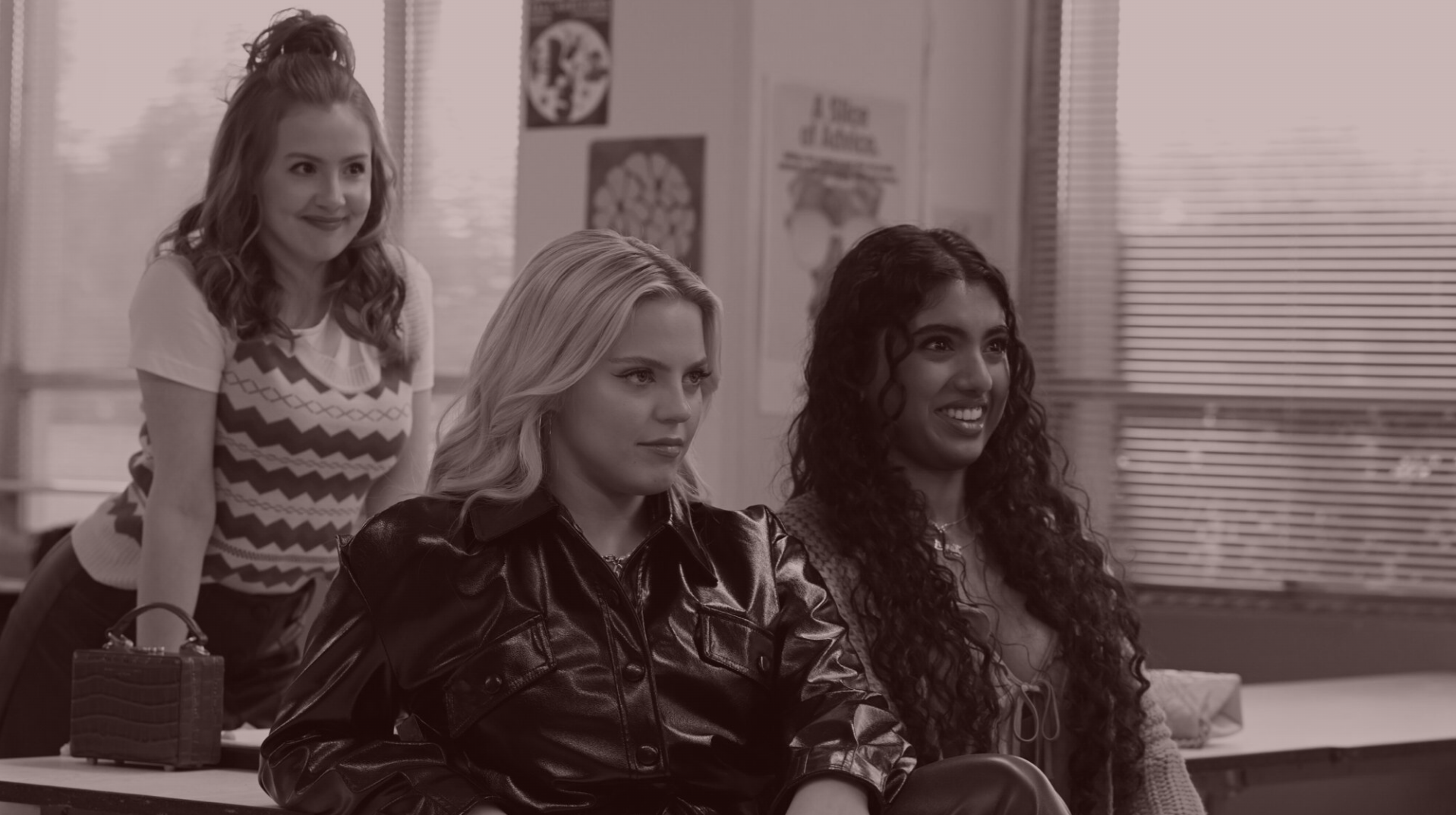
| It may or may not be surprising that Mean Girls, the new film based on the 2004 Tina Fey-written coming-of-age comedy and subsequent Fey-written musical, is on track to gross $32 million over the long M.L.K. Day weekend. Mean Girls is just the latest example (see also: Smile and Evil Dead Rise) of a film intended for streaming that was instead deployed to theaters to seek fortune and glory. It’s also the latest example of a theatrical success story powered by women and girls. The film follows the $1.4 billion global success of Greta Gerwig’s Barbie and those AMC-distributed concert films from Taylor Swift and Beyoncé, which gave strike-impacted theaters a shot in the arm late last year in between #Barbenheimer in mid-July and the year-end holiday frame, which offered up hits big (Wonka) and small (Anyone But You).
The notion that films for young women can be as competitive as the stereotypically manly tentpole isn’t new, no matter how much the internet troll industrial complex might try to make you forget Twilight, Alice in Wonderland, Hunger Games, Frozen, Maleficent, Zootopia, Wonder Woman, Beauty and the Beast, and Captain Marvel. There are also smaller-scale hits, like Sex and the City, Bridesmaids, The Fault in Our Stars, Lucy, Pitch Perfect, Hidden Figures, Girls Trip, Crazy Rich Asians, and Hustlers. Mean Girls would already qualify for this category.
Whether women could front action movies or fantasy tentpoles was less of an issue when Hollywood was still making midbudget, female-focused films like Look Who’s Talking, The Pelican Brief, and Unfaithful on the regular. However, the modern emphasis on all-quadrant fantasy franchises about white guys discovering they’re special (or pushing boy-centric animated spinoffs of Shrek and Toy Story alongside Judd Apatow-inspired bromances over rom-coms) meant that fewer conventional female-led studio films were being produced. Fifteen years ago, Anastasia and My Best Friend’s Wedding were business as usual in this town. More recently, Brave and Trainwreck have become test cases for an entire gender.
During this era, it was notable to see Mamma Mia! outgross Iron Man globally ($609 million versus $585 million), or Bridesmaids and The Help earn domestic grosses ($169 million and $170 million, respectively) on par with Thor ($181 million) and Captain America ($176 million), only for those success stories to be treated like flukes or exceptions to the rule. This past summer, however, a slew of conventionally male-driven franchise flicks all trying to be the next Top Gun: Maverick fell flat. The Flash, Transformers: Rise of the Beasts, F9, Indiana Jones and the Dial of Destiny, and Mission: Impossible—Dead Reckoning, Part 1 underwhelmed or outright tanked. In fact, the “next” Top Gun wasn’t another adrenaline-filled thriller. It came in the form of Warner Bros.’ Barbie. After all, the “next” Harry Potter was Twilight, which was nothing like Harry Potter.
Following the so-called #Barbenheimer phenomenon, the only big-deal domestic hits in the past five months have been Taylor Swift: The Eras Tour ($180 million) and The Hunger Games: The Ballad of Songbirds and Snakes ($165 million, co-starring the troll industry’s latest target, Rachel Zegler); the youth-skewing Five Nights at Freddy’s ($137 million); and the family-friendly Wonka ($177 million and counting). While it’s not a zero-sum game (see also: solid earnings for The Equalizer 3 and Meg 2: The Trench), the likes of A Haunting in Venice, Ferrari, Dumb Money, and Strays all earned a hell of a lot less in North America than that Color Purple re-adaptation.
I wouldn’t classify Wonka as female-driven, necessarily. It was directed by Paul King and starred Timothée Chalamet, of course, but the PG-rated musical played 54 percent female and 52 percent under-25 on opening weekend before legging out $505 million worldwide. Yes, girls and women showed up for reasons beyond Chalamet being an old-school hunk, but that didn’t hurt—nor should it be taken as a criticism to note as much. |
|
A MESSAGE FROM OUR SPONSOR
|
 |
| |
|
|
|
|
| Notably, these hits aren’t coming from Disney. The two big flops of the pre-holiday season were The Marvels (the sci-fi sequel dropped 82 percent from the $1.13 billion of Captain Marvel) and Walt Disney Animation’s Wish, which has earned just $63 million domestic and $224 million worldwide. After an industry-dominating 2010s, partially predicated on female-led blockbusters like Star Wars: The Force Awakens, Frozen, Alice in Wonderland, Beauty and the Beast, and Zootopia, Disney’s tentpoles are struggling compared to their predecessors and their Hollywood competition. To wit: May’s Little Mermaid earned $560 million compared to Maleficent earning $759 million in 2014, let alone Beauty and the Beast passing $1.26 billion in 2017.
Disney tried to (shamefully, I’d argue) blame racism and review-bombing for Little Mermaid’s underperformance abroad. A more likely culprit was its existence as a star-free remake of a domestic-skewing property with little to offer for those not already part of the I.P.’s fandom, not unlike what transpired with Solo: A Star Wars Story and Ghostbusters: Answer the Call. (A week later, Sony Animation’s Spider-Man: Across the Spider-Verse, focused on Afro-Latino hero Miles Morales, would swing toward an eventual $690 million global run.)
In reality, Disney’s slew of animated films became Disney+ cannon fodder (Soul, Luca, Turning Red), compromised hybrid releases (Raya and the Last Dragon alongside live-action tentpoles like Mulan and Cruella), or casualties of a new status quo whereby big-budget, original toons like Strange World, Elemental, and Wish are no longer automatic theatrical events compared to the heyday of 2010 to 2017 (Tangled to Coco). The generation that grew up with Disney tentpoles and Marvel Cinematic Universe films has now comparatively aged out. |
|
|
| They grew up amid total superhero saturation, but the generation that came of age amid a Donald Trump presidency and a global pandemic are less interested in costumed vigilantes metaphorically re-avenging the 9/11 attacks over and over. Of note, The Marvels opened with $47 million in November while playing 65 percent male and 51 percent over-35. Forty percent of the $155 million debut weekend for Captain Marvel was 18-24, while just 19 percent of that demo made up the much-smaller piece of its sequel’s debut. Despite the cast and female filmmaker in Nia DaCosta, women weren’t interested. The very next week, Songbirds and Snakes earned $45 million, with women making up 54 percent, and the overall age split skewing 44 percent 18-24 and 37 percent women under 25.
If a superhero movie or Disney toon is no longer aspirational or cool to today’s kids, and no longer worthy of being seen as a date-night option, that the latest one stars “not white guy” actors is all but irrelevant. Recall an old Simpsons episode where Lisa reacts to a gay pride parade by stating, “You do this every year, we are used to it!” A generation that grew up on diverse and inclusive entertainment like Shadow and Bone and Doc McStuffins isn’t going to give automatic extra credit to a diverse Disney flick.
Female audiences, along with interested boys and men, are now as likely to opt for a Scream sequel, a musical Mean Girls, or a Hunger Games prequel over a girl-powered animated fantasy or a big-budget (female-led or otherwise) comic book movie. Meanwhile, Emma Stone’s Poor Things is about to become the fourth platform release of the Covid era to pass $20 million domestic.
This is all great news. What’s a little more disconcerting, however, is the extent to which male-led franchise biggies wiped out this past year, since that still represents much of what Hollywood has on deck this year and the next. |
| ) |
 |
|
|
|
|
| Looks like Bob Iger found his ESPN lifeline in the NFL, which is negotiating to offload NFL Media in exchange for a stake in the Disney unit. If the deal happens, I’m guessing the word “concussion” will be banned from SportsCenter. [NY Post]
Speaking of ESPN, I’d love a video of the conversation where an executive had to tell Lee Corso that his Emmys are fraudulent and they need to be returned ASAP. [The Athletic]
Universal Music, Pixar, Amazon: Update your Layoffs 2024 scorecard here. [L.A. Times]
Fox News finally grew a conscience and stopped accepting ads from the MyPillow Guy after his dangerous election lies… haha no never mind, he just stopped paying his bills. [WashPost]
Bryan Curtis has a good perspective on ESPN’s Pat McAfee fight and how its stance has changed toward unruly talent. [The Ringer]
Can a bad Globes speech lose you an Oscar? Interesting case studies of Glenn Close, Richard Gere, Lady Gaga, and more. [Vulture]
Ava DuVernay said on Sam Fragoso’s podcast (at minute 56) that she’s “tapping out” of the “Hollywood industrial complex” and will “pass the baton” to others over the industry’s ongoing failures in diversity and inclusion: “This town does not want it.” [Talk Easy]
Bookmark this link so when John Mulaney is announced as Oscars host in the next couple years, you can review why. [YouTube]
The Disney Day Drinkers club is irate that Binny the Trash Can, their official mascot, has been moved from its usual location outside the Rose & Crown pub at Epcot. If any of that makes sense to you, please see a therapist. [WSJ] |
|
|
| My interview Thursday with the leaders of the five big labor unions generated some pushback to their comments, especially on the issue of using A.I. to motivate members. Some examples:
“Ah yes, unifying people around their fear of something they don’t understand. That should work out well.” —A filmmaker
“Thank you for running this [full conversation]. The trade headlines focused only on the strike threats, but these issues are bigger than that. We are part of a global movement, and we are fighting for our ability to have jobs at all.” —A writer
“Let’s review what Big Labor has gotten us lately: [Television] writers have to pay [their agents] commissions now, and the employers are getting richer by not having to pay package fees. A six-month strike that cost everyone billions of dollars and drove many of their own members out of the business. Now a deal that makes every production more expensive, thus leading to fewer productions. Can’t wait to see what’s next!” —An agent
“The arrogance of these ‘leaders’ using all of us as their pawns to get a percentage or two more in pay and some B.S. ‘protections’ against A.I. that the streamers will just sidestep anyways. Another strike would be The End. Period. Just shut down the studios and sell it all to Microsoft.” —A producer |
|
|
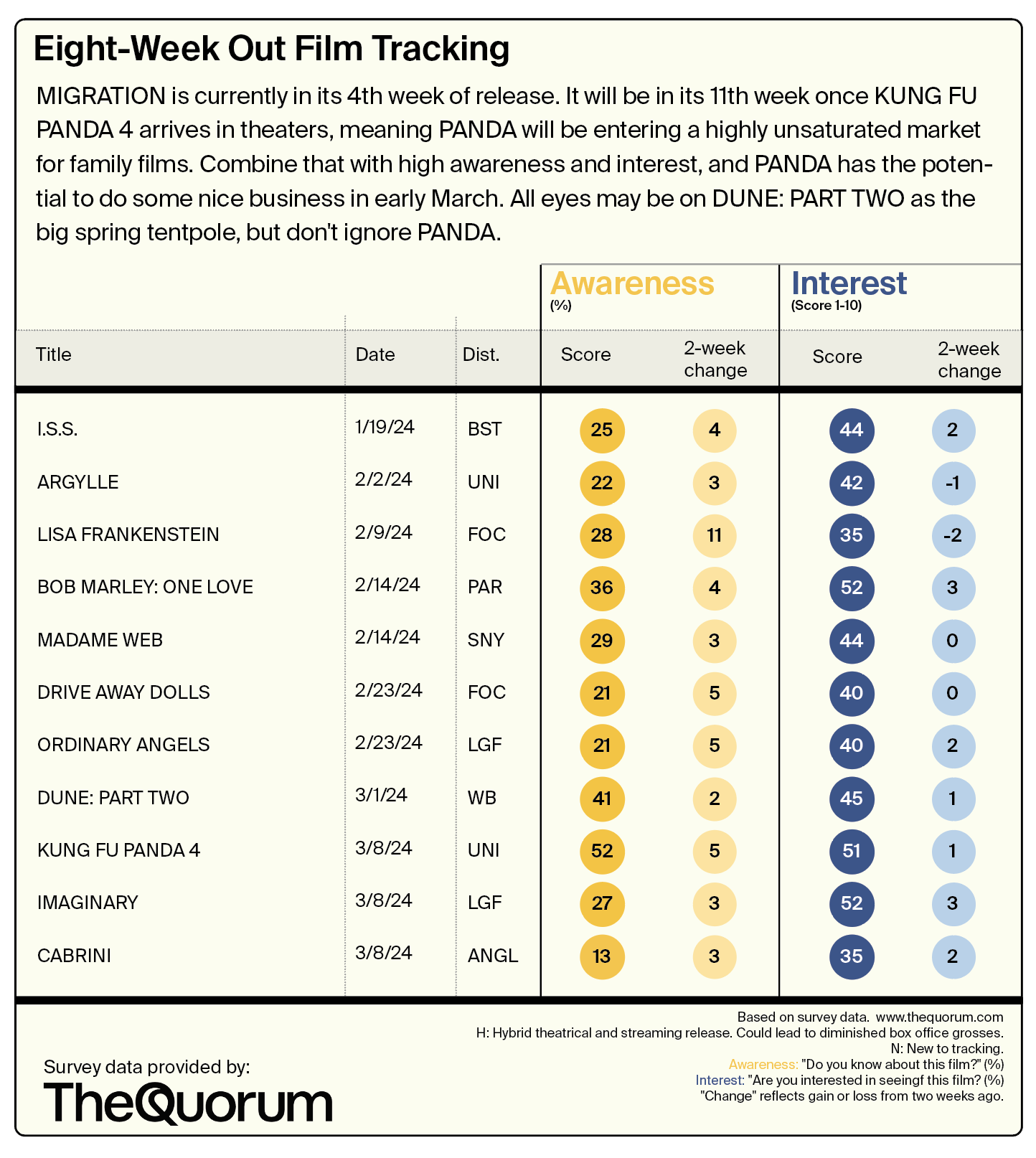
| Kung Fu Panda is looking like a possible breakout in March, benefiting from months without a family animated pic in theaters, according to The Quorum early tracking chart… |
|
|
| Finally Finally… One Fun Thing… |
|
| The Suits spinoff is either trolling or courting Meghan Markle, I can’t tell. I read a draft of the script for Suits L.A., the pilot from Suits creator Aaron Korsh that’s set at an entertainment law firm and is about to start casting at NBC, and it’s got a lead role that might be of interest to a certain actress turned royal turned Montecito Pane e Vino enthusiast.
ERICA - 30s, Black, SoCal native, and Harvard law alum. She’s jockeying to be made Head of Entertainment. She’s great at closing clients but struggles elsewhere. Smarter than everyone. |
| Yes, Meghan is 42 now, but whatever. |
|
|
Have a great (short) week, say hi if you see me at the Emmys,
Matt
Correction: I did the million-billion thing again on Thursday. Amazon bought MGM for $8.5 billion, not million, of course. Apologies to Kevin Ulrich’s bankers for the inadvertent insult.
Got a question, comment, complaint, or an invite to your Sundance party? Email me at Matt@puck.news or call/text me at 310-804-3198. |
|
|
|
| FOUR STORIES WE’RE TALKING ABOUT |
 |
| Ack, Man |
| On Bill Ackman’s very public crusade against B.I., Axel Springer, and KKR. |
| DYLAN BYERS |
|
 |
|
 |
|
 |
|
|
|
|
|
 |
|
|
|
Need help? Review our FAQs
page or contact
us for assistance. For brand partnerships, email ads@puck.news.
|
|
You received this email because you signed up to receive emails from Puck, or as part of your Puck account associated with . To stop receiving this newsletter and/or manage all your email preferences, click here.
|
|
Puck is published by Heat Media LLC. 227 W 17th St New York, NY 10011.
|
|
|
|