Welcome back to a very special anniversary issue of What I’m Hearing. No, it’s not a clip
show… well, not really.
💫💫 Exactly five years ago yesterday, I sent an email to 300 people in my Outlook folder— producers, executives, filmmakers, actors, and friends. I seriously wondered if anyone would read it or care. This was May 2021, Covid had upended the industry, and a new kind of anxiety had descended on a community that was, by most objective measures, thriving but felt under attack by tech platforms, losing relevance to algorithmically amplified social media apps and unsure
if the movie business that built Hollywood would survive the pandemic.
As a trial balloon for a still-secret media company called Puck, What I’m Hearing attempted a new approach to entertainment business journalism—voice and opinion mixed with well-sourced news; a direct connection between the author (me) and the community via newsletters, or “private emails” as we called them; and most importantly, not beholden to the publicity apparatus that had neutered so much of what drew me to
covering Hollywood in the first place. In short, an attempt to reflect what this community was actually talking about.
A few weeks after I sent that first email, a prominent executive invited me to lunch and informed me that she didn’t like my style and her company would not be supporting my efforts. So it was working. Today, tens of thousands of paid members receive What I’m Hearing, and Puck has grown to nearly 100 employees, covering everything from fashion to sports, politics to the
art market, media to sports, and finance to A.I. We recently added Air Mail and its lifestyle and society coverage as well.
Anyway, that’s all prelude to thanking everyone for reading What I’m Hearing over these five years, subscribing to Puck, and coming on this ride with us. Along the way, I launched The Town podcast with the Ringer and Puck, and I welcomed great collaborators in authors like Julia Alexander, Eriq Gardner, Kim
Masters, Scott Mendelson, Maya Tribbitt, and more. But the most important relationship is with you.
So tonight, I’m turning the space over to readers to tell me what’s changed most about their experience in Hollywood over these past five years. The answers really illuminate the crazy era of disruption we’re living through. Plus I’ve got some news, of course. A major firing just went down on a big Paramount+ show, the strange
disappearance of Jared Leto, Netflix’s latest flirtation with theaters, and more…
Discussed in this issue: David Zaslav, Jeff Bezos, Brett Ratner, Greta Gerwig, Jared Leto, David Glasser, Jez Butterworth, Melania Trump, Ted Sarandos, Helen Mirren, Rich Gelfond, Nicholas
Galitzine, Bryan Lourd, Pierce Brosnan, Taylor Sheridan, David Fincher, Tom Hardy, Quentin Tarantino, Eduardo Acuna, Adam Aron, Larry Ellison, John Malone, Jessica Reif Ehrlich, David Ellison, Chris Nolan, Patrick Whitesell, John
Stankey, Reese Witherspoon, Greg Berlanti, J.J. Abrams, and… Netflix cheapskates.
Not a Puck member yet? Just click here. Got a news tip or an idea for me? Just reply to this email, text me, or message me on Signal at 310-804-3198.
Let’s begin… |
-
‘Mobland’ takes a hit out on Tom Hardy: Any list of the most difficult actors in town would probably include Tom Hardy, right? He was just booted off Mobland, the highest-rated non-Sheridan show on Paramount+. I’m told Paramount recently opted not to pick up Hardy for Season 3 after his clashes with producers Jez Butterworth and David Glasser, among others, during the recent production of Season 2. Hardy was
apparently late to set a bunch, constantly asked to give notes on scripts, attempted to change dialogue, and expressed his displeasure that a series initially built around him was increasingly becoming an ensemble showcase for Helen Mirren, Pierce Brosnan, and other co-stars. It got to the point where Butterworth threatened to quit, according to a source familiar. Paramount responded by dropping Hardy instead, though his contract does contain a mutual option for
the third season, so he could have bailed on his own if he wanted. (Reps for Hardy and Paramount declined to comment.)
- Leto’s ‘Masters of the Universe’ erasure: Who’s ghosting who?: No, Masters of the Universe star Jared Leto didn’t attend Monday’s big premiere of Amazon MGM’s summer tentpole. Nor was Leto at the studio’s CinemaCon presentation. Nor is he booked on major talk shows in advance of the June 5 release of
the $175 million movie. Nor has he posted a single message to his 11.4 million followers on Instagram about the film. Which is odd because a) the Oscar winner/rock star is by far the biggest name in the movie, which stars Nicholas Galitzine as He-Man, b) Leto is nearly unrecognizable behind a C.G.I. mask as Skeletor in the film, meaning his value to the production is largely in promotion, and c) Amazon paid him more than $5 million, per one source, which
presumably includes promotion. That source told me Leto wasn’t thrilled with the film, but honestly, it makes sense that Amazon is downplaying Leto’s involvement after recent allegations against him (which he denies), as well as his Tron: Ares bombing last year. (His rep didn’t respond and Amazon declined to comment.)
|
|
|
|
A MESSAGE FROM OUR SPONSOR |
AMC and AMC+ present THE AUDACITY. From Emmy® Award-Winner Jonathan Glatzer, the Tech-Disrupting Drama Features a Powerhouse Cast Led by
Billy Magnussen, Sarah Goldberg, Zach Galifianakis and More. Lauded as “...a Sharp, Sweeping Take on What Makes Tech Moguls Tick” by Variety and a “sharp-edged new AMC series” by Emmy Magazine.
For your Emmy® consideration in all categories including OUTSTANDING DRAMA SERIES. Episodes available to stream now on www.amcfyc.com with access code:
y77xvqth |
|
|
|
-
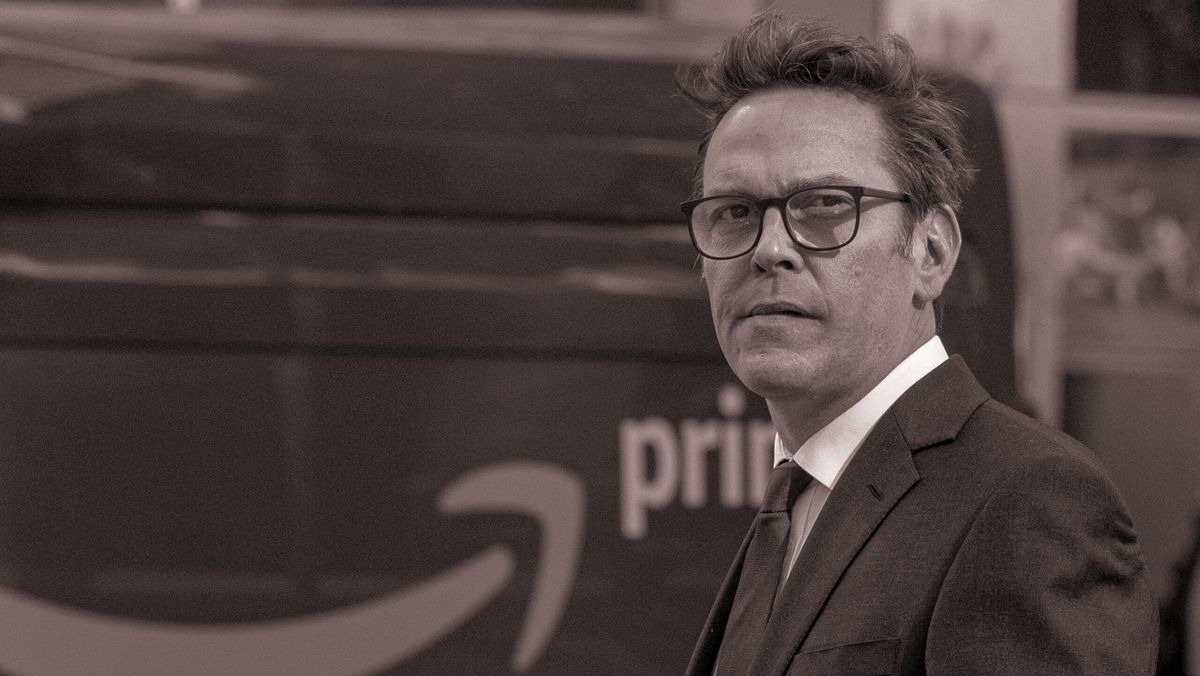
And speaking of Amazon…: It’s tough to argue Hollywood economics with a guy who thought paying $250 million for TV rights to Lord of the Rings was a great idea, but Jeff Bezos’s assessment of Melania as a “good business decision” can’t go un-ridiculed. “It’s done very well on streaming,” Bezos insisted yesterday on CNBC.
Has it? As I reported last year, Amazon paid a crazy $40 million fee to license the first lady’s Brett
Ratner–helmed vanity doc, then another $35 million to release and market it worldwide. It grossed $16 million in theaters and charted on Nielsen’s weekly top 10 exactly once, with 230 million minutes viewed, enough to reach No. 7 in early March. Both the box office and streaming metrics are good for a documentary, but they’re decidedly not good for a movie at that cost—a definite money loser, unless for some reason the international streaming numbers were huge (Nielsen only
tracks domestic). Most likely, Bezos actually means “good business decision” for other, Trump-related reasons. - Will Regal play the Fincher movie?: Congrats to David Fincher for getting the “Greta deal” for his sequel to Tarantino’s Once Upon a Time… in Hollywood—and without even demanding it. I’m told Netflix actually reached out to AMC and Imax about swapping in the Fincher movie for two weeks in theaters at
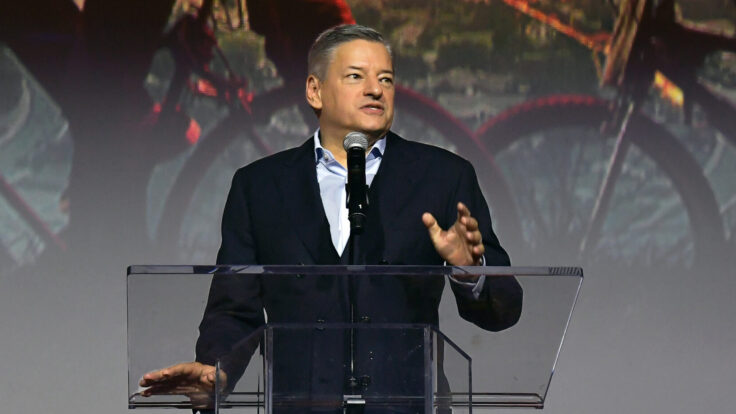
Thanksgiving once Gerwig’s Narnia moved to February, not the other way around. It’s a further softening by Netflix co-C.E.O. Ted “Not Our Model” Sarandos—while Netflix P.R. can still spin it as a stunt. Meanwhile, my buddy Adam Aron at AMC, Ted’s new B.F.F., seems more than happy to allow a short 28-days-to-S.V.O.D. window in exchange for two weeks of a movie whose predecessor grossed $400 million in 2019.
- More…: Regal and other chains with Imax screens were not involved in the deal and have not committed to playing the film, I’m told. With Narnia, Imax C.E.O. Rich Gelfond had committed to delivering about 1,000 theaters, which gave Regal some leverage if C.E.O. Eduardo Acuna declined to play the film on his Imax screens without a longer window. But this time around, there’s no commitment to a full Imax release,
allowing Gelfond to put the film on AMC’s Imax screens without the participation of Regal or others—and leaving Acuna with a tough choice: boycott the movie over the short window and lose out on millions in revenue, or play it and potentially open the door to other studios demanding similar releases, ultimately undermining the foundation of his entire business.
- Are Netflix subscribers just bigger cheapskates?: Our researcher
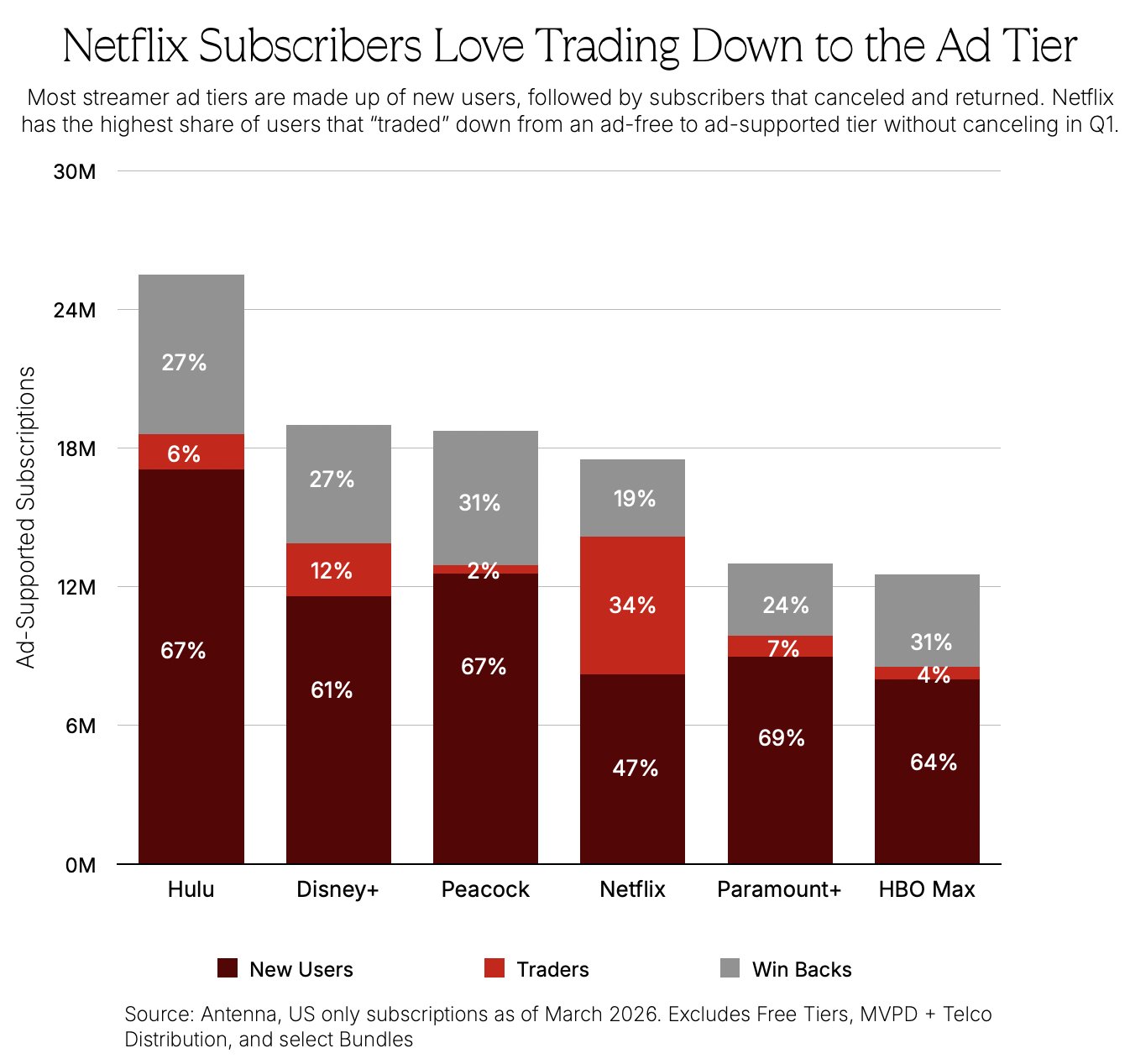
Maya Tribbitt spotted this telling/amusing stat in the latest data dump from Antenna. Fully 34 percent of subscribers to the Netflix advertising tier are former ad-free members who traded down to pay less. That’s nearly triple the rate of the next-highest service, Disney+. Netflix has more total U.S. subscribers than the others, of course, so it’s got a bigger base from which to recruit to the ad tier (and it does recruit). But since so many streaming customers
likely consider Netflix to be more like a utility, it makes sense they’d want to get their “TV” for less, even if it comes with ads.
|
-
Box office over/under: Can a Star Wars movie really be tracking for just $85 million or so over the four-day holiday weekend? Yes, and given the reviews and buzz, I’ll unfortunately take the under on Disney’s Mandalorian and Grogu.
|
Now on to the five-year anniversary quasi-clip show… |
|
|
|
A half decade of M&A opportunists, Peak TV casualties, industry contraction, devastating
strikes, and approximately 1,500 David Zaslav mentions later, show business still can’t figure out if it’s reinventing itself or fading away. So I asked 100 industry sources what they think is going on. |
|
|
|
The first issue of What I’m Hearing landed exactly five years ago yesterday in the inboxes of 300 friends and
colleagues in Hollywood. I know, May 2021 seems simultaneously like five days and five hundred years ago, especially since this newsletter now reaches tens of thousands of readers all over the world. But in ways I couldn’t have anticipated, that first email send was perfectly timed.
That same week, the Discovery Communications investor John Malone and his blunt-force avatar C.E.O., David Zaslav, announced an improbable deal: Discovery, long
considered by Hollywood to be a trashy outsider—with roots in, gulp, Maryland—would merge its low-rent reality shows with the prestigious HBO and Warner Bros. studio. AT&T’s John Stankey, who had taken three years to realize that paying $85 billion for premium content was an ineffective way to sell wireless plans, wanted out. And Malone and Zaslav saw in WarnerMedia a lifeline, a way to catapult their melting cable TV business into a potential Netflix killer. Or
something.
More urgently, this was a chance to bolt their TV deadweight and $50 billion of debt onto Game of Thrones and Batman so some tech behemoth might buy the combined company, melting cable TV business included. “None of this matters,” I wrote back on May 20, 2021, “if Zaslav is simply combining these assets to flip the whole thing to Apple or Amazon.” When that happens, I continued, “if Amazon takes MGM, NBCU goes after ViacomCBS, and tiny players like Lionsgate or Sony’s
Hollywood unit are left looking for suitors, the long-predicted great roll-up of entertainment assets could truly come to fruition.”
Cut to five years later, and that roll-up is in full swing. Amazon did absorb MGM, but it was Oracle money from Larry Ellison, not Apple or Amazon, that first acquired ViacomCBS, now Paramount Global, and Warner Bros. Discovery, pending government approval. Malone and Zaslav succeeded in the most cynical way possible, saddling the
good with the very bad, firing tens of thousands of employees, positioning the company for consolidation, and absconding with many hundreds of millions of dollars for themselves.
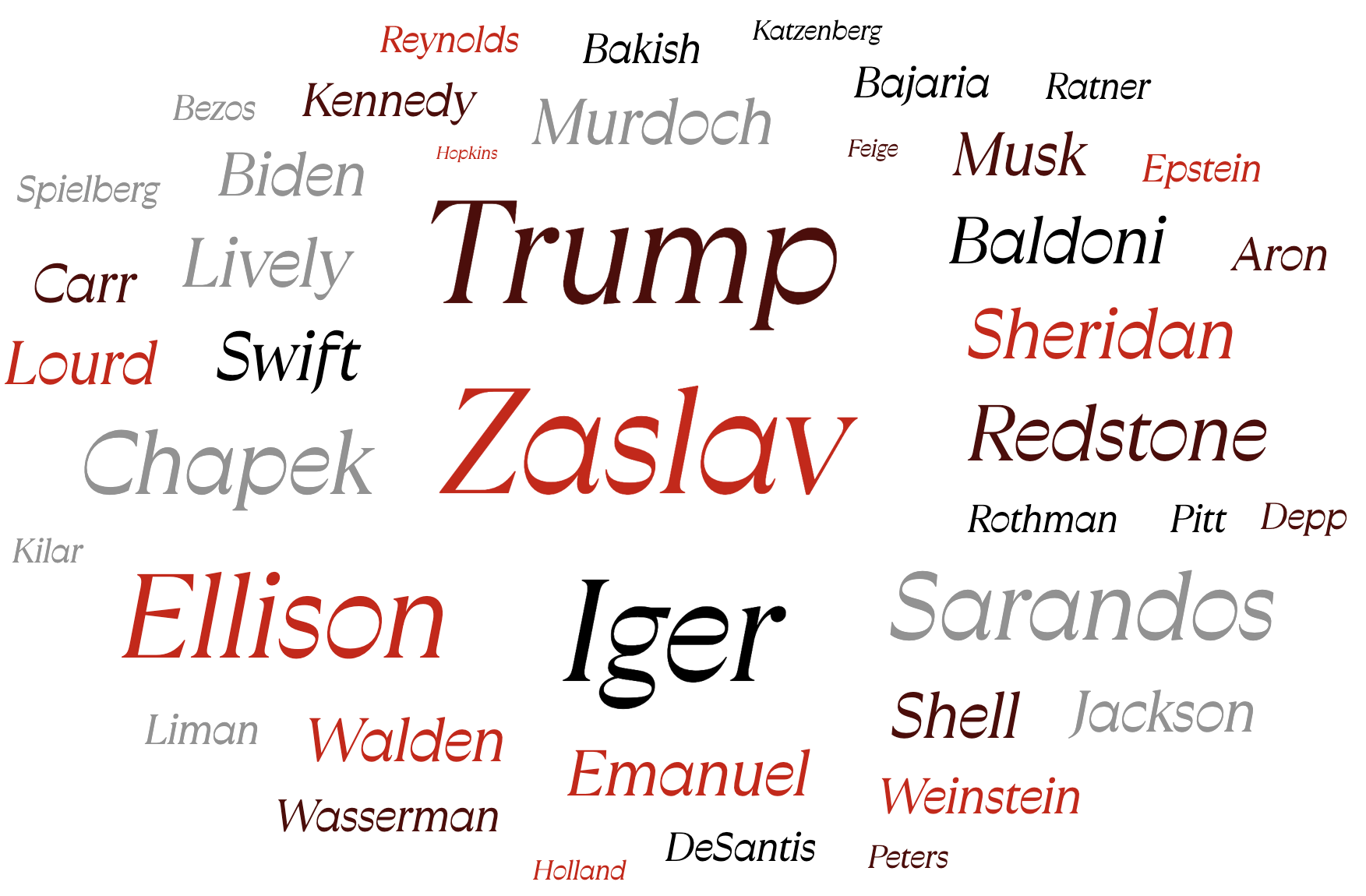
Zaslav may be the defining figure of the past five years in Hollywood, mentioned in this space exactly 1,583 times—more than any other person, living, dead, or in director jail (see the word cloud below). But he’s hardly the only massive story of the What I’m Hearing era. For chaos and disruption and anxiety and,
at times, opportunity, I’d put the past five years up against any period in Hollywood history. Wouldn’t you? Remember, back in ’21, Peak TV was still in full swing, hitting the apex of 1,695 original series released in 2022, as the traditional studios bulked up to challenge Netflix and Amazon. Few worried about YouTube or A.I. or David Ellison. |
The Great Netflix Correction in the spring of that year—right around the time What I’m Hearing spawned my
podcast The Town—threw the entire business model of streaming into question, ending the era where Amazon would greenlight shows about ballerinas orEnglish rappers, and Reese Witherspoon could score a $900
million valuation for a production company with few tangible assets. Two strikes shut the town down for months, and only lately has the overall industry showed any signs of recovery. |
|
|
|
A MESSAGE FROM OUR SPONSOR |
AMC and AMC+ present THE AUDACITY. From Emmy® Award-Winner Jonathan Glatzer, the Tech-Disrupting Drama Features a Powerhouse Cast Led by
Billy Magnussen, Sarah Goldberg, Zach Galifianakis and More. Lauded as “...a Sharp, Sweeping Take on What Makes Tech Moguls Tick” by Variety and a “sharp-edged new AMC series” by Emmy Magazine.
For your Emmy® consideration in all categories including OUTSTANDING DRAMA SERIES. Episodes available to stream now on www.amcfyc.com with access code:
y77xvqth |
|
|
|
But you already knew all that; you’ve lived through it, just as you wondered five years ago whether movie
theaters would ever bounce back like they have. Sort of. The one constant in the five years of this newsletter has been the wisdom of the What I’m Hearing community of readers, fans, sources, CAA mailroom employees, one flight attendant on a private jet (true story), and, yes, even the publicists who begrudgingly confirm news they don’t want me to write. All have contributed to this community. So today, in honor of our anniversary, I reached out to about 100 of those friends and smart sources to
ask a simple question: What’s the one thing that has changed the most in Hollywood in the past five years? Here are the best answers… |
“There used to be executives with opinions. Now nobody has an opinion.” —A manager
“The death
of the superagent. It used to be that names like Bryan, Richard, Kevin, Ari, Patrick, and Jeremy would be as impactful a part of your business at a studio as any star. Now it’s really only Bryan.” —An executive
“The acceptance of tech companies as the winners. Everything else is just parts.” —An executive
“So many people have so totally lost their confidence. They
will put on a good act, but underneath, for the first time, Hollywood people have finally had to concede to their innermost selves that they are no longer the center of the culture.” —A journalist
“HBO vs. Showtime vs. FX has become HBO vs. Netflix vs. Apple.” —An agent
“Five years ago, no one talked about A.I. Now people only talk about A.I.” —A producer
“YouTube was a potential threat, and now it’s a reality.” —An
agent
“Overhead deals have largely disappeared. Backend participation has become dramatically worse.” —A producer
“Peak TV became Broke TV.” —A banker
“It’s much harder to set up TV shows. It’s always been difficult, but since the strike gave the industry the excuse to cut the number of shows in half, it’s become almost impossible, even with big-name stars attached.” —A writer-director
“Film has become a quarterly business, and the
target demographic has become the investor class. Somehow, Jessica Reif Ehrlich has become more important to Hollywood than Chris Nolan.” —An executive
“Throughout the history of Hollywood, something has always come along to save us—TV, video sales, etc. But after Covid, nothing came.” —A publicist |
“I’m going to paint with an optimistic brush. Hollywood felt lifeless to me for several years during and
after Covid. Now it feels like there is life back in it. Restaurants felt empty to me for a long time. Beverly Hills felt dead to me. I don’t feel that now. The city of L.A. is at a crossroads, but the vibe is back to a certain degree.” —A producer
“Streaming became personalized, both on the ad side and sort of on the content side. On the one hand it leads to greater concentration and makes the media oligopoly worse. The good part is the viewers
are getting what they want.” —A lawyer
“The power of the NFL really grew during the past five years. Live sports in general, at the expense of entertainment.” —A producer
“The box office came back. Sort of. Five years ago we all wondered if it would come back at all.” —A producer
“Netflix may have a real competitor in Paramount-WBD.” —An executive
“The de-Marvelization of the business. The greatest run in the history of
entertainment ended, and the industry stopped being suffocated by Marvel’s success. The second everyone else stopped chasing them, there was more opportunity for originals, more creativity, new voices, and new stars.” —A manager
“There are now no young people in any major roles. The olds have fully taken over.” —A producer
“Five years ago everyone was spending infinitely to grow direct-to-consumer subscribers without any thought of a business plan or economic
model. Now everyone is laser focused on not losing money.” —An analyst
“Since you launched, streaming became ubiquitous. But cinema is still the main event.” —A publicist
“It used to be just the superhero genre that relied on I.P. Now it’s everything. Rom-coms (Devil Wears Prada 2), action (Nobody and Violent Night got sequels!), and of course, horror, which used to have a much stronger mix of originals.” —A producer
“No
money for the middle.” —A lawyer
“Social media and RottenTomatoes have eliminated whatever weight the critics still had.” —A publicist
“Way fewer buyers for film and TV and gutted development budgets, which stifles creativity and originality and puts the onus on producers to ‘package’ on their own with no support or incentive.” —A producer
“Five years ago, if you had two good ideas, studios were making seven-figure overall deals with writers
without proven track records. Was great while it lasted, but the pendulum swing has been brutal.” —A manager-producer |
“In TV, we have gone from a business dominated by producer machines (Dick Wolf, Greg
Berlanti, J.J. Abrams, Hello Sunshine) to a far more authored environment.” —An agent
“The top comics are killing it. Nate Bargatze did $80 million in a year. Shane Gillis, Bill Burr, Kevin Hart, these guys can make $20 million to $30 million a year touring.” —An agent
“Podcasts have gone through the typical tech cycle of peak, despair, and now steady growth.” —A
banker
“Five years ago, there were no windows and no theatrical movie business. And now the movies are back.” —A producer
“There are (once again) very real professional costs for political speech in defense of victims, or criticizing power, and god forbid you try to put either onscreen.” —An executive
“You can’t call someone on a Friday afternoon now. It’s considered offensive.” —A manager
“Five years ago there was no David Zaslav.
Today there is no David Zaslav.” —A producer
“Everyone looks great because of Ozempic.” —A manager |
See you Monday,
Matt
Got a question, comment, complaint, or either wood or silverware gifts?
Email me at Matt@puck.news or call/text me at 310-804-3198. |
|
|
|
Need help? Review our
FAQ page or contact us for assistance. For brand partnerships, email ads@puck.news.
You received this email because you signed up to receive emails from Puck, or as part of your Puck account associated with {{customer.email}}. To stop receiving this newsletter and/or manage all your email preferences, click here. |
Puck is published by Heat Media LLC. 107 Greenwich St., New York, NY 10006 |
|
|
|
|