 |
| Welcome back to a special Super Bowl edition of What I’m Hearing. I’m home in L.A. after a quick Vegas trip to record a live episode of The Town with Lucas Shaw and special guest Jimmy Kimmel. (Most fun sighting: Apple’s Tim Cook and Eddy Cue getting drinks late night at Delilah.) Thanks to the Endeavor/TKO Lounge for hosting the show; we’ll post the episode tomorrow morning.
🏈🏈 Also thanks to the hundreds of readers who submitted Super Bowl ratings guesses. I’ll unveil the winner in Thursday’s edition. Shoutout to the guy who guessed 175 million viewers. Aggressive!
Programming note: This week on The Town, Lucas and I enraged the Swifties by daring to criticize Taylor’s Grammys album plug stunt, John Ourand broke down the new “Sports+” super-streamer; and analyst Rich Greenfield explained why Disney’s not out of the woods yet. Subscribe here and here.
Was this email forwarded to you? Click here to become a Puck member. Got a news tip or an idea for me? Just reply to this email.
Discussed in this issue: Bob Iger, Michael Klein, Dana White, David Zaslav, David Rubin, John Landgraf, Larry David, Adam Silver, Nelson Peltz, Bill Kramer, Jon Miller, Woody Allen, Mark Lazarus, Dakota Johnson, Mark Cuban… and the Crazy Days and Nights blogger unmasked.
But first… |
| Who Won the Week: Richard Hicks, Kim Taylor-Coleman, and Debra Zane |
|
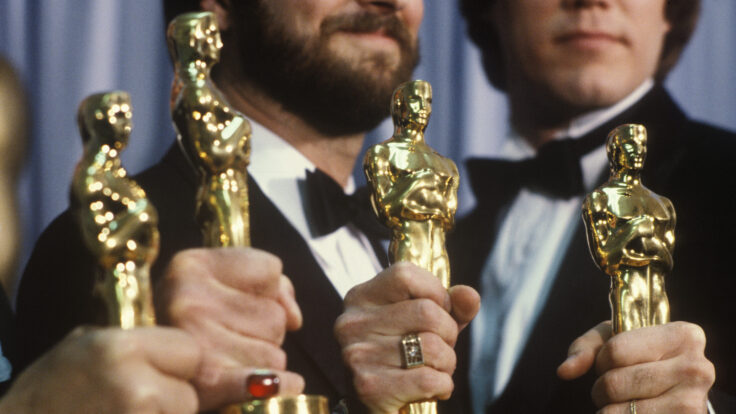
| Who? They’re the Academy’s board of governors from the casting branch, which won a huge victory in this week’s establishment of a casting Oscar, the first new competitive award since 2001.A little more here: I’ve been following this push for a casting Oscar since 2012, when the influential documentary Casting By first premiered at TIFF. So it was fun to jump on the phone on Friday with Tom Donahue, the film’s director, as well as producers Kate Kiley, Ilan Arboleda, and Joanna Colbert. The behind-the-scenes politics here are interesting. Marion Dougherty and other casting directors had been advocating for a casting Oscar since at least the early ’90s, but with no luck. (Directors and producers often want to believe that they “discover” actors.) Then in 2012, casting director David Rubin—an effective operator and lobbyist—screened Casting By for Academy leaders, which led to a larger, industry-wide push for recognition (and this 2013 piece in THR by a pre-canceled Woody Allen).
That year, the Academy established a branch for casting directors (interestingly, it happened the same week Casting By premiered on HBO). And with the branch, Rubin became a governor. In 2016, again at the urging of Rubin (among others), the first honorary Oscar was given to a casting director, Lynn Stalmaster. Then in 2019, Rubin was elected Academy president and helped get a robust casting exhibit into the new Academy Museum. (It’s one of the highlights of the collection.) And by 2023, Academy C.E.O. Bill Kramer was telling colleagues that he was getting pressure—from the casting branch, which is small but now counts almost 160 members, as well as a termed-out Rubin and others—to make the casting Oscar happen.
At the urging of Hicks, Taylor-Coleman, and Zane, the board then took up the issue again, and while I’m told the vote was far from unanimous, it passed, and the outstanding achievement in casting Oscar will debut in 2026. “It gives the profession a higher profile, and ultimately, it raises the level of the profession,” Donahue said during our chat. “That was the whole point of getting a casting Oscar.” |
|
|
| “Why did that go viral? Isn’t any sentence out of context, out of context?”
—Dakota Johnson, responding incredulously to a reporter’s question about the viral meme based on her asinine quote from Madame Web (“He was in the Amazon with my mom when she was researching spiders right before she died”). Man, I’m really going to miss the Madame Web press tour.Runner-up: “I’m trademarking Spulu—as in Hulu for sports.”
—Jon Miller, the media investor and former Fox executive who oversaw its stake in Hulu, on comparisons to the new (and unnamed) Disney/Fox/WBD sports streamer
Now, as a treat for WIH readers and a taste of Puck’s new sports business newsletter, The Varsity, I’ve got a back-and-forth on the industry that I did with John Ourand while we were in Vegas for Super Bowl activities this weekend… |
 |
| Sports Media Roulette & Broadcast Worst-Case Scenarios |
| After spending the better part of a week in Vegas for the Super Bowl, here’s what everyone in the sports-entertainment-media industrial complex is obsessing over: the next wave of rights deals, a super-streamer, Amazon-Diamond, what Endeavor is divesting, and if the NFL’s biggest showcase will return to Las Vegas (yes!). |
|
|
|
|
|
| Matt Belloni: Welcome! And congrats on launching The Varsity, which is like What I’m Hearing for the way cooler sports business. Who’s the most interesting person you’ve seen here in Vegas? I thought it was intriguing that Chris Licht, the former CNN leader, has been making the rounds.John Ourand: I feel like I should mention Killer Mike, who, yes, killed it at the EA Sports party Friday night. But the most interesting person to me has to be Sean McManus, who is winding down a nearly three-decade run as the head of CBS Sports. This is his last Super Bowl; David Berson will take over after The Masters, in April.
Matt: I love that your first piece for Puck was a scoop about the sale of your beloved Baltimore Orioles.
John: I couldn’t have scripted a better start—breaking news of a $1.73 billion deal involving my favorite baseball team on just my second day on the job.
Matt: I do think the sale price that David Rubenstein, a founder of the Carlyle Group, and his consortium are paying struck many as low for a pro sports team on the rise. After all, Mat Ishbia just acquired control of the NBA’s Phoenix Suns in a $4 billion deal, a new record; Mark Cuban is selling the Dallas Mavericks for $3.5 billion to the Adelson casino family; and Apollo co-founder Josh Harris bought the NFL’s Washington Commanders last year for more than $6 billion.
John Angelos, whose family has owned the Orioles for decades, didn’t run an open bidding process, but there are so many questions about media rights in baseball, especially the cratering regional sports networks that most MLB teams are so dependent upon. Is baseball an outlier here, or are all sports teams that rely on regional TV going to eventually decline in value?
John: I can see why people feel like the Rubenstein group got a deal. But the sale isn’t completely out of whack with recent smaller-market Major League Baseball transactions. Just a couple of years ago, a John Sherman-led group bought the Kansas City Royals for $1 billion, and in 2017, Jeffrey Loria sold the Florida Marlins, who play in a new stadium in Miami, for $1.2 billion. So the Orioles price is—if you pardon the pun—in the ballpark.
Matt: Let’s talk about the media piece of this, especially since the Orioles own about 75 percent of the Mid-Atlantic Sports Network, which also broadcasts Washington Nationals games. I just don’t see how these teams and leagues replace the RSN model. The security blanket for the entire media business has been ripped off as customers stop paying for channels they don’t watch. And short of a new bundle (we’ll get to that), there necessarily will be less TV revenue, especially in smaller markets, and it’s ultimately going to trickle down to the teams and players. Give us the best-case scenario for the leagues, and the worst-case.
John: They have to get used to the fact that their local media revenues are going to drop considerably over the next several years. So, how do you replace that? I’m intrigued by Amazon’s decision to invest in the bankrupt Diamond Sports, which operates the Bally Sports RSNs. Local sports are valuable, and big companies like Amazon are trying to figure out a business plan around them in the streaming world. The problem for teams: They will make a ton less from streaming rights than from RSNs in their heyday.
Matt: Rob Manfred, the MLB commissioner, said last week that the league could launch a streamer in 2025 that will carry about half the teams’ local games. So basically, the big-market juggernauts like the Yankees and Dodgers that have super lucrative digital rights will continue to exploit them, and the rest will pool together. Is that a solution? What’s the worst-case scenario?
John: I just can’t see a scenario where those big-market teams adopt that strategy immediately. I don’t see the Yankees, Dodgers, Cubs, or Red Sox—the most popular teams in the league—allowing MLB to use their rights for this service, at least not initially. So I expect MLB will launch a service without those teams. But if MLB’s streaming plan takes off—and if cord-cutting continues to accelerate, as we all expect—I could see them joining in a couple of years.
The worst-case is bleak though, and we’re sort of heading toward it. Local media has been one of the biggest revenue drivers for sports teams almost across the board. The biggest RSN group is in bankruptcy, and Warner Bros. Discovery got out of the business entirely. Local broadcasters and streamers can show games, but they will pay teams a fraction of what RSNs are paying for those rights. If RSNs continue to head south and that revenue stream dries up, it will have a negative effect on everything from player salaries to team valuations to even front-office workers.
Of course, we’ve seen this chasm between big-market and small-market teams for decades. That’s why Bill James and Billy Beane started the whole “moneyball” strategy. The RSN problem is going to make this more pronounced. Want an example? Look no further than your hometown Dodgers this offseason—signing Shohei Ohtani to a 10-year, $700 million deal, Yoshinobu Yamamoto to a 12-year, $325 million deal, and Tyler Glasnow to a four-year, $111.5 million extension. The team can spend that money thanks, in large part, to a sweetheart MLB deal that prints money. The Padres? That’s another story. Bally Sports dumped the team’s local rights, which is the sole reason why it is cutting salaries, including trading superstar Juan Soto to the Yankees. |
|
|
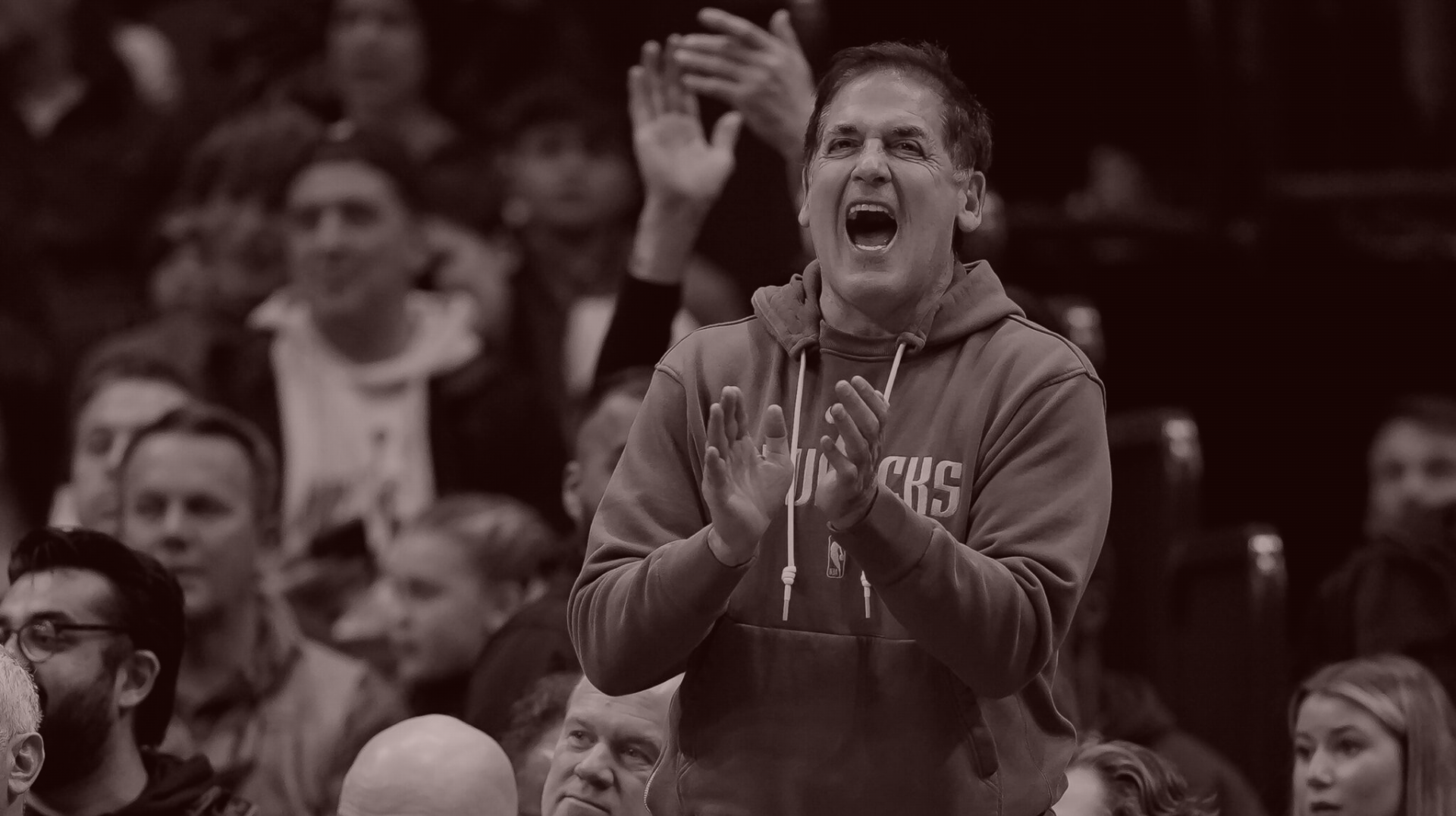
| Matt: I’m definitely not complaining about the Dodgers’ spending. Why do you think Mark Cuban sold the Mavs? I’ve heard all kinds of rumors—from his desire to get into politics to his obsession with the healthcare business to even suspicions that he needed the liquidity. Got any intel?John: I have covered Mark Cuban for 23 years—ever since he launched a TV channel called HDNet. He made his fortune from Broadcast.com. Cuban knows the media business more intimately than just about any other owner in professional sports. He knows what we just discussed—that teams and leagues will take a step back on media revenue. This is even true for big-city teams like the Mavs, which have a local rights deal with Bally Sports. It may take longer to affect the Yankees, but YES Network faces the same cord-cutting pressures as every other linear TV network.
Cuban recently was asked on X why he sold, and his answer was illuminating. He predicted that the next wave of revenue generation for teams will be around real estate and entertainment, not media. That’s why he got out.
Matt: The big news this week, of course, is the Disney/Fox/Warners super-sports streamer announcement. Everyone here in Vegas for the Super Bowl is talking about it. And I bumped into Mark Lazarus, the chairman of NBCUniversal Media Group, who joked he’d been asked about it 50 times. It raises so many questions, but first and foremost is: Will it actually launch, or was this just a press release to juice the Disney and Fox earnings calls?
John: What has particularly struck me during my time in Vegas this week is how little anyone actually knows about this plan—even from the companies involved. We don’t have a name. We don’t have a price point. We don’t know who’s going to run it. We don’t have an official launch date. All we have is a lot of angst from leagues and distributors who were kept in the dark about all of this. The good news for us, Matt, is that this will surely produce reams of copy for us.
League executives were kept in the dark. They felt blindsided by the announcement. In tomorrow’s edition of The Varsity, I will be reporting that at least one league is looking into whether the networks even have the rights to carry their games on this new platform. It’s clear that they aren’t taking this lying down.
Matt: I keep hearing that Lazarus and NBC will make an aggressive run at NBA rights. That factor, coupled with what is expected to be a package carved out for a streamer—Apple, Amazon, or maybe even Netflix—means the NBA could be on the move at a time when sports rights are both as onerous and as valuable as they’ve ever been to television companies. The exclusive negotiating window for the existing partners, Turner Sports and ESPN, is over on April 22, and there could be some serious dealmaking during All Star Weekend, which is days away. What’s your thinking on how the NBA will be divvied up, and will commissioner Adam Silver get that massive increase he’s been talking about?
John: I think the NBA is fine. There are enough suitors that want NBA broadcast rights, which should help keep the haul high. The storylines of the greatest interest to me pertain to how the NBA crafts packages. ESPN and ABC expect the “A” package. But NBC, which has deep relationships with the league (Lazarus worked with the NBA back during his Turner tenure), will not want to be the NBA’s second broadcaster. How much will cord-cutting affect how big a package TNT gets? And then there’s Amazon. Will the NBA be comfortable selling a package with exclusive playoff games to a streamer? These are all issues on the table.
Matt: Endeavor, Ari Emanuel’s Hollywood agency turned amalgamation of sports and fashion and entertainment assets, is looking at some divestments as Silver Lake, its majority shareholder, raises money to take it private. They’ve already said WME, the agency, isn’t going anywhere. But everything else seems to be in play. On Location, the V.I.P. experiences company, seems the most likely to go, according to people I’ve talked to. Maybe Professional Bull Riders, though it has powerful fans at the company. They already sold IMG Academy, the school for athletes. What else seems vulnerable?
John: Well, I can tell you what’s not vulnerable: TKO. Endeavor owns the company that runs UFC and WWE, and it clearly is a priority. Ari and Mark Shapiro went to Casey Wasserman’s annual Super Bowl lunch with UFC’s Dana White and WWE’s Nick Khan. They just landed that $5 billion deal with Netflix for WWE Raw. You know how much sports leagues have been trying to engage Netflix. It’s significant that Netflix bit on WWE’s “sports entertainment.” Then there’s UFC, which will start looking for a new media deal later this year. I still think UFC stays with ESPN. But even in a down market, UFC is in a good position thanks to a proven track record of building subscriber bases for streamers. It’s hardly a bold prediction to say that its ardent fans will follow UFC wherever it ends up.
Matt: I agree. Any final takeaways from the first Super Bowl week in Vegas?
John: I feel like I need to sleep for the rest of the month. One thing I will tell you: NFL executives seem more than a little pleased with Sin City. The league has carried years of angst—probably decades of angst—over holding its biggest game in Las Vegas. It seems like a sure bet that Vegas will become a more regular part of the Super Bowl rotation. This isn’t a one-and-done. |
|
|
| No big deal, just the lowest attendance numbers ever at the box office, an abysmal $37.9 million weekend, and domestic gross will be down 20 percent from 2023 by the end of the month. [IndieWire]Dealmaker Michael Klein, recently fellated in the Journal for joining his advisory firm with CAA’s underperforming merchant bank to form CAA Evolution, is also a top adviser to Saudi Arabia’s public fund. Now he’s caught up in a fight between the Kingdom and the U.S. government over the planned merger of the PGA Tour with LIV Golf. [Bloomberg]
FX’s John Landgraf declared the end of Peak TV with just 516 scripted series in 2023, down 14 percent. But the numbers from Ampere are even worse: 481 scripted shows in ’23, down 24 percent from 633 in 2022. [Ampere]
Fubo, the sports-centric streaming service, is already teasing the coming antitrust fight over the Disney-Fox-Warners sports JV: “Every consumer in America should be concerned about the intent behind this joint venture and its impact on fair market competition.” [WSJ]
Related: Morgan Stanley notes there are about $30 to $35 in distribution fees per month, with about 65 percent going to Disney, about 20 percent to Fox, and about 15 percent to Warner Discovery.
Late to this but just in time for Disney’s bet on Epic Games, Matthew Ball dropped an opus on the “tremendous” yet “troubled” state of the video games industry, including higher costs and lower revenues. Sound familiar? [Matthew Ball]
The anonymous proprietor of the Crazy Days and Nights blog, which dropped incendiary blind items for years, was unmasked in a legal battle with his ex-mistress as lawyer John Robert Nelson, who once ran for Congress as a progressive Democrat. [Daily Beast]
Jason Gay has a fun and mostly Taylor-free Vegas Super Bowl primer for those just now paying attention. [WSJ] |
|
|
| After my Thursday analysis of Ryan Coogler’s next film deal, several talent representatives let me know they too had secured ownership rights for their clients. (Though all in the indie film space, not a major studio.) But the majority of my emails this week concerned the Disney earnings call examples…“I know you love Larry David, so I will ask you to curb your enthusiasm about Disney. Are we really declaring [Bob] Iger king again because he fended off the clowns at Trian that he never should have been fighting with in the first place? He’s just using the activist shareholder playbook. Juice dividend and [stock] buybacks and announce a bunch of things that may or may not happen.” —An investor
“It’ll be fascinating how Nelson [Peltz] spins this. I’m sure he will declare victory and say Iger wouldn’t have made all these moves without his pressure. OK boomer… can you go away now?” —A Disney executive
“Rich [Greenfield] talks about Disney ‘fixing’ its creative engines [at the film studio]. What guys like him [analysts] don’t realize is that going back to the early 2010s, the entire Disney content strategy was designed by Iger to be a short-term fix to an embarrassing long-term problem for Disney. When Iger reorged the film group in 2009 and installed Rich Ross, a TV marketing guy, to run it, they made some spectacularly expensive duds [John Carter, The Lone Ranger, Tomorrowland]. Iger and Alan [Horn, Ross’s replacement] basically said screw it, just remake the hits. Hence the overleveraging of the MCU [Marvel Cinematic Universe], the relentless live-action versions of animated library titles, ramping up frequency of Star Wars films. That worked for a while, but it can’t be a long-term strategy because there’s no NEW franchises. [Hence why Iger felt he needed to buy Fox.] Now that short-sightedness has come home to roost, and audiences are sick of more and more of the same. Iger didn’t think he would be in the chair still, but here he is, and now there’s no obvious answer, so he’s just doing more of the same like Moana 2, one of the last franchises that he hasn’t yet exploited.” —A producer
“He announced a theatrical movie (isn’t that table stakes for Disney… a movie sequel!), a single Disney+ movie (it’s Swift!) and an investment in the industry he’s been disastrously unable to crack (gaming!)… and suddenly he’s figured out the long-term future by spending a fortune? Imagine if he announced a credible successor!” —An executive |
|
|
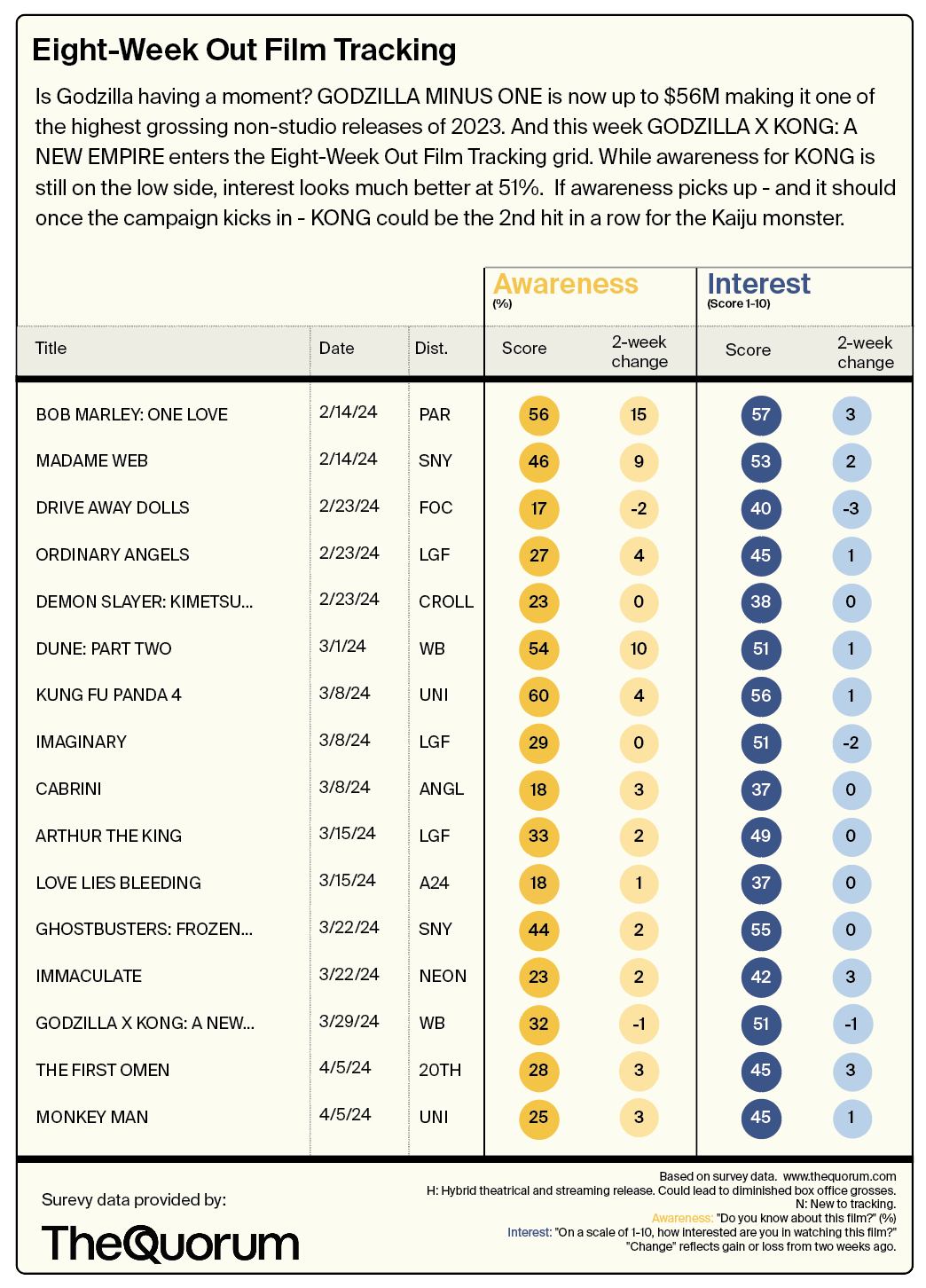
| Godzilla is so hot right now. Interest in late March’s Godzilla x Kong: A New Empire is high, even if awareness still needs a boost from Warner Bros.’ marketing campaign, according to The Quorum’s early film tracking… |
|
|
| Have a great week,
MattGot a question, comment, complaint, or a good Velveeta dip recipe? Email me at Matt@puck.news or call/text me at 310-804-3198. |
|
|
|
| FOUR STORIES WE’RE TALKING ABOUT |
 |
| Little Britain |
| A candid dialogue on U.K. media talent and CNN’s micro-crises. |
| DYLAN BYERS |
|
 |
| Ronna Out of Time |
| On the trial balloons and guessing games surrounding Trump’s R.N.C. replacement. |
| TARA PALMERI |
|
 |
|
 |
| Fade to Zac |
| Considering Posen’s inexplicable appointment at Old Navy. |
| LAUREN SHERMAN |
|
|
|
|
|
 |
|
|
| Need help? Review our FAQs
page or contact
us for assistance. For brand partnerships, email ads@puck.news. |
| You received this email because you signed up to receive emails from Puck, or as part of your Puck account associated with . To stop receiving this newsletter and/or manage all your email preferences, click here. |
| Puck is published by Heat Media LLC. 227 W 17th St New York, NY 10011. |
|
|
|