Welcome back to What I’m Hearing, celebrating May the Fourth, not the Met Gala (though no
disrespect to everyone justifying their brand ambassador deals or sucking up to Jeff Bezos tonight. Fun fact: Puck members get access to all our great newsletters—so for fashion intel, sign up for Lauren Sherman’s excellent Line Sheet here.)
Anyway, speaking of Star Wars, tonight it’s the crucial early read on Disney’s Mandalorian
and Grogu box office. Plus, an overlooked aspect of the big Baldonigate settlement, and the potential impact of Netflix’s first real movie release.
Programming note: This week on The Town, Lucas Shaw and I predicted how many movies Netflix will soon release in theaters, Scott Mendelson
ranked the summer blockbusters on the Confidence Scale, and Lionsgate’s Adam Fogelson explained what the Michael sequel might look like.
More: I detailed
the sordid Michael backstory on the Today, Explained podcast, parsed the Kimmel/F.C.C. fight on CNN, and previewed the summer movies on CNBC’s Squawk Box (before the GameStop C.E.O.
embarrassed himself).
💫💫 P.S.A.: We’re officially booked for tomorrow’s Stories of the Season Emmys event and live taping of The Town with David E. Kelley. Thanks to HBO Max, Paramount+, and Survivor 50 for sponsoring.
Not a Puck member yet? Just click
here. Got a news tip or an idea for me? Just reply to
this email, text me, or message me on Signal at 310-804-3198.
Discussed in this issue: David Zaslav, Rich Gelfond, Blake Lively, Jon Favreau, Laurie Metcalf, George Lucas, Ted Sarandos, Sigourney Weaver, Patty Jenkins, Justin Baldoni, Dave Filoni, Pedro Pascal, Scott
Rudin, Kathleen Kennedy, Martin Scorsese, Jen Abel, Ron Howard, Dana Walden, Natasha Fernandes, Greta Gerwig, Lynwen Brennan, David Ellison, Chris Miller, Andy Jassy, Steph Jones, Peter Jackson, Michael Hackman, Alan Bergman, Bob
Iger, Guillermo del Toro, Tom Rothman, Phil Lord, Meryl Streep, Lewis Liman, Kathryn Bigelow, David McKenna, Adam Aron, Bill McGlashan, the Russos, John Malone, and… empty AMC theaters.
But first… |
Who Won the Week: Meryl
Streep
|
Legacy sequels all need their original stars, of course, but none more so than Disney’s The Devil Wears
Prada 2, which never would have happened—or opened to a staggering $233.6 million worldwide—without Streep signing on.
Strong runner-up: Greta Gerwig, who accomplished something that Scorsese, Fincher, del Toro, Bigelow, and even the Russo brothers (!) could not: Netflix is giving her Narnia: The Magician’s Nephew its first wide global release with a 49-day window
to streaming. |
A little more on this…
A huge flex for Gerwig, obviously, after her initial push for theaters
led to the first compromise of an Imax release on 1,000 screens for two weeks and a 30-day window to Netflix. Now, with the Regal chain balking at the truncated window and the film delayed due to an injury to 12-year-old star David McKenna, Narnia will get a full global release on February 12, then 49 days to Netflix.
Lots of
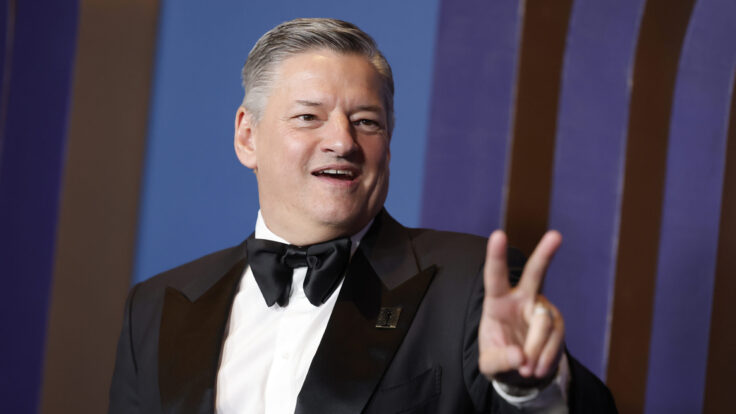
back-and-forth negotiations on this one. Sarandos first sat down with my friend Adam Aron at AMC months ago in Santa Barbara. Ted later floated the wide release once it was clear Narnia wouldn’t make its Thanksgiving date—thus rendering Netflix’s plan for a Christmas drop moot. Conversations picked up again after CinemaCon to go global for Presidents’ Day weekend. Gerwig even visited Imax C.E.O. Rich Gelfond at home last week to stress the importance of
convincing Netflix to cave on the theatrical footprint. She really wanted this.
No, it’s not the 90 days to subscription streaming that theater owners would prefer. But after years of Netflix winning both the public- and, at times, business-case war on moviegoing, the tide has definitely turned, and 45 days seems to be the new “normal” for exclusivity. Disney has long been there; David Ellison said at CinemaCon that Paramount will honor that window from now on (as will
Warner Bros., presumably, if that acquisition is approved); Universal will be at 45 days starting in 2027, though not for all Focus specialty movies; and while Sony Pictures hasn’t committed to ending early P.V.O.D., its new Netflix deal adheres to a 120-day S.V.O.D. window, according to studio chief Tom Rothman. On The Town last week, Lionsgate’s Adam Fogelson said he’s “not going to be an outlier” on the 45-day issue, and that “we will participate in
that.” And Amazon is now honoring 45 days for most, but not all, of its titles. That leaves as holdouts Apple TV, which has zero movies scheduled for wide theatrical release this year… and Netflix.
We can debate why Sarandos caved here. It may be as simple as talent relations; Greta wanted a wide release, the production delay provided an excuse that could be distinguished in future negotiations, and with Narnia being among the biggest, most expensive movies Netflix has ever made,
he ultimately decided to back her. Also… having looked under the hood at Warner Bros. (and maybe eyeing another studio target like Sony Pictures or Universal or Lionsgate?), Ted also seems to be softening his draconian stance on theaters as “outmoded for most people.” I’m guessing he feels the industry winds blowing back toward theatrical, is sick of losing out on major projects that demand theaters, and sees the model in a way he maybe didn’t—or didn’t want to, given his relentless
drive to win the streaming wars—before.
KPop Demon Hunters notwithstanding, a theatrical release remains the only way to enter the broader culture, which is how lasting I.P. is created and nurtured. So if Narnia works (still a big if… Presidents’ Day weekend ’27 also features the Super Bowl, which typically kills moviegoing), it not only provides a blueprint for filmmakers and I.P. owners to ask for the “Greta deal” in competitive situations. It also allows Netflix, as
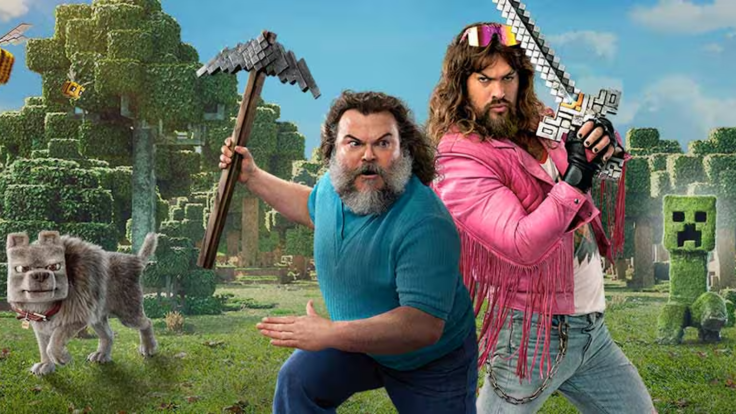
it continues to evolve from digital television network to larger media monolith, to experiment and figure out whether it likes the model that has worked really well for other studios. Not for everything, but for the biggest filmmakers and highest-value projects: KPop Demon Hunters 2 for sure. And maybe if Netflix can offer the Greta deal, it can land big properties like Minecraft or Barbie or Super Mario, the owners of which consistently choose to work with “theatrical” studios. All of
which would speed Netflix on its long, winding journey to becoming just like the other Hollywood studios. |
|
|
|
A MESSAGE FROM OUR SPONSOR |
Five-time Oscar® nominee Ethan Hawke and acclaimed Reservation Dogs Creator Sterlin Harjo team up in FX’s The
Lowdown. Named a 2025 AFI Television Program of the Year, RogerEbert.com says the hilarious and endearing noir is “possibly the only television show worth watching.” For your Emmy® consideration in all Comedy categories, with all episodes now streaming on Hulu and Hulu on Disney+ for bundle subscribers. |
|
|
|
And speaking of streamers…: Congrats to Amazon, which revealed last week that Prime Video is now a
“profitable business in its own right.” That’s the first time C.E.O Andy Jassy has declared its Hollywood operation in the black, meaning only Peacock and, presumably, Apple TV, remain money-losers among the mass-market streaming services. |
“I find it hypocritical that some people want to work with him but didn’t want to be the
first.”
—Laurie Metcalf, the Death of a Salesman revival co-star, when asked by The New Yorker about collaborating with Scott Rudin on his comeback Broadway productions after being banished for abusive behavior.
Runner-up: “It doesn’t offer the consumer anything that they couldn’t get yesterday.”
—Natasha Fernandes, the Imax C.F.O., responding on an earnings call to Disney’s new B.S. “InfinityVision” marketing ploy for non-Imax large-format screens. |
|
|
|

| Eriq Gardner
|
|
Baldonigate Publicists Still Headed to Trial
|
Blake Lively and Justin Baldoni may have come to their senses and settled
the war over It Ends With Us—just in time, coincidentally, for Blake to walk the Met Gala carpet tonight! But remember, onetime Baldoni publicists Steph Jones and Jen Abel are still suing each other over their own explosive professional breakup. Abel worked for Jones until she allegedly came to believe her boss was in a “downward spiral.” On her way out, Jones seized Abel’s company-issued phone and allegedly turned its contents over to Lively’s legal
team, ostensibly in response to a subpoena, though maybe because she was pissed about losing a client. That handoff helped detonate the broader dispute—first in the press, then in court.
Judge Lewis Liman has already allowed claims against Jones for conversion and violation of the Stored Communications Act to proceed. And Baldoni’s company was permitted to press a defamation theory on the premise that Jones knowingly fed Lively’s team a false narrative. Now, even if the
settlement between the principals trims some of that, Abel’s fight with Jones remains, along with the prospect that a jury will hear how all of this unfolded—including with Lively and Baldoni as potential witnesses. |
|
|
|
700,000
New subscribers Paramount+ added in the first quarter, below estimates of 1
million and ending the period with 79.6 million global subs. [Paramount Earnings]
39 percent
Share of the 10,871 new podcast feeds created in a recent nine-day period that may have been A.I. generated. [Podcast Index/Bloomberg]
$9.88 billion
YouTube’s
first-quarter ad sales, up 10.7 percent and more than the TV/streaming revenue of all the traditional studios combined—and yet somehow, still short of analysts’ expectations. [CNBC]
52.2 percent
Decrease in reality TV production shoot days in the first quarter of ’26 compared to the same period last year, down 71.1 percent from the
five-year average. [FilmLA]
Now here’s Scott on the box office story of the month… |
|
|
|
After years of creative chaos, executive indecision, and a streaming glut that cannibalized
the franchise’s theatrical appeal, Lucasfilm is returning to theaters with something very different. Will Grogu be a Solo-sized disaster? Or has Disney just lowered the bar for success? |
|
|
|
More than six and a half years since The Rise of Skywalker frustrated Star Wars superfans
throughout the galaxy, new Lucasfilm chiefs Dave Filoni and Lynwen Brennan are hoping to revive the brand as a theatrical franchise with The Mandalorian and Grogu. It’s a strategic pivot—and a gamble—for Disney on multiple levels. Although the film has some star power thanks to Pedro Pascal and Sigourney Weaver, there’s no escaping the fact that it’s a feature based on a TV series—an extension of Jon
Favreau’s critically acclaimed The Mandalorian on Disney+—and not the other way around. It’s also the first Star Wars spinoff movie without any obvious tie-in to the original trilogy.
Perhaps unsurprisingly, Grogu is tracking for the lowest opening weekend cume for a Star Wars feature since Solo: A Star Wars Story, currently the franchise’s commercial nadir, in 2018. Current projections suggest around $80 million in domestic gross over
the four-day Memorial Day weekend, although some analysts, including Shawn Robbins’s Box Office Theory, see a path closer to $100 million.
Those projections have revived a familiar anxiety. Solo
received a mixed reception—solid but unspectacular reviews—paired with heavy domestic frontloading. A 2.9x multiple off its $35 million Friday led to a $103 million opening weekend. And a disastrous overseas start ($65 million from Wednesday to Sunday) didn’t help. In the end, Solo finished with $216 million in North America and $394 million worldwide. That was a clear disappointment, especially against its $275 million budget, which ballooned after then-Lucasfilm president
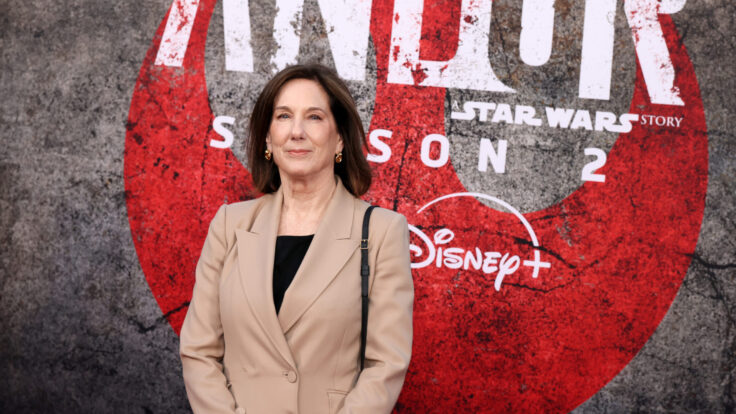
Kathleen Kennedy replaced directors Chris Miller and Phil Lord with Ron Howard well into production.
No wonder Lucasfilm executives have been wary of greenlighting anything else. In the wake of the Solo misfire and negative reaction to Rise of Skywalker, Kennedy and the rest of the Disney unit were crippled by second-guessing—creative changes, director swaps, reshoots, and projects initiated with fanfare
and quietly dropped (pour one out for Patty Jenkins’s roller blades in her Rogue Squadron “teaser trailer,” which is all that ended up being filmed of that project). Now the fear is that The Mandalorian and Grogu, which has an even weaker I.P. hook to the Star Wars mainline than Solo, could be a similar miss.
Well, it depends on
the threshold for success. With a reported budget of around $160 million—about half the cost of Andor Season 2—Favreau arguably doesn’t need to smash box office records. But the film does need to perform well enough to reestablish the franchise as a strong theatrical draw. During its period of soul-searching, Lucasfilm was often focused on catering to the whims of its very online superfans, many of whom grew up loving the original trilogy or George
Lucas’s prequels, at the cost of engaging a broader—and younger—general audience. In this regard, Grogu’s outsider status, especially amid a franchise that has often skewed domestic even in the best of times (The Force Awakens earned $2 billion but split 45 percent domestic and 55 percent overseas, more U.S.-heavy than other massive titles), may be a benefit. |
Having seen the first 17 minutes, I can vouch that Grogu is newbie friendly. The film’s opening reel
plays like what might happen if you hired the man who directed the first two Iron Man movies and the blockbuster Jungle Book remake to offer up a Star Wars–sized variation of a James Bond pre-credits set piece. I spoke with a few CinemaCon attendees who were entirely unconfused, despite having never seen a single episode of The Mandalorian. |
|
|
|
A MESSAGE FROM OUR SPONSOR |
Five-time Oscar® nominee Ethan Hawke and acclaimed Reservation Dogs Creator Sterlin Harjo team up in FX’s The
Lowdown. Named a 2025 AFI Television Program of the Year, RogerEbert.com says the hilarious and endearing noir is “possibly the only television show worth watching.” For your Emmy® consideration in all Comedy categories, with all episodes now streaming on Hulu and Hulu on Disney+ for bundle subscribers. |
|
|
|
The question of accessibility is largely a challenge of Disney’s own making. The poorly reviewed Rise of
Skywalker, which nevertheless topped $1 billion in 2019, was followed by a tsunami of Disney+ shows designed to serve the company’s burgeoning streaming business. That strategy worked, but the output arguably diluted the theatrical appeal of new film opportunities—precisely what happened when the flood of Marvel shows on Disney+ seemingly diminished demand for subsequent MCU movies, including The Marvels and Thunderbolts.
Nielsen just released viewership data for
Star Wars shows and movies on Disney+ over the past year. Beyond raw viewership, which is allegedly 33 billion minutes across all Star Wars content, The Mandalorian remains comparatively popular with the youngest and oldest demographics, suggesting at least the
potential to nab kids and their parents (or grandparents). That should fuel hope in Burbank that Grogu can prove popular with the generation of kids who were first introduced to the property over the last seven years of Disney+ availability, many of whom have never seen a Star Wars movie in theaters. Think Moana 2 soaring to $1 billion thanks in part to five years of kids watching and rewatching (the $645 million-grossing) Moana on streaming.
Perhaps
for that reason, Disney’s marketing efforts have pitched The Mandalorian and Grogu to more general audiences—there was that clever Super Bowl ad riffing on the Budweiser Clydesdales and a series of promotions emphasizing the Grogu muppet’s kid-friendly appeal. If the ads work and the reviews are good enough, the picture might score well as the first live-action spectacular aimed at
families since the soft PG-13 outer space blockbuster Project Hail Mary—directed, ironically enough, by fired Solo filmmakers Lord and Miller—and, before that, December’s Avatar: Fire and Ash. |
The Marvel Phase Two Comp
|
While Disney content chief Dana Walden and film head Alan Bergman would
love for The Mandalorian and Grogu to perform more like Rogue One ($1 billion worldwide in 2016) than Solo, there’s no law saying that the new flick must become a stepping stone toward returning Star Wars to the $1 billion-on-the-regular club. After all, there is more to the brand than global box-office glory—revenue from Disney theme parks, Star Wars toys, related Lucasfilm merch, etcetera. And even if this new Star Wars does not
shatter records, just the perception that the franchise is back on solid critical footing will help boost the potential for next year’s Star Wars: Starfighter, directed by Shawn Levy and starring Ryan Gosling.
As for priorities, Disney would do well to tune out the online gatekeepers, especially if their S.E.O.-friendly discourse conflicts with the real-world reception. Recall that Favreau’s Iron Man helped make the MCU
what it would eventually become by creating fans out of general moviegoers with little to no attachment to the four-color Marvel Comics universe. Ditto Peter Jackson’s Lord of the Rings trilogy, which earned $2.95 billion worldwide and 21 Oscars largely thanks to non-J.R.R. Tolkien obsessives.
Assuming all else skews positive, and Disney budgets appropriately, there can be a measured victory if the Star Wars franchise settles into a place akin to Marvel’s Phase Two (post-Avengers) and early Phase Three releases. Early 2010s biggies like Iron Man 3 and Avengers crossed $1 billion at the box office, but the 2013-16 likes of Thor: The Dark World, Captain America: The Winter Soldier, Guardians of the Galaxy, and Doctor Strange were still seen as aspirational successes with $644 million–$777 million global cumes. The key to affirming Star Wars as a
must-see brand starts with making movies that are actually, you know, must-sees. That’s why you hire Favreau.
Ultimately, more-realistic box-office expectations are probably healthy for Lucasfilm. After The Force Awakens, some in Burbank came to view $2 billion as a replicable goal rather than a generational miracle. Then-Disney C.E.O. Bob Iger was clearly over his skis when he said he wanted a Star Wars movie every year. Meanwhile, Kennedy was
ultimately unable to deliver anything close to that—and she struggled with the quality (or at least the perception of quality) of what she did make. But success in 2026 can look like more than an endless parade of C-tier streaming shows, or 10-figure blockbusters. For a franchise just getting back on its feet, it might be a relatively cheap, family-friendly spinoff that hits a double or triple, instead of a home run. |
Man, real estate investor Michael Hackman is losing his shirt on studio properties. Hackman
Capital Partners just defaulted on the former Sony Pictures Animation offices in Culver City, following massive losses on L.A.’s Radford Studio Center and New York’s Kaufman Astoria Studios. [Real Deal]
Genuinely insane anecdotes here about Disney Adults squandering their life savings (and then some) on Goofy pins and Chip ’n’
Dale meet-and-greets. [New Yorker]
Bill McGlashan, an architect of TPG Growth’s investments in CAA and other Hollywood companies before he went to prison in the Varsity Blues college admissions scandal, is back! Selling a fancy fertilizer! (Usual disclosure: TPG is an investor in Puck.)
[N.Y. Times]
Sad that we’re learning more from kids on TikTok “speed running” Scientology buildings than we ever have from law enforcement. [L.A.
Times]
Anyone else suspect Apple TV might end up regretting this new $750 million F1 streaming deal? [WSJ]
You won’t believe this, but Trump’s war on the media hasn’t actually delivered many legal wins. [Air Mail]
A guy made a website to
track AMC movie theaters with zero seats sold, so go pretend you’re on the Bel Air Circuit. [Empty Screenings] |
A few fun comments on my Thursday chat with high school kids, but David Zaslav’s salary dominated my
emails…
“If it didn’t already tip, the cart tipped yesterday. Employees en masse cannot wait for [Zaslav] to go away and are welcoming the merger (and job-loss risk) to not see or hear from him again. Officially went from disliked to hated. Never seen anything like it.” —A Warner Discovery employee
“The grift is extraordinary, but you are missing one aspect in your analysis: Everyone involved in the chain of command is incentivized to look the other way. The board and
compensation committee are all handpicked by Zaslav and Malone and are heavily incentivized to get a sale done (and have been so from the beginning BTW), so anything they do to encourage that will never come back to them; shareholders just want to get paid; and the other executives at the company have their own extraordinary pay to protect. The result is great for them and catastrophic for everyone else.” —An M&A lawyer
“I’m one of those people waiting for their small raise to be
approved. Maybe I should have just become [Zaslav’s] interior designer.” —Another WBD employee |
Have a great week,
Matt
Maya Tribbitt contributed research for this issue.
Got
a question, comment, complaint, or an explanation of what Justin Theroux thinks he is doing in ‘Devil Wears Prada 2’? Email me at Matt@puck.news or call/text me at 310-804-3198. |
Need help? Contact us for assistance. For brand partnerships, email ads@puck.news.
You received this email because you signed up to receive emails from Puck, or as part of your Puck account associated with {{customer.email}}. To stop receiving this newsletter and/or manage all your email preferences, click here. |
Puck is published by Heat Media LLC. 107 Greenwich St., New York, NY 10006 |
|
|
|
|