 |
|
Welcome back to What I’m Hearing, and happy Sunday night after a wild week of Hollywood news.
Programming note: I’m back on CNBC Squawk Box tomorrow at 6:50 am Eastern. This week on The Town, Lucas Shaw and I tried to figure out why Shari Redstone hasn’t sold her company; Andy Wallenstein discussed the economics of “music tourism;” and Klutch Sports Group C.E.O. Rich Paul politely deflected my questions about Adele. Subscribe here and here.
Was this email forwarded to you? Click here to become a Puck member. Got a news tip or an idea for me? Just reply to this email.
Discussed in this issue: Tim Cook, Maha Dakhil, Rick Rosen, Hasan Minhaj, George Clooney, Ted Sarandos, Meredith Stiehm, Lou Taylor, Fran Drescher, Bryan Lourd, Julia Ormond, Jeanell English, Duncan Crabtree-Ireland, Madonna… and last-minute David Zaslav Halloween costumes.
But first…
|
| Who Won the Week: Greg Peters and Ted Sarandos |
|
| The Netflix co-C.E.O.s silenced skeptics thanks to their 8.8 million new subscribers, largely via the company’s newish password-sharing crackdown and the ad tier. Their stock jumped 16 percent in a day and closed above $400 on Friday after a few months of decline.
A little more on this: Bigger picture… a year and a half after the Great Correction, Netflix is really pulling away from everyone else in streaming: Unrivaled scale (247 million subs), actual profitability (net income of $1.68 billion in the quarter vs the billions that the rest of Hollywood keeps lighting on fire), and the swagger that comes with being by far the biggest hit-maker in television. What is Beckham or Lupin if they dropped on Peacock or Apple TV+? Niche. On Netflix, they get seen, they get currency, people go there looking for something new to watch.
Several big questions linger, of course. Namely, can the ad tier actually juice revenue in a meaningful way? What’s the impact of strike delays on customer acquisition and churn next year? What happens after all the freeloaders are assimilated or purged? And why are so many of the movies so bad? But now more than ever, the conversation in streaming is Netflix versus everyone else. |
| More Fallout from the War in Israel |
|
| Just to refresh, here’s an incomplete list of the topics that the Writers Guild recently has chosen to issue statements about: George Floyd, violence against Asian Americans, Harvey Weinstein, an F.C.C. decision, and even Endeavor’s I.P.O.
That’s why much of the town seems to be fuming at the WGA board over its refusal to say anything about the attack on Israel. WGA West president Meredith Stiehm finally responded this weekend. “Like the membership itself, the Board’s viewpoints are varied, and we found consensus out of reach,” she wrote to a group of showrunners, many of whom had signed the open letter “against terrorism in Israel.”
What Stiehm didn’t mention, and what a recipient of her email wouldn’t be able to discern, is that she, herself, was among the board members who wanted to remain silent, according to two sources familiar with the internal debate. (Stiehm didn’t respond to my text.) Sister guilds SAG-AFTRA and the DGA—which also have members with varied views—found the words to decry the situation without taking a stand on Israel itself. But at the WGA, now there’s even an open letter to respond to the open letter…
“Consensus should not be needed to denounce a terrorist attack,” Rick Rosen, the co-founder of Endeavor and head of TV at WME, told me today. “I am proud of the statement my company made in addition to SAG-AFTRA, DGA and other entertainment companies in condemning terrorism. It is disappointing that the WGA board, a group elected by writers who understand the power of words, has chosen to remain silent, especially in light of their statements on other political and social issues.”
Rosen’s not alone in his anger. I got a similar statement from UTA, which represents Stiehm. The agency “stands with the people of Israel and prays for the safe return of the hostages and the lives of all the innocent people of the region.”
I didn’t get a statement from CAA, the other Big Three agency, and I guess that’s to be expected. The company had its hands full this weekend with its co-head of motion pictures, Maha Dakhil, after she posted that message on Instagram that was viewed by many as Anti-Semitic, accusing Israel of committing “genocide” in its war with Hamas. As CAA heads Bryan Lourd, Kevin Huvane, and Richard Lovett told employees in an email today, Dakhil was removed “for the time being” from her leadership post, as well as from CAA’s internal board, but she’ll continue to rep clients like Tom Cruise, Madonna, and Natalie Portman. “In this time of too much divisiveness and suffering, we choose to help one another; we choose to be compassionate and forgiving; and we choose the optimism of education and personal growth,” the partners wrote.
First of all… really? Optimism and personal growth?? This coming from CAA, the most ruthless and unforgiving of the Hollywood talent agencies—a place that routinely purges employees rather than give second chances, and that dispassionately shitcanned the agent Jay Baker after 20 years when he emailed a racially insensitive joke. They’re choosing to be “compassionate and forgiving”?? Can’t make this stuff up. CAA’s actual message, of course: Racism, not OK; Anti-Semitism, another story.
Also, Dakhil’s removal from the CAA “internal board” isn’t exactly a defenestration. That’s largely a functionary entity, created in 2020 for the “day to day management” of the company but with little actual strategic power. It’s basically one step up from the Party Planning Committee on The Office. The actual point of it is to allow a company run by three men to placate its ambitious next generation with a taste of “leadership” and to say publicly that it has a “board” made up of 50 percent women. The three actual CAA board members rarely, if ever, attend those “CAA Board” meetings, I’m told.
For that reason, amid this supercharged emotional environment, some inside CAA find the Dakhil punishment weak. That’s mostly because of her comments. But there’s also a perception of hypocrisy—that she’s been so public (some say sanctimonious) about her activism for Time’s Up, Black Lives Matter, and so forth, which she’s leveraged to help sign clients. I’m loathe to even mention that, especially about talent agents, all of whom I just assume would abandon their families if it meant getting two inches closer to a movie star—and screwing rival agents. That’s kinda the job, and again, CAA is known for its ruthless and all-encompassing pursuit of clients.
Still, not a single client has publicly dropped CAA or spoken out against Dakhil’s comments, though I’m told several big-name conversations took place this weekend, and the Anti-Defamation League was also involved. I suppose it’s also not surprising that many of Dakhil’s friends and clients reached out to me today to argue that one moment shouldn’t destroy a lifetime of work. Several noted that CAA has actually become a better place to work for women and people of color since Dakhil has had a say in its management. “I called her and she took it down almost immediately,” Guy Oseary, the Israeli manager of Madonna and others, told me tonight. “I know who she is, she’s a good person. The minute I told her that this might be a trigger for Jews, she had no idea and immediately took it down.”
Let’s see how this one plays out. Dakhil’s probably not returning to a leadership spot for awhile. One theory relayed by a close CAA-watcher is that Lourd is actually pleased she’s been taken down a notch because he sees Maha as a potential rival for the top job as he ages, and Dakhil has a tight relationship with client Salma Hayek, wife of CAA’s new majority owner François-Henri Pinault. I don’t really agree with that, but CAA is in the middle of signing its agents to new deals after the sale of TPG’s interest to Pinault. Perhaps the Dakhil negotiation just got a lot easier for CAA.
I could also see a scenario where this all blows over, a testament to the heated rhetoric around the Israel war that just needs some time to cool down. We’ll see. Same with the Julia Ormond lawsuit alleging CAA enabled abuse by Harvey Weinstein. As with everything at the agency, ultimately it only matters what the clients think. |
| Quote of the Week (Ted Again!) |
|
“Part of our reason for not publishing [viewership data] early was part of our promise with creators.”
—Netflix co-C.E.O. Ted Sarandos, attempting to spin the years-long, systemic hoarding of consumption data as a favor to the creatives whose reps, in Sarandos’s telling, didn’t want to be bothered with the information that determines the value of their work. I’m sorry, but who is Ted kidding? Netflix kept this data hidden because that benefited Netflix. Pretty simple. Only amid pressure from creatives, competitors, and ad buyers did Netflix begin releasing just enough to claim “transparency” without actually being transparent.
Runner up: “We look like a joke.”
—Melissa Gilbert, the former SAG-AFTRA president, responding on Instagram to the striking guild’s ridiculous Halloween “guidelines” against wearing studio character costumes, like Barbie and Wednesday. “Go negotiate!” she added.
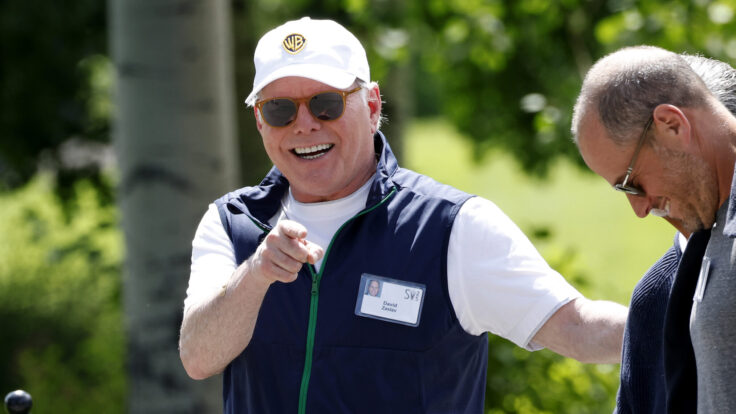
Related: Still time to put together a David Zaslav costume. Vest and glasses for Media Conference Zaslav; add a B.U. red gown and mirrored sunglasses for Commencement Zaslav; or, if you’re feeling adventurous, a cream-colored suit and a bottle of Dom Perignon for Cannes Party Zaslav. (Graydon Carter sold separately.) |
| Lou Taylor Back in Britney Spotlight |
|
| So, the new Britney Spears memoir is… good? Positive reviews in the New York Times and L.A. Times, and a steady stream of news tidbits have leaked ahead of its release on Tuesday. One unreported aspect centers on Lou Taylor, the business manager whose cozy relationship with Britney’s dad Jamie Spears came under the microscope during the whole conservatorship fight. If you remember, Taylor insisted that she was not involved in setting up or operating the conservatorship, which would have been a huge conflict because it paid her and Tri-Star, her firm, at least $18 million, and made lavish contributions to her church.
But I’ve seen the book. In it, Britney writes: “It felt like my father and Lou’s employee Robin Greenhill ruled my life and monitored every move I made. They treated me like I was a criminal or predator.” There’s more: “I am convinced that it was all planned and that my dad and my mom and Lou Taylor were all involved. Tri-Star was even planning to be my co-conservator.”
Yikes. This aligns with documents filed, in 2022, by Britney lawyer Mathew Rosengart, which showed: Of course Taylor was involved. In fact, in an early 2008 email attached to a court filing, she writes to Jamie that the eventual co-conservator Andrew Wallet and “tri star will serve as co’s w you…” The conservatorship began two weeks later.
Why should anyone care? After all, the father was removed and Britney has been famously freed. But Taylor hasn’t been shamed into oblivion, although client Travis Scott recently parted ways with her. Thanks to a religious connection to Hailey Bieber, and her relationship with the Kardashians, Taylor has weaseled her way into the life of Justin Bieber, another troubled pop star. |
|
|
| My colleague Bill Cohan attempts to put a valuation on ESPN after this week’s disclosure of declining revenue and $2.9 billion in profits from fiscal 2022. [Puck]
Related: I keep hearing that Disney’s Bob Iger and Apple’s Tim Cook are talking about some kind of investment in ESPN, but I’ll believe it when I see it. The ESPN brand is A-plus, but Apple could just spend those same billions to simply steal away its sports rights.
Speaking of Apple: In the decade after Wolf of Wall Street, Martin Scorsese has consistently found companies willing to lose massive amounts of money on his movies. Apple has now joined the club with the $200 million-plus Killers of the Flower Moon opening to just $44 million worldwide. Let’s see if Scorsese’s next planned movie for Apple, an adaptation of another David Grann book, The Wager, actually happens. [Indiewire]
Former Academy diversity chief Jeanell English really annoyed the old guard with this op-ed torching her former employer for “micro and macro aggressions” without revealing many specifics. [LA Times]
Fun fact in this amusing rise-and-fall story of Cameo: Kevin from The Office was the platform’s highest earner as of early 2022, with $3 million in revenue. [NY Times]
An update on the Netflix games initiative—the next way that the company will “surprise” all of Hollywood with something that it was doing out in the open for years. [WSJ]
Everything is too f-ing expensive. [WSJ]
Now for a preview of the restarted SAG-AFTRA talks and what SHOULD happen… |
 |
| A 10-Point Plan to Finally Resolve the Actors Strike |
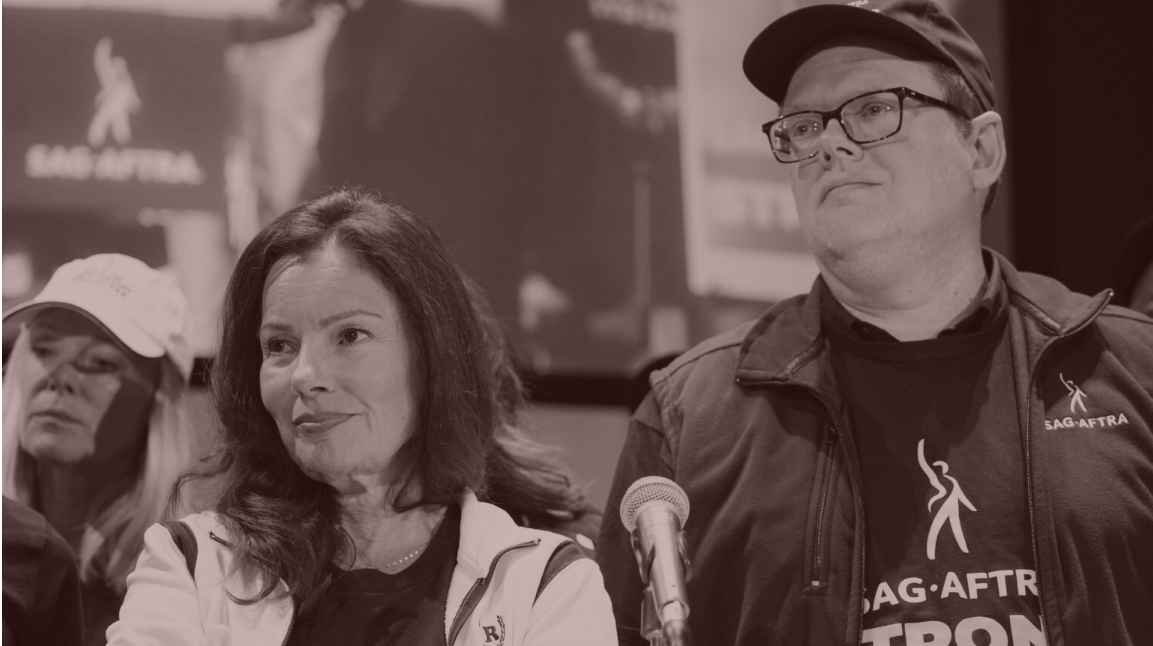
| With SAG-AFTRA and studios set to restart negotiations, it's time to get real: the union should drop its insistence on a per-subscriber payment and instead propose a supercharged version of the “success” bonus that the Writers Guild achieved. |
|
|
|
| Yes, SAG-AFTRA and the studios are going back to the table on Tuesday to try to end the 100+-day strike—a welcome development that was apparently so abrupt that the union suspended its biennial (virtual) convention on Saturday to accommodate.. But as the window for a deal this year steadily inches shut, what are the prospects?
Not great. As Matt Belloni noted the other day, George Clooney and a group of other A-listers (“high-pros,” in SAG-AFTRA parlance) are pressuring the union but suggesting nonsense—redistributed income, removing the cap on member dues, etcetera—that doesn’t move the needle. Meanwhile, I’m told that the SAG-AFTRA negotiating committee is wedded to its per-subscriber fee approach for residuals, a business model that Netflix co-C.E.O. Ted Sarandos has already decried as a “levy”—a comment that SAG-AFTRA national executive director Duncan Crabtree-Ireland called “preposterous.”
That proposal led the companies to walk out of negotiations two weeks ago, frustrating everyone—especially those who had wrongly assumed that SAG-AFTRA would simply accept the WGA deal as a template. Crabtree-Ireland had said from Day 1 that the actors were not going to be locked into pattern bargaining. Now, on the outside looking in, crew are getting frustrated, but what IATSE, the crew union, achieves next year on basic wages and A.I. protections depends a lot on what SAG-AFTRA gets in these negotiations.
Somewhere along the way, as the union proposal shifted from a 2 percent revenue pool to a 1 percent pool and then to a per-subscriber assessment—reportedly at studio urging—SAG-AFTRA seems to have lost control of the public narrative. Everyone’s nerves are frayed. That led the A-listers to weigh in with a proposal that evinced little or no knowledge of labor law, basic arithmetic (the $50 million purported value of the proposal doesn’t pencil out) or residuals, as Matt addressed in part on Thursday. There must be a better way, right? |
|
|
| Of course, the Fran Drescher-led SAG-AFTRA proposal is also flawed. A per-subscriber fee feels too much like a tax and in any case doesn’t account for the differing value of subs in different territories and on different tiers. The earlier, revenue pool approach made more sense, but it wouldn’t be easy to shift back to that now. And even that approach should have scaled the size of the revenue pool by platform size.
Both of the SAG-AFTRA approaches suffer from two other deficiencies: they distribute revenue even to non-hits and they distribute revenue not just to content made for streaming but also to content like Suits that is moved over from other media or platforms. Non-hits are supposed to be taken care of by the basic, preexisting residual for streaming; and move-over content is subject to a percentage residual that should reflect the content’s popularity. Granted, there are flaws in these assumptions, but we’ll address that in a minute. Here’s my suggestion for how to solve this thing:
1. Expand the definition of hits: Too few shows qualify for a bonus residual under the WGA proposal. So, for SAG-AFTRA, a “hit” show should satisfy the WGA definition or register among the top, say, 25 percent of shows on the platform in its first 90 days, as measured by viewership numbers that the companies will have to disclose to SAG-AFTRA under NDA, as they are doing with the WGA. This would ensure that a meaningful number of shows on each platform participate in the bonus.
2. Extend a lesser bonus to near-hits: A near-hit would be any show that falls a bit short of being a hit, e.g., a show that falls in the next 10 percent of shows by viewership. Give it a 35 percent bonus, say, rather than a 50 percent bonus.
3. Improve the actors’ preexisting streaming residual: The WGA and DGA streaming residual for a one-hour show on Netflix in its first year of exhibition is about $20,000 per episode, but an actor on the same episode will see at most about $3,000. That’s because of an artificial ceiling that’s imposed on the residual to reflect that there are too many actors on a show to pay them at the same rate as the director or writer. But that ceiling could be doubled or maybe tripled, which would bring in a lot more money to actors without changing the existing structure at all. And the residual does scale based on subscribers, albeit indirectly: Stranger Things on Paramount+ would already pay a lower residual than on Netflix.
4. Ensure that actors see the streaming residual by restricting advance pay: SAG-AFTRA’s agreement allows a large portion of an actor’s streaming residual to be bundled into their initial compensation. That means they see the money sooner, but it also means that when their agent boasts of the high fee obtained for the actor, disappointment follows a year later when no residual check is forthcoming. In effect, the residual has invaded initial compensation. And moreover, the agent is more likely to improperly commission an advance pay residual than one paid in the ordinary course. But SAG-AFTRA could curb these risks and abuses by insisting on tighter restrictions on advance pay residuals.
5. Protect against lowball imputed license fees: Move-over content can underpay residuals for two reasons. One possibility is that the licensor made a bad deal that didn’t capture full value (i.e., Suits). This is probably an outlier, and it’s hard to say that a third-party licensor that screwed itself should be further punished by paying residuals recipients as though it had made a more lucrative deal. But the other possibility is more common and more problematic: that the licensor and licensee are corporate siblings and the actual or imputed license fee reflects corporate goals rather than any market reality. It’s not an easy problem to solve, but at a minimum, the union should consider requiring that the terms of non arms-length transactions be reported to the union, along with related key data such as the production budget of the licensed property. That might enable closer monitoring and more effective control, and should be required not just for streaming deals but any transaction that generates percentage residuals.
Is that it? No. Now is the time to use the union’s leverage to achieve several other goals that will pay dividends into the future and be tough for the companies to argue against.
6. Index basic wages and other amounts to inflation: Every bargaining cycle, the companies force each union to fight over basic wage increases even though the outcome is often not in doubt. Typically, SAG-AFTRA gets a point, or point-and-a-half, above inflation. The companies’ real goal is to make the union exhaust itself fighting for bread-and-butter wage increases, sapping the time and energy it could otherwise devote to residuals, working conditions and other matters. But the union could throw its weight behind a proposal to obtain what it’s always wanted: indexing wages and other dollar figures in the contract (“money breaks,” penalties, upcharges, fixed residuals and more) to inflation, i.e., the government’s CPI-U measure plus 1.5 percent.
7. Yield slightly on the 2023-2024 wage increase: In return for indexing, the union may have to back off a bit further than it might otherwise from its 11 percent ask for the first year of this contract (vs. the companies’ 5 percent offer, which is what the DGA and WGA got). But I still would expect to see a robust demand here.
8. Establish and fund a residuals enforcement corporation: Require the AMPTP 8 companies to fund a non-profit industry-wide Residuals Enforcement Corporation (REC), controlled by SAG-AFTRA but featuring extreme financial and operational transparency, with the DGA and WGA West invited to appoint board members too, and with non-voting board members appointed by the companies, and observers from other stakeholders (WGA East, IATSE, Teamsters, AFM, P&H plans, etcetera). The goal would be to develop software to rationalize residuals inquiries, claims, and detection and reporting (to members and guilds) of nonpayment, underpayment (and overpayment) of residuals. I and other subject matter experts have estimated that a quarter-billion dollars or more in residuals go unpaid every year across all affected unions. An REC could help reduce the shortfall.
9. Institute meaningful enforcement for existing contract clauses: Actors repeatedly find that studios and producers violate some of the most basic requirements in the collective bargaining agreements, such as timely paying fees, paying for travel days on films, or when and how to pay actors per diems on location. Now’s the time to put real teeth into a host of oft-violated provisions.
10. And everything else…: The union rightfully is pushing for meaningful A.I. guardrails, and has a variety of smaller asks, including those relating to pension & health contribution levels, virtual auditions, electronic paperwork, background and stunt performers, other matters, and things that the DGA and WGA obtained, such as improvements in foreign and domestic streaming residuals and establishment of high budget AVOD minimums and residuals. These should all be part of a package of demands.
Is this a perfect package? Nothing ever is. But it allows SAG-AFTRA to retake the initiative, flip the emerging public narrative, achieve significant increases in success-based residuals even without getting at platform revenue, and attain key goals in basic wage negotiations and residuals enforcement. That seems like a win to me. |
|
|
| Another grab bag of feedback today, mostly because I don’t want to just run all the Israel-related personal attacks against the Writers Guild or CAA’s Maha Dakhil…
“As a member of the WGA, I actually found it refreshing that the guild didn’t put out a statement akin to the NBA or SAG-AFTRA. These guilds have Arab and Muslim members, too, and most corporate statements to date have been woefully bereft of mentions of the millions of Palestinians being displaced and bombed in their homes and hospitals by the IDF response. Writers are known for nuance and thoughtfulness—I’m hoping the guild puts out a statement that condemns the horrific terror attack AND acknowledges the massacre undertaken in response, which has already claimed more civilian lives than the first wave of violence. Standing with the Israeli people is not the same as standing with annihilation of Gaza.” –A writer
“As someone who lost a client to Maha [Dakhil], I can tell you she uses her social activism as a weapon. One day I was doing a great job for my client, the next I was accused of not doing enough for Time’s Up.” –A (non-CAA) agent
“I have to believe that it’ll start to become very hard for [Dakhil] to do her job. Producers, executives, clients, studios, even other agents in the building—who among them can imagine that it’s going to be easy to help her, or collaborate with her? And just look on social media at the fringe grifter-types who are defending her. That’s who a senior agent at CAA wants in her corner at this time?! Is that a conversation that helps CAA or its clients? Come on, let’s get real here.” –A lawyer
“All of this discussion about Netflix makes me really feel like people are overly bullish on ad-supported tiers. We are only a few years removed from when the DVR suddenly allowed everyone to avoid ads. Hard to imagine that genie is going back into the bottle in a significant way.” –Another writer
“The Daily Show folks are getting what they deserve. [Hasan] Minhaj is a talented comic but Roy Wood Jr. was the best fit and most obvious choice for host and their inability to see this leads me not to shed a single tear on this legal entanglement they now find themselves in.” –A filmmaker-producer |
|
|
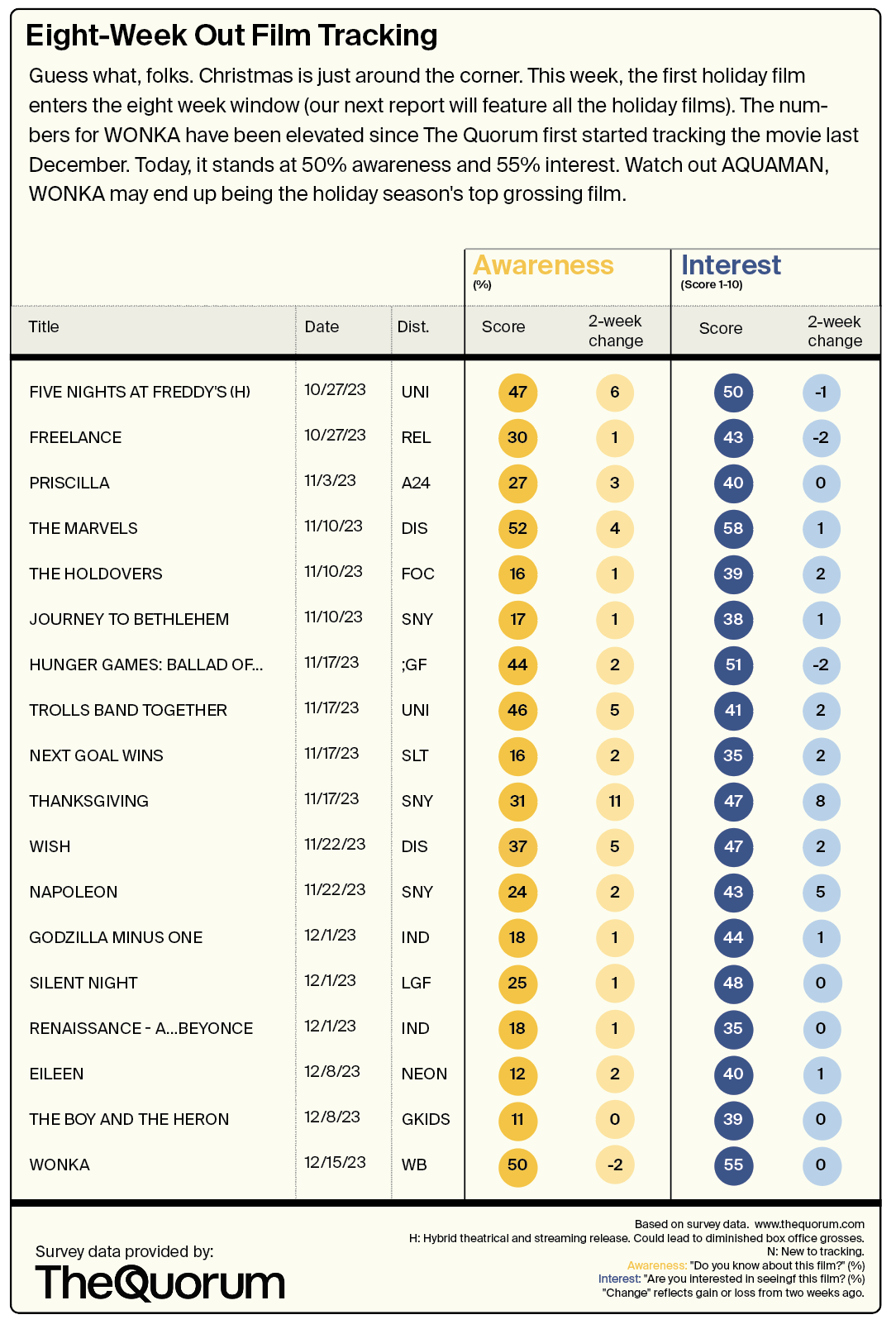
| I’ve been predicting doom for Wonka for a year now, so the strong early awareness and interest numbers in The Quorum tracking chart are… surprising. Happy to eat shit on this one if I’m wrong… |
|
|
Have a great week,
Matt
Correction: I noted on Thursday that removing the cap on member dues was part of the SAG-AFTRA platform. That’s wrong, the actual proposal is to remove the cap on salaries subject to pension and health fund contributions. Thanks to everyone who flagged the error.
Got a question, comment, complaint, or an invite to your top-secret Bosch fan chat room? Email me at Matt@puck.news or call/text me at 310-804-3198. |
|
|
|
| FOUR STORIES WE’RE TALKING ABOUT |
|
|
|
|
|
 |
|
|
|
Need help? Review our FAQs
page or contact
us for assistance. For brand partnerships, email ads@puck.news.
|
|
You received this email because you signed up to receive emails from Puck, or as part of your Puck account associated with . To stop receiving this newsletter and/or manage all your email preferences, click here.
|
|
Puck is published by Heat Media LLC. 227 W 17th St New York, NY 10011.
|
|
|
|