Welcome back to What I’m Hearing, now officially straddling both awards and media
conference seasons. Sadly I again was not invited to fellow podcaster Ari Emanuel’s big The Weekend get-together in Aspen. David Zaslav wasn’t there either, I’m told, which is probably for the best because it prevented an awkward encounter with would-be acquirer David Ellison, who attended along with… Bari
Weiss. But I will be at the Bloomberg Screentime event next week in L.A. doing a live episode of The Town with Lucas Shaw. Get tickets here.
Tonight, a check-in from Julia Alexander on how bad the Jimmy Kimmel standoff was for Disney+ and Hulu cancellations, and what Disney can
do to prevent other “churn events.” Plus, the cold reality of P.T.A. at the box office, and OpenAI steps up its Hollywood turf grab.
Programming note: This week on The Town, Lucas Shaw and I parsed One Battle After Another’s battle for profitability, KPMG’s Scott Purdy
unveiled new research on overall content spend, and Eriq Gardner explained why Disney held so much leverage over ABC affiliates. Subscribe
here and here.
Not a Puck member yet? Just click here for 20 percent off a subscription
(our fourth anniversary sale ends this week). Got a news tip or an idea for me? Just reply to this email, text me or message me on Signal at 310-804-3198.
Discussed in this issue: Joe Earley, Leo DiCaprio, Jared Kushner, Bryan Lourd, Shari Redstone, Reed Hastings, Jason Kwon, Paul Thomas Anderson, Quentin Tarantino, Bob
Iger, Taylor Swift, Atsuko Okatsuka, Jimmy Kimmel, James Gunn, Larry Ellison, Michael Eisner, James Cameron, Dana Walden, and… A24: The Restaurant.
But first… |
Who Won the Week: Sam
Altman
|
With today’s
announcement that OpenAI’s latest Sora video tool will require copyright holders to opt out of inclusion, the company’s C.E.O. steps up his effort to trample all over Hollywood—without much significant pushback at all.
A little more on this…: I don’t think people in town realize how fast the
entertainment industry’s collective grasp over its key assets is slipping away. Altman is now taking the few copyright guardrails off his marquee video product, attempting to graft onto the Section 230 protections afforded to social media companies and forcing studios and other I.P. owners to explicitly ask OpenAI not to include their assets in videos the tool creates. That potentially means anyone can make Minions clips that compete with the actual Minions content… every kid can input their own
lyrics for a Taylor Swift song and instantly create a music video with Swift’s actual voice. And the onus would be on the I.P. owners to play Whack-a-Mole on steroids with every single piece of infringing content.
Where was the outrage today? The guilds and talent agencies are silent. The studios, some of which want deals with OpenAI and its potential $500 billion valuation, have been slow to respond, despite knowing about this at least a week in advance. (I heard about
it this weekend, and when I contacted a major agency source, he responded, “Yeah, we’re adding it to the list.”) Today, when I asked for a reaction from the Motion Picture Association, which now counts Amazon as a member, I was directed to a years-old statement noting that “if the fair use defense does not excuse the exercise of the copyright owner’s exclusive rights, the use of the owners’ works for training requires affirmative, i.e., opt-in, consent.”
Okay, and dozens of A.I.-related
lawsuits are pending, including from Disney, Comcast, and other major copyright owners. But it’s clear that OpenAI and the others are seeking to define the legal and policy rules of the A.I. road on their terms, and they seem to be winning. For example: Sora won’t generate images of real people, just other I.P.-protected materials, because “our general approach has been to treat likeness and copyright distinctly,” Jason Kwon, the company’s chief strategy officer, told the
Journal. Our general approach? Is everyone in Hollywood just okay with whatever OpenAI prefers?
Puck’s A.I. expert, Ian Krietzberg, whose newsletter you should definitely be reading (sign up here), had this to say when I asked his reaction to the Sora news: |
- I’ve
often heard A.I. described as a sort of social media 2.0—all the engagement and hyper-targeting of your X feed raised to the power of on-demand, personalized, and human-like conversations. But the latest rumblings from both Meta (surprise, surprise) and OpenAI are even less subtle than that. First, there’s “Vibes,” a Meta platform for the creation and publication of shortform A.I.-generated videos. Now, OpenAI is reportedly preparing to launch a TikTok-esque app whose entire pitch, similarly,
revolves around the sharing of 10-second A.I.-generated videos. The rub is that these videos will feature copyrighted material—unless, that is, the I.P. holder opts their copyrighted content out. The move is sure to bring about even more legal tension between Hollywood—and the creative industry writ large—and Big Tech. There are currently more than 51 A.I.-related copyright lawsuits in existence (just in the U.S.); I expect we’ll see a bunch of new ones shortly after OpenAI’s new app goes
live.
|
I would hope so. Otherwise, the A.I. ship is going to sail for the New World with Hollywood staying well
behind—and eventually wondering where its business went. |
“ARTIST shall not prepare or perform any material that may be considered to degrade, defame, or bring into
public disrepute, contempt, scandal, embarrassment, or ridicule:
A) The Kingdom of Saudi Arabia, including its leadership, public figures, culture, or people;
B) The Saudi royal family, legal system, or government, and;
C) Any religion, religious tradition, religious figure, or religious practice.”
—The Riyadh Comedy Festival performer contract, as posted online by
comic Atsuko Okatsuka, who passed on the Saudi whitewashing event. |
|
|
A MESSAGE FROM OUR SPONSOR |
Three-time Academy Award winner Daniel Day-Lewis returns to the big screen in Anemone,
directed by Ronan Day-Lewis. Also starring Sean Bean and Samantha Morton. Anemone explores the complex and profound ties that exist between brothers, fathers, and sons. Only in theaters October 3. |
|
|
Runner-up: “I think box office is important because it means people are in the seats going to the
theater, going to have that communal experience.” —Leo DiCaprio, acknowledging in his usual media-trained, say-nothing way at a junket interview that the financial success of One Battle After Another does matter to the future of the kind of movies he likes to make (and most of us like to watch).
A little more on this…: No, a $22 million domestic opening and $48 million worldwide is not a good start for a $140 million-ish R-rated political dramedy, even
if it’s Paul Thomas Anderson’s best ever. Mickey 17, another star-driven genre-bender from Warner Bros. and a prestige filmmaker, opened to a similar $19 million in January and was declared D.O.A. despite a budget about $20 million lower. The hold should be much stronger on OBAA, given the great reviews, A Cinemascore, Leo’s lure, and awards buzz, so let’s hold off judgment. But a trajectory similar to DiCaprio’s last movie, Killers of the Flower Moon, which
ultimately made just $158 million in 2023, seems most likely.
Fun stat: With $137,104 in total box office over the weekend, Tarantino’s Vista theater in Los Feliz ranked in the top five theaters in the country for OBAA, lagging only New York’s AMC Lincoln Square 13 ($237,212) and Regal Union Square ($138,214) and L.A.’s Burbank AMC 30 ($138,187). The rare VistaVision format is certainly paying off. |
20 percent
Share of global box office coming from Chinese productions in
the five years since 2020, double the 10 percent they earned in the five preceding years. [Bloomberg]
66 percent
American movies’ share of that global box office, down from 92 percent two decades ago [Bloomberg]
203
percent
Increase in monthly active users of video games after the release of a TV series adaptation, compared to just 48 percent for movie adaptations. (Amazon’s Fallout led to a nearly 500 percent increase in M.A.U.s.) [Ampere Games Analytics]
23.3 percent
Share of Disney+
subscribers who haven’t used the service in 30 days or more, according to a recent survey. [Self Financial]
Which leads to Julia’s latest observations on Disney and the cancel movement… |
|
|
Beyond the shabby politics and Hollywood outrage, Disney’s decision to
reinstate its late-night host was also evidence that “churn events” matter more than ever. |
|
|
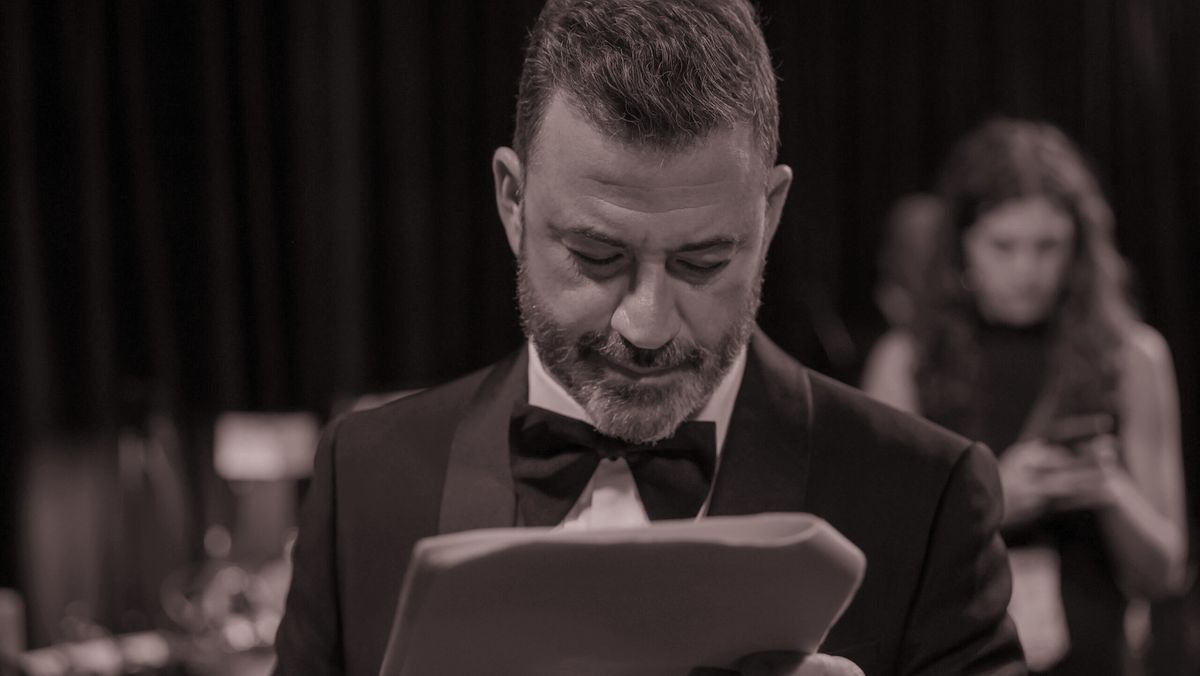
Obviously, multiple variables factored into the decision by Disney leaders Bob Iger
and Dana Walden to reinstate Jimmy Kimmel last week: blowback from talent, recognition (finally) that appeasing Trump would encourage further attacks, and maybe even a twinge of moral principle. But there’s little question that an uptick in streaming cancellations, which Kimmel winked at during his first night back, also played a role. Online boycotts like this don’t usually amount to much, especially in the long term. But certain
moments can gain traction. As one financial analyst told me, Iger undoubtedly wanted to minimize a subscriber exodus just as the company’s fourth fiscal quarter ended.
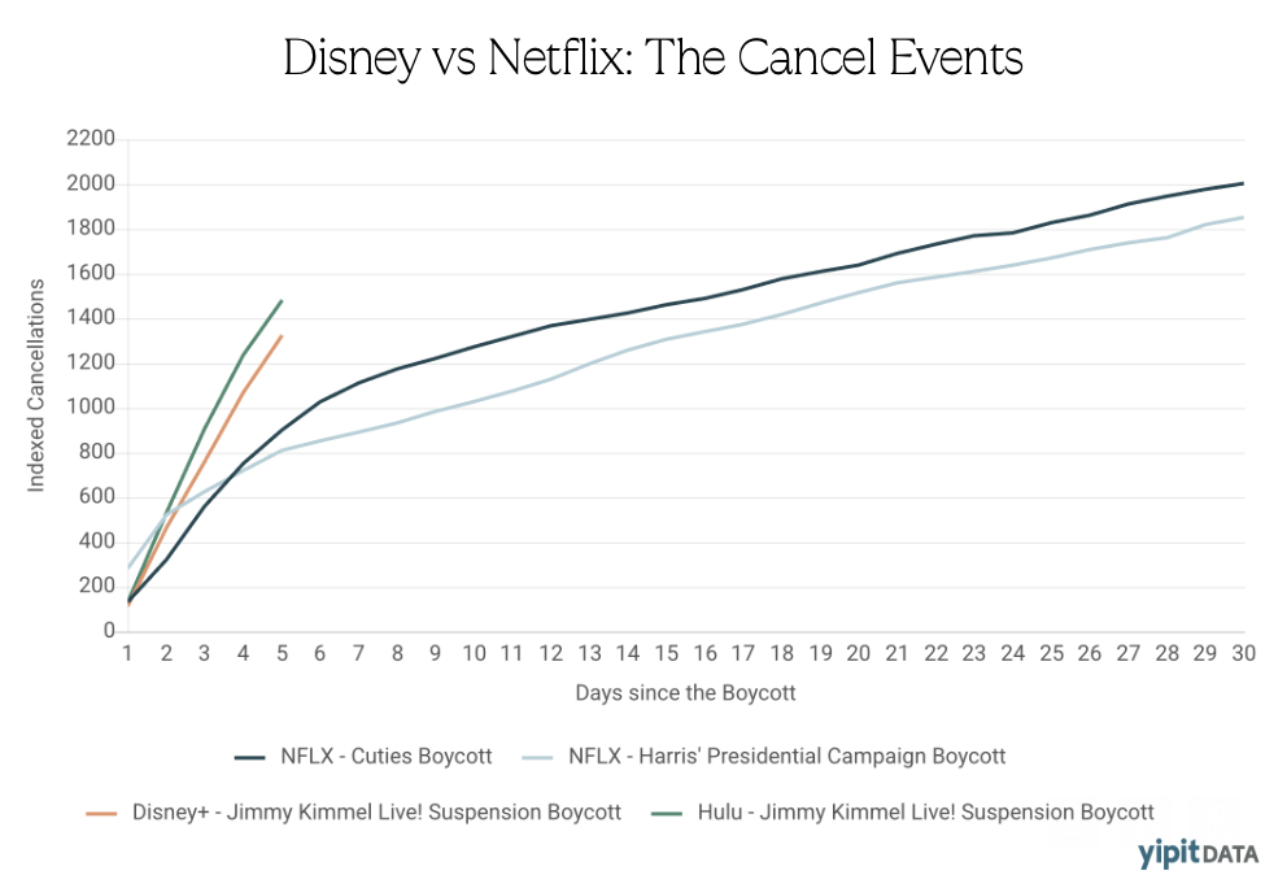
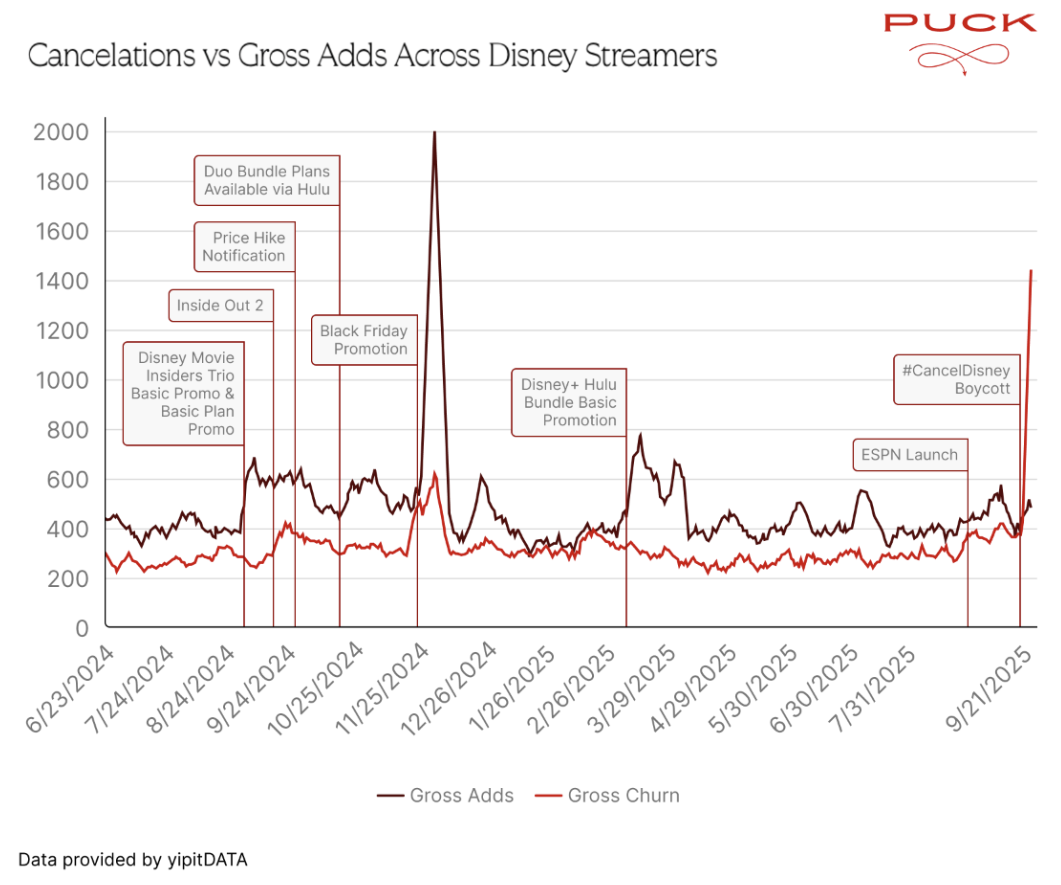
Disney hasn’t disclosed the exact number, but subscribers have been canceling, beginning with the MAGA crowd after Kimmel’s initial comments and then picking up with the free speech set after Disney preempted Kimmel “indefinitely.” According to Yipit, a data firm that uses credit card transactions and
browser cookies to track consumer activity, the churn rate for Disney+ and Hulu during the first five days of l’affaire Kimmel was nearly six times higher than before the host’s suspension. That exceeded the initial churn rate at Netflix following the 2020 controversy surrounding Cuties, which sparked a furor over allegedly exploitative marketing. It’s also higher than the churn blowback following Netflix co-founder Reed Hastings’ $7 million
donation to a Kamala Harris super PAC last year. |
It’s unclear how many of the Kimmel cancelers might have turned their subscriptions back on when Disney
relented. And sometimes it can be difficult to tell why subscribers are cancelling in the first place. The shift after Hastings donated to Harris, which represented triple the streamer’s average churn, was seemingly buoyed by Netflix’s efforts to phase out its cheapest tier. But the initial Kimmel data is pretty straightforward: There was no big series or sports season ending, and Disney didn’t announce its next price hike until the following Monday—an apparently unavoidable, yet
unfortunate coincidence—concurrent with revealing that Kimmel would return.
Joe Earley, Disney’s head of D.T.C. operations, will run all the usual win-back campaigns. But even minor mass cancellation events can be tough for Disney+ and Hulu, whose usual churn rates of around 5 percent are three points higher than Netflix’s. And the data shows that neither service is as valuable to customers as it was a couple of years ago, when there were fewer options. (Disclosure: I
previously worked at Disney.)
Iger told analysts last month that he is “very, very focused” on the churn issue. Folding Hulu into Disney+ is a smart first step toward creating a unified super-app with everything in one place. In the future, Fubo and ESPN could also be integrated into the single app. Theoretically, the growing value of the bundle would outpace price hikes, making subscribers less likely to cancel—including when controversies flare over a single show, like Kimmel’s.
|
|
|
A MESSAGE FROM OUR SPONSOR |
Three-time Academy Award winner Daniel Day-Lewis returns to the big screen in Anemone,
directed by Ronan Day-Lewis. Also starring Sean Bean and Samantha Morton. Anemone explores the complex and profound ties that exist between brothers, fathers, and sons. Only in theaters October 3. |
|
|
Iger et al. still have plenty of work to do on that front, though. Disney’s combined streaming
services (Disney+ and Hulu) have failed to move beyond a 5 percent share of all TV viewership in the U.S. since Nielsen started reporting their combined engagement in January. In that same time, Netflix has increased its share by nearly a full percentage point, and YouTube jumped 2.5 points. According to a recent Wolfe Research survey, consumers ranked Disney+ as the least valuable of the six major stand-alone streamers, but still far ahead of more niche offerings like Starz. Hulu fared better,
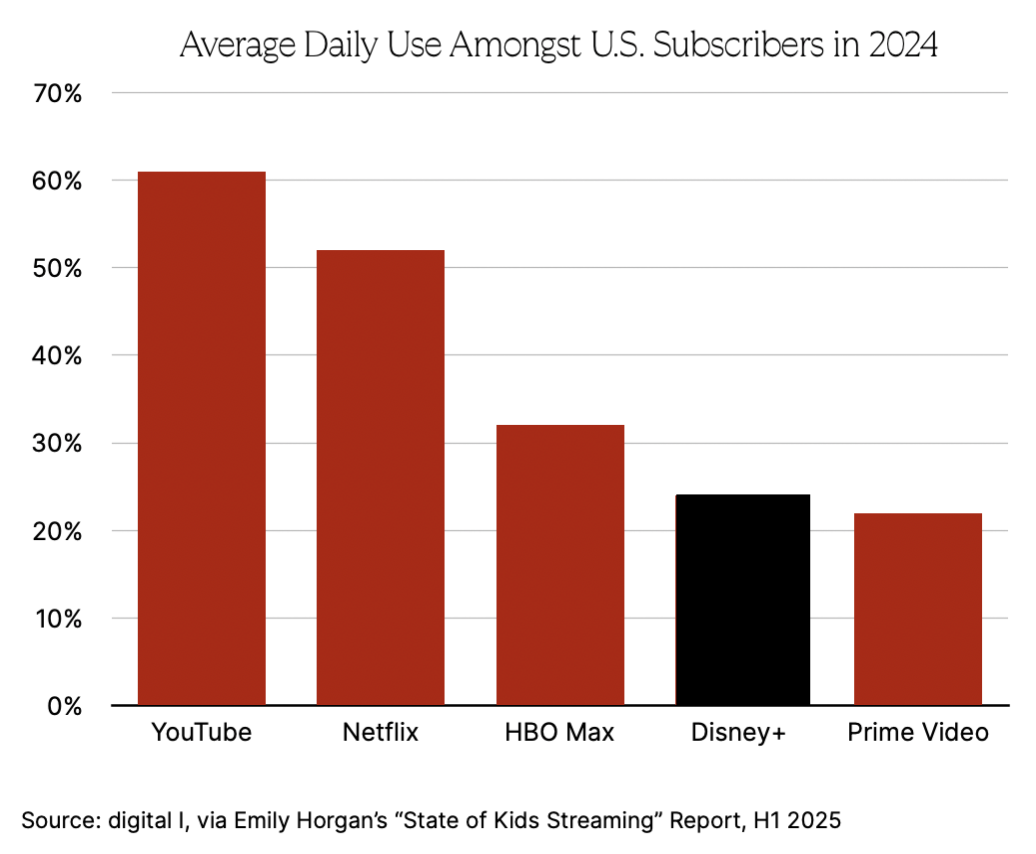
but was beaten by Paramount+. Among U.S. streaming customers, less than 25 percent use Disney+ every day, compared to 52 percent for Netflix and 32 percent for HBO Max, according to Digital i. And while Disney+ outperforms Netflix with preschoolers—historically, the first stage of Disney’s lifetime consumer acquisition pipeline—Netflix now leads with the 6-9 and 10-12 demos, according to Precise TV data from kids’ content analyst Emily Horgan. |
Plenty of cancelers do come back, of course, often sooner rather than later. About 33 percent of
those who cancel a streaming service resubscribe within six months, Antenna has found. And Disney’s newly enhanced bundle is helping: Hulu’s churn rate dropped an average of two percentage points when offered with Disney+, Antenna noted. Meanwhile, of the nearly 1 million subscribers who have signed up for the new ESPN Unlimited in its first 10 days, 80 percent chose the bundle option with Disney+ and Hulu—no doubt helping offset some of the Kimmel-related losses. About 10 percent of all
customers also chose an annual plan, making those audiences less likely to cancel.
Maybe some of those new subscribers subsequently canceled due to the Kimmel situation. But it’s unlikely they’ll want to miss out on another weekend of football, especially given the strong lineup of games on ESPN (well… after tonight’s battle of 0-3 teams on Monday Night Football, anyway). In the last week of August, all the programming across Disney’s portfolio (regardless of platform) accounted
for 11.5 percent of TV viewing time in the U.S., per Nielsen’s Distributor Gauge—mostly due to the return of college football and preseason NFL coverage.
The fall season tends to be good for Disney+ and Hulu off the field, too: The return of popular shows like Grey’s Anatomy and Abbott Elementary drives strong next-day viewing on Hulu. Between September and November, more than 90 percent of Disney+ and Hulu subscribers will watch Halloween content such as The
Nightmare Before Christmas, Hocus Pocus, and American Horror Story, per the company. High-profile movies like The Fantastic Four: First Steps will land on Disney+ soon, and the first two Avatar films will likely get a boost in advance of James Cameron’s Avatar: Fire and Ash on December 19, not to mention the number of Zootopia restreams ahead of Zootopia 2 in November. |
As Disney moves toward integrating all that content—the NFL, classic films, big I.P., the Hulu serials, and
prestige FX shows—individual churn events like the Kimmel imbroglio should become easier to weather. Like any churn activity, the question that matters is what percentage of those customers a company can win back—and how fast—so advertisers don’t follow them out the door. Unlike with cable, where nearly every network was tied into one unwieldy service, customers who want to make their voice heard can just open an app and hit cancel. No one at Disney is celebrating right now, but we can be sure
they’re thankful the Kimmel screwup happened during football season. |
Bill Cohan breaks down the valuation challenge for Ellison’s WBD bid, and
how the recent media leak complicates matters. [Puck]
So… Disney, Skydance, and the other media powers are just gonna let Jared Kushner, Silver Lake, and the Saudis take Electronic Arts private in a $55 billion deal?
[WSJ]
Joe Adalian gets into some of the interesting options if networks like ABC want to shake up the fraying affiliate station business (and its billions in reverse compensation) and go direct to linear viewers.
[Vulture]
The potential Ellison acquisition of Paramount and WBD is starting to generate pushback from politicians and the media.
[The Conversation]
But… Peter Supino, the Wolfe Research analyst, is skeptical—writing that even if Ellison controls 30 percent of North American box office, the WBD acquisition “looks viable in
light of the intense and growing competition across TV and film.”
Hedge fund managers are now hiring agents. Countdown until Bryan Lourd starts having lunch at San Pietro? [WSJ]
A24’s new restaurant in the recently purchased Cherry Lane Theatre is a “raw bar meets a Midwestern supper club.” Presumably, the menu will be
all over the place and way too long. [Grub Street]
Michael Eisner and Shari Redstone could soon be kicked out of the Pierre if the Central Park–adjacent co-op is sold to the Saudis. [NY Times]
|
My Thursday missives on Ellison’s antitrust playbook and Iger and Walden’s handling of the Kimmel debacle
sparked a ton of messages. Some highlights…
“Weird that in all this conversation about free speech vs. canceling Jimmy, no one has pointed out that the last time Disney bowed to hysterical conservative pressure, they handed D.C. the biggest weapon of the destruction of Marvel: James Gunn.” —A producer
“Thank you for getting it right on the Disney/Kimmel of it all. This is mostly a P.R. failure, and in the postmortems I really hope they go through the
timeline and ask hard questions about how the communications people handled themselves.” —A Disney shareholder
“I don’t know why Ellison isn’t just going after Netflix. Yes, it’s trading at 10x WBD, but Oracle is getting closer to $1 trillion in market value. That’s some great collateral. Buying WBD is just a CNN headache, even if he spins that off. Netflix is the only thing that would change the game.” —A journalist
“Remember when Disney was buying Fox and they
‘committed’ to keeping 20th Century Fox alive as a ‘studio’? Look at 20th Century now: It’s a few genre titles that don’t fit with Disney branding and Avatar, a shadow of its former self. That is the fate that awaits WB if Ellison gets his hands on it.” —A filmmaker
“Let’s hope Ellison getting WBD doesn’t end up with a stifling of voices. The studio that put out Sinners and One Battle After Another under de facto Larry Ellison
control is a real existential problem for the town.” —An executive |
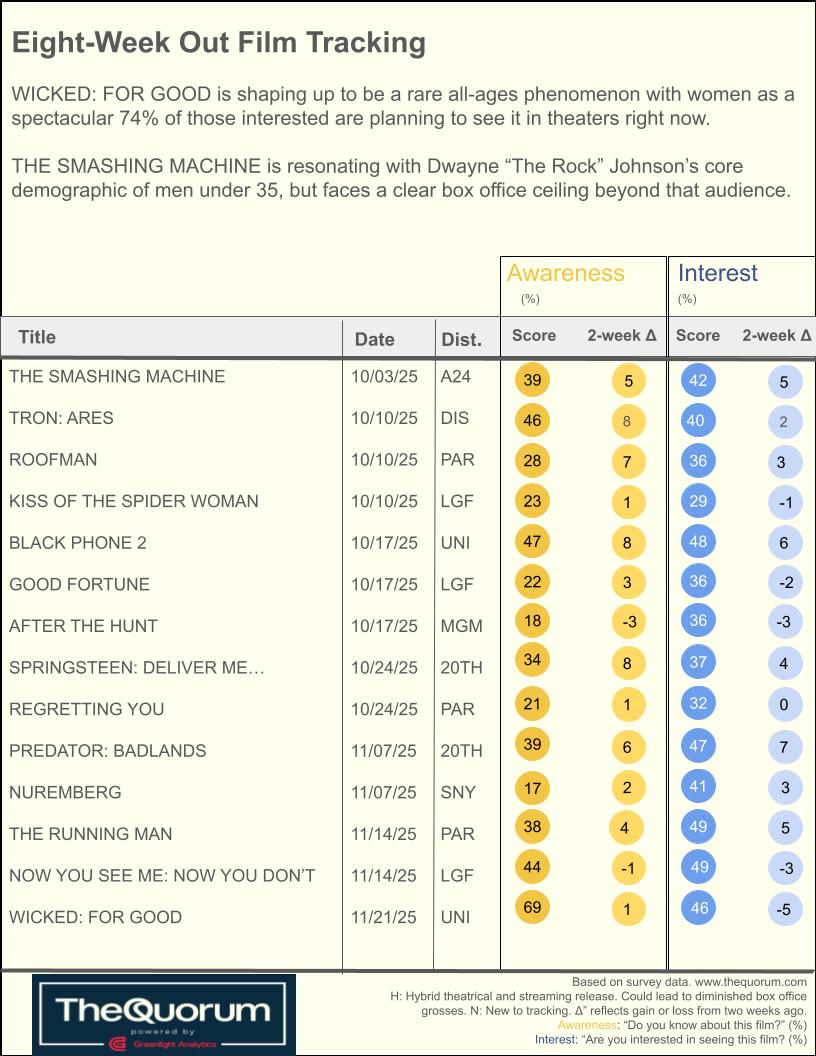
Universal’s Wicked: For Good debuts with strong awareness and interest (especially among women),
suggesting it could challenge the first film’s $750 million worldwide, according to the new early tracking chart from The Quorum… |
Have a great week,
Matt
Correction: The D.O.J.
would likely review Disney deals with NFL Media and Fubo, not the F.C.C., as I referenced on Thursday.
Maya Tribbitt contributed research for today’s issue.
Got a question, comment, complaint, or ideas on who prompted Trump’s Hollywood tariff post this morning? Email me at Matt@puck.news or call/text me at 310-804-3198.
|
|
|
Puck sports correspondent John Ourand and a rotating cast of industry insiders take you inside the executive suites and owners
boxes where the decisions that shape the entire sports business are made. You’ll hear interviews with players, network execs, and everyone in between. The Varsity is an extension of John’s private email for Puck by the same name. New episodes publish every Wednesday and Sunday. |
|
|
The ultimate fashion industry bible, offering incisive reportage on all aspects of the business and its biggest players.
Anchored by preeminent fashion journalist Lauren Sherman, Line Sheet also features veteran reporter Rachel Strugatz, who delivers unparalleled intel on what’s happening in the beauty industry, and Sarah Shapiro, a longtime retail strategist who writes about e-commerce, brick-and-mortar, D.T.C., and more. |
|
|
Need help? Review our FAQ page or contact us for assistance. For brand partnerships, email ads@puck.news. You received this email because you signed up to receive emails from Puck, or as part of your Puck account associated with {{customer.email}}. To stop receiving this newsletter and/or manage all your email preferences, click here. |
Puck is published by Heat Media LLC. 107 Greenwich St, New York, NY 10006 |
|
|
|