 |
 |
|
Welcome back to What I’m Hearing, which I’m told just earned an 11-minute standing ovation at Cannes.
Programming notes: My chat last week with Roku’s Charlie Collier is online here. On The Town, Lucas Shaw and I broke down the streamers’ plans to pay talent less up-front, analyst Rich Greenfield anointed the winner of the TV upfronts, and McKinsey’s Camilo Becdach brought data to the push for better Latino representation. Subscribe here and here.
Also, on May 29 in D.C., Puck will host a screening of For Love & Life: No Ordinary Campaign, a film chronicling the life and times of attorney-activist Brian Wallach and his wife, Sandra, in the aftermath of his A.L.S. diagnosis at age 37. Following the screening, Julia Ioffe will interview the filmmaker, Christopher Burke. You can RSVP here.
Not a Puck member yet? Click here to fix that problem. Got a news tip or an idea for me? Just reply to this email.
Discussed in this issue: Bob Iger, Ryan Reynolds, Shari Redstone, Simon Kinberg, David Zaslav, Ben Stiller, Kevin Hart, Kevin Costner, Chris Pratt, Greg Peters, Brian Robbins, and… Michael Rubin’s Instagram.
But first…
|
| Who Won the Week: Scarlett Johansson |
|
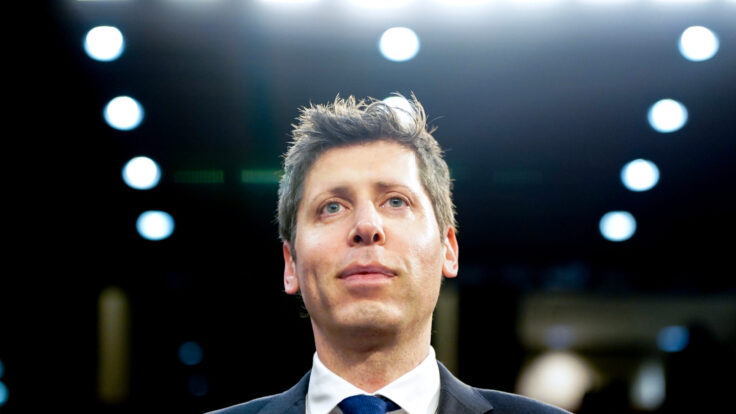
| She’s an eleventh-hour winner for this afternoon’s fantastic legal letter bomb-drop on OpenAI C.E.O. Sam Altman, who, Johansson revealed, tried to enlist her as the voice of ChatGPT-4o before either hiring an imposter or generating her voice via… A.I.! Hollywood stars rarely look like victims in high-profile disputes, but Johansson is now the face of exploitation by tech creeps like Altman.
Honorable mention: Tom Rothman, the Sony film boss, for celebrating the 100th anniversary of his studio at a Cannes party without wearing a cream-colored suit or posing for champagne sponcon with Graydon Carter. It can be done!
Speaking of Rothman: His career-capping toast in Cannes will do nothing to quell those recurring retirement rumors. The latest round got a quick “far from true” denial when I asked about them last week. Still, Rothman turns 70 in November, and making Garfield reboots and brain-dead Spider-Man villain spin-offs probably isn’t on his bucket list. I could see Tom using the four Beatles movies he just greenlit for 2027 as an off-ramp into producing. |
| Paramount in the Eye of Hurricane Shari |
|
| I’ll admit that I suspected some grim anecdotes when I started asking around about dealing with the Paramount movie studio amid the chaos of its parent company’s tortured sale process. Instead, most people say it’s kinda business as usual, albeit the depressing new industry-wide usual of fewer projects and squeezed budgets. Even deals on the larger side are happening. Brian Robbins unfurled a ton of project news at CinemaCon. Plus, there’s a secret reboot of Warren Beatty’s Heaven Can Wait in development with Glen Powell starring and Stephen Gaghan writing. (That’s on top of Powell starring in Par’s reboot of The Running Man, which I’m really hoping casts Steve Harvey in the Richard Dawson role.) And I’m told Simon Kinberg, the prolific producer of X-Men and other Fox-Marvel movies, is negotiating to join Star Trek as its new steward in film.
If his deal closes, Kinberg will technically produce just the prequel being directed by Toby Haynes (Andor) and written by Seth Grahame-Smith. But since Star Trek 4 has script and schedule issues with that famous (and expensive) cast, the prequel will likely shoot in early 2025 and could very well end up as a reboot. Plus, Paramount sees Kinberg as a franchise shepherd à la Alex Kurtzman for Trek TV projects, even though J.J. Abrams remains as a producer. Whether that new film is a Paramount or Sony release remains a question to be answered by Shari Redstone, of course, but the studio’s other suitor, Skydance, does retain its option to co-finance and produce the Kinberg Trek movie.
More, just for fun: Speaking of big projects, The Sims movie adaptation with Margot Robbie producing and Kate Herron directing has found a home. Amazon MGM Studios is negotiating for the project, outbidding pretty much all the studios except Netflix (the producers want a theatrical release). Amazon has really spent on movie projects lately. |
|
A MESSAGE FROM OUR SPONSOR
|
 |
|
|
|
|
|
“Where are all you brave, rich billionaires?”
—Kevin Costner, in GQ, fishing for investors for his Horizon film series, the first of which premiered at Cannes to just 29 percent on Rotten Tomatoes. Added Costner, after admitting he invested about $38 million of his own money: “I need somebody that’s impulsive, is emotional, has money, and wants to go west.” Don’t everybody sign up at once!
Runner-up: “Every time they open the app it has to be something different—this is where A.I. will just be a huge, huge, important tool to do all this.”
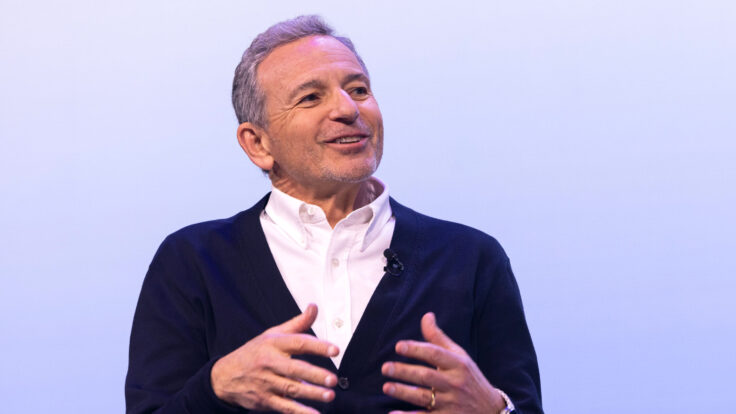
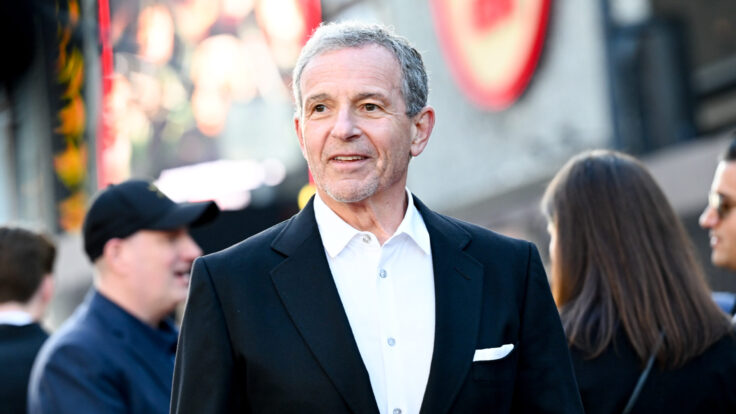
—Bob Iger, last week at a MoffettNathanson conference, explaining one way Disney plans to succeed in streaming.
A little more on this…
No disrespect to Iger; he’s talking about A.I. personalization and password crackdowns and integrating Hulu into Disney+—all fine initiatives, and all being adopted across the industry. But Disney’s streaming services are so far behind Netflix on pretty basic tech issues. They don’t even do the one thing that could instantly increase engagement and reduce churn: video previews.
This isn’t a novel gripe. When I open up the Hulu app and click on, say, Dune: Part One, a slick-looking content page with Timothée Chalamet’s pretty face appears. What doesn’t appear immediately is a trailer, or a curated video clip, or anything vibrant or dynamic that might suck me in (besides Timmy’s flowing locks and soulful eyes, of course). Same is true for Dune on Max, whose sister company actually distributed the movie. Max offers a static, quiet experience, unless you affirmatively choose to click on trailers. Even the Max page specifically set up to show the trailer for Dune: Prophecy, an upcoming TV show, doesn’t automatically play that trailer. You need to click again.
Now flash back to a couple months ago, when Dune was available on Netflix in the run-up to Dune: Part Two hitting theaters. There, I was greeted automatically with a video preview. It was fast and urgent—and, yes, slightly annoying—but it was curated and had been A/B tested to ensure it was very good at convincing me to watch. That’s what leads to maximum engagement.
Same movie, different interfaces, and a metaphor for how far behind Disney and Warner Discovery are here. Both spent millions of dollars to sell advertisers on their streaming ambitions at last week’s upfronts, yet they said almost nothing about the tech delivering all that content. On the other hand, Netflix has superior recommendation algorithms, personalized tile images, and the Open Connect content-delivery system, which engineers seamless viewing across thousands of devices and platforms and has cost the company billions of dollars to deploy. And yes, those aggressive video teasers. These tools have proven that the difference between popular and unpopular has way more to do with technology than name-brand showrunners or third-act twists.
Netflix launched autoplay trailers back in 2016 and now has live previews for nearly all its titles. “We know we have less than 90 seconds to capture someone’s attention and get them excited about a title,” the company’s product innovation leaders said at the time. Some people bitch about the videos, which can be disabled in settings, but at this point consumers have been trained to expect video previews via YouTube and their social feeds. Plus, argued Stephen Garcia, one of those leaders, “Television has decades’ worth of expectation that when you turn it on, the video and audio play. So it’s actually quite strange to have a silent experience.”
Exactly. When Netflix executives talk about its technology advantage, this is what they mean. Amazon Prime Video and Peacock have both adopted video play recently, though theirs are far more annoying and often blurry. Apple TV+ has them too. But Max, Paramount+, and the Disney services don’t even bother with auto-videos—or with personalized tile images, another big engagement driver. Why? Because it’s expensive, the kind of thing that tech natives and otherwise healthy businesses invest in.
Iger knows this. “We need to be at their level in terms of technology capability,” he said about Netflix in March. When Disney+ launched in 2019, “What we didn’t have was the technology that we needed to basically lower customer acquisition and retention cost, to increase engagement, to essentially grow our margins by reducing marketing expenses.” But, he continued, “We’re now in the process of creating and developing all of that technology, and obviously the gold standard there is Netflix.”
He hopes. Someday soon, hovering over a tile for The Acolyte should generate a lightsaber battle from the trailer. The Wish page should give kids a snippet of that catchy song—Disney’s version of maximum engagement. Then we’ll know Iger is at least really trying to compete. |
|
|
| Lucas Shaw does a nice job making Greg Peters, Netflix’s other C.E.O., more interesting than he probably is. [Bloomberg]
The Academy Museum, after some questionable vocal pushback from members of the board of governors (you know who you are), is finally acknowledging that Hollywood’s founders were Jewish. [LA Times]
It wouldn’t be a TV upfront if media buyers didn’t immediately complain anonymously about the presentations. [AdAge]
How does Taylor Swift stack up against Michael Jackson, The Beatles, and Madonna? It’s impossible to compare eras, but the Times tries with nice graphics. [NY Times]
Ari Emanuel and the Silver Lake bros are risking shareholder suits by taking Endeavor private without majority-of-minority approval. [Reuters]
Fanatics C.E.O. Michael Rubin’s personal P.R. firm, Berk Communications, sent an embarrassing yet 100 percent on-brand email today requesting that media orgs link to his Instagram for pictures of Tom Brady and Jay-Z speaking to young NFL players in L.A. So I’ll link to Brady’s account. [Instagram]
Now Scott Mendelson’s take on Ryan Reynolds’s non-Deadpool summer season performance… |
 |
| The Ryan Reynolds Youthquake |
| The ultimate success of ‘IF’ hinges on whether Reynolds can continue to be as successful entertaining kids as managing soccer clubs and investing in spirits. |
|
|
|
| So it turns out that IF, John Krasinski’s $110 million live-action/animation fantasy-comedy hybrid, opened at $33.7 million. That was below the prerelease tracking projections but still decent for an original studio programmer. In many ways, the movie had almost everything working against it—a depressing “survive till ’25” box office season, the lack of a Marvel character, a 49 percent Rotten Tomatoes score, etcetera. On the other hand, its potential long-term profitability—via PVOD and third-party licensing, among other things—and even its mere existence largely depend on one factor: Ryan Reynolds.
Reynolds, of course, has forged a notably unorthodox career path, from his TV origins, to the 2000s romantic comedies, and the eventual success of Deadpool, which generated $783 million worldwide in early 2016 and suggested that he was on an inexorable mid-career rise to conventional butts-in-seats stardom. But, as evidenced by the pre-Deadpool commercial missteps like Self/Less, R.I.P.D., and The Change-Up, the R-rated superhero smash wasn’t the final piece to an all-quadrants movie star puzzle.
However, in the years since, the actor and producer, and gin/wireless tycoon, and unlikely football club owner/reality TV star amassed relative successes in family-friendly entertainment. He helped push Pokémon: Detective Pikachu (where he voiced the title character alongside human lead Justice Smith) to $450 million worldwide in the summer of 2019. Reynolds followed that up with the surprisingly successful Free Guy (another wholly original fantasy, albeit a PG-13 action-comedy set within a video game), which would earn solid reviews, strong buzz, and a robust $335 million worldwide in the Covid-y summer of 2021.
That film would earn more than 1 billion viewing minutes, according to Nielsen, when it arrived on Disney+ and Max, providing ample evidence at a key juncture that a strong theatrical run would not cannibalize streaming success. Reynolds also enjoyed streaming-focused hits with...
Continue reading online... |
|
|
|
|
| Judd Apatow’s conscious uncoupling from UTA drew interesting responses from readers. A few examples…
“We talk about this issue constantly. Judd is a good example of someone who should fire his team. They’ve had a great run together and made a lot of money. The market turned, Judd adapted but not enough. If he’s unhappy and there’s not much more [UTA] can do for him, then let one of the others try. I could see him going back in a few years.” —A rival agent
“Like a former CAA client who went to lunch to fire his agent once said… ‘My career isn’t going how I want it to, and I can’t fire me.’” —A filmmaker
“So much of [Apatow’s] success came from riding an incredible generation of talent and helping them succeed/thrive. I don’t think the up-and-coming talent is there anymore. He tried hard with Pete and the Please Don’t Destroy guys and Billy Eichner… they aren’t exactly Jonah and Carell and Rogen and Rudd and Hader, etc.” —An executive
“You should have written a bigger story about how UTA lost Kevin Hart, Ben Stiller, and Judd Apatow in one month.” —Another rival agent
“Agents having to do their jobs?!? The horror!” —A producer |
|
|
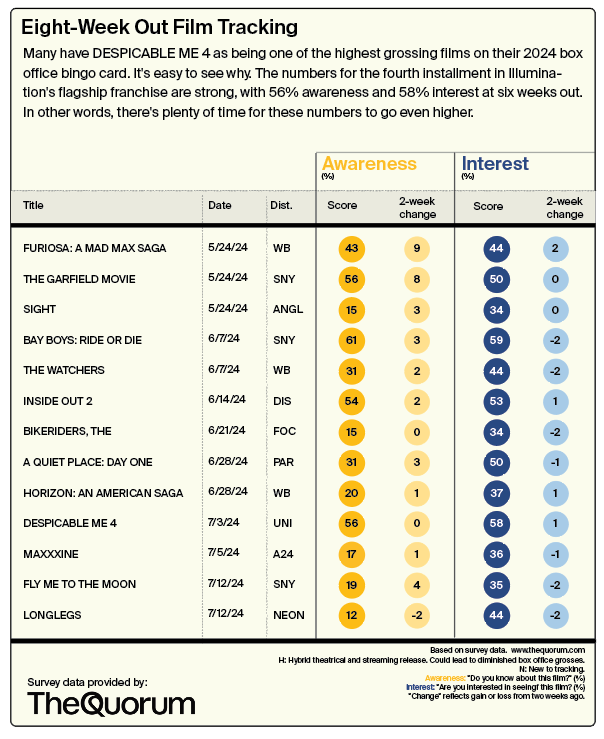
| Despicable Me 4 will be big, but how big? It debuts on the Quorum early tracking chart with huge awareness and interest numbers… |
|
|
Have a great week,
Matt
Correction: Greg Mottola is the director attached to the Judd Apatow project with Katt Williams that I mentioned on Thursday, not Nick Stoller. Apologies to both. Hopefully that film will find a buyer.
Got a question, comment, complaint, or a list of things you’d rather do with your billion dollars than invest in Kevin Costner movies? Email me at Matt@puck.news or call/text me at 310-804-3198. |
|
|
|
| FOUR STORIES WE’RE TALKING ABOUT |
 |
|
 |
| Zuck’s Gambit |
| Dissecting Meta’s plunge into A.I. |
| BARATUNDE THURSTON |
|
 |
|
 |
| $1B Art Flop |
| Chronicling a topsy-turvy week for the art market. |
| MARION MANEKER |
|
|
|
|
|
 |
|
|
|
Need help? Review our FAQs
page or contact
us for assistance. For brand partnerships, email ads@puck.news.
|
|
You received this email because you signed up to receive emails from Puck, or as part of your Puck account associated with . To stop receiving this newsletter and/or manage all your email preferences, click here.
|
|
Puck is published by Heat Media LLC. 227 W 17th St New York, NY 10011.
|
|
|
|