 |
 |
|
Welcome back to What I’m Hearing. I’m home from a weekend in Vegas and am now officially the last person to tell you that the Sphere is very cool! Who knows if it will ultimately succeed, but seeing a band like U2 there is a rarity in entertainment: a truly incomparable experience. (No, this is not becoming a Jim Dolan fan newsletter.)
Programming note: I did a fun profile interview with LinkedIn where I complained about how busy I am (sorry). On The Town, Lucas Shaw and I debated who will buy Paramount, casting director Denise Chamian revealed that she really wanted Austin Butler for Miles Teller’s role in Top Gun: Maverick, and Julia Alexander and I picked the streaming power move of the year. Subscribe here and here. And a big thanks to film Academy C.E.O. Bill Kramer for the shoutout to Puck at the member meeting this weekend.
Give the gift of What I’m Hearing! Click here to become the envy of your holiday party. And FYI, this week Puck is publishing our annual gift guide, so look for that in your inbox.
Discussed in this issue: Dana Walden, “Weird Al” Yankovic, Beyoncé, Tom Cruise, Jay Penske, Bob Iger, Jamila Hunter, Tim Cook, Charles King, John Woo, Andrew Ross Sorkin, Jacob Elordi, Ron DeSantis, and… Nelson Peltz’s ego.
|
| Who Won the Week: Steve Phelps |
|
| Who? Sure, Spotify announced that Taylor Swift was listened to more than 26 billion times this year. But Phelps is the NASCAR president who closed new media deals worth $7.7 billion over seven years, a jump of 40 percent over existing contracts, and he added Amazon and Warner Bros. to NBC and Fox.
Honorable mention: Ousted CNN chief Chris Licht, fresh from his nice shout-out by David Zaslav at the DealBook conference, who wore a sweater emblazoned with “Get Licht” to Libby Geist and Kevin Wildes’s holiday party last night. (Yes, it lit up.) |
| Globes Boycott Movement Now Targeting Stars |
|
| “Boycott the Beverly Hilton!” reads the subject line of an email, shared with me, that was sent this week to likely Golden Globes nominees. The union representing striking L.A. hotel workers has been pressuring all awards shows to relocate from struck venues, but it seems to be especially targeting the embattled Globes, calling and emailing reps for actors in the awards race with a specific plea. “We are respectfully asking that the Golden Globes stand with these hotel workers by relocating, postponing or canceling this upcoming event at The Beverly Hilton,” the email reads.
A boycott would be a particular disaster for the Globes as the Jan. 7 show attempts to recover from recent scandals. (It’s still looking for a host; Ali Wong passed last week.) And it’s especially awkward because Todd Boehly, who was the interim C.E.O. of the Hollywood Foreign Press Association and co-owns Globes producer Dick Clark Productions with Jay Penske, also owns a piece of the Beverly Hilton. DCP already took a huge haircut to get the Globes back on TV via CBS, and now this? A DCP rep tells me, “We are monitoring the strike closely, and believe the situation will be resolved by the end of December.” |
|
|
“First of all, I’m Andrew.”
—Andrew Ross Sorkin, the CNBC anchor and Times writer, responding at the DealBook conference when Elon Musk said, “The only reason I am here, Jonathan, is because you are a friend.” |
| What Is the Ridiculousness of Freeform? |
|
| I’m told Disney isn’t planning on replacing Jamila Hunter, the top original programming executive at Freeform, who bailed this week to run TV at Charles King’s Macro studio. So add another network to the list of formerly active purveyors of original scripted shows that will likely be forced to ride out the waning days of cable with almost exclusively licensed reruns and stunts like “25 Days of Christmas.”
The young-female targeted network still has some originals, but Grown-ish is in its last season, and Disney TV chief Dana Walden is talking about putting more streaming shows on linear, so the concept of a Freeform original makes less and less sense. As Paramount TV executive Chris McCarthy proved by running Ridiculousness nonstop on MTV, the least possible effort can still deliver some ad spend and those sweet, sweet carriage fees. Plus, Disney was quick to clarify that when Bob Iger announced at the town hall this week that, nah, he doesn’t want to sell the TV networks anyway, he was talking about the “core” networks—ESPN, ABC, FX, Disney Channel—meaning everything else is presumably fair game.
Now our new box office contributor Scott Mendelson gives some much-needed context to the Beyoncé and Godzilla numbers… |
 |
| All Hail the Niche Event Film |
| A subgenre of demographically specific movies, as exemplified by current hits featuring Beyoncé and Godzilla, used to be gravy for the theatrical business. Now it’s a necessity. |
|
|
|
| Silent Night, which marks John Woo’s first American film since Paycheck in 2003, opened to just $3 million domestically this weekend via Lionsgate. That’s not a shock—Joel Kinnaman isn’t exactly a butts-in-seats draw, and Woo was barely known to general audiences back in the days of Face/Off and Broken Arrow. But while Hollywood mostly took the post-Thanksgiving weekend off, as it does most years, Beyoncé and Godzilla stepped in to save the box office. The result, with a famously slow weekend getting a shot in the arm, presages how theaters can help salvage their business as traditional movies falter.
Renaissance: A Film by Beyoncé, distributed independently by the AMC Theatres chain and Variance, earned an estimated $21 million over its first weekend. That’s among the biggest openings for a concert/music doc and the second-largest post-Thanksgiving debut (sans inflation) after The Last Samurai ($24.2 million, or $42 million adjusted) exactly 20 years ago. As I’ve said for two decades, skipping out on this frame is a mistake, as films like the Tom Cruise historical epic have shown that an appealing enough movie can compete with holiday parties and shopping. But there was more!
Toho International’s U.S. release of the (justly) acclaimed Godzilla Minus One earned a monstrous $11 million in its Fri-Sun launch. For comparison, the acclaimed Shin Godzilla earned $2 million total in 2016. Also this weekend, the latest Indian epic, an ultraviolent, 3.5-hour crime drama called Animal, opened with $6.1 million. Finally, The Shift, a multiverse riff on The Book of Job from Angel Studios, the faith-centric outfit behind the summer smash Sound of Freedom, opened with $4.4 million. All these films cost relatively little to produce and played to proven, mostly presold fan bases. None of them was likely factored into analysts’ predictions for quarterly box office.
So, while that isn’t necessarily a king’s ransom for any of these films, each is successful on its own terms. Moreover, they combined for $44 million in domestic box office, which wouldn’t have existed if multiplexes relied only on Hollywood. These four pictures boosted the overall weekend to around $94.4 million. That was 79 percent higher than the same weekend last year (around $52.7 million) and 5 percent higher than the same pre-Covid frame in 2019 ($90.3 million) when Frozen II and Knives Out were doing best-case-scenario business.
These are what I like to call demographically specific event films. They are usually relatively inexpensive (or expected to earn most of their box office outside of North America) and lure fans who otherwise wouldn’t bother to go to a theater. By virtue of the financials, they can become hits just by bringing in those who are already primed to want to see the film. Think of the 2021 anime entry Jujutsu Kaisen 0 ($34.5 million domestic) and Angel Studios’ Christmas With the Chosen: The Messenger ($13.7 million), last year’s word-of-mouth gross-out slasher Terrifier 2 ($11 million), the concert flick BTS: Permission to Dance ($6.8 million in one day of theatrical play), and this year’s Shah Rukh Khan-starring Bollywood action spectacular Pathaan ($17.5 million).
All these films have earned relatively strong domestic grosses without the participation of a major studio, a studio specialty arm, or the kind of indie “hitmaker” we usually think about, like A24. All qualified as “found money” for theater chains during the post-Covid years of terribly inconsistent Hollywood slates. If one of them breaks huge, like Demon Slayer: Mugen Train ($49 million domestic out of $500 million worldwide in early 2021), Sound of Freedom ($195 million domestic) or the Taylor Swift concert film (a resounding success, though it may not top the $261 million global take for Michael Jackson: This Is It, in 2009) then all the better for theaters weathering the storm of an underwhelming franchise tentpole or three. |
|
A MESSAGE FROM OUR SPONSOR
|
 |
In Uganda’s 2021 presidential election, music star, activist, and opposition leader Bobi Wine rallies his people in a dangerous fight for freedom from an oppressive 35-year regime. The Playlist hails it "a portrait of unfathomable political courage" and the San Francisco Chronicle boldly declares it "a clarion call against authoritarianism." This film is a testament to the courage and determination of Bobi Wine and all the brave opposition leaders all over the world who continue to fight for justice, democracy, and freedom. Bobi Wine: The People's President, now streaming on Hulu and Disney+.
|
|
|
|
|
| These films were mere bonuses in pre-Covid times, as the industry wasn’t depending on the likes of Baahubali: The Conclusion or Dragon Ball Super: Broly to keep the lights on. However, in the 2020s, these relatively niche, fan-driven offerings have been semi-regular boosts to theater chains amid Covid delays in 2021, foolishly lower-volume film slates in 2022 due to the streaming push, and now strike-related delays in 2023 and beyond. This is a rationale behind AMC’s recent dalliance with pop star-driven concert flicks. Of course, they won’t replace traditional tentpoles or even midrange Hollywood hits. But such offerings can provide an occasional life raft even if few marquee musicians are Swift or Beyoncé. (Maybe Lady Gaga or… he says half-jokingly… “Weird Al” Yankovic?) If the production costs and marketing spend are kept in check, a handful of concert films netting even $20 million to $40 million worldwide will help fill in the blanks.
I expect this sort of thing to continue. The tiny distributors like Angel Studios and Cineverse (which is hoping next Halloween’s Terrifier 3 is a breakout sequel) are recognizing an opportunity. Moreover, theaters know they can’t depend on a steady supply of mainstream theatrical releases from the majors. Besides, as we’ve seen with Lionsgate stepping in to distribute Nikhil Nagesh Bhat’s buzzy Indian actioner Kill (or Sony outright buying anime distributor Crunchyroll back in 2021), there’s no law saying that the traditional distributors can’t get in on this game. Regardless, this weekend is a prime example of how theaters still depend on but cannot exclusively rely on conventional, Hollywood-distributed theatrical releases. And in terms of butts-in-seats value, alleged new stars like Jacob Elordi and Barry Keoghan can’t hold a candle to Queen Bey and the King of the Monsters. |
|
|
|
|
| Deloitte is out with its 2024 predictions in the entertainment space. Spoiler: Women’s sports will grow, streamers will charge more for premium tiers, and podcasts will multiply but become harder to monetize. [Deloitte]
Erich Schwartzel tells the wild and tragic story of how Dave Hollis went from Disney film distribution executive to self-help influencer to rehab to dead at 47. [WSJ]
Broadcast is down only 15 percent in total primetime viewers in this strike-hobbled season, which isn’t a great sign for broadcast networks continuing to invest in a full slate of scripted originals! [Vulture]
Paramount+ and Apple TV+ are discussing a bundle, which caused the Paramount stock price to jump a bit on Friday on the off off off chance that Tim Cook might just decide to spend some pocket change to buy the whole company. [WSJ]
U.S. streaming cancellations hit a record 5.7 percent in October, Lucas Shaw notes, from Antenna TV data. When prices go up for a product, people tend to buy less of that product. [Bloomberg]
The husband of one of Ron DeSantis’s handpicked Disney World board members was accused of sexual assault by an alleged lover who participated in threesomes with the G.O.P. power couple. Cool cool. [AP]
Bill Cohan thinks the Nelson Peltz/Ike Perlmutter crusade against Disney is about to get ugly. [Puck]
Related: A big Disney investor said it is “concerned that Trian’s campaign prioritizes Mr. Peltz’s ego over what is best for all Disney shareholders.” You think? [PR Wire]
Now, with voting on the new actors contract set to end on Tuesday, Jonathan Handel addresses a couple lingering issues… |
| Some Final SAG-AFTRA Concerns… |
|
| We’re less than 48 hours from the close of balloting on the SAG-AFTRA deal. It only takes 50 percent plus one to approve the tentative agreement, and I’m expecting ratification in the 75 percent to 85 percent range—overwhelming, sure, but also significantly softer than the high 90 percent range, which is what one might expect without organized opposition.
There are still some challenges with the A.I. element of the agreement, as I have previously identified: displacement, of course, but also privacy, data control, and cybersecurity. These objections run the gamut from the minute to the significant. “They’re going to scan my fingerprints!” exclaimed one stunt performer during a webinar I gave last month. Alas, there’s nothing in the new A.I. language that prohibits scanning fingerprints—or retinas, even though studios and producers already scan actors’ faces when creating their digital replica. Faces themselves are now used for identification purposes, yet the SAG-AFTRA language doesn’t prohibit the sale or transfer of scans, or of biometric parameters mathematically derived from scans, such as the measurements of facial features used in recognition algorithms, or measurements of gait that can also play a role in identification. Nor does the language limit the use of scans to creating digital replicas (as opposed to calculating biometrics), or require the producer to delete the scan once its business purpose has been served.
The California Consumer Privacy Act may provide some of these rights and restrictions, but there are loopholes—the law protects biometrics but maybe not scans as a whole, for instance, and it applies only to California residents and entities, among other limitations.
A related concern is cybersecurity. Even if the studio or producer doesn’t misuse a digital replica, and its technology vendors are likewise honorable, what happens if the data storage is hacked? The ability to generate and manipulate someone’s likeness or voice can power all sorts of nefarious schemes: deepfake porn, spoofed Zoom meetings, fraudulent phone calls (“Mom, send money!”) and more. Reducing the vulnerability to such hacking—the attack surface, in cybersecurity lingo—is thus essential, but the SAG-AFTRA agreement, again, contains no language addressing technical security requirements, nor explicitly imposing data breach liability on studios.
Does all this missing language justify voting down the new contract? No. For independents, the necessary language can be included in the digital replica consent forms that SAG-AFTRA is developing at my recommendation. As for the studios, the union might have to wait until the next round of bargaining two and a half years from now, but it wouldn’t hurt to attempt a limited reopener with the AMPTP to bargain on the subject, or at least seek informal agreement to include the necessary language in the studio version of the consent forms. One way or another, the issues should be addressed. —Jonathan Handel |
|
|
| Lots of responses to Thursday’s analysis of Disney, the culture wars, and Bob Iger’s comments about too much “messaging” in movies. Some examples:
“I didn’t think about it until reading your piece, Matt, but I’m beginning to think what happened to Bud [Light] is happening to Disney.” —A producer
“Everything you said is being discussed internally, as I’m sure you know. Bob, Alan [Bergman], and the leadership have made it clear that our mandate has changed.” —A Disney employee
“Whether or not the company earned this treatment from conservatives is up for debate. You can also debate how to solve it or if it’s even worth trying to solve. But Bob is right to take it as seriously as he is.” —Another Disney employee
“As someone who produces purpose-driven content all day, I think everyone overlooks the reality of ‘go woke, go broke’: Underperforming projects have bombed because the content sucks! Not because of the unpopularity of the message! Barbie was aggressively on-the-nose in its ‘message’ but the rest of the movie was extremely well done. And it succeeded! It’s not rocket science, folks.” —Another producer
“I believe you are underestimating the Disney ‘woke’ animosity across the country. It’s not just the Fox News crowd. The number of moderates and liberals who have expressed frustration to me that Disney and Pixar seem more focused on sending a message than telling good stories is substantial. Perhaps it’s a case of correlation instead of causation, but the decrease in great Pixar movies over the past 4 years tracks closely with the need to inject obvious messages into the movies, and people are saying it a lot outside of the NY/LA bubble.” —An executive |
|
|
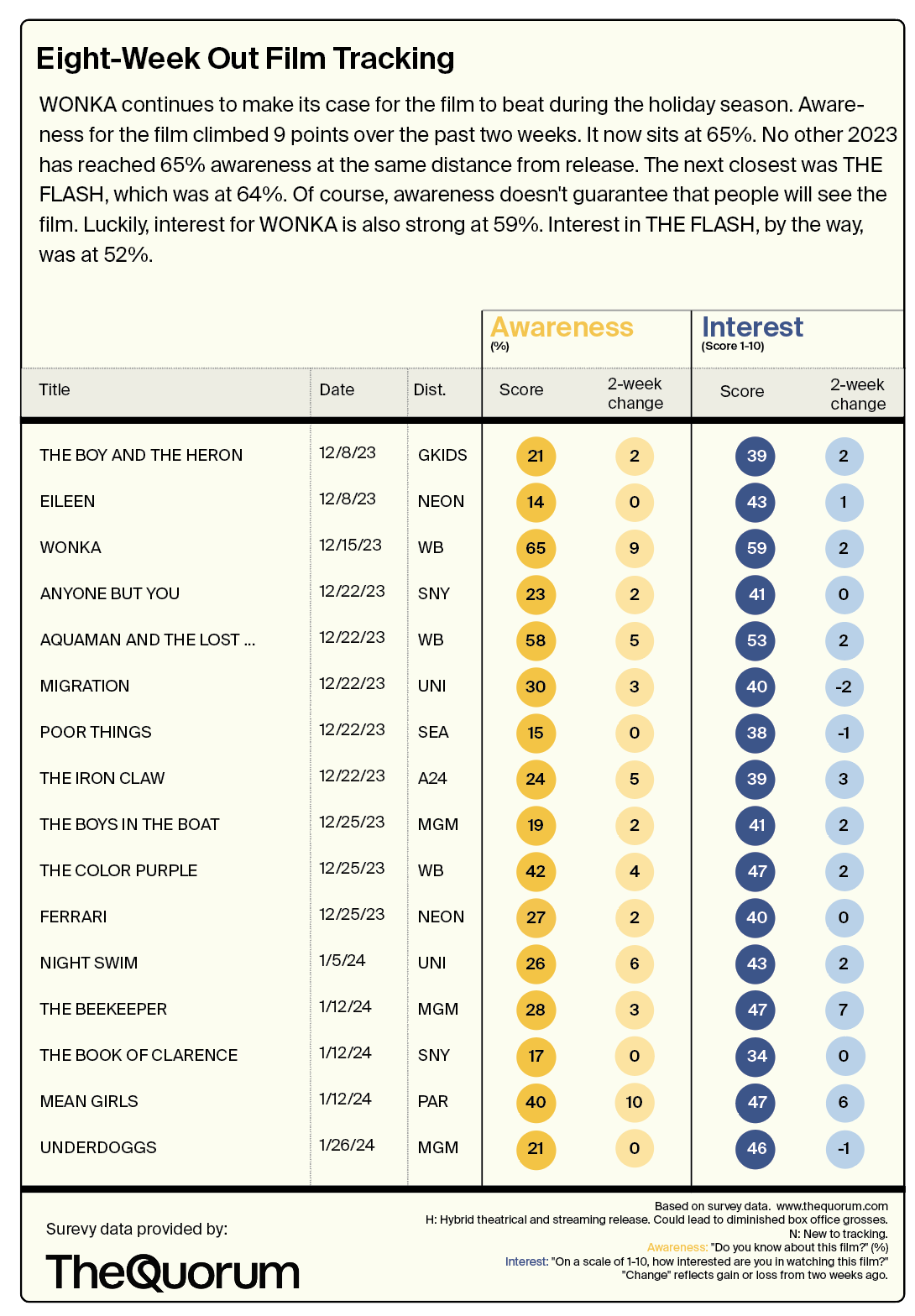
| Get aboard the Wonka train, people, resistance is futile. The new Quorum early tracking chart reveals consistently rising awareness and interest… |
|
|
Have a great week,
Matt
Got a question, comment, complaint, or a band you’d like to see at the Sphere? Email me at Matt@puck.news or call/text me at 310-804-3198. |
|
|
|
| FOUR STORIES WE’RE TALKING ABOUT |
|
|
|
|
|
 |
|
|
|
Need help? Review our FAQs
page or contact
us for assistance. For brand partnerships, email ads@puck.news.
|
|
You received this email because you signed up to receive emails from Puck, or as part of your Puck account associated with . To stop receiving this newsletter and/or manage all your email preferences, click here.
|
|
Puck is published by Heat Media LLC. 227 W 17th St New York, NY 10011.
|
|
|
|