Welcome back to a jam-packed What I’m Hearing, still coming from my undisclosed (and very air-conditioned) summer hideout. Congrats to all 534(!) new Academy invitees, even the TV people who have nothing to do with movies. More than half (55 percent) are from outside the U.S., in case you’re wondering whether the Academy cares that so many of the nominated films are foreign-language and unfamiliar to U.S. Oscars viewers.
💫💫 You might be off next week to celebrate America and the Bezos- Sánchez union, but WIH will be up and running. Send your tips and ideas from your giant inflatable swan to Matt@puck.news.
Tonight, I reveal a big change in how HBO pays its stars and creators, and the possible reason for the shift. Plus: Some Bond deal points for Denis Villeneuve, Michael Bay crawls back to Transformers, and every single person who voted for themselves in the big New York Times top 10 movie list.
Discussed in this issue: David Zaslav, Denis Villenueve, Jason Blum, Celine Song, Courtenay Valenti, Michael Bay, Matt Strauss, Rachel Zegler, Casey Bloys, Josh Cooley, Craig Mazin, Tom Bernard, Jordan VanDina, Sam Mendes, Mike White, Bill Weinstein, Lauren Sánchez, Glenn Whitehead, Amy Pascal, Tom Brady, Eric Roth, Stephanie Jones, Gunnar Wiedenfels, and… the return of Kelly Bush Novak.
Still not a Puck member? Just click here. Got a news tip or an idea for me? Just reply to this email or message me on Signal at 310-804-3198.
Let’s begin…
|
- A one-and-done Bond deal for Denis: If you can’t get Chris Nolan, Denis Villeneuve is about as great as Amazon MGM Studios could do for both the quality and commerciality of its first James Bond movie. The Oscar-nominated Dune and Arrival filmmaker is certainly the most acclaimed and visually stylish auteur to take on Bond since… all of them? Though Sam Mendes (American Beauty) is still the only Oscar-winning Bond filmmaker, both Lewis Gilbert (Alfie) and Marc Forster (Finding Neverland) had been nominated before they took on 007. Anyway, it’s quite a statement by Amazon’s Courtenay Valenti and producers David Heyman and Amy Pascal, as if to announce: We’re not the Broccolis, we don’t just want someone to boss around.Still, the gig comes with limitations. Villeneuve won’t get final cut, I’m told, and isn’t attached to produce future Bond film and TV projects—though obviously that could change in success. Studios have really cut off the trough for directors/producers who make one movie based on big I.P. and then attach themselves to everything after that. These ground rules were laid out in advance of the final director meetings that I wrote about last week, so no big shock. Next up for Amazon: Picking a writer.
- A related facepalm: Did you notice that publicist Kelly Bush Novak added her firm’s name to Amazon’s Denis press release? No, publicists do not negotiate deals and are not typically included in talent announcements, but is anyone surprised? I suppose CAA should be thankful that the P.R.-seeking P.R. person didn’t demand to be listed first.
|
|
And speaking of publicists…
|
- Tom Brady minus Steph Jones: I’m sad to report that Stephanie Jones, the former publicist for bride-of-the-century Lauren Sánchez and current litigant in the Baldoni-gate mess, did not accompany her marquee client, Tom Brady, to his recent appearances at Fanatics Fest and his “Hall of Excellence” exhibit at the Fontainebleau in Las Vegas. Multiple sources have told me that Brady effectively ended his years-long professional relationship with Jones a couple months ago, around the time she was sued by former client Justin Baldoni and ex-colleague Jen Abel for allegedly “maliciously” turning over Abel’s phone to Blake Lively’s publicist. (Jones has denied those claims.) Brady, according to these same sources, has instead been using his internal team to handle his P.R. However, when I asked Steph about it today, she responded by cc’ing three separate lawyers, including one for Brady. They all dutifully denied that Brady and Jones have parted ways professionally.
- Bay misses the ’bots (and the megabucks): Did you know that Michael Bay is developing a new Transformers movie at Paramount that he wants to direct? Bay, the auteur of explosions and up-skirt shots that defined the first five mega-grossers, had sworn off directing the franchise since his Shia LaBeouf–free Transformers: The Last Knight earned just $600 million in 2017—big, but about half the gross of the previous installment. (Paramount also tired of his astronomical fees.) Yet the franchise has atrophied without Bay, and he himself has not reached those box office heights since—even complaining recently about not being able to get movies greenlit.Bay approached the studio last year to come back as a hands-on producer and possibly director, and he’s got writer Jordan VanDina working on a script. It’s one of five or so Transformers projects in development that David Ellison and Skydance will inherit if/when the Paramount sale closes. Josh Cooley, who made last year’s animated Transformers One, just closed a deal to pursue a live-action take. There’s also a possible G.I. Joe/Transformers crossover in development, and the studio has two separate ideas in early stages. Hopefully the Bay project will come together; it really is the perfect match of filmmaker and material. And Paramount can take its time. The studio keeps the rights as long as a movie is in production by 2029.
- A micro-purge comes to Peacock: Don’t be surprised if you soon notice fewer movies on Peacock. In July, NBCUniversal will drop from the platform about 6,000 to 7,000 hours of film content produced by third-party suppliers, a rep confirmed to me. Those little-watched movies, which represent just 1.3 percent of total Peacock usage, were mostly included on the ad-supported tier on a revenue-sharing model. Peacock did a bunch of these deals in its early days, but now, coming up on its fifth anniversary (and how are you celebrating??), the platform has a lot more stuff, so Matt Strauss and his team are ending a lot of those licenses. A bummer for the indie studio suppliers.
- Verve’s Hollywood money pit: Verve, the boutique talent agency, recently cited the ongoing content recession as the reason for cutting staff salaries and limiting expenses. Unmentioned was the 53,000-square-foot office space in the former Quibi building in Hollywood that Verve took over in 2023, part of C.E.O Bill Weinstein’s grand expansion plan before he was ousted. As part of that 10-year lease, the agency’s low rent increased over time, and it’s now become a big burden for co-co-founders Bryan Besser and Adam Levine. Onerous leases are not unique to Verve, of course, but I feel for them. The film and TV representation business is tough these days.
- Top 10 movies list: Who voted for themselves: Congrats to the Times for getting 123 Hollywood people to fill out top 10 ballots for their best movies of the 21st century extravaganza. But, of course, all WIH readers really want to know is… who voted for their own movies? Behold, the vanity list…
Producers/executives
Jason Blum (producer): Get Out, Whiplash
Amy Pascal (producer): Spider-Man: Into the Spider-Verse (plus The Social Network, which Sony released when Pascal was co-chair)
Tom Quinn (Neon): Parasite, Portrait of a Lady on Fire, Oldboy (a Neon rerelease)
Michael Moses (Universal): Get Out, Oppenheimer
Michael Barker (Sony Pictures Classics): Bad
Education; Crouching Tiger, Hidden Dragon; I'm Still Here
Tom Bernard (Sony Pictures Classics): Picked all movies he released except for Moneyball, which was a Big Sony movie.
Actors
Casey Affleck (The Assassination of Jesse James…), Chiwetel Ejiofor (12 Years a Slave), Naomie Harris (Moonlight), Vicky Krieps (Phantom Thread), David Krumholtz (Oppenheimer), Paula Poundstone (Inside Out), Gabourey Sidibe (Seven Psychopaths), June Squibb (Nebraska),
Jodie Turner-Smith (Queen & Slim), Rachel Zegler (West Side Story)
Filmmakers
Judy Becker (production designer): The Brutalist
Darius Khondji (cinematographer): Uncut Gems
Joseph Patel (documentarian): Summer of Soul
Eric Roth (writer): Munich
- Box office over/under: Apple/Warner Bros.’ F1 is tracking for a not-great $45 million debut. NRG has it lower, and presales aren’t strong, so I’ll take the under. And man, what happened to Megan 2.0? The quickie Universal/Blumhouse sequel is tracking for about $22 million, far below the $30 million debut of the first Megan in early 2023. I’ll take the under as well.
|
|
Now, here’s the main event…
|
|
|
|
The prestige outlet is moving to a “bonus” system based on thresholds of “success” in different categories. It’s all dependent on HBO’s definitions of success, and not dissimilar to how other outlets calculate payouts. But it raises a troubling question: Why?
|
|
|
Have you seen this new HBO pay scheme? Executives at the network and the soon-to-be re-renamed HBO Max sent a 13-page document to key talent agents and lawyers this week dubbed, in the most low-key language possible, “Performance-Based Contingent Compensation.” That’s the technical term for “backends,” of course, and the doc lays out new guidelines for how the company’s talent partners will be paid above and beyond their per-episode fees when their shows are deemed hits—and, importantly, the data used to determine what qualifies as a hit. The title may be boring, but the fresh HBO rules represent the first major change in how the town’s most prestigious outlet pays people in more than two decades.
It’s definitely a big shift. Until now, HBO has been operating mostly on so-called “net profits” definitions, as opposed to gross, which means it was notoriously difficult for stars and writer-producers to make much of anything on the backend, even on supposed hits. Instead, HBO has famously made up for those poor definitions by awarding its key talent outsize overall deals that generated big windfalls—and locked them into their hit shows. See, for instance, how Craig Mazin scored an eight-figure, four-year renewal of his overall deal right after his The Last of Us hit big, or what Mike White is getting for The White Lotus. At times, HBO has even provided advances against net profits, even if those net profits never actually materialize. That’s the thing about HBO: Agents trust them. Glenn Whitehead, the top dealmaker, has a great reputation, and everyone from Martin Scorsese to Steven Spielberg has been willing to work on a net definition because HBO, for the most part, makes it right. It’s how the network earned and maintained its reputation for being talent-friendly: The backends may not be great, but they have always taken care of the creatives who mattered.
Now everything’s changing—at least on paper. After a months-long process that involved input from talent reps, those net definitions are disappearing. Instead, HBO is moving to a “bonus” system based on thresholds of “success” in different categories. It’s all contingent on how HBO defines those levels of success, and not dissimilar to how other outlets do it. I’ve written a bunch about Disney’s notorious “Series Bonus Exhibit,” which fundamentally changed how the Disney studios and platforms like Hulu and Disney+ paid talent—and which extinguished huge windfalls. And even streamers like Prime Video and Apple TV+, both of which used a buyout model to avoid the “home runs” that contingent compensation deals once enabled, have recently experimented with a performance-based (yet capped) backend model.
|
|
Anyway, here’s how the HBO guidelines break down, per the new document, with the caveat that these are guidelines, subject to negotiation:
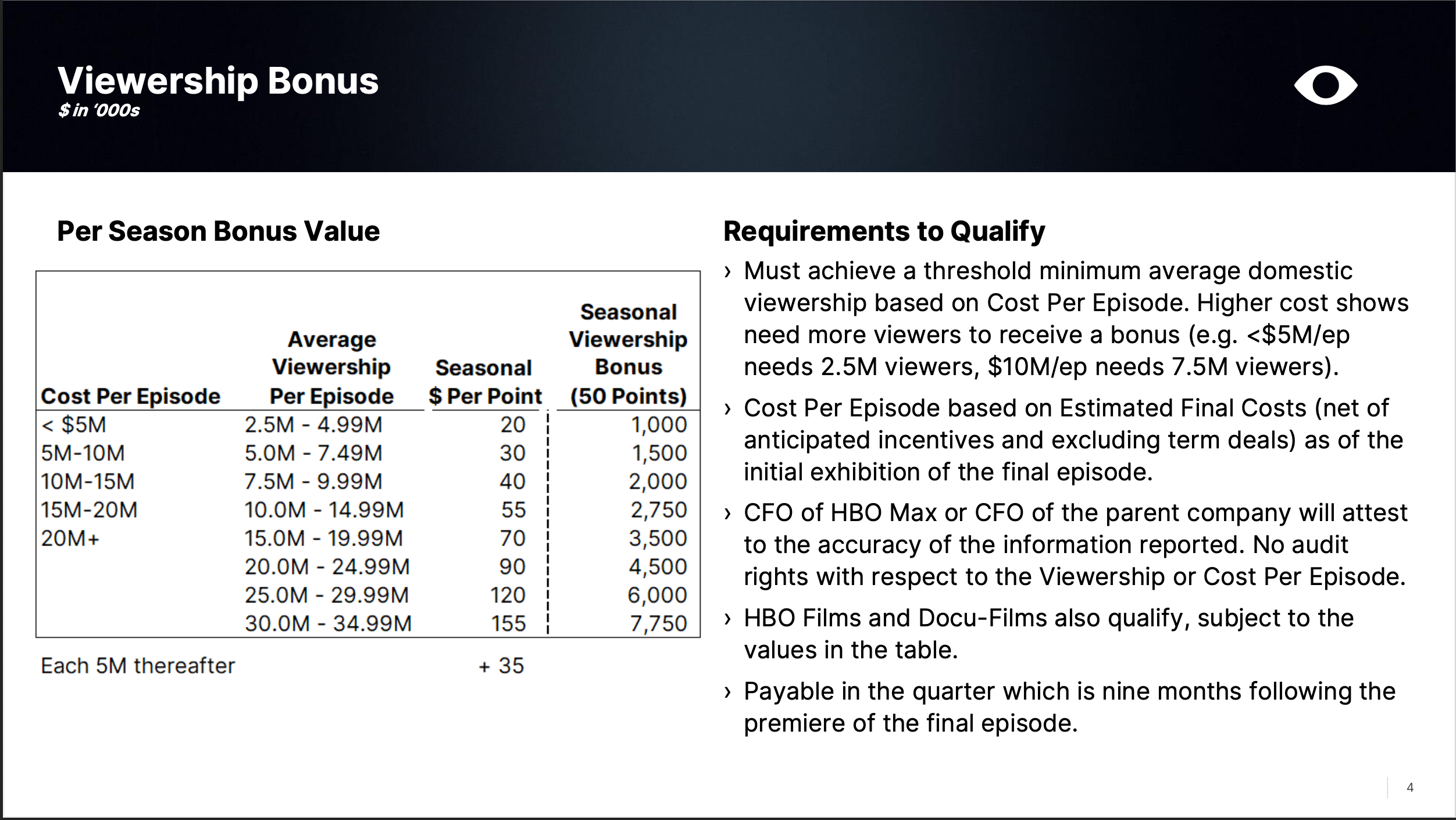
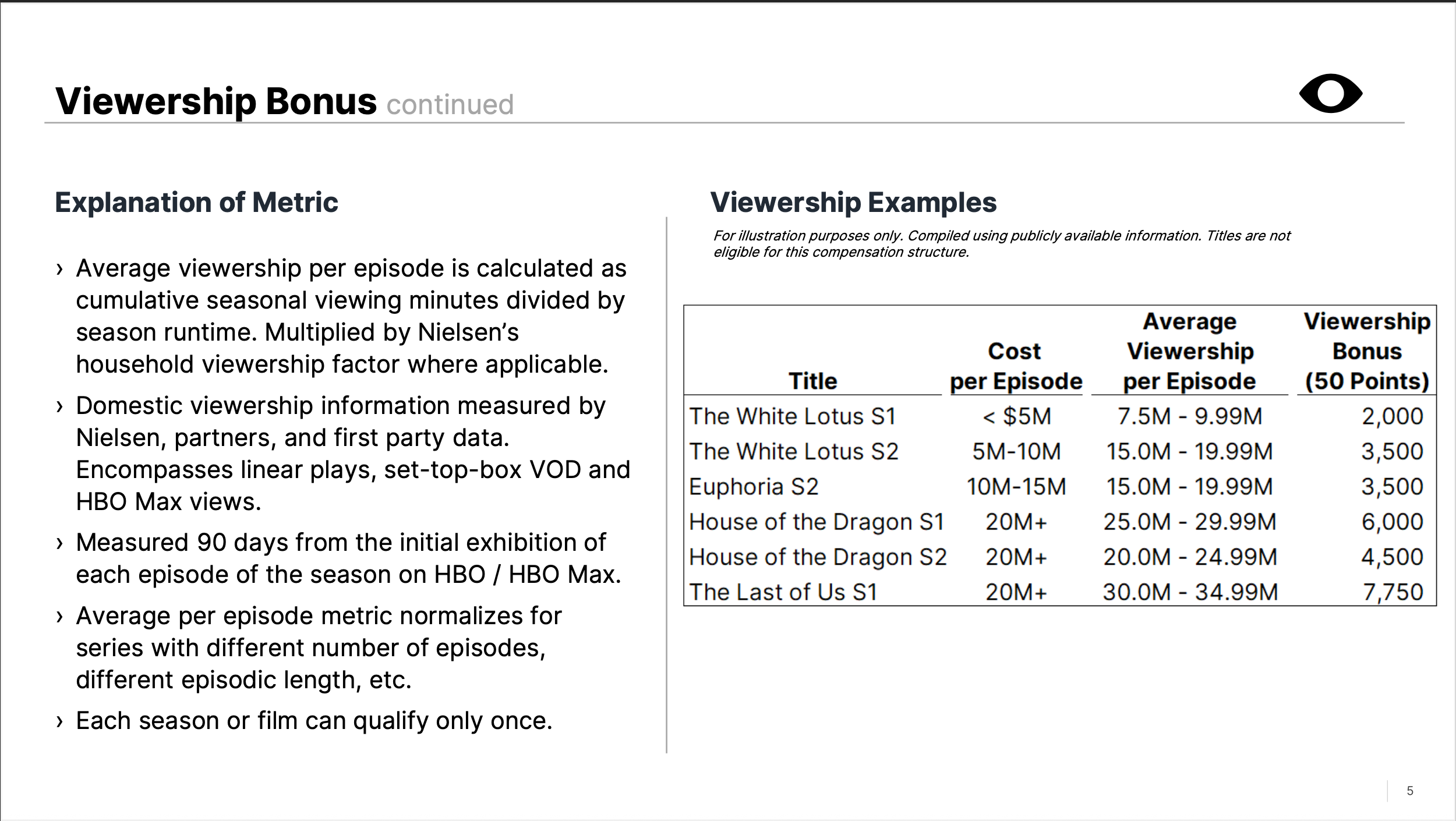
1. Viewership Bonus: This is what it sounds like: Fixed escalating rewards (everything’s a “bonus” now) tied to domestic audience levels and budget, and shared among eligible talent based on how many “points” in the show each person has negotiated. So there’s a viewership floor to be eligible, and the threshold increases for high-budget shows, meaning it would have been easier to get the viewership bonus for, say, White Lotus Season 1, which cost less than $5 million per episode (it’s way more expensive now) than for Last of Us or House of the Dragon, which cost more than $20 million per episode, per HBO. Regardless, with viewership bonuses kicking in immediately, this mechanism provides backend on hits earlier than might have been expected with the previous profit-participation model, according to a couple agents I surveyed. That’s good news for talent.
|
|
But… the all-important question: How is viewership calculated? HBO says it’s the cumulative minutes viewed of each episode in a season in the first 90 days in the U.S., divided by the runtime. That’s becoming the industry standard “view” metric, and it includes linear HBO plays, HBO Max views, and V.O.D. numbers, all multiplied by Nielsen’s household measurement (where applicable). Nielsen and “partners” are listed as data sources, but obviously HBO uses some first-party data that it doesn’t share publicly, and the guidelines explicitly deny audit rights. So it’s a bit of a trust me situation, though a C.F.O.-level executive will “attest to the accuracy of the information reported,” which at least provides some accountability. I know, famous last words…
|
|
2. Viewership Ranking Bonus: This is an additional $2 million bonus, per season/film, shared among participants based on their “points,” if the show or film ranks “in the top 3 for average episodic viewership in a given calendar year.” This is designed to account for success on HBO platforms and is similar to how streamers, which all have different subscriber numbers, have judged their content against stuff in their own unique ecosystem. It’s an acknowledgement that, unlike in the cable TV era, not all platforms have the same reach. Ten million viewers on, say, Apple TV+ is a way bigger deal than 10 million viewers on HBO Max.
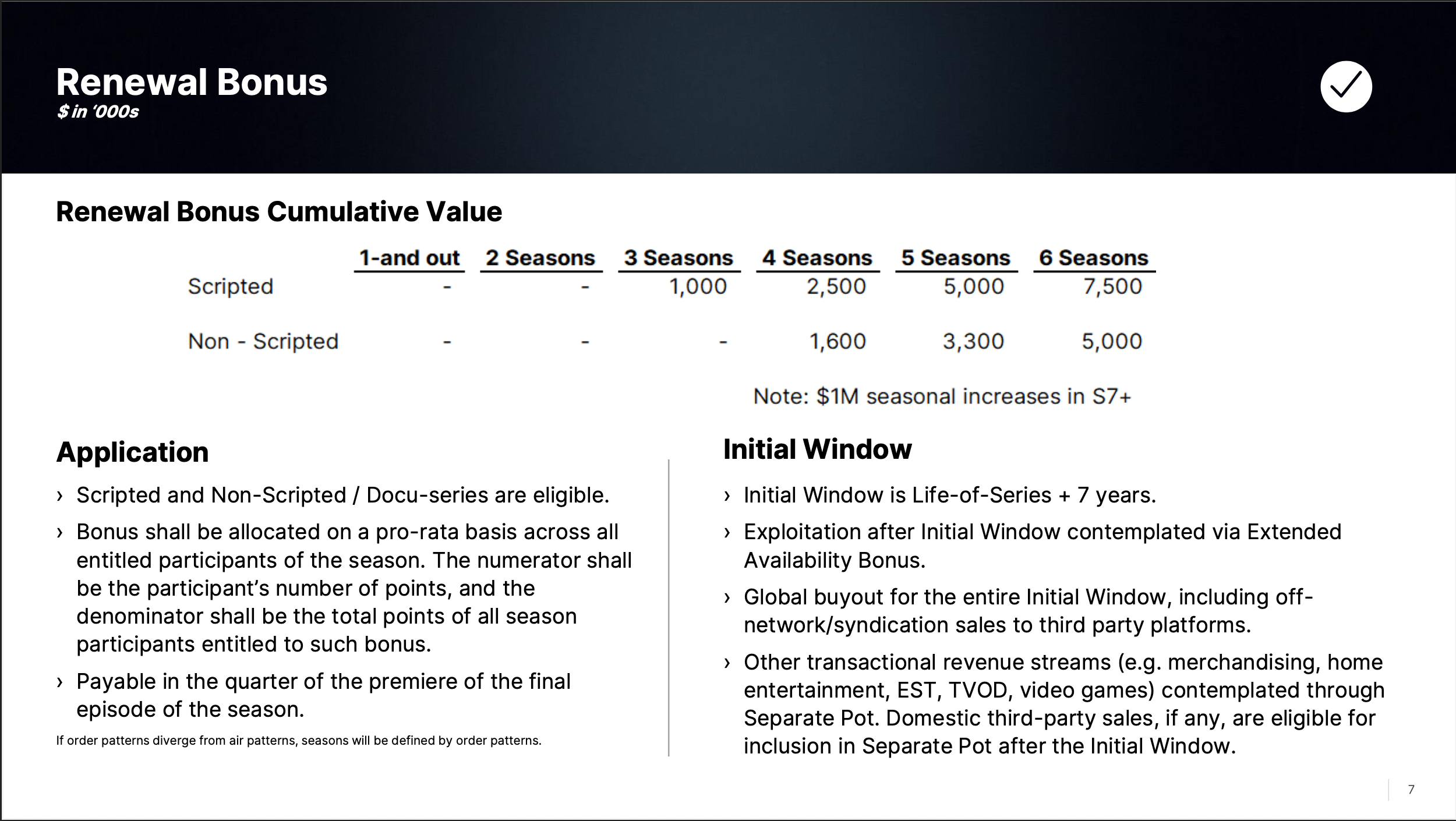
3. Renewal Bonus: No bonuses for a Season 2 renewal, but it’s $1 million for Season 3 in scripted, going up to $7.5 million for Season 6, again shared among participants based on their points.
|
|
4. Emmy Wins Bonus: This has long been a fixture of premium TV deals, especially at HBO, which cares very much about awards. Interestingly, a comedy series win is considered less valuable than a drama or limited series win (sorry, Hacks):
|
- Outstanding Drama Series: $1.5 million
- Outstanding Comedy Series: $1 million
- Outstanding Limited Series: $1.5 million
- Outstanding Television Movie: $500,000
|
|
That’s just series bonuses—which, again, will be shared by the participating talent according to those prenegotiated points. Individual stars and creatives can negotiate separate bonuses for their own categories. And the series money goes up 25 percent for subsequent wins, which would have been great for Jesse Armstrong and the team behind three-time winner Succession.
5. An “Extended Availability Bonus”: All of the above bonuses apply to the show during its initial window (usually seven years). Then the participants will get a percentage of their renewal and viewership bonuses starting at 15 percent for years eight through 10, and down to 2.5 percent after year 25. The proverbial mailbox money.
6. The “Separate Pot”: For those that qualify, there’s another way to profit based on a more traditional share of “transactional revenue streams” (like merchandising, video games, and home entertainment purchases), as well as off-platform domestic deals (like cable syndication, after the show’s initial window). It’s a complex formula, similar to the adjusted gross receipts scheme that I’m pretty sure only one or two lawyers at each studio fully understand. But some outlets don’t offer the separate pot, so it’s something…
Got all that? Remember, these are just the guidelines for HBO negotiations. Top talent will invariably negotiate more—like, for instance, Emmy nomination bonuses. But overall, it’s a big change and, arguably, a lot clearer for talent and their lawyers to understand.
|
So… why is HBO doing this? Officially, a rep declined to comment, but the reasoning communicated to the town has been that after 20-plus years, it’s time to catch HBO up with the movement away from complex profit definitions and toward a more digestible and easily accountable bonus structure. Which is how a lot of platforms have characterized their shifts.
As I’ve reported, streamers in particular want to evolve from costly “buyouts,” which pay talent as if their projects are all hits, to a more performance-based regime. I saw a recent Amazon film backend contract, which eliminated the usual streaming “buyout” and replaced it with a “streaming imputed revenue” calculation for movies that go to Prime Video within 70 days of release in theaters. Ashley Cullins recently reported that Apple is using a variation on the points and ranking system based on engagement, cost efficiency, and subscriber acquisition. (HBO doesn’t seem to be using sub gains as a factor.) Netflix has proposed something similar in film, but as of now the vast majority of its talent has chosen to take the up-front money.
The fear for talent working at HBO, of course, is that the new backend scheme codifies how even the biggest hitmakers should be paid in success, and that the ultimate goal here is to reduce those extra-large make-good overall deals that have served to pave over net definitions with gold. Now that there’s a formal “bonus” structure, HBO’s top executive, Casey Bloys—or, rather, his business affairs army—will deploy that shield and deflect requests for big overalls, especially for talent not at the very apex of demand.
After all, HBO is still, as of today, owned by Warner Bros. Discovery, which is swamped in debt and plagued by cost-cutting. C.E.O. David Zaslav and C.F.O. Gunnar Wiedenfels certainly don’t want to pay people more, especially if they don’t absolutely have to, and you can almost hear them questioning why HBO would cut fatter checks to stars or creators if their contracts don’t actually require it. To some, talent relations is a rich person’s game, and both WBD and HBO are certainly not the profit machines they once were. Now, Zaslav can point to the new backend guidelines and say, essentially, that’s it—and still feel good about air-kissing stars at the Emmy party. “This is certainly not about being a partner and maximizing the upside,” one top agent told me.
Is that the real goal here? We’ll see. Like I said, HBO has thrived because dealmakers trust them. Darren Star continued to get paid on Sex and the City despite quitting the show—not because HBO had to, but because HBO looked at the big picture and the kind of people they want to be in business with. There are a bunch of similar examples. I don’t think the A-plus people will be impacted by this new system, but below that?
The HBO shift continues a trend seen across the industry: The relationship between studios/networks/streamers and the talent that creates their product is becoming more like employee/employer, subject to bonuses with specific and enforced caps, rather than the true partnerships that defined the television era—mutually beneficial relationships where networks (and their executives) would create billion-dollar franchises and allow the talent to become phenomenally wealthy in the process. Maybe the HBO largess will continue, but maybe it becomes yet another casualty of a system that is turning home runs into doubles, and the TV pot of gold into a streaming bucket of quarters.
|
See you Monday,
Matt
This issue was created with research assistance from Maya Tribbitt.
Got a question, comment, complaint, or a thoughtful review of Netflix’s ‘Trainwreck: Poop Cruise’? Email me at Matt@puck.news or call/text me at 310-804-3198.
|
|
|
|
Puck founding partner Matt Belloni takes you inside the business of Hollywood, using exclusive reporting and insight to explain the backstories on everything from Marvel movies to the streaming wars.
|
|
|
|
Ace media reporter Dylan Byers brings readers into the C-suite as he chronicles the biggest stories in the industry: the future of cable news in the streaming era, the transformation of legacy publishers, the tech giants remaking the market, and all the egos involved.
|
|
|
Need help? Review our FAQ page or contact us for assistance. For brand partnerships, email ads@puck.news.
You received this email because you signed up to receive emails from Puck, or as part of your Puck account associated with . To stop receiving this newsletter and/or manage all your email preferences, click here.
|
|
Puck is published by Heat Media LLC. 107 Greenwich St, New York, NY 10006
|
|
|
|