Welcome back to What I’m Hearing, and happy Emmy nominations eve. My questions: Will four shows
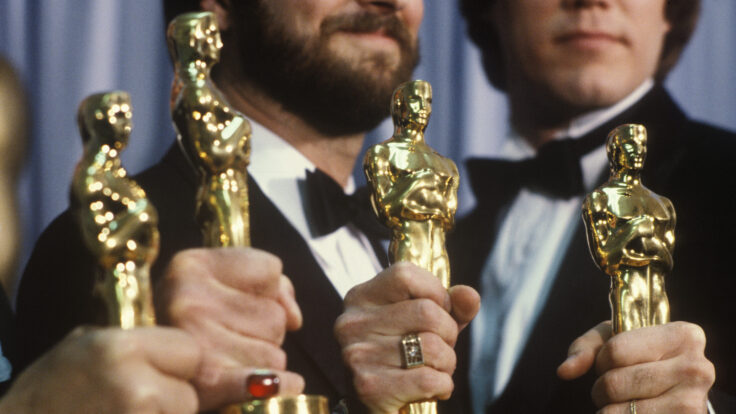
(Adolescence, Severance, The Studio, and White Lotus) just run the table with nominations for everyone involved? How far will FX fall from the Shogun/The Bear heights of last year? How many actors will be nominated for playing themselves on The Studio, Hacks, and SNL? Will Prime Video be totally and embarrassingly shut out?
Programming note: This week on The Town, Lucas Shaw
and I parsed the Superman numbers and the DC and Marvel trajectories, Joe Chianese sorted through the new California production incentives (more below), and CNBC’s Julia
Boorstin detailed what she saw at Sun Valley. Subscribe here and here.
Not a Puck member yet? Just click here. Got a news tip or an idea for me? Just reply to this email or message me on Signal at 310-804-3198.
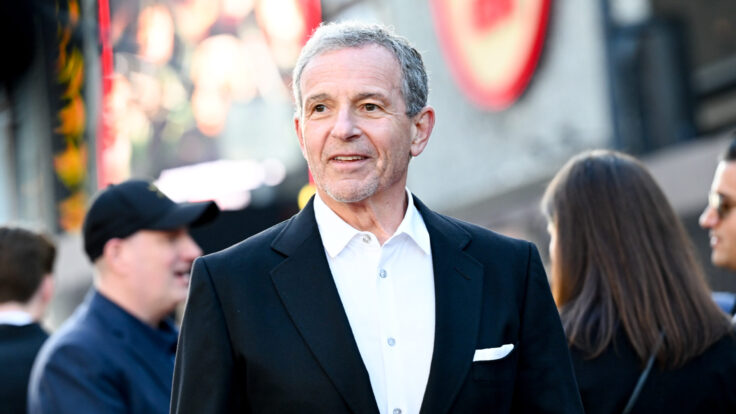
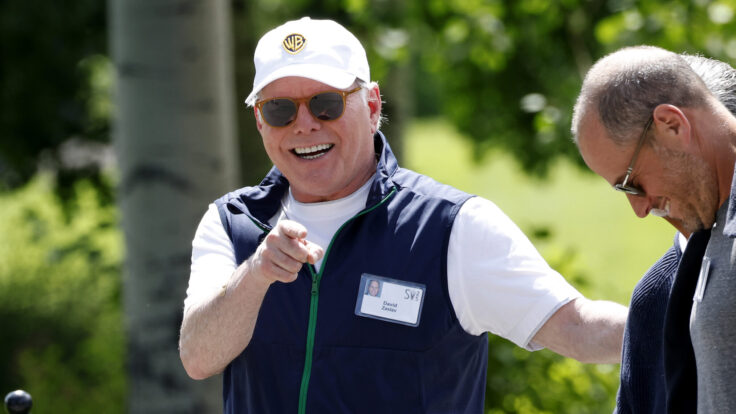
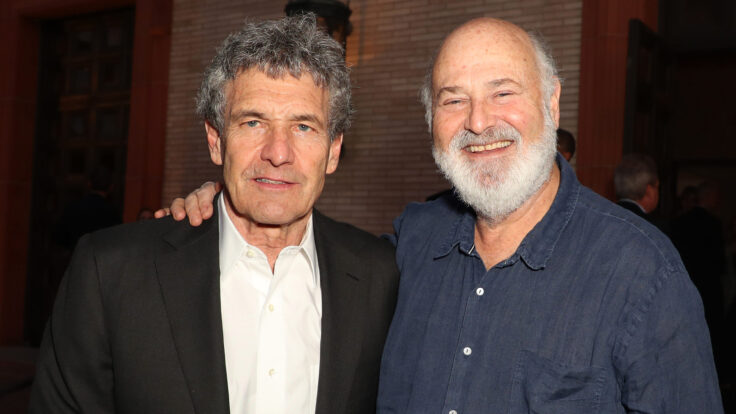
Discussed in this issue: David Zaslav, Alan Horn, David Ellison, Josh D’Amaro,
Trey Parker, Matt Stone, Bryan Freedman, John Williams, Rob Lowe, Kevin Feige, Jeff Shell, Casey Bloys, Bari Weiss, Kevin
Morris, Shari Redstone, and… Bill Ackman’s 30 for 30.
But first… |
Who Won the Week:
James Gunn and Peter Safran
|
With a $125 million domestic debut and $220 million worldwide, Superman will almost certainly earn
less ultimately than Man of Steel back in 2013. (It grossed $670 million, which would be $924 million today.) But the mere enthusiasm for a Superman movie—and the new “mandate” that C.E.O. David Zaslav can use to justify more DC movies—is a big win. Maybe not a time to brag to The New York Times about being “on the attack,” as Zaslav did today, or to personally send swag boxes to friends and media people with “S”
sweatshirts and Krypto plushies—which Zaslav also did—but a win nonetheless.
Irony alert: If Gunn does go on to become some version of the new Kevin Feige, shepherding a long and fruitful series of interlocking DC movies and shows, it will be a fate of Marvel and Disney’s own making. Remember, Disney’s Alan Horn fired Gunn off Guardians of the Galaxy 3 for bad tweets in 2018. He was later reinstated, but in the meantime, DC
hired him for The Suicide Squad, which started the relationship that led to him taking the unit’s co-C.E.O. job. Gunn then hired himself to write and direct Superman, with Horn—now advising Warners on film matters—consulting on everything and celebrating Gunn’s win.
Runner-up: Josh D’Amaro, the Disney parks chief, who flexed this weekend when J.D. Vance—the same guy who once
tweeted that “Disney has declared war on our children”—vacationed with his family at… wait for it… Disneyland.
Honorable mention: John Williams, who has score credits on the top two movies this weekend, Superman and Jurassic World: Rebirth, without having performed a second’s worth of work on either film. |
“How does one go about setting Paramount on fire?”
— @Acceptable-Bid-1019, one of hundreds of posters on
the South Park subreddit who became furious when the show disappeared from international streaming services amid the standoff between Paramount and the show’s creators over new deals.
A little more on this…
I
reported today that South Park creators Trey Parker and Matt Stone have brought in attorney Bryan Freedman as their dispute with David Ellison and the incoming Paramount regime looks like it’s headed for litigation. (Ellison is interviewing lawyers.) Not much has changed otherwise in the standoff:
Trey and Matt, and their longtime deal lawyer Kevin Morris, think they have a good claim that Ellison and his lieutenant Jeff Shell improperly interfered with the handshake deals that were negotiated by the current Paramount management. Those would have generated $1 billion from both Paramount+ and HBO Max over 10 years for the 50-50 joint venture that Paramount and the creators share, a huge increase from the current arrangement with just HBO Max,
and paid Matt and Trey as much as $3 billion over a decade on their separate overall deal to make the show. (That deal is up in 2027.) |
|
|
A MESSAGE FROM OUR SPONSOR |
STAR POWER
High achievement. Higher adrenaline. With a twin-turbocharged V8, the Range Rover Sport delivers
heart-pounding intensity on every drive.
EXPLORE |
|
|
Ellison and Shell argue that those arrangements would advance the South Park guys way more money
than the distribution deals would bring in, and thus make no sense for Paramount. So, they argue, they were justified in not just exercising veto rights over these “material” contracts, but also reaching out to executives at HBO Max and Netflix about alternative (and shorter) arrangements that would have made sense. You can almost hear Matt and Trey screaming, But we had a deal, you fuckers!.
What a mess. Last thing Ellison wants as he takes over Paramount is to declare
war on two of his most important creatives and their millions of avid fans, who are already livid that the show was taken down and new episodes have been delayed. But the two questions Matt and Trey, and now Bryan, need to answer are: How is reaching out to deal partners any different than exercising veto power over a deal, and why would Ellison and Shell devalue or undermine an asset they’re about to own?
Speaking of Ellison…: No, I was not surprised that David would be
interested in buying Bari Weiss’s Substack publication The Free Press and involving her in CBS News, as Status and the Times reported. Trump may have settled with Paramount, but Ellison knows the
liberal “bias” issue at CBS isn’t going away. He’s also spent enough time in Hollywood to know it’s not really okay for studio heads to be aligned with conservatives, or even to openly court them. But it is all right to be socially progressive and fiscally libertarian—that type of West Coast conservatism that positions itself as against the Christian Right and the cruelty of Trump but also skeptical of so-called wokeness and some of the extremities of the left.
That’s why so many wealthy Hollywood people quietly gravitate toward Weiss and her Free Press brand, which positions itself as “down the middle” by virtue of being reactionary to both sides. (Bill Maher gets a taste of that crowd, too.)
So Ellison can own The Free Press and still donate to Democrats and participate in the liberal fundraising social circuit that comes with these jobs. And he can wave Weiss in front of Trump and F.C.C. chair Brendan
Carr for points toward “fixing” the CBS issue—to the extent he still needs them. And in Weiss he gets a fierce champion for Israel, an issue Ellison and his father, Larry, care deeply about, and one that CBS News has fumbled recently, in his view. (Ellison and Shari Redstone initially bonded over their shared advocacy for Jewish causes.) And for Bari, who has been courted by many wealthy acolytes of her brand of journalism, she would get access to CBS,
one of the best brands in news—and something none of the other rich guys can offer. |
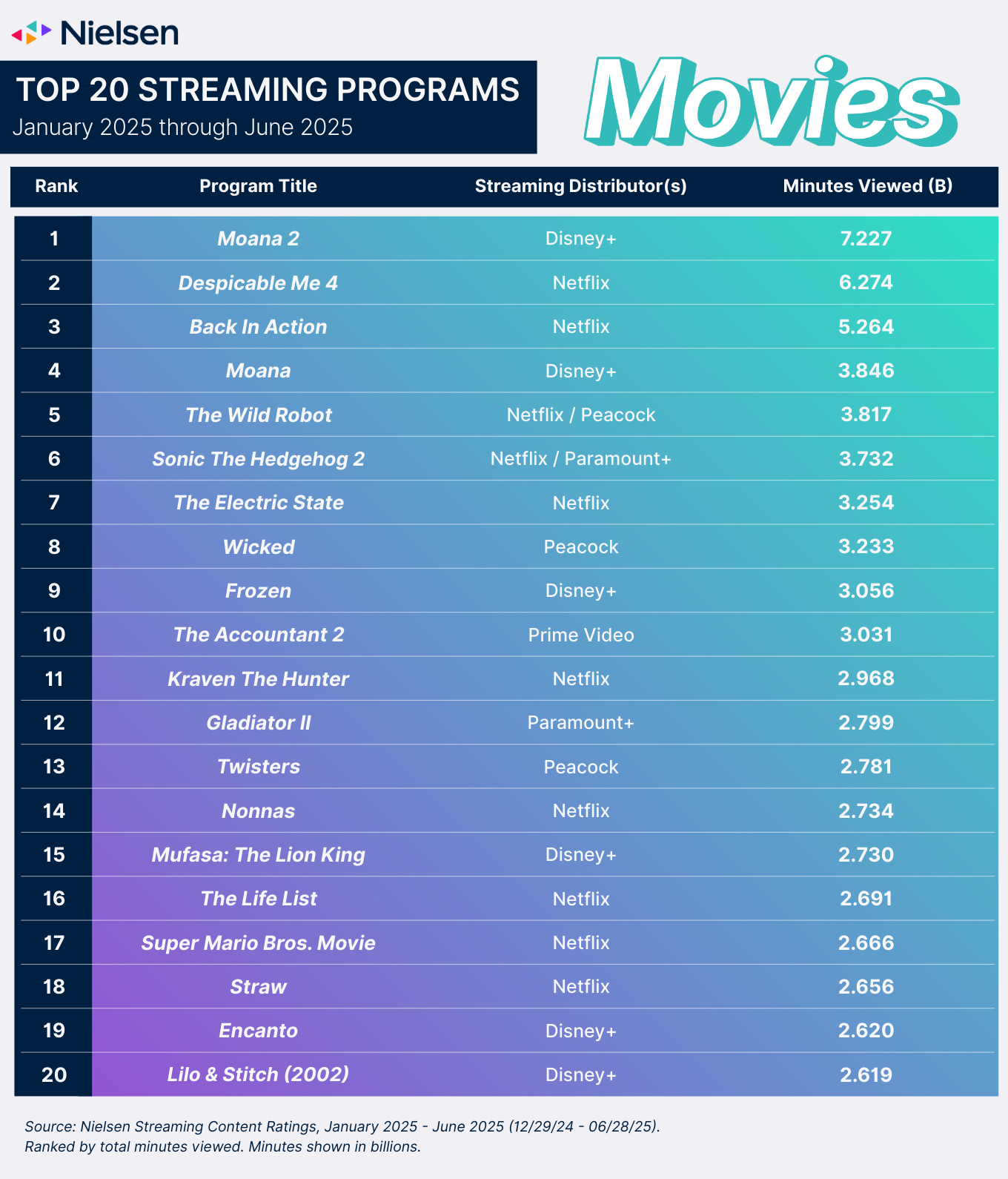
75 percent
Share of the top movies on streaming in the first half of
2025 that first premiered in a robust theatrical window. ⬇️⬇️ [Nielsen] |
2 hours 29 minutes
Time U.S. adults still spend watching traditional TV
each day, more than any other media activity and 31 minutes more than streaming [Emarketer]
61 Percent
Share of Americans who say they’re considering canceling or reducing their spending on streaming subscriptions because of the current financial climate.
[Hub Entertainment Research]
25.7 percent
Year-over-year decrease in gross monthly adds for Netflix, after a 97.8 percent increase the previous year, suggesting the password-sharing crackdown has run its course
[Antenna]
27 percent
Share of consumers who watch TV content weekly in a language they don’t speak fluently, up 8 percent from 2024 [Horowitz Research]
And now, the latest in the HBO Max saga… |
|
|
After a two-year identity crisis at the newly re-rechristened service, how can David Zaslav
and Casey Bloys make the streamer successful, and not just the butt of every joke? |
|
|
It’s easy to mock David Zaslav for his decision to re-rebrand the streaming service
formerly known as HBO Max, then as Max, back to HBO Max—it’s an almost perfect metaphor, really, for the general strategic confusion that followed the WarnerMedia–Discovery merger. Zaslav initially chased scale, but Max never accounted for more than 2 percent of total TV viewing in the U.S., according to Nielsen, placing it behind every major paid streamer except Peacock as well as the Roku Channel and Tubi, which are both free. Max also has the highest churn rate of all the major U.S.
streamers, and it just lost the NBA. On the other hand, the name change was the correct move, and it’s one among a number of things that HBO Max is finally, belatedly, starting to get right.
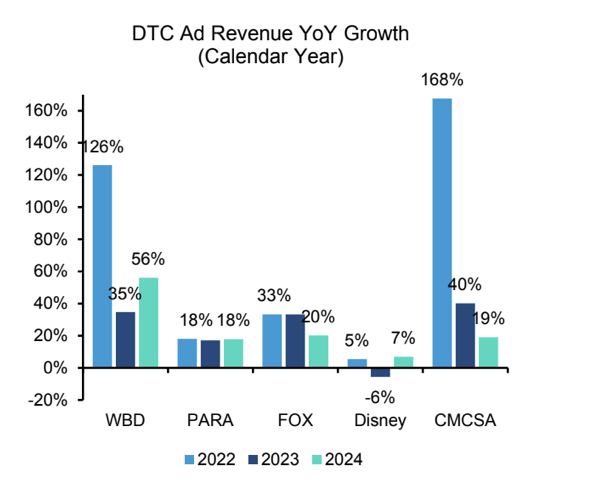
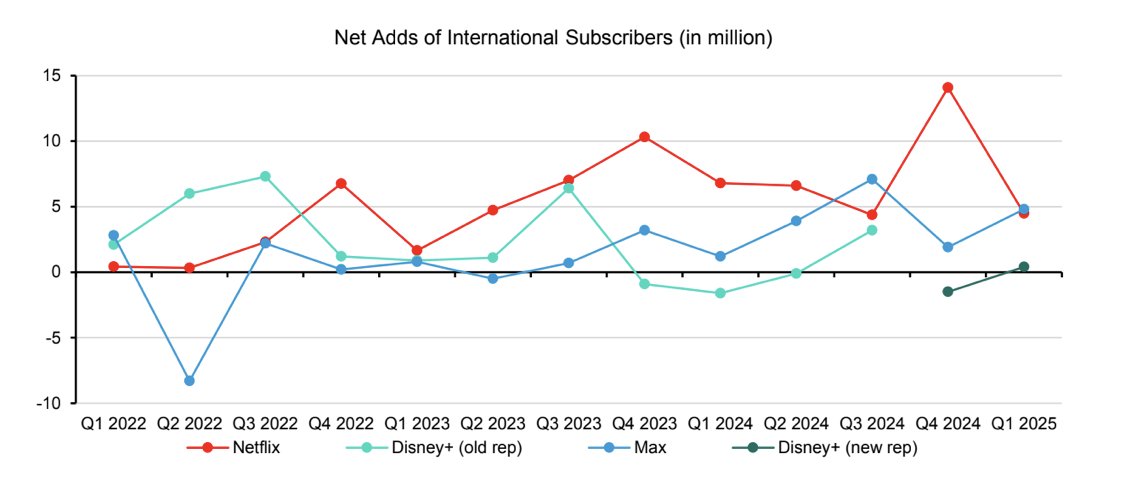
Globally, Zaslav has broken ground in new markets, placing the streamer second only to Netflix in the number of new international subscribers amassed during the past few quarters. Warner Discovery saw its advertising revenue increase by 56 percent year over year from 2023 to 2024, per Bernstein analysis, the highest percentage gain of any legacy media company. |
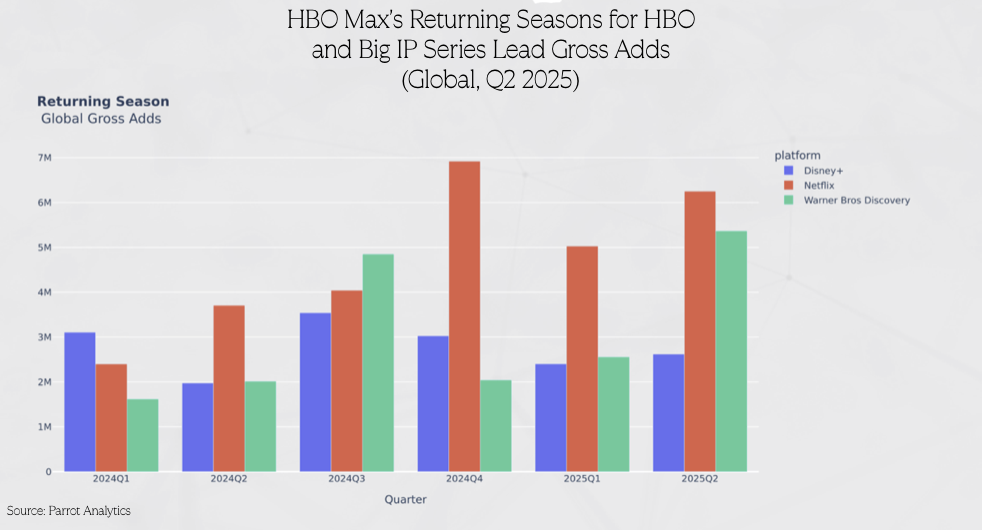
More importantly, however, Max is consistently beating every non-Netflix streamer in the number of subscribers who sign up for the platform to watch a returning show, per Parrot Analytics, demonstrating loyalty to, and interest in, I.P. and brands (like… HBO) that Zaslav is once again putting at the center of the streamer’s strategy. |
|
|
A MESSAGE FROM OUR SPONSOR |
STAR POWER
High achievement. Higher adrenaline. With a twin-turbocharged V8, the Range Rover Sport delivers
heart-pounding intensity on every drive.
EXPLORE |
|
|
That last data point is particularly salient. Zaslav’s bet with HBO Max v.1 was that prestige content from
HBO, the Warner Bros. film library, and TNT Sports combined with endless Discovery chum could create a true Netflix challenger. But merging premium with lowest-common-denominator programming was the wrong way to approach diversification. (As of Q1, Max averaged a mere 35 minutes of viewing time per day in the U.S. on TV sets, compared to Hulu’s 55 minutes and Netflix’s 90 minutes, also per Bernstein.)
Instead of diversifying the quality of content that the service offers, Zaslav
and HBO chief Casey Bloys have finally decided to focus on expanding the types and genres of its premium content—and betting that a smaller, more focused product can reach a level of meaningful engagement. Indeed, the data repeatedly showed that users were returning for tentpole programming, including The White Lotus, The Last of Us, and other HBO series, plus the best of the Max originals, like The Pitt and The Penguin. Neither is
classic HBO fare, but they scratch the same itch for a new generation. |
The streaming wars are over: It’s now YouTube and Netflix’s world. But if HBO Max can stop chasing everyone
else and start chasing meaningfully engaged audiences—leaning into the HBO brand as it does—it might just thrive under a set of new expectations. Customers want splashy, culture-dominating TV shows, but that requires an emphasis on harnessing quality, not throwing spaghetti at the wall.
Indeed, HBO Max’s 2025 slate so far has driven three times the global gross subscriber growth compared to the previous year, per Parrot. Most of that growth can be directly attributed to White Lotus
and Last of Us, but big I.P. (Harley Quinn) and HBO-quality originals (such as The Pitt) also contributed. These findings align with data from Nielsen, which has seen more Max original titles land on its top 10 list for exclusive originals in the first half of 2025 than in any full year prior, per new
analysis from Entertainment Strategy Guy. |
The Pitt, for instance, racked up more views in Q1 (48.1 million minutes) than The Traitors,
Yellowjackets, and Beast Games. It still felt like an HBO show in terms of quality, even as it adhered to a more traditional medical show format. Similarly, The Penguin had a better first week than House of the Dragon’s second season, according to Nielsen. And even on the non-HBO documentary front, Quiet on Set notched the record for a Max unscripted project back in 2024 with 1.3 billion minutes in its first week. These numbers aren't just evidence that Warner Bros. Discovery can succeed outside of HBO, they also suggest there’s a way to increase the diversity of content without deviating from the streamer’s main appeal.
At this point, Zaslav and Bloys have likely come to terms with the fact that HBO Max will never replace Netflix, but they can at least pivot to building a completely different business. General entertainment products like Netflix, Hulu, and even YouTube, work because audiences know they can always find
something to watch, whether it’s a high-quality serial drama or a time-lapse of a guy building a pool in his backyard. But the metric for success is different for a niche player like HBO Max, which can differentiate itself as a true premium product, just as HBO did in the cable era.
Zaslav is targeting 150 million global subscribers by the end of 2026, which would make the service roughly half the size of Netflix. The bad news for Zaslav is that number isn’t much higher than what
AT&T executives projected in 2021. With one of the lowest annual compound growth rates of all major streamers when it comes to subscribers, per Bernstein, that ceiling may be much lower than analysts originally thought. But what if HBO Max can become the king of the niche services, as opposed to a general entertainment also-ran? Suddenly, being half the size of Netflix doesn’t look bad at all. |
There’s a reason that Zaslav has been focused on international expansion. If HBO Max is going to make the
transition to focus on the premium “niche,” it’s going to need to aggressively expand into more territories to find its audience. Sixty percent of all streaming growth is now coming from outside the U.S., and HBO Max has had some of the strongest international subscription growth over the last few quarters, thanks in large part to launches in multiple countries, Bernstein found. |
But getting customers to subscribe upon launch is one thing, and keeping them is another. The European
market, in particular, is very specific. Free linear channels still account for up to 70 percent of all TV viewership in Europe, per Dataxis. Public broadcasters still account for a significant share of viewing each month, and networks like BBC 1 have a larger reach than Netflix in high-demand territories like the U.K., per Barb. Disney+, for its part, has partnered with ITV, one of the largest free TV operators in the U.K., to share content across one another’s streaming platforms. As I’ve
noted before, Netflix just announced a landmark partnership with France’s TF1. Warner Bros. Discovery is ahead of the pack on similar arrangements elsewhere, having struck deals with Foxtel in Australia and BluTV in Turkey, so it’s not unreasonable to expect Zaz & Co. to seek out broadcast partners in Europe as it continues to expand.
Indeed, partnerships with European broadcasters present an opportunity unavailable in the U.S.: Streamers get carriage of very popular local content that
should stimulate engagement, and the broadcasters reach entirely new audiences. European audiences, for their part, are looking for add-ons to their linear packages, and it’s here that HBO Max can find some real success. The service is launching in 12 more territories this summer, mostly in Europe, and it’s still not available in major markets like Germany, Italy, or the U.K.—so there is plenty of room for future growth.
Warner Bros. Discovery’s own data reflects that European audiences
are particularly drawn to prestige fare, with shows like Dune: Prophecy, The Penguin, and White Lotus being some of the leading acquisition titles for the streamer. If HBO Max’s new “quality-first” ethos can keep paying dividends as it expands, it may help turn the streamer’s business around. Or, at the very least, help it evolve into something that looks more appealing to a buyer down the road. |
Formula 1 is getting Major League Soccer-ed—taking a bigger check from Apple TV+ ($150 million a year, per
Dylan Byers) to disappear on to a service that fewer people watch, especially for live events. [Puck]
Still more on the Trainwreck and Poop Cruise phenomena from media researcher Ted Linhart. [Ted
on TV]
The streaming music boom (and all those new PROs) might be why there’s no music playing in your favorite bar. [Bloomberg]
Scooter Braun maybe wasn’t the best influence in Justin Bieber’s life.
[Rolling Stone]
Forget Warner Discovery and the collapsing cable business: Investor John Malone’s greatest challenge may involve a Buc-ee’s truck stop and the “Heave the Beave” movement.
[WSJ]
Rebecca Keegan explains why Kevin Costner hasn’t responded after I sent him all my paychecks. [THR]
Caitlin
Flanagan on Pamela Anderson. Click! [Atlantic]
Bill Ackman, who managed to lose $1 billion on Netflix stock, got the 30 for 30 parody he deserved for buying his way into a pro tennis tournament.
[YouTube] |
Last week’s discussion with Joe Chianese on ‘The Town’ about the new California production incentives
sparked a smart comment from Producers United, the industry group that helped get the incentives passed…
“We appreciated the thoughtful conversation on The Town about California’s film and television tax credit, but there were two crucial points that deserve further analysis. First, while it’s easy to joke that celebrities like Rob Lowe have such privileged lives that leaving California to work is hardly worth our empathy, actors wanting to stay in Los
Angeles aren’t optional in the fight to stay in L.A.—they’re essential. Actors insisting on staying in L.A. is often the only leverage we have to keep productions local. That choice supports thousands of jobs—not just in below-the-line trades, but in the broader economic network of caterers, prop houses, dry cleaners, tailors, etcetera In this context, talent is often the solution.
“Second, the idea that film tax credits are ‘corporate welfare’ or part of a ‘race to the bottom’ ignores
the bigger picture. Entertainment has been one of America’s most powerful exports and an engine of global influence and U.S. soft power for close to a century. The more we outsource production, the more we erode the connection between American culture and its creators. Hollywood, as a brand and a beacon, weakens when it becomes a label slapped on globally made content. L.A. and California aren’t just competing with New York, New Jersey, or Atlanta—we’re up against over 100 nations investing in
what we seem willing to let go. We need to change that mindset, or we risk losing a key component of our global cultural influence and all the jobs that go with it.” —Producers United |
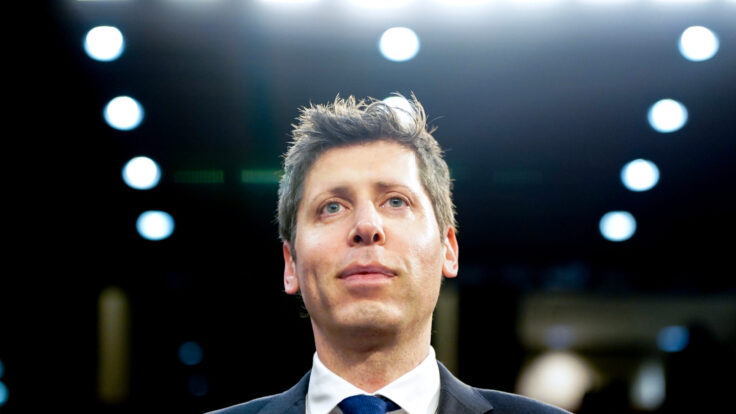
A couple people asked how Paramount and Warner Bros. both passed on the Sam Altman movie
project when it was developed and written at Amazon. That’s because CAA and writer Simon Rich shopped the detailed pitch, those studios passed, and Amazon then bought it and developed it internally with Rich and producer David Heyman. Sony had its own Altman project with Tom Holland loosely attached to star, and Todd Black producing, but that seems to be inactive, especially now that Amazon’s Altman movie is
happening. |
Have a great week,
Matt
Got a question, comment, complaint, or ideas for how to destroy the
disturbing Walt Disney audio animatronic? Email me at Matt@puck.news or call/text me at 310-804-3198. |
|
|
Need help? Review our FAQ page or contact us for assistance. For brand partnerships, email ads@puck.news. You received this email because you signed up to receive emails from Puck, or as part of your Puck account associated with {{customer.email}}. To stop receiving this newsletter and/or manage all your email preferences, click here. |
Puck is published by Heat Media LLC. 107 Greenwich St, New York, NY 10006 |
|
|
|