{{ 'now' | timezone: 'America/New_York' | date: '%b %d, %Y' }} |
|
|
|
Hello and welcome back to the Tuesday edition of What I’m Hearing, piloted by legal expert
Eriq Gardner. Now that Paramount has selected its lead antitrust litigator, a showdown with state attorneys general over the pending WarnerMount merger seems imminent, and Eriq has a timely analysis of how it could go down. Plus, how the OpenAI I.P.O. will handle all those pending copyright lawsuits.
All yours, Eriq (and send him tips at Eriq@puck.news).
Not a Puck member yet?
Never too late. Just click here.
Discussed in this issue: Samuel Goldwyn, Melania Trump, Jonathan Franzen, Greg Brockman, Joseph M. Alioto, Jeffrey Epstein, John Grisham, Rob Bonta, Thomas Clare, Joseph Alioto
Jr., Michael Wolff, Al Davis, Mary Kay Vyskocil, Bobby Kotick, George R.R. Martin, Jeffrey Kessler, David Korzenik, Joseph L. Alioto, Alex Spiro, Gavin Newsom, Walt Disney, Sam Altman, Letitia James, and more. |
|
|
|
A MESSAGE FROM OUR SPONSOR |
Puck sponsors include television’s biggest phenomenon LANDMAN
Billy Bob Thornton, Demi Moore, Andy Garcia, Ali Larter, and Sam Elliott return for the explosive second season of Taylor Sheridan's cultural phenomenon. Actor Award-nominated for Outstanding Performance by an Ensemble in a Drama Series, The Wrap calls it "one of the best TV shows of the year" and Esquire says "this
season is better than ever." For Your Consideration in all categories, including Best Drama Series. Now Streaming on Paramount+ EXPLORE MORE |
|
|
|

| Eriq Gardner
|
|
- Opening the books on
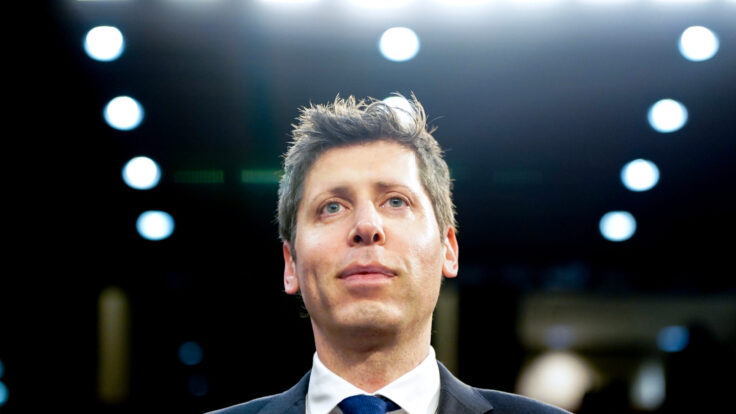
OpenAI: Who else is looking forward to OpenAI’s S-1 registration statement ahead of its potentially trillion-dollar I.P.O.? Specifically, what does the S.E.C. filing have to say about the company’s copyright litigation with The New York Times as well as publishers and authors including George R.R. Martin, John Grisham, and
Jonathan Franzen?
I’ve heard two schools of thought. One camp believes the prospectus will become the first major public-market document to put a price tag on the A.I.-copyright mess. After all, OpenAI has billions of dollars at stake in potential licensing battles and injunctions. In this view, the bankers will have little choice but to give investors a candid account of OpenAI’s ultimate exposure.
The other camp believes a trillion-dollar company won’t
waste much oxygen on nine- or even 10-digit trifles. These people expect the S-1 to be mostly boilerplate, much like SpaceX’s recent prospectus—which, after discussing the fate of the dinosaurs, nodded to the “inherent uncertainty” of intellectual property litigation and the possibility that adverse judgments could affect, well,
everything. Out of curiosity, I asked ChatGPT what its mothership might do, and got a rather technical earful on the finer points of securities law. Suffice it to say that the machine might advocate for full disclosure from C.E.O. Sam Altman.
Either way, OpenAI may hit the market just as these copyright cases reach summary judgment. That could mean a flood of new information about the company—including depositions from president Greg Brockman,
Altman, and assorted colleagues.
There’s also the widespread expectation that OpenAI will eventually need fresh training data and may want to make a deal with at least some of these plaintiffs. If so, there’s a logic to settling before the I.P.O. And if those deals happen, they immediately set the market price for the non-settling cases. In other words, litigation would drive disclosure, disclosure would sharpen valuation, and valuation would lead to settlements…
creating new benchmarks for the next wave of litigation. - Wolff loses a round to Melania: In case you missed it, Michael Wolff’s audacious suit against Melania Trump—in which the journalist/White House chronicler attempted to use anti-SLAPP law to prevent her from suing him over his attempt to connect her to Jeffrey Epstein—has failed. More than failed, actually. While declining to
issue any declaratory judgment on whether the First Lady has a viable defamation claim against Wolff, Judge Mary Kay Vyskocil had some pointed words for what she called an “inappropriate level of tactical gamesmanship.” Read the 45-page opinion here.
I still think New York’s relatively new anti-SLAPP law offers intriguing possibilities for
defendants who beat back frivolous speech-targeting lawsuits elsewhere in the country. But trying to weaponize the statute preemptively—before any defamation action has even been filed—always seemed like a stretch. (David Korzenik, Wolff’s lawyer, told me he intends to appeal.) - The Microsoft-Activision settlement subtext: There haven’t been many Delaware Chancery cases quite like the one over Microsoft’s $75 billion
acquisition of Activision Blizzard—and the same goes for last week’s $250 million shareholder settlement. Sure, that’s a hefty sum to resolve a lawsuit centered on whether Activision’s board rushed into a sale amid allegations of sexual misconduct at the company. But the more remarkable part is how both sides are backing away from mutually assured reputational mudslinging.
As I
wrote back in March, the fight had spiraled into ugly territory. Alex Spiro, on behalf of former Activision C.E.O. Bobby Kotick, accused a Swedish pension fund of coordinating with labor interests and weaponizing E.S.G. rhetoric to advance an agenda benefiting a rival gaming company. The fund’s lawyers responded, among
other ways, by dragging Kotick’s communications with Jeffrey Epstein into the mix. The whole thing became sensitive enough that, after my story ran, Puck received a letter from Kotick’s other lawyer, Thomas Clare, telling us that Kotick barely knew Epstein and that no allegations of systemic sexual harassment at Activision were ever substantiated.
Anyway, the 55-page settlement brief contains quite a bit of throat clearing. Included are statements that there is now “compelling information” undermining any suggestion that Kotick failed to act in good faith, along with plaintiffs formally withdrawing three lines from a February motion that took a swipe at the moral character of anyone associating with Epstein. Litigation, it turns out, permits backsies.
And lest anyone draw the wrong conclusion from the eye-popping
settlement number, the filing makes clear that Microsoft and Activision—or, more precisely, their D&O insurers—are footing the bill. Just weird.
|
|
|
|
Paramount’s planned takeover of Warner Bros. has triggered an all-out legal arms race
between white-shoe law firms and an increasingly aggressive coalition of state A.G.s. Among the first battle lines: whether the Ellisons secured favorable regulatory treatment in exchange for favorable coverage. |
|
|
|
When Paramount Skydance arrives in court to defend its $110 billion merger with Warner Bros. Discovery, it
will not be light on firepower. As I first reported, the company has retained Winston & Strawn rainmaker Jeffrey Kessler, fresh off his victory on behalf of states against Live Nation. And Kessler is merely the opening act. Latham, Cravath, and other white-shoe firms are expected to join the defense in an extravagant display of corporate legal
muscle.
As for who will be seated across the aisle, that remains very much in flux. The states most likely to challenge the merger as anticompetitive are still searching for senior antitrust litigators to lead the effort. (It was a smart move by Paramount Skydance to take Kessler off the board…) Both New York and California are advertising for seasoned
recruits. California A.G. Rob Bonta quietly posted a LinkedIn job ad last week touting the opportunity to litigate some of the nation’s marquee competition fights, including Live Nation–Ticketmaster, Nexstar–Tegna, and, yes, Warner–Paramount.
The pay tops out at roughly $17,700 a
month—which, granted, may not purchase much serenity in Sacramento these days. (By contrast, Kessler’s firm regularly charges nearly $3,000 an hour for marquee partners.) But the job is hybrid, meaning at least some trust-busting can apparently be conducted from home. And if the California Department of Justice wins the additional $4.1 million budget increase that it recently
requested for 16 new antitrust hires, the lucky recruit may even get a small army to back him or her up. |
|
|
|
A MESSAGE FROM OUR SPONSOR |
Puck sponsors include the record-breaking Paramount+ Drama Series THE
MADISON From executive producer Taylor Sheridan. Michelle Pfeiffer shines in this epic drama about resilience, transformation and the family ties that bind. Variety proclaims, “Michelle Pfeiffer gives a powerhouse performance” in a show RogerEbert.com calls “rock-solid,
gripping television.” Emmy eligible in all categories including, Outstanding Drama Series, Outstanding Lead Actress Michelle Pfeiffer, Outstanding Supporting Actor Kurt Russell, Outstanding Guest Actor Will Arnett and Outstanding Director Christina Alexandra Voros Now Streaming on Paramount+ EXPLORE MORE |
|
|
|
All of this is part of a broader push to build the infrastructure needed to carry bigger, more complicated
cases, amid a growing sense that Trump’s regulators may not be up to the job—or may be working both sides. The project has taken on fresh urgency after the Justice Department’s controversial settlements with Hewlett Packard and Live Nation. Now comes the less glamorous work of actually staffing up and
getting budgets approved. Texas, for instance, recently set aside $33 million for outside counsel.
Perhaps more significantly, states are also constructing their own early-warning systems for deals. California, Washington, and
Colorado have adopted laws modeled on the federal pre-merger-notification regime, giving the D.O.J. and F.T.C. a heads-up above a certain financial threshold. Meanwhile, according to a recent fee petition filed by Oregon
in the Kroger-Albertsons case—which, by the defendants’ telling, marks the first time A.G.s have sought to recover fees after winning a preliminary injunction against a merger—the states recently created a shared database for investigatory materials.
The goal is to get eyes on deals sooner and build independent screening capacity. Whether that will be enough to match the companies’ resources is another matter entirely. But the days of waiting around for Washington to call the
plays are over. |
The First Injunction Gambit
|
The state attorneys general aren’t the only ones trying to muscle into the competition-enforcement spotlight.
A group of streaming consumers have brought a private antitrust action, contending that Paramount’s proposed $110 billion Warners deal violates Section 7 of the Clayton Act by substantially lessening competition. On Wednesday, the plaintiffs moved for a preliminary injunction to stop the transaction from closing. For all the chatter about what the D.O.J., F.C.C., and ambitious state A.G.s might do, this lawsuit is being slept on.
That’s somewhat surprising because the case is being led by
Joseph M. Alioto, a name that still carries weight in antitrust circles. No, he’s not quite a legend of his father’s caliber—Joseph L. Alioto represented everyone from Walt Disney to Samuel Goldwyn, helped Al Davis pry the Raiders loose for Oakland, and parlayed his courtroom fame into the San Francisco mayor’s office. Nor is he as politically plugged in as his son Joseph Alioto Jr., whom
Gavin Newsom appointed chair of California’s Occupational Safety and Health Standards Board. But Alioto remains very much an old-school antitrust brawler, fond of noting that he has tried more antitrust cases than perhaps any lawyer alive.
Alioto’s preliminary-injunction case leans heavily on a recent federal ruling granting DirecTV’s bid to temporarily halt Nexstar’s acquisition of Tegna’s local television stations. His argument is familiar: If Paramount and WBD are
moving toward a third-quarter closing, preserving the status quo pending trial would be far less disruptive than attempting to unwind the transaction afterward. Once a merger of this scale closes—executives reshuffled, operations integrated, layoffs initiated, and market leverage consolidated—courts become far more reluctant to dismantle it, even if they later determine competitive harm occurred.
Whether Alioto prevails is another matter entirely. A few years back, he tried something
similar during Microsoft’s acquisition of Activision Blizzard and lost after the court concluded that his clients failed to demonstrate imminent injury and therefore lacked standing. This time, several plaintiffs are citing recent Paramount+ price hikes, while others contend the streaming service has become too expensive to maintain altogether.
Is that enough to establish concrete harm from a merger that hasn’t closed? Perhaps not. Still, even a failed injunction could shape the ongoing
legal fight. At minimum, it forces Paramount to respond immediately. If the judge issues a substantive opinion, particularly on market definition, streaming competition, or irreparable harm, that reasoning could influence subsequent litigation.
As for the substance, Alioto’s case intriguingly defines three separate product markets allegedly threatened by the merger: premium-video distribution, theatrical-film production, and national news. The first two are unsurprising. (I’ve already laid out the battle lines.) The third is more unusual. Alioto is specifically targeting the proposed consolidation of CBS News and CNN, an issue that’s already rattling media and political circles. From a traditional antitrust standpoint, however, this may prove the weakest part of the case. The complaint doesn’t even attempt to quantify the companies’ combined
share of the national-news market. Moreover, courts historically have been reluctant to treat diminished editorial independence or viewpoint concentration as conventional antitrust harms.
But Alioto appears to be nudging the law toward the theory that media consolidation can reduce not merely price competition but diversity of reporting and public discourse itself. It’s a provocative argument. It is also one that risks pushing judges into realms bordering media regulation and the First
Amendment, where courts tend to tread very cautiously.
Not coincidentally, this is also where the case becomes openly political. Alioto’s preliminary-injunction motion explicitly raises the specter that favorable regulatory treatment may be intertwined with favorable media coverage, an allegation that pushes the merger fight beyond ordinary competition analysis and directly into the bloodstream of Trump-era media paranoia.
Notably, Paramount appears eager to lean
into that framing, with Kessler blasting Alioto’s complaint as “baseless” and relying on “political scaremongering.” Expect more of the same, with Paramount continuing to frame its opponents as politically motivated actors. The plaintiffs, in turn, will have to persuade the court that the politics are incidental and that market power is the point. |
Thanks, Eriq. WIH will be back tomorrow.
Matt |
|
|
|
Puck founding partner Matt Belloni takes you inside the business of Hollywood, using exclusive reporting and insight to explain
the backstories on everything from Marvel movies to the streaming wars. |
|
|
|
Ace media reporter Dylan Byers brings readers into the C-suite as he chronicles the biggest stories in the industry: the future
of cable news in the streaming era, the transformation of legacy publishers, the tech giants remaking the market, and all the egos involved. |
|
|
|
Need help? Review our
FAQ page or contact us for assistance. For brand partnerships, email ads@puck.news.
You received this email because you signed up to receive emails from Puck, or as part of your Puck account associated with {{customer.email}}. To stop receiving this newsletter and/or manage all your email preferences, click here. |
Puck is published by Heat Media LLC. 107 Greenwich St., New York, NY 10006 |
|
|
|
|