 |
 |
|
Welcome back to What I’m Hearing, a special retro Sunday night edition. No, this isn’t a return to the old schedule; honestly, we had a lingering advertising commitment that had to run tonight, so thank whoever’s logo appears up top for the early WIH.
💫💫 PSA: No issue on Thursday night. I’ll be traveling with spotty Wi-Fi, so barring some wild news event, I’ll be off that day and back next Monday. (You’ll probably be watching the Biden-Trump debate while wincing and drinking heavily, anyway.) Tuesday’s WIH+ will arrive as usual.
Programming note: I spoke to The Washington Post’s Impromptu podcast about how to save movie theaters. On The Town, Lucas Shaw and I parsed the Inside Out 2 box office bonanza, and Scott Galloway ensured he’s never getting invited to the Oscars (see feedback below). Subscribe here and here.
Not a Puck member yet? Click here to fix that problem. Got a news tip or an idea for me? Just reply to this email.
Discussed in this issue: John Malone, Kevin Costner, Bob Iger, Chris McCarthy, Bob Chapek, Taylor Sheridan, MrBeast, Ryan Reynolds, Anjali Sud, Shari Redstone, Tom Cruise, Justin Timberlake, Justin Timberlake’s lawyer, and… the speakers at the Norman Lear memorial.
But first…
|
| Who Won the Week: Kelsey Mann |
|
| I hate to do another Pixar person, and I think the global heat wave is contributing to these crazy box office numbers, but the first-time feature director’s Inside Out 2 scored the top second-weekend gross in the history of animated films ($100 million), and a huge $724.4 million worldwide total after two weekends.
Runner-up: Ed Burke Jr., who has long been the criminal defense lawyer in the Hamptons (just ask Lizzie Grubman), just got perhaps his most famous client in Justin Timberlake.
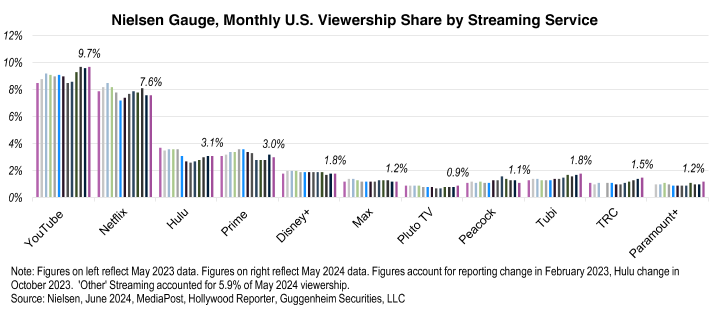
Second runners-up: Paul Cheesbrough and Anjali Sud, the Fox digital executives, as Tubi pulled even with Disney+ in U.S. viewership last month at 1.8 percent, according to Nielsen’s latest Gauge study… |
|
|
Courtesy of Guggenheim Partners
|
|
|
| Kevin Finally Realizes Taylor Wasn’t Bluffing |
|
| The head-scratcher of the week definitely comes from Kevin Costner, who took to Instagram on Thursday to “announce” that he would not be returning for the final tranche of Yellowstone episodes. Huh? This despite me and others reporting for over a year that creator Taylor Sheridan was writing Costner out of Season 5B due to his insane demands and conflicts with filming the various installments of Horizon: An American Saga.
Nothing has changed in months. Paramount made several offers for Costner to return, including on a shortened production window and for the same pay that put him in the very top tier of TV actors. But Costner kept making odd demands, like wanting an extremely truncated schedule and script approval over the final episodes. Remember, Costner has a very bizarre “moral death” clause in his contract that prevents John Dutton from being killed off in a dishonorable manner. (My suggestion is to load his obscured dead body onto a horse and ride it off into the “horizon,” but that’s a bit on the nose, even for Taylor Sheridan.)
Anyway, script approval was never happening, especially considering how frosty the Costner-Sheridan relationship had become. Despite Costner’s team making several overtures during last summer’s strikes, the two sides haven’t talked in months. Sheridan is said to be happy with the Costner-free creative work-around to finish Yellowstone and transition to the planned sequel series. And, of course, Paramount’s Chris McCarthy is going to back the creator whose massive success got him elevated to co-C.E.O. of the company over the star of one show who would rather be elsewhere. No-brainer.
So why did Costner go public now with the proclamation? After all, on the seemingly endless Horizon press tour, he’d been suggesting that he wants to return to Yellowstone under “the right circumstances.” But production on Season 5B is already underway in Montana without him, and on Thursday, hours before Costner’s Instagram post, Paramount announced a November 10 premiere date in a press release that conspicuously did not mention him. That led to a new round of “Will Costner Return?” headlines and, presumably, a stark realization for a star that has been coddled for decades that Sheridan and Paramount were not, in fact, bluffing. |
|
A MESSAGE FROM OUR SPONSOR
|
 |
| For Your Emmy® Award Consideration for Outstanding Talk Series and all other categories.
“Late Night with Seth Meyers” is home to incisive humor, topical jokes and A-list celebrity guests. The show’s signature “A Closer Look” segment has garnered millions of views and is critically acclaimed for its thoughtful approach to analyzing and satirizing news of the day. Meyers has been lauded for his exceptional interviews, and the host’s “Day Drinking” series has quickly become one of the most enjoyable segments on late night television.
Watch “Late Night with Seth Meyers” on NBC and stream on Peacock. |
|
|
| There’s a promo angle, too: With Paramount’s Yellowstone announcements (intentionally?) muddying the Horizon promotion, Costner’s fans might have assumed he would appear in both, or that the two projects are related. So Costner seems to have felt the need to clarify, ending his IG missive with a very Tom Cruise-esque, “See you at the movies,” telegraphing to fans that if they want to watch him looking amazing in a cowboy hat, they can’t just wait around for Yellowstone—they need to pay to see him in Horizon now, and preferably again in August in Horizon: An American Saga—Chapter 2.
Speaking of Horizon, the numbers aren’t looking great as the $100 million-plus, three-hour Chapter 1 hits multiplexes this weekend. NRG tracking has it at $10 million domestic for the weekend—down from a troubling $12 million a couple weeks ago—despite a marketing and P.R. blitz. The Quorum has it a little higher, in the $10 million to $13 million range, which is up a bit after weeks of declining numbers. Either opening gross would be poor for a film with that budget.
Of course, heartland audiences often don’t track (see: Sound of Freedom last summer), which Costner is betting on. He’s been hitting the Middle America media tour hard: local TV in markets where Yellowstone over-indexes, daytime TV, a People cover, an awkward appearance at a Walmart that doubled as a plug for his coffee brand. I gotta say: The dude looks great for 69, and he’s selling the crap out of this thing—a total movie star, as much as that even matters anymore.
Still, Warners has subdued expectations, especially after the film landed at Cannes with a thud. It didn’t help that Costner basically begged billionaires to help bankroll the final films, after his global roadshow apparently delivered disappointing returns. Remember, Costner and his mysterious, likely Middle Eastern backers paid for these first two movies, with Costner telling GQ he’s spending $38 million of his own money. Warners’ Toby Emmerich agreed to release only the first two Horizons back in April 2022 for a distribution fee, right as Costner’s longtime friend and Taylor Swift concert buddy David Zaslav became C.E.O. of Warner Bros. Discovery. The two sides then agreed on a mid-tier marketing plan, which Costner is also financing. Overseas, where Westerns typically perform worse than in the U.S., distribution is territory-by-territory. Reviews can help, but Horizon is at a splattery 47 percent on Rotten Tomatoes. Zero Imax theaters have been booked.
So, yeah, this could end up one of the bigger indie film financial disasters in recent years. It’s actually a gift of sorts for Warners that the media narrative on the movie is so bad. If it comes in around the high teens or even $20 million this weekend, Horizon will have “overperformed,” even though it still will likely not come close to profitability in theaters. And once the numbers arrive and we all start doing the math on what Costner and his financiers might lose on this expensive passion project… Remember, there’s a sequel coming in six weeks, a third Horizon currently shooting, and—for the love of God and Taylor Sheridan—another one planned after that. |
|
|
“I think all the small players will have to shrink down or go away.”
—John Malone, the cable TV pioneer, in a Times discussion on the future of streaming businesses. Left unsaid is whether Malone, a key Warner Bros. Discovery shareholder and board director, believes its Max streamer is a “small player.”
ChapekWatch ’24: Deposed Disney C.E.O. Bob Chapek continues to poke his head back into the public sphere, offering several on-record quotes to the Times and claiming he launched the Disney+ ad tier. Notably, Bob Iger did not participate. |
|
|
| David Zaslav noticed Paramount Global’s stock dipped below $10 this week and whispered to Shari Redstone, “Hold my beer,” shepherding the Warner Bros. Discovery share price briefly below $7, down more than 70 percent from its April 2022 launch. But hey, he’s got a new P.R. guy! [Yahoo Finance]
Last year, half of social media influencers made $15,000 or less, per a leading agency. Only 13 percent made more than $100,000. [WSJ]
ESPN wants to re-up Stephen A. Smith for $18 million annually for five years. He wants $25 million a year. Question for Jimmy Pitaro: Where can Stephen A. go that he would hurt you? Fox/FS1? Another broadcast network? CNN?? Doubt they’d use him enough to justify that cost. Amazon? He wants to be in the conversation, meaning, for now, on television. [Puck]
The music business seems willing to do what the Hollywood studios have not: properly label A.I. scraping as “stealing.” [Music Business Worldwide]
TikTok formed an investment team to acquire music rights, the first step toward a terrifying union of algorithmic amplification of wholly owned content. [Midia Research]
Jennifer Weiner offers a nice explanation of why the entire internet pounced on Justin Timberlake’s Hamptons D.U.I. [NY Times]
Of all the videos of Tom Cruise pretending to enjoy what humans enjoy at a Taylor Swift concert, the clip of him cluelessly exchanging friendship bracelets is my favorite. [Twitter/X]
Now, Scott Mendelson’s take on Disney’s role in the overall health of movie theaters… |
 |
| ‘Inside Out 2,’ ‘Deadpool 3’ & The Benefit of the Disney Bounce |
| There is a certain grim irony in the year potentially being dominated by overperforming Disney toons and MCU spectaculars, like we’re right back to 2016 all over again. We’re not. But Disney’s success is a boon to the overall theatrical industry in profound ways. |
|
|
|
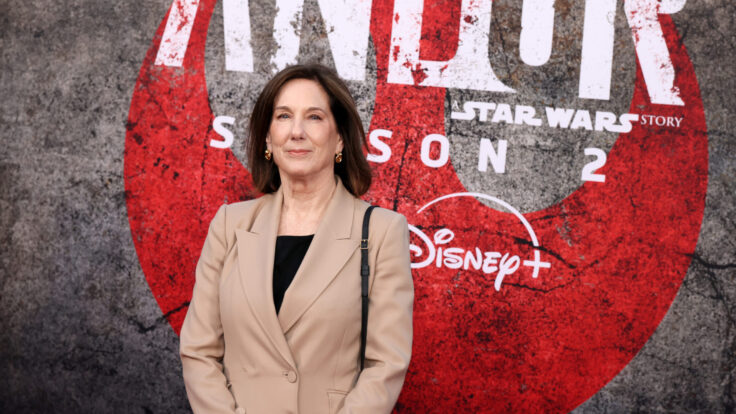
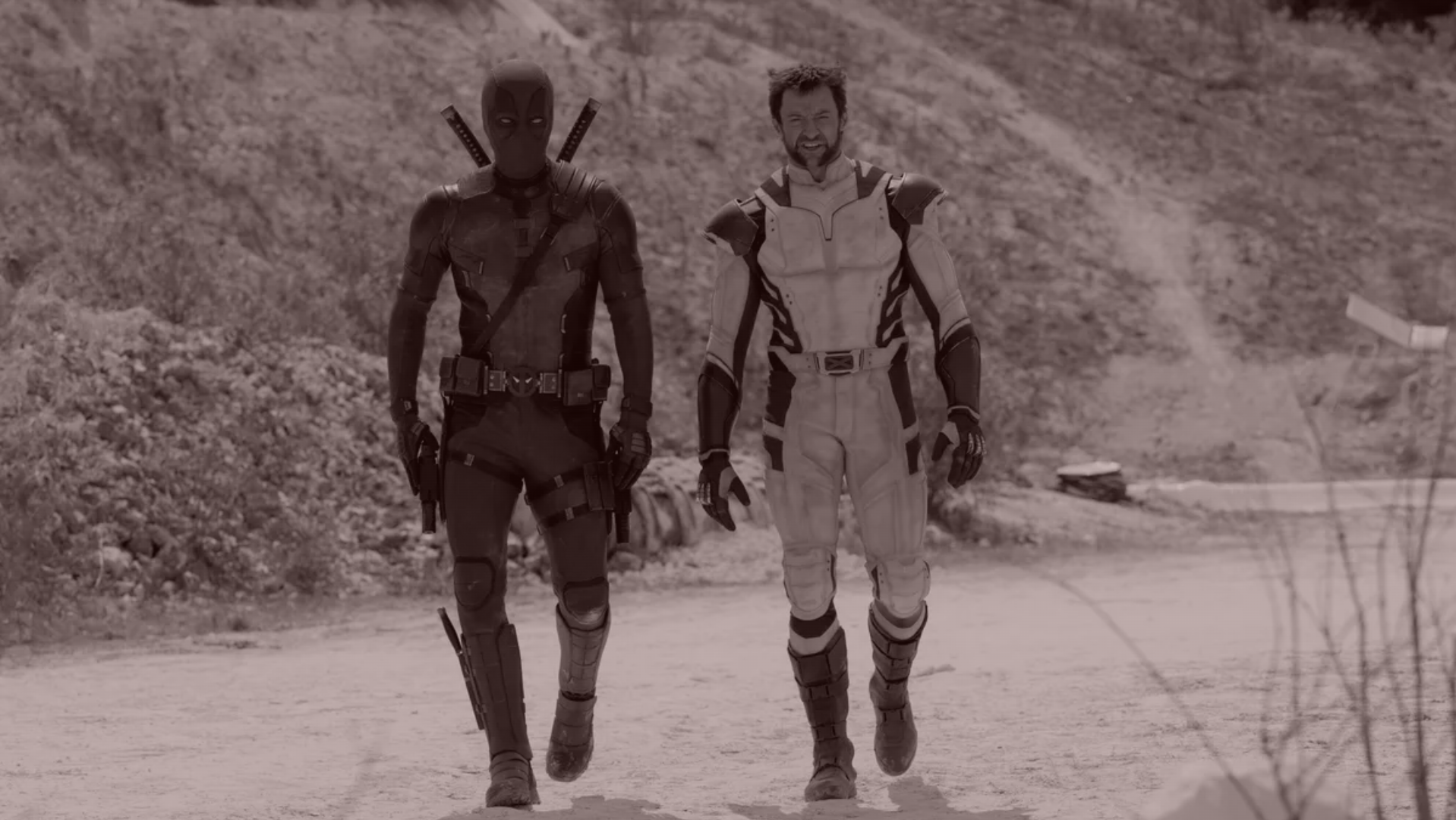
| Don’t tell Nelson Peltz or Ron DeSantis, but it’s quickly becoming the summer of Disney at the box office. The extraordinary success of Inside Out 2, which has now soared past $355 million in North America and $720 million worldwide in less than two weeks, and the immense anticipation building toward Deadpool & Wolverine, which may open near Star Wars: The Force Awakens numbers ($248 million in 2015), offer a genuine salve to Bob Iger’s struggling movie division. Yes, it’s too early to say that Pixar is back, and far too early to suggest either that the MCU has returned to prominence, or even that the assets acquired in the Fox deal—from which Deadpool hails—are finally paying off for Disney. But the 2024 films—including two similar franchise plays in Moana 2 and Mufasa: The Lion King—will nevertheless help restore the company’s box office revenue to something approximating the pre-Covid era.
Disney’s magical theatrical run began almost a decade ago. The company neared $3 billion in global box office in 2016, and reached an insane-sounding $3.74 billion in 2019. Then came the pandemic, oversaturated franchises, and former C.E.O. Bob Chapek’s emphasis on Disney+. The company netted a mere $1.45 billion worldwide last year—some 40 percent below its worst late-2010s year ($2.37 billion in 2017). This outcome was barely above Disney’s lowest-grossing year of the previous decade ($1.26 billion in 2011), inflation notwithstanding.
Yes, Disney’s incredible success during these years—the “final” Skywalker Star Wars movie, the “final” Avengers films of the Infinity Saga, the live-action remakes of the most popular animated Disney films of the modern era, etcetera—may have created unrealistic expectations. Disney also can’t be blamed for an inevitable decline in the all-quadrant popularity of its respective brands, or the pre-Covid box office challenges faced by non-sequel animated films. However, the Disney+ variable, which sent several promising 20th Century Studios films (along with three Pixar originals) to streaming and overexposed the MCU and Star Wars brands, helped turn an inevitable challenge into an existential crisis.
Meanwhile, save for semi-regular events like Avatar: The Way of Water, the output from Fox was a total nonstarter, as I’ve noted before. Fox films earned an average of $1.2 billion in domestic revenue from 2011 to 2018. That dropped to $493 million in 2019, the first year Disney owned the studio. 20th Century earned $200 million in 2021 (mainly from Free Guy), $566 million during the calendar year of 2022 (primarily thanks to Avatar 2), and $410 million in 2023.
There’s something ironic about the blow-out success of Inside Out 2 and the presumed triumph of Deadpool & Wolverine. The former—alongside the upcoming follow-ups to Moana, Frozen, Zootopia, and the Lion King remake—amounts to Iger selling nostalgia for his prior 2005-20 reign as Disney C.E.O. The latter is likely to be an MCU mega-earner even as its key selling point (Ryan Reynolds’ Wade Wilson teaming up with Hugh Jackman’s Logan/Wolverine) is only possible because Disney bought Fox. In a prior era, Fox hits like Dawn of the Planet of the Apes, Logan, or Deadpool were competition for the Mouse House; now, their successors’ success will be attributed to the might of the Disney empire. |
|
|
|
|
| Disney’s theatrical health is a boon to the overall industry in profound ways. After all, the decline for Disney and the relative erasure of Fox are among the chief reasons why the 2020s grosses have yet to reach the highs posted by the 2010s. I tallied up the cumulative domestic box office totals, courtesy of The Numbers, for each major studio (Disney, Warner Bros., Universal, Sony, Lionsgate, and Fox/20th Century Studios… not counting specialty divisions Focus Features and Searchlight) from 2011 to 2023, skipping 2020 for obvious reasons.
The domestic cumulative grosses from the six majors went from about $10 billion in the 2010s to $6.6 billion in 2022 and $7.5 billion in 2023. Sony, Paramount, and Warner Bros. each scored their biggest domestic earners ever (Spider-Man: No Way Home, Top Gun: Maverick, and Barbie) between 2021 and 2023. Lionsgate scored its biggest non-Hunger Games/Twilight earner with the $187 million-grossing John Wick: Chapter 4. So the decline for Disney’s event films—the MCU flicks, live-action remakes, original animated films, and sequel/prequel toons—amounts to a sizable portion of the deficit, along with fewer releases across the board.
Fair or not, the fact that Indiana Jones and the Dial of Destiny, The Marvels, Wish, and Ant-Man and the Wasp: Quantumania earned “just” $700 million domestic combined in 2023 (compared to the over/under $1 billion they would have been expected to pull in several years ago), and 20th Century output earned around $1 billion less than what Fox’s annual slate netted a decade ago, are key reasons why the 2023 totals among the six major studios sunk to just $7.5 million. Disney represented the delta.
And perhaps it will make it up. Inside Out 2 has a 100-day theatrical window, while Alien: Romulus will get the theatrical release in August that Prey did not. Even if many low- to mid-budget Disney or 20th Century Studios films end up on streaming, the entire industry realizes that a streaming smash will not generate the same return as even a modest box office hit. Plus, we’ve now seen years of evidence suggesting that films that receive theatrical releases (and their attendant marketing campaigns) perform better on streaming than even the highest-quality SVOD originals. It is in Disney’s best interest—as a movie studio, as a theme park giant, and as a merchandising empire—to emphasize theatrical, even if the overall earnings aren’t going to reach those Avengers/Star Wars-boosted highs of the mid-20teens.
Back in the last decade, notably, audiences were opting to show up for huge Disney event films but were comparatively far less likely to engage in everything else. In 2019, for instance, Disney/Fox captured nearly 40 percent of the domestic box office. The ideal status quo would be a return to an industry that could support best-case-scenario performances from Disney blockbusters and big-deal tentpoles, like Dune: Part Two, Despicable Me 4, and Gladiator 2, which aren’t from the Mouse House. It’s great for theaters and the industry if Disney wins big, as long as everyone else doesn’t lose. |
|
|
| As predicted, my Thursday chat with professor/podcaster Scott Galloway generated fast and mostly furious feedback, though he’s also got a lot of Hollywood defenders as well…
“Everyone is talking about your interview with Scott Galloway. Incredible and frightening. Feels like there’s a giant sinkhole in the business and we are all falling in.” —A producer
“We are at the point where someone does need to start shouting from the mountaintop that the good guys are going the wrong way.” —A filmmaker
“Perhaps the best argument Galloway makes is that who is in charge at a guild is what matters most, and that’s true whether the union is in Hollywood or Detroit. Just because you can write a hit TV show (or star in The Nanny) doesn't mean you should necessarily run the union for workers that can also do those things.” —A lawyer
“Dude needs to read this WSJ article about how broke these influencers and content creators are. One made $120 after 10 million views. How is that going to take over Hollywood?” —A writer
“Scott’s advice for under 40 creatives to pivot from film and TV to online content is absurd. It is like someone in 1980 telling Basquiat to ditch painting for music video directing. Two different crafts, both zero-sum games. Scott was often comparing the top 1 percent of content creators like MrBeast to the ‘average 50 percent’ of TV writers to highlight tech platforms’ dominance over Hollywood. But if you compare average content creator to average TV writer, I offer a WSJ article from this week. Big tech is squeezing us all.” —Another writer
“He complains so bitterly about how arrogant we are about what we do, arguing that what we create is no more valuable than what a TikTok creator does. But then he argues we should be suing A.I. companies for billions for stealing our valuable content. Which is it, Scott? Do we have and create value, or do we not? Maybe he should get his head out of his ass.” —An animation producer
“I sincerely hope Galloway will one day be able to move past the witty things that were said about him on Twitter by professional writers during the WGA strike, but he clearly still has a long road of therapy ahead of him.” —Another filmmaker |
|
|
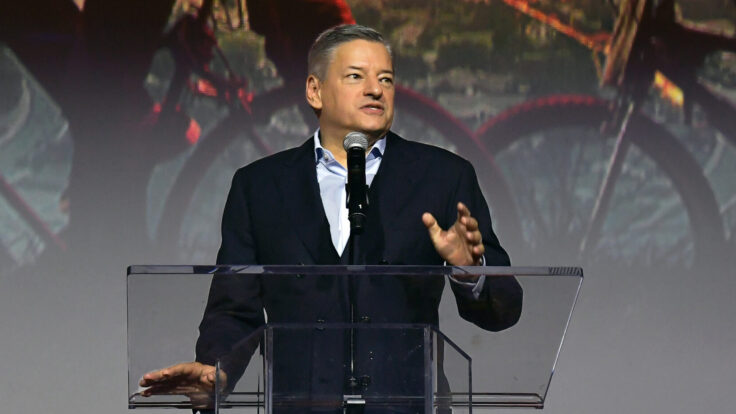
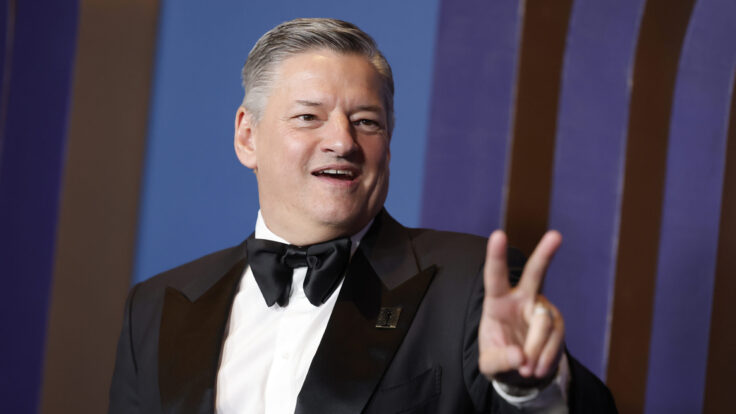
| I’m out of town and didn’t make the Norman Lear celebration yesterday at UCLA’s Royce Hall, but I’m hearing it was an awesome tribute to the TV pioneer, who died in December at age 101. Speeches by Jimmy Kimmel, Judd Apatow, Rob Reiner, Amy Poehler, and more—Ted Sarandos, Sherry Lansing, Kenya Barris, to name just a few, and basically all the living cast members from his shows.
Have a great week,
Matt
Got a question, comment, complaint, or a media opportunity for Glen Powell to immediately accept? Email me at Matt@puck.news or call/text me at 310-804-3198. |
|
|
|
| FOUR STORIES WE’RE TALKING ABOUT |
 |
|
 |
| M for Murdoch |
| News and notes on Trump’s V.P. bake-off. |
| JULIA IOFFE |
|
 |
| Hollywood Econ 101 |
| A candid conversation with NYU professor Scott Galloway. |
| MATTHEW BELLONI |
|
 |
|
|
|
|
|
 |
|
|
|
Need help? Review our FAQs
page or contact
us for assistance. For brand partnerships, email ads@puck.news.
|
|
You received this email because you signed up to receive emails from Puck, or as part of your Puck account associated with . To stop receiving this newsletter and/or manage all your email preferences, click here.
|
|
Puck is published by Heat Media LLC. 227 W 17th St New York, NY 10011.
|
|
|
|