 |
|
Welcome back to What I’m Hearing, after a long, tough week for a lot of people.
Programming note: This week on The Town, Lucas Shaw and I parsed the impact of streaming service price hikes, and music litigator Howard King walked me through the behind-the-scenes disputes over songwriting credits. Tomorrow we’re dropping the episode recorded Thursday from the Bloomberg event, so subscribe here or here now.
Was this email forwarded to you? Click here to become a Puck member.
Discussed in this issue: Kevin Costner, Ted Sarandos, Nelson Peltz, David Zaslav, Julia Ormond, Taylor Swift, Jenji Kohan, Rick Rubin, Bruno Mars, Amy Reinhard, Rob Stringer, Jerry Seinfeld, Daniel Ek, Graham Yost, Adam Aron, Jimmy Pitaro… and a leaked Scientology video.
But first…
|
| Who Won the Week: Taylor, of Course |
|
| But let’s not schedule the victory parade. (See below.)
Runner up: Lionsgate C.E.O. Jon Feltheimer and vice chair Michael Burns, for pulling in outsized $21.5 million and $10.1 million pay packages in fiscal 2023, respectively, a big jump over last year while Lionsgate stock tanked by 33 percent in that period (and the S&P500 was down just 10 percent).
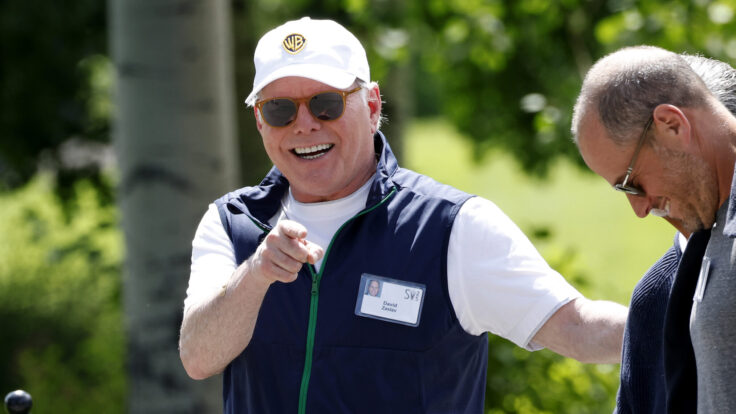
Second runner up: This guy, which leads me to… |
| Box Office Mixed Messages (Taylor’s Version) |
|
It’s hard to use the word disappointment to describe a $96 million domestic opening for a movie that cost $15 million to make and was marketed mostly via Instagram. It’s an incredible number, AMC and especially Taylor Swift will profit handsomely, and The Eras Tour is now a template for other top artists to galvanize fans and pad their pockets. But… if we’re being honest, the massive pre-sales and earned media suggested a bigger debut. Some pegged it at $110 million or $120 million. Film consultant David Gross floated that $150 million was possible. And the foreign numbers (just above $30 million from 94 territories) are especially weak, leading to a weekend global gross below even the lowball $150 million total that AMC publicly forecasted. Why? Five thoughts:
- Nearly 80 percent of domestic moviegoers were female, per Comscore, meaning AMC’s hope for a four-quadrant play turned into basically one-and-a-half. Even a bare-bones studio marketing campaign might have convinced more men to join the party.
- About 60 percent of moviegoers purchased tickets well in advance. Since AMC dropped its rules governing theater decorum, I’m wondering if all those social media videos of Swifties screaming and dancing in circles like crazed cultists scared away regular customers.
- Saturday indexed much higher than a usual Friday. That’s mostly because previews and pre-6 p.m. screenings were added last minute. But the global “day of jihad” declared by Hamas might have scared off some walk-ups in big cities.
- One international exhibitor emailed me that “there’s much disappointment everywhere.” He added: “While Taylor’s social channels and NFL press might be enough to drive awareness in the U.S., there is much more work to be done when taking this global. A studio distribution arm would have seen this coming and have used a more strategic approach in booking screens and marketing…”
- A concert film was never gonna do Barbie numbers, despite the hype by the media (including me). Even This Is It, which was pitched to Michael Jackson fans as a way to honor him in death, opened to just $33 million domestic, adjusted for inflation. I’ve avoided Swift puns throughout my coverage, but maybe we all need to calm down.
Now to the other story of the week… |
| Netflix and Ads: Rom-Com or Slasher Pic? |
|
| Netflix co-C.E.O. Ted Sarandos admitted Thursday that the company’s recent meet-cute with the advertising business is “not at the scale we want it to be yet.” That seemed like quite an understatement after he fired his ads chief after only a year in the job and an Information report suggested that ad-tier subs and revenue are trailing expectations by nearly half.
It’s early in this story, of course, and Netflix has said its ads business is building nicely off the 5 million ad-tier subscribers it claimed in May. But the conversation about streaming is increasingly a conversation about advertising: Who’s serving it effectively, and at what scale. That’s where the growth is, and those that can’t grow (or, in Netflix’s case, grow fast enough) will be hacked to pieces by the market. Interestingly, selling ads is something that the traditional media companies do really well. Netflix? Still unclear, and now crucial, despite its 238 million global subs. So as Netflix reports its earnings on Wednesday, it kinda needs to do better than simply replacing Jeremi Gorman with company veteran Amy Reinhard. Netflix has to show that it has a plan to push new and existing customers into that ad tier.
To that end, the coming price hike on the ad-free tier should be effective, but the ongoing crackdown on password-sharing seems equally important. Morgan Stanley analyst Ben Swinburne projected that the crackdown will contribute 7 million to 10 million new subscribers (or 30 percent to 50 percent of net adds) in 2023. In North America, where an estimated 30 million cheapskates get Netflix from a friend, anywhere from 22 percent to 32 percent of them (6 million to 9 million) could become paying subscribers, per a new MoffettNathanson report. That’s a nice little boost, and, if Netflix plays it right, many of these clearly price-sensitive new subs will take the $7 ad tier—which, remember, delivers Netflix more revenue than its non-ad plan. The question is: Will Netflix play this right? |
|
|
| “Aron apparently mistook the model for someone with whom he’d had a prior relationship. He asked ‘whether she was a ballerina who had done ‘unmentionable things’ to him.’” —From the Semafor report on how AMC C.E.O. Adam Aron was enticed by convicted catfisher Sakoya Blackwood into sending her explicit photos of himself, which she used to attempt to blackmail him.
“We haven’t called each other husband and wife in a long time.”
—Jada Pinkett Smith, promoting her new book. “Uh, excuse me?” responded everyone who was there for The Slap at the Oscars. |
| Kevin’s Paying for His Own Release Party |
|
| Why would Warner Bros. agree to the massively risky release of a $100 million old-guy Western and then a $100 million sequel to that Western just six weeks later? After all, if Horizon: An American Saga flops in theaters on June 28, it immediately takes down Horizon: Part Two on Aug. 16 (not to mention the planned third and fourth installments), with no time to regroup and shift strategy. That’s why studios don’t do this.
All the supposed “comps” for this situation aren’t actually comparable—Quentin Tarantino’s Kill Bill was one movie split into two “volumes” released six months apart, and Clint Eastwood’s Letters from Iwo Jima arrived two months after his Flags of Our Fathers, but Iwo Jima was not a sequel. And those were lower-stakes plays to appease powerful filmmakers, not someone like Kevin Costner, whose last movie as a director, Open Range, opened two decades ago and grossed just $68 million worldwide.
This is happening only because Costner and his Horizon investors have agreed to shell out the P&A (marketing and releasing costs) for both Horizons, I’m told. Warners is a rent-a-studio here, taking a distribution fee to release it domestically (foreign is still available, everyone!) and having very little skin in this game, despite Costner attending the Taylor Swift concert with his buddy David Zaslav. Releasing a movie like this typically costs about $40 million or $50 million, though one benefit of squashing the two parts together is that the marketing outlay on the first can bleed into the second. Saving some P&A money for investors is a reason to do it—not to create a Barbenheimer-style stunt, which was the reason spun by Warners. Maybe it’ll happen, but remember, adding “Part One” to Mission Impossible: Dead Reckoning didn’t seem to help that movie this summer.
Costner’s investors are still unnamed and mysterious—I’m told only that they are a consortium of wealthy, non-Hollywood people—except for Costner himself, who has said in court filings that he’s in this thing for at least $20 million. And since Costner still isn’t returning to Yellowstone when that goes back into production, he won’t have the new episodes to market the film. So if this thing bombs, like some at Warners fear, it’s Team Kevin that goes down with it. |
|
|
| 82-year-old Disney nemesis Nelson Peltz’s ongoing effort to get himself on CNBC includes this fun tidbit: Peltz’s son Matt “has studied” Disney’s business and is about to publish a white paper on the company. So obviously Bob Iger should just give the guy a board seat! [Puck]
How Jimmy Pitaro’s initial effort to launch an ESPN betting app with an industry leader like DraftKings turned into Dave Portnoy’s sloppy seconds. [WSJ]
More Disney-in-crisis porn, complete with the required semi-humiliating Iger photo illustration: Has Bob Iger Lost the Magic? [Bloomberg]
Julia Ormond gave a sit-down interview urging others to come forward against CAA, and detailing how Bryan Lourd and Kevin Huvane allegedly responded when she told them about Weinstein’s assault: “They weren’t surprised, they didn’t disbelieve me, and they guided me to silence.” [Rolling Stone]
Marvel’s TV division realized it might be a good idea to hire TV people to make the TV shows on its TV service. [THR]
Taffy Brodesser-Akner on Taylor Swift. Click. [NYT Magazine]
American Fiction writer-director and TIFF audience award winner Cord Jefferson took his assistant to Vegas and gorged himself into a fetal position, then wrote an amusing column about it. I challenge Chris Nolan to match that Oscar season stunt. [Eater]
Leah Remini posted a wild hidden-cam video purporting to be of Scientology trainers discussing how to extract money from members who don’t have it. [YouTube] |
|
|
| A light grab-bag of responses tonight about Jonathan’s analysis of the SAG-AFTRA impasse and some other stuff. Remember, send me your feedback by responding to my emails. I don’t use names.
“The staffing minimums the WGA negotiated are in practice already what is used on all non-Mike White, Taylor Sheridan, etc., shows. So genuinely that was no great accomplishment. The major accomplishment the WGA did manage was the guaranteed 2nd step [for screenplays]. And in any case, [Jonathan] and the unions for that matter did not identify, let alone address, the real issue, which is flat wages.” –A representative
“You goofballs went bananas expecting Taylor Swift’s movie to open at Avengers x Barbie x Spider-Man x Return of Jesus money. This is a concert film. No one cares except Swifties.” –Non-industry
“Seriously, there are about 100 things going on in the world that are more important than Ari [Emanuel] fighting with Bryan [Lourd] about something that may have happened 25 years ago. You’re better than that!” –A producer
“We are all thinking it so I’ll say it. The only one who wants a naked pic of Aron? A blackmailer.” –An executive |
| Writers at War Over Israel |
|
| The internal fights at the Writers Guild this week got so bad that, according to two screenwriter sources, some pretty big names are considering renouncing their membership. It’s over Israel, of course, and the fact that the WGA is now the only major Hollywood guild to not release a statement of support for the victims of the Hamas massacre. Remember, the guild did publicly back Black Lives Matter and #MeToo, so it’s not like it stays away from serious issues. “If we cannot stand up to call it what it is—a monstrous act of barbarity—then we have lost the plot,” reads an open letter posted this morning and signed by everyone from Jerry Seinfeld to Jenji Kohan to Graham Yost. I asked the WGA for a response and got nothing.
I’ll leave you today with an important guest column from Shirley Halperin, the editor of LA Magazine and a veteran music journalist, who’s also Israeli… |
 |
| The Sound of Silence |
| The music business was built, like the rest of Hollywood, by immigrants escaping antisemitism. So why is the industry so silent in the wake of the massacre in Israel? |
|
|
|
| Lyor Cohen will say something. That’s what I told a concerned music executive who reached out to me last Tuesday, asking why the major labels had yet to post a public statement of support for Israel in the wake of a horrendous, brutal invasion by Hamas terrorists on Oct. 7. Cohen, the global head of music for YouTube and Google, is arguably the most influential Israeli in the music business, and he is scheduled to accept a major honor in Los Angeles next week: the City of Hope Spirit of Life Award. No doubt he will address the horrors we’re collectively absorbing. Furthermore, the same day as the gala, Variety will publish a 12-page feature on antisemitism and Hollywood, in which Cohen contributed a personal essay.
But by the time I had this conversation, it was already Oct. 10, three days since more than 1,200 Israeli civilians had been viciously slaughtered, nearly a quarter of which were attending a dance music festival. And yet for the social media accounts of Universal Music Group, Sony Music, and Warner Music Group, it was business as usual: new songs, upcoming concerts, signing announcements.
This got me calling and texting to label executives and others in the music business to make sure I wasn’t alone in noticing that the silence was deafening. Of the majors, all three of which have affiliates in Israel, none replied—though I heard from staffers that internal notes were sent to employees, many of whom conveyed that they would have appreciated the simple step of an Instagram post. By Oct. 11, most of the major talent agencies—Wasserman, WME, CAA, and UTA among them—had posted statements of cautiously-parsed P.R. speak that supported Israel but was careful to avoid offending, well, anyone. Finally, on Oct. 12, Warner Music units, including Atlantic, posted a public condemnation of the terror attack, calling it a “massacre of innocent lives.” WMG was followed in lockstep by UMG, and then Sony, whose labels distributed identical messages.
These label groups compete for market share fiercely and daily. They rarely come together in public, but clearly there was some communication, actual or implicit; when one pressed the button, they all went. And yet, still there are some peculiar holdouts: Spotify C.E.O. Daniel Ek, who in 2015 was named Music Visionary of the Year by the UJA Federation (the same honor bestowed on UMG’s Michele Anthony, Republic Records’ Monte and Avery Lipman and Sony Music’s Rob Stringer), hasn’t said anything on his very active Twitter/X handle; and Clive Davis’s Instagram last saw an update a month ago.
This week, as grief has turned to anger for many—over the tragedies in Southern Israel and the countless innocent lives, Palestinians among them, that will be affected—we are wondering: why have the music companies taken so long and done so little? In fact, I have heard from sources that the corporations have been engaged in rigorous internal debates: if they should say something, when, and how should they position a statement that would fly with their corporate bosses, music consumers around the world, and, of utmost concern, their artists. As no doubt has been the case all over corporate America, I’m told such messaging meetings were tense, heated, and divided, with reticence the order of the day. One insider describes a game of “Not it!” Another characterized the conversations as devolving into shouting matches. |
|
|
| Forget the politics of Israel. Let’s start with a simple acknowledgment that a traumatic, catastrophic, unimaginable event has taken place. Normal, non-military people—including American, British, German, and Filipino citizens—were among the more than 150 hostages taken to Gaza. They listen to the music industry’s product, as do their friends, families, and neighbors who will suffer the collateral damage for decades to come.
This industry’s roots were sowed by Jews. So I ask everyone working in music: Why did you get into the business? The Beatles? If so, maybe Brian Epstein deserves some credit for helping bring them to American shores? Did a concert at CBGBs change your life? Owner Hilly Kristal’s father survived a Russian pogrom. Did an album get you through a tough time? Maybe it was Carole King’s Tapestry, which sold 14 million units in the U.S. alone, and was produced by Lou Adler. Or Run-DMC’s Raising Hell, produced by Rick Rubin.
A love of jazz brought Atlantic Records co-founders Ahmet Ertegun (a Turkish immigrant) and Herb Abramson (a Brooklyn-born Jew), together in 1947. Jerry Wexler, a partner in Atlantic and producer, helped create seminal recordings by Aretha Franklin and Ray Charles, and signed a little band called Led Zeppelin. He also introduced the “R&B” designation to replace what were, until 1949, called “race records.”
In 1950, Jac Holzman founded Elektra Records, where his success with the Doors and Carly Simon opened the door for label acts like Tracy Chapman and Missy Elliott. Herb Alpert, the A in A&M Records, in addition to his successful career as a trumpeter, would also help launch the Carpenters and Burt Bacharach in the 1970s and the Police and Bryan Adams a decade later, alongside Jerry Moss. David Geffen, who influenced popular music for a decade with Asylum signings Jackson Browne, the Eagles and Joni Mitchell, found in Mo Ostin (Grateful Dead, Prince and Neil Young at Warner) an equally witting tastemaker.
I could list dozens more Jewish music pioneers, from managers to promoters, songwriters to producers and executives. The business they helped create is not without flaws. But music is global and hugely influential, now more than ever. It is supposed to be a universal language that crosses boundaries and borders, yet companies who claim to be “one love,” “one language,” “one heart” have historically remained silent on political issues. And they don’t view this muted response on Israel as complicity.
If there’s one thing virtually all Israelis have in common, it’s a love of a great song. For instance, Radiohead’s 1992 breakout hit Creep topped the chart in Israel before the rest of the world latched on. Free-form radio is still a thing on Israeli music stations. Israelis often travel abroad to concerts and music festivals, and the country welcomes a steady supply of western live acts to its open-air venue in Tel Aviv’s Park Hayarkon, which this year featured Guns N’ Roses, OneRepublic, and Travis Scott.
On the day Hamas invaded Israel, Bruno Mars was scheduled to perform a second Tel Aviv concert. Instead, according to sources, he and his crew— along with other locals taking cover—were rushed to an underground shelter as sirens wailed. The show was promoted by Live Nation, which opened a Tel Aviv office in 2017, and the company swiftly jumped into action facilitating Mars’ exit, leaving his gear behind.
Live Nation finally commented publicly five days after the attacks, as the labels, performance rights organizations and publishers had done. But not on the main Live Nation Instagram handle (which boasts more than 600,000 followers). It was on the Israel office’s social feed, which only recently passed the 20,000 mark. You can’t lead in culture when it’s convenient. Leading starts at the top.
Friends who work in the Israeli music industry, I should add, don’t necessarily see the delayed response as a slight. The prevailing sentiment seems to be that these companies saying anything positive about Israel at all is, while hardly a big win, a big deal. Bruno Mars hasn’t talked about his experience in Tel Aviv watching rockets explode over his luxury Jaffa hotel, but he did post a prayer emoji on Twitter/X—which I suppose is better than nothing. |
|
|
Have a great week,
Matt
Correction: Management 360 changed its name to Entertainment 360 last year. Apologies for dead-naming the company last Sunday.
Got a question, comment, complaint, or an idea for how to get Victoria Beckham into more shows? Email me at Matt@puck.news or call/text me at 310-804-3198. |
|
|
|
| FOUR STORIES WE’RE TALKING ABOUT |
 |
|
 |
|
 |
| War & Scalise |
| How long can the House G.O.P. chaos last? |
| TINA NGUYEN |
|
 |
|
|
|
|
|
 |
|
|
|
Need help? Review our FAQs
page or contact
us for assistance. For brand partnerships, email ads@puck.news.
|
|
You received this email because you signed up to receive emails from Puck, or as part of your Puck account associated with . To stop receiving this newsletter and/or manage all your email preferences, click here.
|
|
Puck is published by Heat Media LLC. 227 W 17th St New York, NY 10011.
|
|
|
|