 |
 |
| Welcome back to What I’m Hearing, and congrats to all of tonight’s Tony winners.
Programming notes: This week on The Town, Lucas Shaw and I offered our winners and losers of 2023 so far, Dylan Byers performed an autopsy on the Chris Licht corpse, and WGA A.I. working group member John Lopez explained what the writers actually want on this issue. Subscribe here and here.
Discussed in this issue: Bela Bajaria, Jon Avnet, Larry Charles, Michael Ovitz, Chris Licht, Adam Fogelson, Bonnie Hammer, Gary Ginsberg, David Zaslav, Scott Derrickson, Jeff Zucker, and Michael Rubin’s July 4th party.
But first… |
| Who Won the Week: Lionel Messi |
|
| The soccer star reportedly extracted an unheard-of concession to join Major League Soccer’s Inter Miami: a cut of the revenue from Apple TV+’s MLS Season Pass subscriptions. Is this a precedent-setting deal or is Messi simply a unicorn? Agents I asked seem to think the latter, but we’ll see.
Runner up: Netflix’s licensing group, which happened to score the dark drama To Leslie in a bulk package from eOne before Andrea Riseborough’s controversial Oscar campaign and shock nomination. The film shot up to No. 8 on this week’s global Top 10 film list, despite Netflix only carrying the movie in the U.S.
Speaking of Netflix… |
| Busting Bela Bajaria’s Netflix ‘Mythbusters’ |
|
| My I.P. law panel on Friday at the annual UCLA Entertainment Symposium served as the opening act for the keynote conversation between legendary lawyer/professor Ken Ziffren and Bela Bajaria, chief content officer at Netflix. Bajaria came ready to “bust” a few “myths” about Netflix and its black box of data and algorithms. But many of us in the audience weren’t entirely convinced by her mythbusting. Some examples:
Mythbuster #1: “There is no data to support that weekly is better.”
Wait, yes there is. Bajaria was referring to the age-old—and, yes, somewhat tired—binge vs. weekly debate. But judging by the actions of most streamers not called Netflix, this question seems to have been decided in favor of spaced-out episode drops, if not weekly, for most shows. “No data except every study we’ve ever done!” texted a friend in the strategy group at a rival streamer when I sent him Bajaria’s comment. Even Netflix has split the runs of big series like Ozark and Stranger Things—not exactly consumer-friendly behavior, but it combats subscriber churn. Watch what Netflix does with Season 2 of Wednesday, a show Bajaria cited as “not needing” spaced-out drops to grab the zeitgeist: I’ll bet you right now it will be split into two tranches.
That’s because tons of data supports the weekly, three-then-weekly, or split-season cadence. It’s not universal, of course, but we’ve all seen the week-over-week build by HBO shows like The Last of Us and White Lotus. A study last year by Roku’s audience insights team found that top binge titles remained in Roku’s top 40 searches for just one or two weeks, while top episodic titles often stayed for all of their season and beyond. A SambaTV report similarly found that bulk-release shows like Wednesday drove new viewership at a lower rate than weekly releases, like HBO’s House of the Dragon.
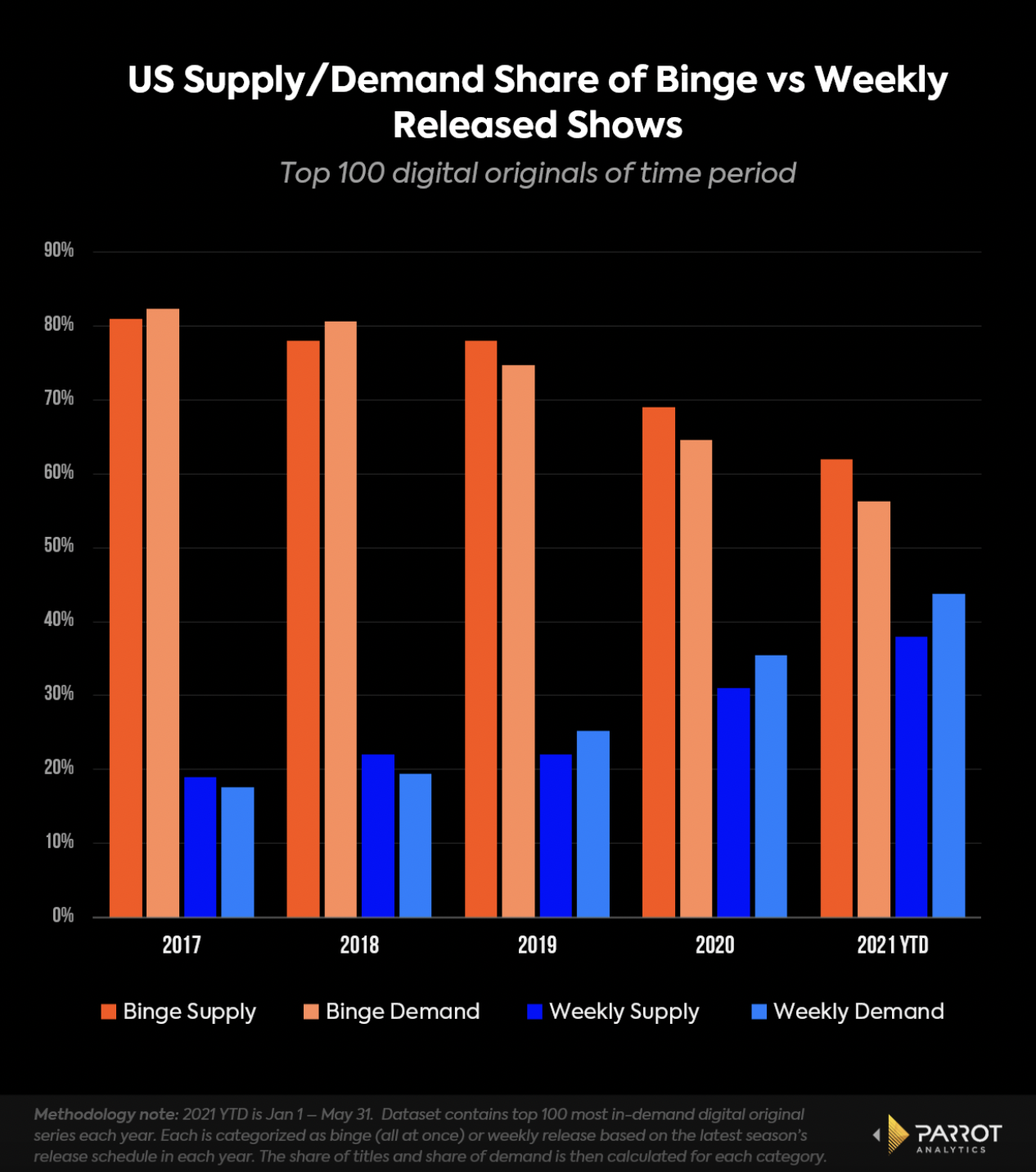
And then there’s this chart, put out by Parrot Analytics, which shows the “demand” (Parrot’s performance metric) increasing for weekly shows. |
|
|
| My Puck colleague Julia Alexander even did a side-by-side analysis of two similar Netflix originals, Arcane (three episodes a week over three weeks) and Locke & Key (all at once). The result, unsurprisingly: Demand for Arcane increased each week, while it spiked and then declined for Locke & Key. And demand very often equals higher engagement and lower churn.
As I said, it’s not universal. Bloomberg crunched the Nielsen numbers recently and found that Netflix’s biggest hits “spent more time in the top 10 than any show on Amazon, Hulu, Disney+ or HBO Max,” which suggests a long tail despite the full season-drop philosophy. But Nielsen’s total-minutes-viewed metric favors the Netflix shows, as does the huge size of the Netflix audience. Bajaria might be correct that dropping all episodes at once is fine when a service spends $17 billion a year on content and can constantly spew out original shows. But at this point it seems clear the Netflix firehose is more likely a remedy for the perils of the binge model, not evidence of its superiority. “Netflix’s data dump means that they have to do more content to minimize churn,” analyst Michael Pachter noted last summer. And there’s certainly data to support that point.
Mythbuster #2: “Algorithms don’t decide what we make.”
Sure, fine, whatever. But that statement seems a bit disingenuous when the factors that do determine what Netflix makes are heavily data-driven, and the factors that lead to renewals—cost, consumption, engagement, completion rates, awards—are all sucked into a formula that spits out a recommendation. All streamers and TV outlets utilize some formula, of course, but it’s hard for Netflix to argue that it is the most sophisticated data-driven organization in Hollywood history and also that it picks and renews its hits based on the gut feelings of its brilliant executives.
Mythbuster #3: “I think the key part was we’re ahead of it. That’s the headline.”
Bajaria was referring here to data transparency, and the infamous Top 10 lists, which Netflix executives love to cite as evidence that it is an industry leader on transparency. Except… Bela knows very well that the Top 10s offer the illusion of transparency without providing much actually useful data—certainly not for creators who negotiate with Netflix. Bajaria is essentially a poker player with full X-ray vision, while her opponents—the agents and talent lawyers who do business at Netflix—can maybe see just one of her cards.
Yes, Netflix offers more data than many streamers, especially Amazon and Apple. But it’s only sharing publicly its Top 10 list, so the consumption of the vast majority of Netflix content still remains secret—and ripe for third-party data companies to fill the void. Second, there’s no unique household numbers, no completion rate data, no comparisons with other titles, no long-tail projections, and the “hours viewed” metric skews the results to longer projects. This is all data that Netflix possesses and constantly cites as determinative of content decisions, yet it won’t share.
So no, Netflix still isn’t transparent about anything that might disadvantage the company in a negotiation—Sure, it was in the Top 10, but the completion rate was horrible! Trust us!—while providing a dynamic ranking that users like and executives can tout at conferences to keep talent quiet. Until, of course, that talent goes on strike over this very issue. |
|
|
| “Mr. Licht—sorry about that. I’d like to apologize to Mr. Licht.”
–Donald Trump, mocking the deposed CNN leader at a rally, after adding (of course) that Licht’s much-derided Trump town hall delivered “tremendous numbers.”
A little more on this: My Thursday Chris Licht-and-The Atlantic-inspired ranking of media executive magazine profile meltdowns prompted readers to submit other cringey examples. I’m omitting disastrous celebrity profiles, of which there are many, though my picks in that genre are Courtney Love admitting in a 1992 Vanity Fair profile that she used heroin while pregnant (a piece that Love later claimed led to Kurt Cobain’s suicide); and Duck Dynasty star Phil Robertson comparing homosexuality to beastiality in this GQ profile, which basically killed cable TV’s No. 1 show at the time.
As for executives, there’s the damaging 2016 New Yorker profile of fired Universal chairman turned STX film chief Adam Fogelson, The Mogul of the Middle, in which he projected Licht-ian confidence and noted that his Burbank office “can look right down on Universal.” There’s also NBCUniversal cable executive Lauren Zalaznick’s 2008 victory lap in New York Times Magazine, The Affluencer, in which she basked in Bravo’s success right as Bonnie Hammer was taking over NBCU’s cable networks. And, of course, basically anything Ryan Kavanaugh ever did. Plus, an honorable mention must be given to P.R. executive Gary Ginsberg, who left Rupert Murdoch’s News Corp. in 2009 after giving access to Michael Wolff not for a magazine piece but for a whole biography, which Murdoch hated.
But… for the absolute best/worst of the suggestions, consider this Sunday Times (UK) profile headline:
Maxim Publisher Felix Denis: I’ve Killed a Man.
Can’t beat that one.
Now contributor Jonathan Handel has his take on the DGA deal and the vocal opposition to it… |
|
|
| The Directors Guild’s new studio deal is in the news, and not necessarily in a good way. With ratification ballots due back on June 23, some members are saying their union achieved too little—particularly on the subjects of residuals, basic wages, and transparency.
“This isn’t the time to accept table scraps and call them historic,” tweeted Steven DeKnight (Pacific Rim: Uprising), echoing several prominent DGA directors, many of them also WGA members. Some writers and actors feel that the deal undercuts the ongoing WGA strike and the SAG-AFTRA negotiations that began last Wednesday. Larry Charles, the Borat director and WGA multihyphenate, posted a video in which he said, “I found my conscience tugging at me, saying, ‘You can’t leave everyone else behind.’ So I voted no to this contract.” |
| A MESSAGE FROM OUR SPONSOR |
 |
|
|
|
| I respectfully disagree. While I don’t consider the pact “truly historic” or the wage increases “groundbreaking”—terms the DGA leadership used in its positioning—this is a solid deal. And some of what I’ve learned and can reveal here about the residuals improvements demonstrates why.
The guild announced a 76 percent increase in the foreign streaming residual over the first three years, on the largest platforms. That cherry-picked figure is dramatic, but the details, it turns out, are even better, because the structure is good and it builds for the future.
Previously, the foreign residual was 35 percent of the domestic residual—itself a figure that depended on the number of domestic subscribers—and that declined year by year. In Year 1 of an episode or movie’s life on a platform, the foreign residual on the largest platforms would be a Residual Base ($30,290 for a one-hour program, for instance) multiplied by a Subscriber Factor (150 percent for the largest platforms) multiplied by an Exhibition Year Percentage (45 percent in the first year) multiplied by 35 percent. That works out to 24 percent of the Residual Base, or $7,156 for the foreign residual.
In the new deal, however, the foreign residual is calculated by multiplying the Residual Base (here, $30,290) by a Foreign Subscriber Factor (90 percent for the largest platforms) multiplied by the Exhibition Year Percentage (here, 45 percent). That works out to 40.5 percent of the Residual Base, or $12,267, a foreign residual in the first year that’s almost twice as much as before.
There are four tiers for the Foreign Subscriber Factor: Tier 1 (under 20 million foreign subs) is 47 percent; Tier 2 (20 million to 45 million) is 60 percent; Tier 3 (above 45 million but fewer than 75 million) is 75 percent; and Tier 4 (75 million or more) is 90 percent, the figure I used in the above example. And as foreign subscribers grow over the next few years, we can anticipate the guilds seeking higher and higher tiers. The structure builds toward the future.
Meanwhile, the DGA also obtained improvements in other areas of the streaming residual. As previously announced, the lowest two domestic tiers will be collapsed into Tier 3, bumping up the applicable Domestic Subscriber Factor. The Residual Bases will be increased, as previously announced. And the Exhibition Year Percentage in several of the out years will increase. The new percentages, which have not been previously released, are in Years 8 and 9 (10 percent) and Years 10, 11 and 12 (5 percent). The intent of those increases is to capture some of the library value of product on the platform, and incentivize the companies to license out the product to other markets—such as ad-supported video on demand (AVOD)—if the residual exceeds the value of keeping the content on the platform.
And speaking of AVOD, product made for that market—for example, original programming made for Pluto TV, Tubi, or Amazon Freevee—is another area of growth addressed by the new deal. Previously, terms and conditions were negotiable, and there was no residual. But now, for shows above certain budget thresholds, there are minimum terms, plus a 2 percent residual, one of the higher percentage residuals in the residual system. As previously announced, the applicable budget thresholds are $1,030,000 for half-hours and $1,750,000 for one-hours. I’ve also learned that there is a $3 million threshold for longer programs, such as movies.
The deal includes numerous other components, which have been reported. Could the DGA also have achieved higher basic wage increases? Maybe, maybe not. It did get an extra day of guaranteed work for pay TV and streaming series, which softens the blow a bit. Could the guild have achieved a transparent success metric for streaming residuals? Who knows. Collective bargaining agreements can’t be compared against figures in a Blue Book, the way used car values are.
But that takes us back to the accusatory language. There is historically tension between the guilds, although more solidarity has been in evidence this negotiating cycle. But did the DGA do its sisters dirty by reaching a deal? No. There’s conflict between inter-union solidarity and the requirements of federal labor law. Jon Avnet and the DGA negotiations committee were bound by a duty of fair representation to their own members and, also, were obligated to negotiate in good faith with the companies. The guild didn’t have the option of saying, Well, this deal is good for us, but it’s not everything the writers or actors want, so we’ll reject it and strike.
And solidarity doesn’t only mean striking when a sister union does. The DGA deal seems like a solid foundation for the next three years and a good bridge to the future. Was it the best deal possible? Would a better deal, if any, have been worth the cost of a strike? We’ll never know, but sometimes a solid deal is the best one possible. |
|
|
|
|
| Early opening weekend projections of summer’s best showdown: Barbie: $45 million to $55 million; Oppenheimer: $30 million to $35 million. And depending on how Mission: Impossible holds up, neither might open at No. 1. [The Quorum]
Prime Video’s inevitable ad tier will be a lot more interesting once Amazon figures out how to show me a commercial, get me to scream “Buy!” then deliver the product directly to me by the time I finish the show. [WSJ]
Related: Jury Duty, which cost about $2 million an episode, will be the most-viewed half-hour show in the history of Freevee or Prime Video. The same Prime Video that spent $50 million an episode on Rings of Power and Citadel. [Vulture]
About 100,000 deadbeat cousins all stepped up to their own Netflix subscriptions in two of the days immediately following the password crackdown, says Antenna. A win! [Bloomberg]
Succession generated about half the audience of CBS’s NCIS and nearly six times the media coverage. [Axios]
The same day I asked my I.P. law panel whether copyright terminations are still a hot topic (they are), termination shark Marc Toberoff quietly settled big-ticket litigation with Disney on behalf of writers and illustrators of the original Iron Man, Captain Marvel, and Ant-Man comics. [Reuters]
Universal coincidentally placed a story on its $1 billion in PVOD revenue right as people are starting to notice that Fast X probably won’t be profitable in theaters. [NY Times] |
|
|
| The Chris Licht pile-on continued in my inbox. I’m not including the personal insults and toldja-so’s, but still plenty of interesting comments:
“Thank you for finally pointing the finger not at Chris Licht (a functionary/puppet), but at David Zaslav and John Malone, the architects of this mess. The arrogance and disrespect of thinking a TV producer can run a global business like CNN—it’s just bad judgment. And I’m not a Jeff Zucker fan! But at least he knew what he was doing.” –A CNN employee
“It was never going to work out no matter who was running CNN. CNN is absolutely done bringing good ratings and revenue like it did in the Zucker/Trump era, and it will simply have to go back to being what airports have on in the background. Zaslav should read the writing on the wall and just sell it off while he still can to some billionaire sucker and use the proceeds to pay down the WBD debt.” –An agent
“Thank you so much for connecting me back to those earlier media flameouts. The Licht one, honestly, might be worst of all because it was a self-proclaimed journalist succumbing.” –An executive
“You wrote the Ben Silverman piece? What an epic exposé. And it meant the end of tigers at Hollywood parties. How sad.” –Another executive
“Why aren’t more journalists talking to unscripted below the line talent? We’ve been living with Zaslav’s machinations for decades, and he’s doing what he did to the unscripted world to the scripted/studio/film world.” –A crewmember |
|
|
| The WGA’s “Bey Day” Beyoncé picket on Friday at CBS Radford has taken the lead in the coveted Best Themed Picket Line contest. Taylor Swift day at Netflix and the Newsies-themed line outside Disney are second and third … Fanatics C.E.O. Michael Rubin can’t seem to quit his addiction to seeing himself in Page Six, which inadvertently announced that he’s stocking his July 4th party with food from celebrity-backed restaurants to get them to attend. …It’s getting pretty grim at industry-favorite Beverly Hills restaurants. I was at the Palm and the poolside spot at the Peninsula this month, and you can definitely see that expense accounts are on hold during the strike. Not fun at all.
Have a great week,
Matt
Corrections: The Mike Ovitz “gay mafia” profile was in 2002, not 2022 (obviously). Apologies to Ovitz and all the mafia members. And last week, Jonathan wrote that basic scale wages affected “mostly fledgling TV directors and below-the-line members such as assistant directors.” In fact, most TV directors work at scale, and are thus affected by the increases.
Got a question, comment, complaint, or a magazine meltdown I missed? Email me at Matt@puck.news or call/text me at 310-804-3198. |
|
|
|
| FOUR STORIES WE’RE TALKING ABOUT |
 |
|
 |
|
 |
|
 |
| Goldman Brain Drain |
| Turnover is part of the firm’s D.N.A., but this feels different. |
| WILLIAM D. COHAN |
|
|
|
|
|
 |
|
|
| Need help? Review our FAQs
page or contact
us for assistance. For brand partnerships, email ads@puck.news. |
|
| Puck is published by Heat Media LLC. 227 W 17th St New York, NY 10011. |
|
|
|