 |
 |
|
Welcome back to What I’m Hearing, where I’m hopeful you made Tom Cruise’s annual holiday cake list. Alas, I missed the cut again.
Programming note: It was C.E.O. week on The Town, with Netflix’s Ted Sarandos explaining his pivot to ratings transparency, and Illumination’s Chris Meledandri revealing why most animated films are so expensive (and why his aren’t). Subscribe here and here.
What’s better than a yule log this time of year? Puck! Click here to become a member, or to gift subscriptions to your frenemies.
Discussed in this issue: Mayim Bialik, Ted Sarandos, Gerard Butler, Jay Penske, Tyler Perry, Carey Mulligan, Suzanne Prete, Greta Gerwig, David Zaslav, Lady Gaga, Chris Pratt, Timothee Chalamet, and… Michael Eisner’s Malibu compound.
But first…
Instead of Who Won the Week (it was Netflix for the Great Data Dump), I need to start with a short rant. When did movie premieres get so goddamned rude? At the risk of sounding like Grandpa Simpson shouting at a cloud, I’m ready to call for a ban on phones at afterparties.
I went to three L.A. premieres this week, and at two of them I saw people shoving cameraphones directly in the faces of the talent. These weren’t journalists trying to record a party interview, or even influencers generating #content. These were random guests recording their own up-close videos of celebrities in quasi-private moments at their own tables. I know phones and social media have basically ruined everything in Hollywood, and premieres exist to generate media attention, which benefits the actors. But at Maestro on Tuesday at the Academy Museum, two middle-aged women stood casually filming Carey Mulligan like 5 inches from her face as she chatted with a friend. It was super cringey, and I was reminded why stars now hate even the nicest awards season events.
Despite the awkwardness, Mulligan’s publicist didn’t want to shoo the creepsters because they might have been Academy voters or friends of an HFPA member or something. Lady Gaga, there to support Bradley Cooper, had the right idea: She surveyed the scene and bailed very quickly.
|
| Strike Shrapnel Hits Jeopardy! |
|
| Remember when I speculated back in late September that the studios may not soon forget the outsize animosity on display during the Writers Guild strike? A few readers (and many on Twitter!) said I was fearmongering. Now we see Sony Pictures Television firing Mayim Bialik as host of the syndicated Jeopardy!, duties she shared since 2022 with Ken Jennings. And while Sony insists the parting is to “maintain continuity” for viewers, Bialik’s actions during the strike were at least a contributing factor, according to three sources close to the show. Sony declined to comment beyond its statement.
Sony TV executive Suzanne Prete and executive producer Michael Davies were furious when Bialik said in May that she would step away from the final week of filming last season in solidarity with the show’s striking writers. After all, Jeopardy! and Wheel of Fortune are well-oiled machines, requiring precise timing to make the show’s five-episodes-a-day schedule. Plus, Bialik wasn’t loved on set, and Sony had switched up shooting that season to accommodate her Fox sitcom, Call Me Kat. Bialik’s reps were told that by refusing to perform, she was in breach of her contract, which began with an annual salary of $4 million (that includes her primetime Jeopardy! work), and has increased by $1 million each year. Jennings, who stepped in on those final episodes, is paid the same.
Post-strikes, Bialik had expected business as usual, but Sony recently informed her that her services won’t be needed next season. She was offered the chance to stay on for the rest of this season, but she said no thanks. Assuming the primetime Celebrity Jeopardy! and the college tournament are renewed by ABC for 2024-25 (a safe bet), she may still stay on those. But given her anger, I’ll be a bit surprised if that happens. |
|
|
| “Thank you to Sony Pictures and to the Golden Globes voters for this recognition, I cannot wait for some lukewarm Chardonnay. Let’s go!!!” —Jennifer Lawrence, on her No Hard Feelings nom, the one reaction quote that didn’t feel written by five publicists.
Speaking of the Globes… |
| Anyone Spare a Seat for Globes Voters? |
|
| Golden Globes voters have hit my inbox complaining about not being invited to the Jan. 7 ceremony. Honestly, what did they expect? The Beverly Hilton is a famously tight room; that’s part of the reason the Globes are fun (or fun-ish). And in addition to increasing the voting members from 90 to about 300, the new Todd Boehly-Jay Penske Globes expanded to six nominees per category and added new awards, both to help secure more stars in the room and to juice business at Penske’s trade publications (more nominees = more trade ads… or at least that’s the calculus).
But despite voters apparently being told a while back that they’d have a seat at the show, Globes exec Tim Gray emailed the heartbreaking news this weekend. “They want to use me to rehabilitate their brand but don’t actually want me on the premises? Got it,” one emailed me.
Uh, yeah, that’s the whole plan here. Talks with the voters are said to be ongoing. Maybe Boehly should offer them Chelsea tickets, or Penske can host them on his private island. That would probably shut them up.
Now for Puck contributor Scott Mendelson’s lessons from the year in movies…. |
 |
| The 10 Commandments of Movies in 2024 |
| As the industry takes stock of a year that will fall short of $9 billion at the domestic box office, here are 10 rules that can help executives decide what movies to make. |
|
|
|
| As this year ends, there are fewer and fewer truisms regarding what works and what doesn’t in the theatrical movie business. Things were already shifting, in 2019, as we saw the end of Disney’s dominant Avengers and Star Wars sagas. Then Covid came, and then this year’s labor stoppages deprived the studios of time that could have been spent adjusting to the new normal.
Now, as Hollywood takes stock of a year that will fall short of $9 billion at the domestic box office, down from $11 billion pre-Covid (and with 2024 looking even scarier), here are 10 rules—some older, some newer—that can help executives decide what movies to make, and (more importantly) how to make them. After all, on paper, Wonka looked like a much bigger risk than The Marvels. Herewith…
I. Superheroes Are Now Execution-Dependent
Yes, DC and Marvel have fallen to Earth. However, Guardians of the Galaxy Vol. 3 ($845 million global) and Spider-Man: Across the Spider-Verse ($691 million) are two of this year’s biggest hits. At the same time, indifferently received titles like The Marvels ($200 million), The Flash ($275 million), and Shazam: Fury of the Gods ($134 million) outright tanked. This isn’t the late-2010s, when a pretty good superhero movie, like Ant-Man and the Wasp ($623 million in 2018), or a smaller-scale gem, like Shazam! ($368 million on a $90 million budget), could automatically become an event. In 2016 or 2017, Blue Beetle might have been a modest hit in relation to its $100 million budget. This year, it topped out at $129 million worldwide.
Kevin Feige and friends must rehab the Marvel brand and its overall storyline, or the notion of new X-Men and Fantastic Four franchises—“but this time, they’re in the MCU!”—won’t mean anything. And please please please, James Gunn, don’t subject us to yet another Clark Kent origin story in 2025’s Superman: Legacy.
II. Don’t Spend Sequel Money on Non-Sequels
This has been true at least since 2013, when Disney threw $225 million—about the cost of the second Pirates of the Caribbean—at the first The Lone Ranger, starring Johnny Depp and Armie Hammer, which was part of Disney’s infamous run of pricey failed franchise-starting attempts that included 2010’s Prince of Persia: The Sands of Time, 2012’s John Carter, and 2015’s Tomorrowland. Until your would-be franchise has proven itself—as in, the film is well-liked and profited in theaters—studios shouldn’t spend top-tier money trying to get there. In the early 2000s, Sony spent $200 million on Spider-Man 2, but only after Spider-Man earned $825 million on a $139 million budget. In 2020, Paramount and friends spent $85 million on Sonic the Hedgehog; so its $307 million global haul justified a $110 million spend on the sequel. March’s Dungeons and Dragons: Honor Among Thieves cost $150 million—far too much for untested I.P. with no butts-in-seats stars (sorry, Chris Pine).
Are there exceptions? Sure, if your movie is directed by James Cameron. If not, especially with higher marketing costs and less-reliable post-theatrical revenue streams, keep that first installment in the $90 million to $120 million range. |
|
A MESSAGE FROM OUR SPONSOR
|
 |
Oppenheimer, from Universal Pictures, is now nominated for 8 Golden Globe Awards including Best Picture – Drama. A staggering global cinematic phenomenon, writer/director Christopher Nolan’s epic thriller propels audiences into the paradox of J. Robert Oppenheimer, the enigmatic man who must risk destroying the world in order to save it. Entertainment Weekly, The Atlantic and New York Magazine have all named Oppenheimer the best film of the year. For your consideration in all categories including Best Picture.
|
|
|
| III. I.P. Is the Starting Point, Not the Whole Pitch
In 2019, Men in Black: International and Charlie’s Angels stumbled partially because they offered nothing beyond, Oh, another one of these. Conversely, Jumanji was not strong I.P. unto itself, in 2017, when Sony leveraged the limited name value to reinvent the property with a video game story (and Dwayne Johnson and Kevin Hart). Jumanji: Welcome to the Jungle was a $995 million (!) grossing smash (on a $90 million budget—see previous point), where the I.P. was barely the point for most audiences.
This year’s most successful I.P.-driven pics, Barbie and The Super Mario Bros. Movie, took their properties and did something interesting and fresh with them. Too many of this year’s new installments of formerly special brands failed the Oh, another one of these test. To wit: Indiana Jones and the Dial of Destiny repeated the old-and-regretful bit from Kingdom of the Crystal Skull; Fast X managed to feel not ridiculous enough after the last one went to space; and Transformers: Rise of the Beasts played like another sequel that existed because shareholders, not audiences, demanded it.
IV. Every Sequel, Prequel, Or Spin-Off Must Offer Something New
Despite strong reviews and goodwill from Top Gun: Maverick, Tom Cruise’s seventh Mission: Impossible film earned just $567 million globally, or barely more (sans inflation) than Mission: Impossible II back in 2000. Yes, it lost premium screens to Oppenheimer and Barbie, and #Barbenheimer dominated the culture, thus rendering Dead Reckoning Part One an also-ran.
But beyond that, the seventh M:I brought nothing new and valuable to the franchise, nor did The Marvels or Shazam: Fury of the Gods. Whether it’s a big new movie star as a marquee character (Idris Elba as Knuckles in Sonic the Hedgehog 2), a change of scenery (sending Denzel Washington’s Equalizer 3 to Italy), or a new conflict (Creed III pitted Michael B. Jordan against a justly embittered childhood friend), sequels, spin-offs, and prequels need to offer something beyond the same. Possible unspoiled surprises notwithstanding, we’ll see if Aquaman: The Lost Kingdom suffers from this issue.
V. Forget It, Jake, It’s China
Even in the mid-2010s, most Hollywood franchises that broke big in China were the same (Jurassic World, Avengers, Transformers) that scored worldwide. The otherwise-failed tentpole saved by China was—save for flukes like xXx: Return of Xander Cage—a mirage. However, since 2020, only Godzilla vs. Kong ($188 million out of $470 million worldwide in 2021) and Oppenheimer ($61 million out of a stunning $955 million global, on par with $66 million for Tenet and $65 million for Inception) have broken out in China on a pre-Covid scale.
China makes its own tentpoles now and doesn’t need Hollywood. So, U.S. studios should consider every dollar earned there to be found money, and budget accordingly. With that in mind, it’s even more impressive that Barbie and Super Mario Bros. soared to billion-dollar heights, earning $1.44 billion and $1.36 billion this year, respectively, with little or no money from China.
VI. When Every Franchise Is Funny, Moviegoers Won’t Pay for Comedies
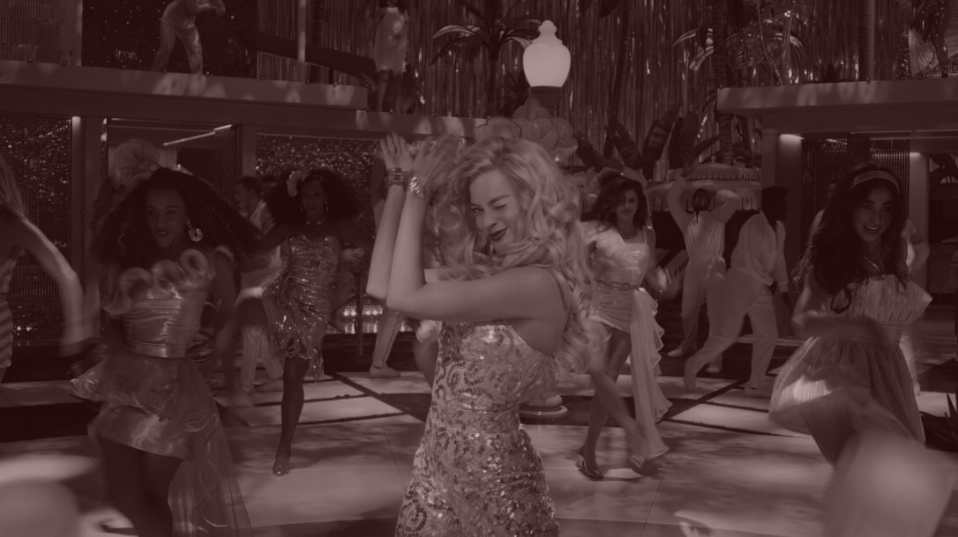
Hollywood really tried this year, with wide releases for several star-driven, high-concept comedies. But Jennifer Lawrence’s No Hard Feelings barely cleared $87 million worldwide on a $45 million budget, and the likes of Mafia Mamma, Joy Ride, Strays, and Dumb Money all bombed. Even comedy-centric genre flicks like Renfield and The Haunted Mansion tanked. The one DreamHouse-sized exception was Greta Gerwig’s Barbie, which became a cultural phenomenon.
For most audiences, however, it was a Barbie flick first and a comedy second. Likewise, most of today’s franchises offer laughs as an added value element: Scream VI, Guardians of the Galaxy Vol. 3, TMNT: Mutant Mayhem, Fast X, and horror-specific black comedies like Cocaine Bear, M3gan, and The Blackening, among others. In this market, a real-world movie about funny people in funny situations can wait until at-home viewing, as Universal acknowledged when it sent the Judd Apatow-produced Please Don’t Destroy: The Treasure of Foggy Mountain, originally planned for theaters, directly to Peacock.
VII. Horror Is the Last Bankable Genre
Cheap, marketable, and far less reliant on stars or I.P. (looking at you, Universal, spending $400 million on a trilogy of sequels to The Exorcist), this year saw new horror hits, relative to budget, like M3gan ($181 million global on a $12 million budget), The Pope’s Exorcist ($77 million worldwide on a $17 million budget), and Talk to Me ($92 million on a $5 million spend), plus successful continuations of the Evil Dead, Scream, and Saw franchises. Five Nights at Freddy’s is nearing $300 million on a $20 million budget.
How? The horror habit is still a thing, and genre media and social channels champion horror movies, making fans aware of what’s coming to theaters. No such ecosystem exists for live-action comedies or straight-up dramas. Moreover, while franchise films have appropriated nearly every genre—heist flicks, coming-of-age melodramas, rom-coms, thrillers, etcetera—the all-quadrant tentpoles can’t absorb R-rated horror mayhem. Fright flicks remain where fans must go to get what they crave.
VIII. Movie Stars Add Value, Not Bankability
Tom Holland is not a movie star, not in the sense that he could open an original movie starring as just some guy. However, he is bankable as Peter Parker or even as Nathan Drake in an adaptation of Uncharted. Margot Robbie suffered dual bombs this time last year with Amsterdam and Babylon, but she helped Barbie become 2023’s biggest movie. That’s modern movie stardom in a nutshell. Unless you’re Leonardo DiCaprio, Sandra Bullock, or (on a budget) Gerard Butler, you don’t open a movie unless you’re playing a marquee character in a known brand. Say, Timothée Chalamet as Willy Wonka. And if that character leverages your persona—like Will Smith playing Genie in Aladdin as if he were in a Hitch sequel—all the better. Movie stars are now mostly added value elements in I.P. plays, some more valuable (Chris Pratt) than others (Chris Pine). |
|
|
| IX. Theaters Make Movies Bigger on PVOD and Streaming
Offering films on premium video-on-demand just weeks after opening day for a $20 rental fee barely made a dent in theatrical earnings this year—while also generating new revenue for studios. For films to benefit, however, they must be given a conventional, wide theatrical release. Theatrical titles almost entirely dominate the daily VOD charts. Likewise, the playability on streaming for theatrical films both new and old is dependent on awareness from the run in theaters. This explains why Sing 2 was among last year’s biggest successes on Netflix after a $408 million run, and how random flops, like The Snowman, can briefly become Netflix’s most-watched movie.
That’s why films intended for streaming—like The Boogeyman, Magic Mike’s Last Dance, and next month’s Mean Girls—ended up in theaters. The money spent marketing even a failed theatrical release makes that film a bigger deal in the PVOD and streaming ecosystems. That’s the strategy Amazon employed for Air and Apple is banking on for Killers of the Flower Moon and Napoleon. It may not work every time, but theatrical and streaming function better as reluctant partners than malevolent enemies. To paraphrase Lost, better to live together than die alone.
X. Hollywood Can Use (But Should Not Listen To!) the Internet
Consumers watch fewer films in theaters and less linear television, giving them far less exposure to theatrical trailers and TV spots. And while a strong YouTube clip or TikTok trend or X/Twitter controversy can juice awareness or interest in a picture, they do not determine a hit or a flop.
Young moviegoers showing up in suits didn’t turn Minions: The Rise of Gru into a hit. The real world didn’t care about a Black actress playing Ariel in The Little Mermaid. #Barbenheimer was the rare online narrative that helped create mainstream awareness and interest. But Barbie was the first live-action movie of one of the world’s biggest girl-focused I.P.s, which benefited from strong reviews following a merchandising blitz. Oppenheimer was a critically acclaimed drama sold like a white-knuckle event tentpole from Christopher Nolan, a director who’s probably the biggest “movie star” in Hollywood. The memes helped whet the appetite, but the movies—following a slew of underwhelming early-summer titles, no less—had to deliver the goods. |
|
|
| Ben Thompson tackles the Great Netflix Data Dump and the fact that so much content isn’t watched by anybody. [Stratechery]
Bill Cohan teases out the various Shari Redstone scenarios for offloading Paramount Global or its parent company. Not mentioned: launching the whole company into space with Tom Cruise. Just an idea. [Puck]
Utah’s Harmon family, which owns Sound of Freedom distributor Angel Studios, has a bunch of overlapping corporate entities that may have violated S.E.C. rules. [Rolling Stone]
The Sean Combs downfall stories keep getting worse. [LAT]
Nick Vallelonga, the Green Book best picture Oscar winner that everyone wants to forget won a best picture Oscar, was sued by IATSE for allegedly stiffing crew on a John Travolta-Katherine Heigl musical rom-com called That’s Amore! that is most definitely not winning best picture. [Vulture]
An actor who made his film debut in a Tyler Perry movie claims he was sexually harassed for years by a “billionaire” mogul and has a recording of being offered $100,000 to undress in front of him. Hmmm. [Urban Hollywood]
Michael Eisner took his 5-acre Malibu spread off the market after nobody would buy it for $225 million, and then $185 million. Sad. [Real Deal] |
|
|
| Readers don’t seem ready to accept Ted Sarandos’s word for why Netflix started releasing full viewership data. Some examples:
“It’s going to be interesting in 5 years when Ted admits the ‘transparency flex’ wasn’t a flex at all, it was strategically designed to put downward pressure on the cost of content.” —An investor
“Call me cynical, but I believe there is a really simple explanation: money. Since day one, Netflix has been paying everyone as if their show is a hit. Maybe a modest one, but still successful because they bought out the back-end up front. The reality is that only a small percentage of shows are really successful, and really matter in the sense that they can't be replaced with something else without an impact on subscribers or revenue. Netflix finally did the math, realized just how crazy it is to pay everyone when only a small number of shows really matter, and the long-term play is to shift to a model where they only pay for success. Step one: release data. Step two undoubtedly will be a change in their model to stop buying out the full back-end up front, and only pay that extra money when they have to. (See new contracts that limit bonuses to a small number of shows.) That the data was going to end up coming out anyway through the ad business just made it easy.” —An executive
“David Zaslav has been yelling for a while about how few titles drive the vast amount of engagement on Max, so it’s no surprise that the same trajectory is true on Netflix. What’s different is Zaslav monetizes the underperforming titles by licensing. How long can Netflix allow this stuff to just sit unwatched on the service?” —An investor
“Good for Netflix, who cares what the motive is here, more transparency is better for the overall industry.” —An actor |
|
|
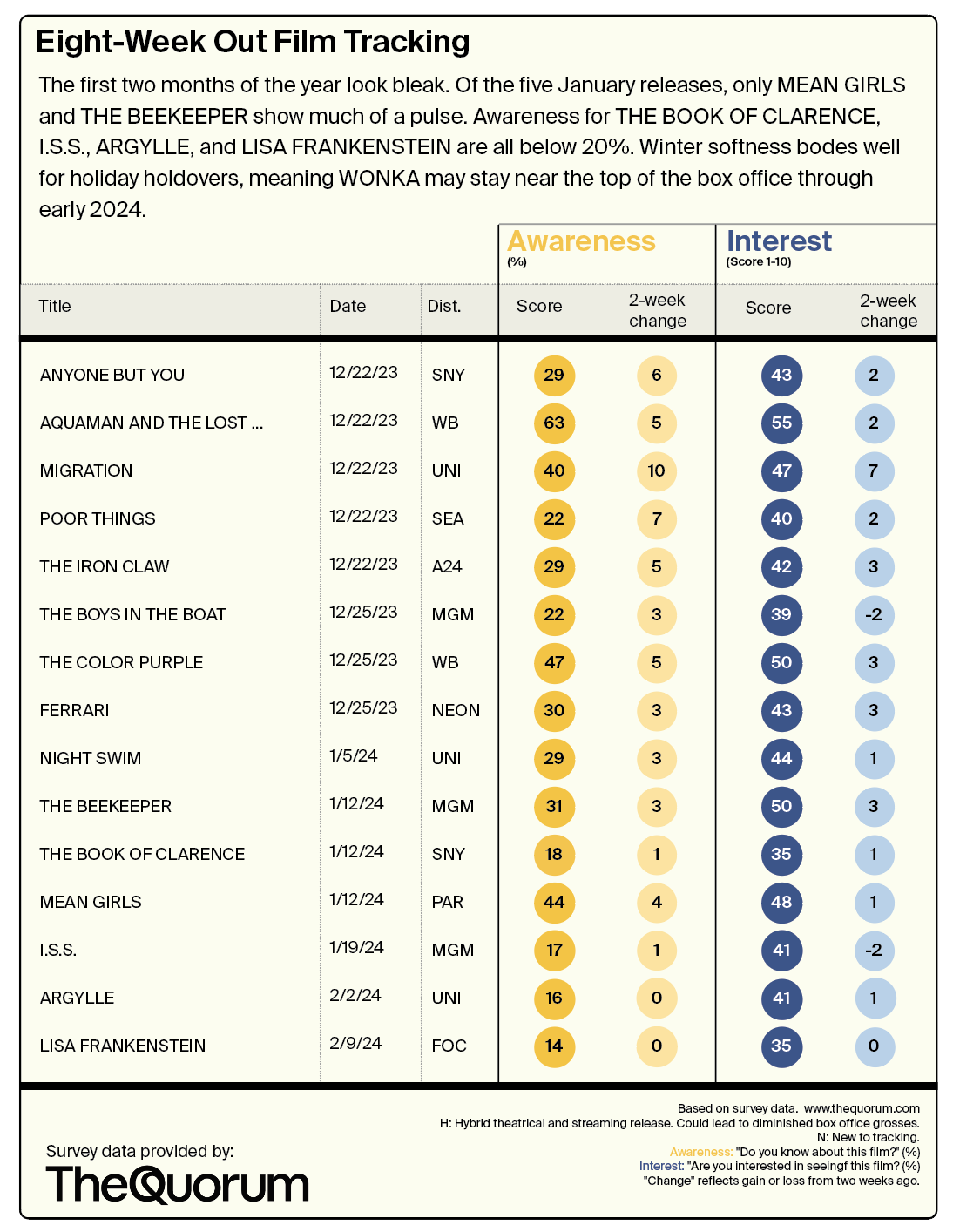
| January looks super bleak on The Quorum’s early film tracker, which is good news for the holiday holdovers and awards contenders… |
|
|
| Finally finally… one fun thing… |
|
| I’m guessing you didn’t make Tom Cruise’s holiday cake list. If not, and if you don’t live near Doan’s Bakery in Woodland Hills (it’s sold out on Goldbelly), you too can make the white chocolate coconut bundt cake that Tom Hanks called “so great you can really only have it once a year.” Here’s the Xenu-approved recipe:
Cake:
- 3 cups all-purpose flour, plus more for flouring the pan
- 1/2 teaspoon salt
- 1/2 teaspoons baking powder
- 3 cups white sugar
- 1 cup unsalted butter, softened
- 6 large eggs
- 1 teaspoon vanilla extract
- 1 teaspoon coconut extract
- 1 cup sour cream
- 2 cups sweetened flaked coconut
- 1 cup white chocolate chips
Frosting:
- 4 ounces cream cheese
- 1/4 cup unsalted butter
- 1 teaspoon vanilla extract
- 1/8 teaspoon salt
- 2 cups powdered sugar
- 2 tablespoons heavy cream
- 1 ½ cups sweetened flaked coconut
The 9 preparation steps are here, thanks to AllRecipes.com. I’ll be making this on Christmas Eve and will report back. Happy baking and everlasting immortality! |
|
|
Warmest wishes this holiday season,
Matt
Got a question, comment, complaint, or suggestions for kid-friendly things to do in NYC around Christmas? Email me at Matt@puck.news or call/text me at 310-804-3198. |
|
|
|
| FOUR STORIES WE’RE TALKING ABOUT |
 |
| Times Flies |
| Notes on James Bennet’s screed against the Gray Lady. |
| DYLAN BYERS |
|
 |
|
 |
|
 |
|
|
|
|
|
 |
|
|
|
Need help? Review our FAQs
page or contact
us for assistance. For brand partnerships, email ads@puck.news.
|
|
You received this email because you signed up to receive emails from Puck, or as part of your Puck account associated with . To stop receiving this newsletter and/or manage all your email preferences, click here.
|
|
Puck is published by Heat Media LLC. 227 W 17th St New York, NY 10011.
|
|
|
|