Welcome back to What I’m Hearing. I’m still on vacation in the wilderness, hearing only alpine
breezes and evening crickets. So I’m paying minimal attention to this week’s Hollywood madness, like Warner Bros. touting its hot streak at the box office right before laying off 10 percent of employees… or Shari Redstone declaring content is still “king” as she hands over Paramount to the family of a tech billionaire… or the fact that Amazon has signed Hollywood guild contracts agreeing to credit and pay professional showrunners while today announcing its
funding of an app, conveniently called “Showrunner,” that uses A.I. to create TV shows. (Puck’s A.I. guy, Ian Krietzberg, interviewed its C.E.O. today here.)
So
no Thursday Thoughts today. Instead, our streaming video guru, Julia Alexander, is here with an updated look at one of the enduring industry questions: Why the heck doesn’t Apple TV+ sell ads?
Still not a Puck member? Just click here. Got a news tip or an idea for me? Just reply to this email or message me on Signal at 310-804-3198.
All yours, Julia… |
|
|
As Tim Cook touts “double-digit” streaming growth, whatever that means, Hollywood’s most
price-insensitive player is facing growing pressure to actually make money from its unprofitable service. Turning on the ad revenue spigot is probably inevitable. |
|
|
In its six-ish years of existence, Apple TV+ has mostly operated as a sort of vanity project, largely immune
to such quotidian concerns as profit, revenue, and return on investment. Apple, after all, is currently the third-most-valuable company in the world, today revealing $94 billion in third-quarter revenue, up 10 percent year over year and a record for the quarter. The Services division, which houses Apple TV+, was responsible for around 30 percent of the company’s total revenue. This financial advantage is what executives from Disney’s Bob Iger
to Netflix’s Ted Sarandos are referring to when they say that competitors like Apple TV+ and Amazon Prime Video are operating under completely different constraints.
But Apple isn’t quite as carefree these days. As Bank of America analyst Wamsi Mohan
observed, Apple is increasingly reliant on Services revenue, such as iCloud storage fees, Apple Care plans, and in-app advertising and payments.
(In the 2024 fiscal year, for instance, Services accounted for slightly less than a quarter of total revenues and profit, but nearly 40 percent of total gross profits.) Services also includes Google’s estimated $20 billion annual fee to be the default search engine on Apple devices.
Alas, some of those revenue streams are now in jeopardy from legal rulings, including one that
impacts Apple’s ability to take a 30 percent commission on in-app payments, and another that could threaten those massive checks from
Google. Eddy Cue, who oversees Services, has said that the possible loss of the Google dowry keeps him up at night. And, of course, Apple is watching its fellow tech giants spend tens of billions each year to compete in the A.I. superrace—one that Apple lags far, far behind in, even if C.E.O. Tim Cook reiterated the company’s commitment to A.I. in today’s earnings note, including being open to further acquisitions.
All this has precipitated a bit of
handwringing in the entertainment industry over whether Apple will continue to fund its production division and streaming service at a reported billion-dollar annual loss. Both Cue and Cook have reassured the town of their commitment to the streamer, which by at least some metrics is riding high, with 81 Emmy nominations and a few back-to-back hits (Severance on the TV side and The Gorge in film). Cook also noted today that TV+ viewership is up “strong double digits” year over
year… but since the service has never revealed actual subscriber or viewership numbers, it’s impossible to know what that means. (For context, Apple TV+ fails to capture a single percentage point share of TV viewing in the U.S., according to Nielsen.) But the issue facing Apple isn’t quality, it’s profit… or lack thereof. |
Why is Apple, a company that isn’t afraid of acquisitions and could have bought Netflix or Disney
years ago, invested in content at all? As Cook recently noted in an interview with Variety ahead of the premiere of F1 (a movie that got a special shout-out on today’s earnings call), Apple is “in it to tell great stories, and we want it to be a great business as well.” Of course, Cook’s unspoken truth is that,
as the company becomes more services-focused, it needs more gateways, like TV+, to bring people into its ecosystem. Hence why Apple TV+ is now being distributed through third-party arms, like Amazon’s Prime Video Channels.
Though Apple has accomplished the great storytelling part, if its desire is to be the modern HBO, then it needs to take some lessons from the HBO of today, not the one of yesteryear. Today, both HBO and Apple TV+ are competing in a much more fragmented and delineated
environment, without the benefits of a centralized cable ecosystem, and with shows whose budgets are increasing all the time.
Cue has been trying to get Apple studio chiefs Zack Van Amburg and Jamie Erlicht to rein in their budgets for more than a year—a message that has trickled
down to the creative community. But now is really the time for Apple to lean into other strategies, including advertising and licensing, which even HBO’s own streaming service currently offers, to transform a service with genuine momentum into a profitable platform.
Apple executives have so far resisted putting ads on the streamer, but it may be inevitable. Remember, Netflix chairman Reed Hastings once declared that advertising was “exploitative,” too—all it took was
24 months and one horrific quarter for him to change his mind and aggressively launch a global ad tier. And he had a good reason to do so: Per the company’s most recent earnings call, ad revenue is projected to double this year.
Apple already has a pretty robust advertising business, which is expected to surpass $7 billion in revenue in the U.S. this year, per eMarketer. There are ads in App Store search results and in owned and operated apps like News and Stocks. Experts also
point out that App Tracking Transparency, a privacy feature that Apple introduced in 2021, has hurt Meta and Google’s advertising businesses but nevertheless seemed to fortify Apple’s own through increased first-party data collection. (Indeed, the market power concerns were so strong that courts in Germany and Brazil have opened antitrust investigations—which are ongoing—into Apple’s practices following France’s antitrust regulators fining the company $162 million.) So Apple already has much of
the infrastructure in place. Why not start making money on one of the few business units that’s in the red?
People tend not to see Apple as an advertising business because the company doesn’t bill itself as one—unlike Meta and Google, which drew about 98 and 76 percent of their total revenues, respectively, from advertising in their most recent quarters. But Apple is quietly becoming much more open about its ambitions in the space. Several analysts have suggested that the company’s recent
moves, including simplifying the name of its Apple Search advertising arm to “Apple Ads,” represent a turning point. Meanwhile, unpredictable tariffs on key hardware-export countries like China and India make it even more important to squeeze revenue from the apps. As industry analyst Eric Seufert recently noted, advertising is the singular lever that Apple has to lean on for revenue growth in the short term—and that growth has never been more important.
Which
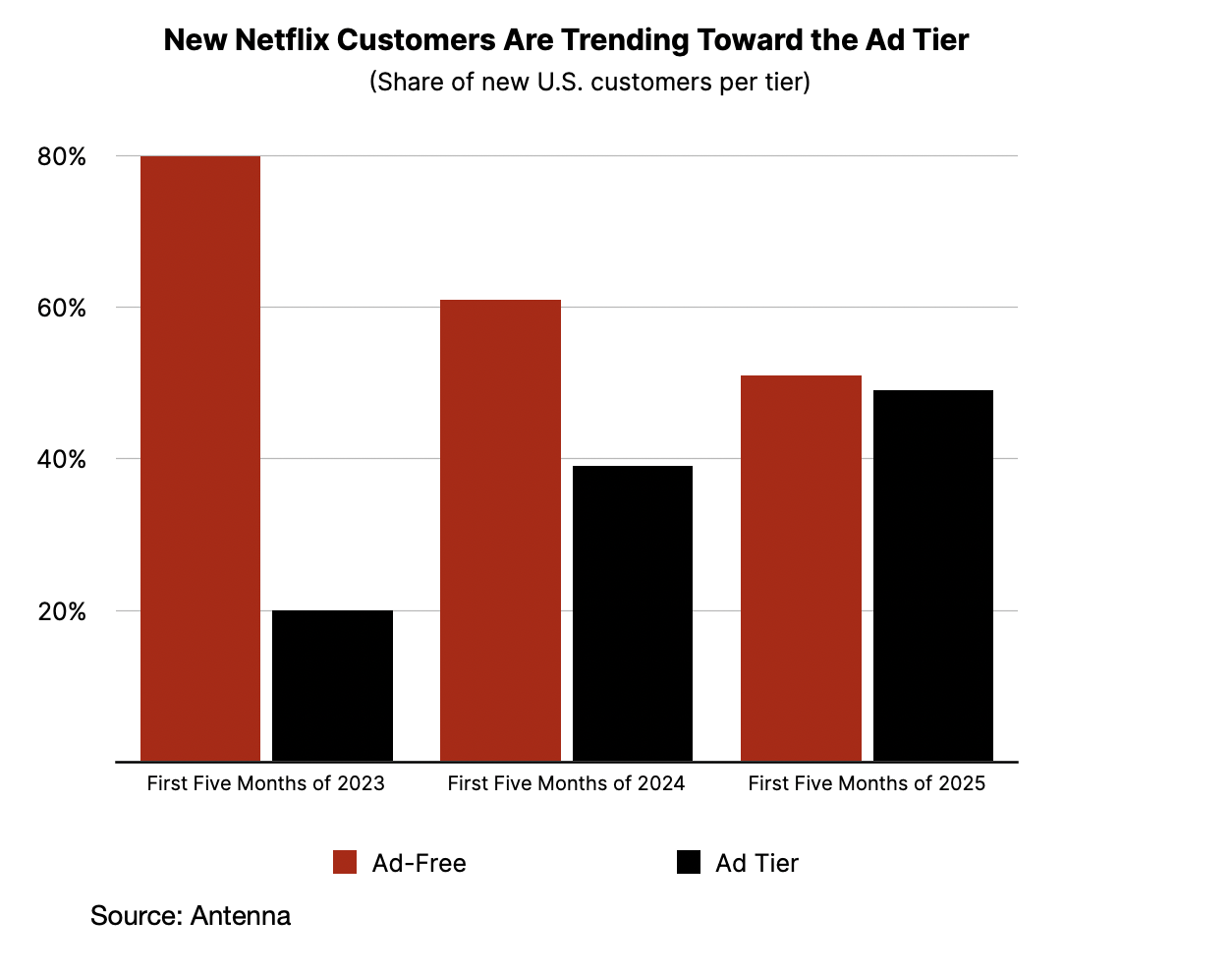
brings us back to Apple TV+. Ad-supported TV now accounts for 73.6 percent of all viewing in the U.S., per Nielsen. Streaming is also taking more of that ad-viewing away from broadcast, Nielsen found. Half of all new Netflix customers in the U.S. are now choosing the advertising tier, per Antenna, with no measurable harm to the longevity of that customer.
Put another way, more people are coming into tiers that will theoretically produce higher average revenue per user and aren’t canceling
at higher rates. As streaming shifts from a pure subscription economy to one focused on engagement—and therefore, advertising—these numbers will continue to increase. And Apple TV+ is well positioned to join in the transformation. |
If advertising is going to become part of Apple TV+’s growth story, creating more inventory for
those ads is mandatory. After all, Apple TV+ commissioned the fewest original titles of all major streamers between 2020 and 2024, according to Ampere Analysis. Obviously, the solution can’t be to double down on Apple’s pricey (and unprofitable) originals strategy. That leaves licensed content as the simplest and most cost-effective way to grow subscribers and a robust ads business.
Apple already allows users to buy or rent TV and movies through its aggregation platform. But it also needs
to add licensed content directly to its streamer—something that Apple executives now seem more willing to explore. Earlier this year, Apple hired a global licensing head with a focus on finding acquisitions for the platform. Last year, Bloomberg reported that the company was interested in licensing films from third-party studios to bolster its Apple TV+ business. Adding licensed content would create an additional revenue layer (through ads, and combating churn) that can be reinvested in
the high-quality content Apple prides itself on.
Of course, Apple doesn’t have to do any of these things. It’s a $3 trillion company that can float a vanity project for as long as it likes. As Cook acknowledged in his Variety interview, although “procuring a catalog” is a “faster way into the business, it didn’t feel like Apple at the end of the day.” But Apple is also a for-profit business with demanding shareholders—and many of its profit engines are at risk. Apple TV+
is undoubtedly on a creative winning streak, but now it needs to start pulling its weight as part of the Services ecosystem Apple increasingly relies on.
Perhaps the biggest hurdle for Apple executives is that advertising seems less premium, and Apple TV+ is supposed to mirror the sleekness of the company’s products. But if Apple wants to continue playing in the world of television, executives should abide by the rules that have dictated TV for the last 50 years. If Netflix can reverse
its philosophy on ads, there’s no reason Apple can’t do it too. |
Thanks, Julia. See you Monday,
Matt
Got a question, comment, complaint, or a good pedicurist
for dirty feet? Email me at Matt@puck.news or call/text me at 310-804-3198. |
|
|
Puck fashion correspondent Lauren Sherman and a rotating cast of industry insiders take you deep behind the scenes of this
multitrillion-dollar biz, from creative director switcheroos to M&A drama, D.T.C. downfalls, and magazine mishaps. Fashion People is an extension of Line Sheet, Lauren’s private email for Puck, where she tracks what’s happening beyond the press releases in fashion, beauty, and media. New episodes publish every Tuesday and Friday. |
|
|
The industry’s go-to source for unflinching reporting on the trillion-dollar business of artificial intelligence - perhaps the
single most important technology of our time. Ian Krietzberg, the powerhouse journalist behind The Deep View, delivers twice-weekly insights into the latest dealmaking and breakthroughs in A.I., and how the intersecting worlds of finance, entertainment, media, and politics are being transformed in its wake. |
|
|
Need help? Review our FAQ page or contact us for assistance. For brand partnerships, email ads@puck.news. You received this email because you signed up to receive emails from Puck, or as part of your Puck account associated with {{customer.email}}. To stop receiving this newsletter and/or manage all your email preferences, click here. |
Puck is published by Heat Media LLC. 107 Greenwich St, New York, NY 10006 |
|
|
|