Welcome back to What I’m Hearing...
Happy Presidents Day. A reminder for Puck members: you can subscribe (and unsubscribe) to different authors and their private emails. Just want me? That’s fine. Want to explore more? Great. My partner Julia Ioffe is an expert on Russia, for example, and her dispatches on Putin and Ukraine are indispensable these days. Just go to this page to manage your account.
Discussed in today’s email: Shari Redstone, David Zaslav, Tom Rothman, Quentin Tarantino, Tom Holland, Bill Block, Ari Emanuel, The Tinder Swindler, and Robert Evans’ butler.
A few shorter items tonight for your flight back from Park City or Jackson Hole, but first…
SPONSORED BY HULU 
Who Won the Week: The Toms
Uncharted’s $51 million, 4-day domestic opening means Tom Holland and Sony’s Tom Rothman have boasted the No. 1 movie eight times in the past 10 weeks. It pains me to compliment Rothman because he can be so grating, but without an affiliated streaming service, Sony’s pandemic strategy—selling off dramas, like Fatherhood, and kiddie fare, like Mitchells vs. the Machines, then going all-in on theaters with franchises Spider-Man: No Way Home, Ghostbusters: Afterlife, Venom: Let There Be Carnage and now the game-based Uncharted—has bested its studio peers.
Related: Congrats to Ari Emanuel, who had to convince his famously headstrong client Mark Wahlberg to take a back seat to Holland in the Uncharted marketing. Suppressing that ego paid off for both WME actors…
Now let’s start with some feel-good news…
Bob Evans’ Butler Stays In the Picture
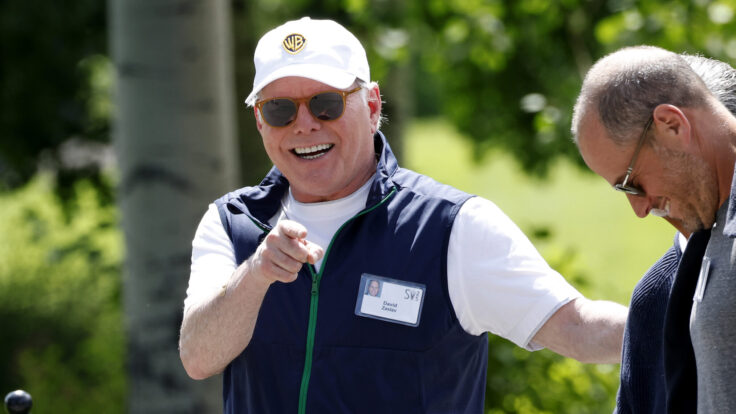
Incoming Warner Bros. Discovery C.E.O. David Zaslav has made much of ingratiating himself to the Hollywood community. That courtesy has now extended to the staff at “Woodland,” the Beverly Hills property that Zaslav purchased for $16 million in 2020 from the estate of legendary producer and Paramount chief Robert Evans.
ADVERTISEMENT 
Quote of the Week
“It’s like making a Caesar salad.” –Michael Bay, the Ambulance director, telling Empire about his “secret sauce” for blowing shit up on screen.
Runner up: HBO’s John Oliver, on Zaslav taking over WarnerMedia: “We do not need to meet each other. We do not need to speak.”
Second runner up: FX’s John Landgraf, on the continuing rise in the number of TV shows: “I might have been woefully off on when the peak might occur.”
Now for an update on one of the more bizarre stories in recent months…
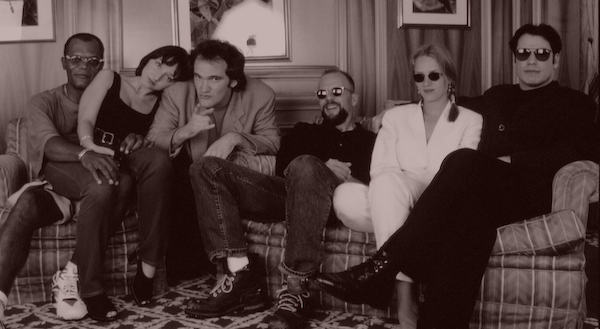
The company behind the screenplay tokens trumpeted a $1.1 million sale then abruptly shelved more, but a mysterious new push could be a pivot to populism or just smoke and mirrors. For more than a week now, I’ve been trying to track down Guy Zyskind, the Israeli founder and C.E.O. of SCRT Labs. That’s the developer of the Secret Network, the NFT exchange behind the much-discussed Pulp Fiction screenplay tokens that Quentin Tarantino planned to sell for millions of dollars. I’ve got lots of questions for Zyskind now that the whole endeavor seems to be as dead as Vincent Vega in the black suit.
As I wrote back in November, Miramax hired a six-litigator team to sue Tarantino over the NFT plan, claiming that the studio, not the film’s writer-director, owned “broad rights” to offer collectible tokens based on the script. In response, Tarantino’s team argued that his original deal maintained his right to “publish” his screenplay, which now allows him to “publish” NFTs on the blockchain. If this topic makes your eyes glaze over, it shouldn’t; pretty much every Hollywood studio is trying to figure out its NFT strategy, and rights ownership is key. A lot of money is at stake.
Anyway, Secret Network went ahead with the first of seven planned Tarantino NFT sales in January, netting what it trumpeted as a $1.1 million price from an anonymous buyer for the famous Samuel L. Jackson-John Travolta “Royale with Cheese.” Zyskind put out a triumphant press release saying the sale “represents a monumental moment for our community, Quentin, and the Secret Network.” And then… the whole thing was abruptly abandoned.
Yes, four days after its monumental moment, Secret Labs indefinitely postponed future Tarantino sales, citing “extreme market volatility,” which sounded like total B.S., even though the crypto market has been on a roller coaster in recent weeks. Then on Friday, the @TarantinoNFTs Twitter account announced that it would “change directions” to a new NFT plan, and that “activity of this channel will now be 100% dedicated to this new endeavor.” So, is the Pulp Fiction plan permanently dead? Or is it being revived with a shot of adrenaline like Marcellus Wallace’s wife?
Tarantino’s rep tells me the plan is to continue the NFT sales at the appropriate time, but neither Zyskind nor his company responded to my request for an explanation of that timing. And it all sounds fishy. Demand may have been low, despite all that media attention. Or perhaps a tech problem intervened. Some of the art used to promote that first NFT turned out to be copyrighted by an illustrator, which required Secret Network to take it down, but I doubt that derailed the entire endeavor. So what’s going on?
Miramax C.E.O. Bill Block, while stopping short of declaring victory, certainly believes that his legal claim created a cloud of uncertainty that negatively impacted the auctions. After all, who wants an NFT whose ownership is disputed by a film studio that is backed by Paramount Global (formerly ViacomCBS) and a Qatari media company? Secret Network isn’t some fly-by-night operation, but it’s also not one of the major NFT exchanges, and it probably says something that neither OpenSea nor Rarible, both of which require sellers to satisfy certain terms and conditions, ended up hosting the Pulp Fiction sale.
Then there’s the veracity of that $1.1 million price for “Royale with Cheese.” The winning bidder, “AnonsNFT,” defines itself as the “1st @SecretNetwork PFP Collection,” which has caused some in that community to suggest it is either related to Secret Network or a front for Zyskind to generate an eye-popping initial price to establish a lucrative market. That’s apparently a common scheme in the NFT world. I don’t know if that’s the case, but Miramax, at least, thinks that could have happened.
A source close to Tarantino says Team QT believes the plan is to re-launch the NFTs as a lower price-point endeavor. I’m certainly not an NFT expert, but apparently there’s a debate raging in that world as to whether these tokens should be the province of the very wealthy, who can afford to shell out $1 million apiece for trophies like their very own Quentin Tarantino scene, or more populist collectibles sold in groups of, say, 5,000 or 10,000 copies, like an artist’s limited-edition prints. The Pulp Fiction NFTs may be pivoting to that latter path, whether by goal or necessity, which could explain why the @TarantinoNFTs account tweeted on Friday: “…we've decided to change directions so that every community member will have an opportunity to be a part of that journey.”
Given the media hubbub and the Miramax litigation, which is still pending, it would be amusing if the Pulp Fiction auction ends up looking like merely a virtual fan convention, with Zyskind allowing thousands of QT disciples to stand in line for what is essentially their own digital autograph. The account says the new plan will be announced tomorrow.
ADVERTISEMENT 
The Tinder Swindler Is Looking for a Publicist
Speaking of Israelis: Simon Leviev, the subject of the very amusing and very popular Netflix documentary The Tinder Swindler, has been shopping for a crisis PR expert. One such consultant who got the call last week tells me Leviev is adamant that Swindler is full of lies, and that he can salvage his reputation with smart spin. (This person passed.) He seems to already be on the offensive, giving an interview to Inside Edition in which he says the film “is like a made-up movie.” Good luck to Leviev.
My Reading List
The Feedback
Interesting comments on my Thursday column analyzing the Wall Street rejection of Shari Redstone’s streaming pivot and the renaming of ViacomCBS as Paramount Global. Some examples:
“Viacom’s 20 percent correction on announcements that were more or less exactly what people expected makes me wonder what took Wall Street so long.”–An executive
“The arms deal strategy isn’t looking so bad now, is it?”–Another executive
“You note that Paramount has promised to spend $6 billion on content in 2024. But that’s nothing compared to what Netflix and Disney will spend. How can Shari expect to compete when she’s not even promising a competitive product?”–A lawyer
“Aren’t you loving all the honest self-reflection from investors and commentators who were adamant that direct-to-consumer streaming was the only future for these companies? Get 500 million subs, raise prices, and voila…shangri la. Puh-lease. Netflix ripped $50 billion of producer surplus out of the ecosystem and handed it back to consumers. Did people think consumers were just going to say, OK, have it back? And what of the rest of the players in the ecosystem? They were supposed to take a discount to account for the shift? Of course not, they got more money now on the premise that they would make less down the road. But the guarantees keep growing.” –Another executive
“The Viacom desperation prompted me to sell all my content [company] shares and buy crypto. Sorry, Hollywood, it’s over.” –An investor
Finally…
This week’s movie interest and awareness chart captures the post-Super Bowl ad sentiment… 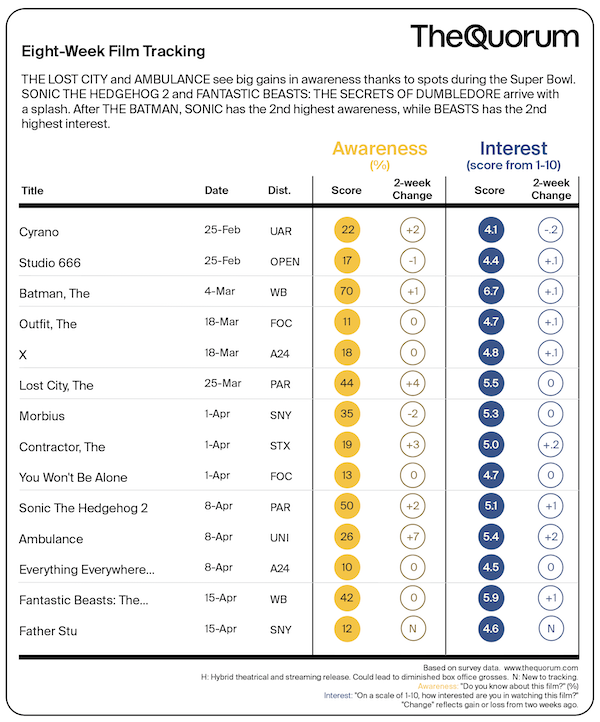
Have a great (short) week, Matt
Got a question, comment, complaint, or a fun story about Bob Evans’ butler? Email me at Matt@puck.news or call/text me at 310-804-3198. 
You received this message because you signed up to receive emails from Puck.
Was this email forwarded to you?
Sent to {{customer.email}}
Interested in exploring our newsletter offerings?
Puck is published by Heat Media LLC.
For support, just reply to this e-mail. For brand partnerships, email ads@puck.news |


SHARE