Welcome back to What I'm Hearing...
Thanks to the California Chamber of Commerce for hosting me and a few of my Puck colleagues for a great talk yesterday in Anaheim. I do speaking engagements from time to time, so if you’re interested in booking me or a colleague to talk to your group, just email fritz@puck.news.
If this email was forwarded to you, sign up for a Puck membership here. Also check out In the Room, a new private email debuting from my colleague, Dylan Byers. (Sign up here.) Thanks again for your support.
Sponsored by Amazon Prime Video 
Thursday Thoughts…
A few people asked why Dune got a sequel despite middling box office. Putting aside all the studio spin this week, here are six reasons:
Kevin Reilly Wants to Ride the International TV Wave
It’s hard to believe, but it’s only been about 15 months since WarnerMedia’s direct-to-consumer chair Bob Greenblatt and content chief Kevin Reilly were ousted by newly installed C.E.O. Jason Kilar as part of his re-org to cut costs and boost HBO Max. Greenblatt, who loves producing, continued to set up projects, and this summer he landed a production deal at Lionsgate. But Reilly has been mostly silent.
Now he’s ready to re-emerge. I’m told Reilly is preparing to raise money for a new venture that will seek to invest in international television companies, particularly independent outfits in Europe, and help scale them and sell projects globally. Reached by text, Reilly declined to comment on the venture. He’s still under contract at WarnerMedia, so he’d need to resolve that relationship before launching anything new.
Reilly, 59, has a resume that reads like an alphabet soup of top TV jobs, with major roles at NBC, FOX, TNT, TBS and FX. He’s been looking at the international sector for awhile, so this isn’t just a knee jerk reaction to Squid Game or Money Heist. To be honest, his biggest challenge is that all the U.S.-based TV powerhouses are investing overseas. Just today, ViacomCBS bought the Spanish language content producer Fox Telecolombia Estudios TeleMexico from Disney and the founding family. As streaming subscribers for Netflix and others begin to plateau in North America, local-language foreign programming that could travel globally is everyone’s goal. Soon it could be Reilly’s too.

A conversation with Matthew Ball about how Hollywood botched the rise of the internet, digital gaming, online distribution—and how Disney could turn Robert Downey Jr. into a metaverse billionaire. If you’re like me, you’ve been reading a lot lately about the metaverse, the next-gen virtual environment where many believe people will soon work, play, shop, socialize, use apps—and consume entertainment. Mark Zuckerberg has been a longtime proponent of the metaverse concept, buying V.R. and A.R. companies and, earlier today, renaming Facebook, Inc. as “Meta Platforms, Inc.,” with a $10 billion commitment to developing the metaverse as the next version of the internet. Zuckerberg’s interest isn’t just visionary, of course. He has long been frustrated that Apple and Google own the smartphone platforms on which Facebook runs. With the metaverse, “we’ll be able to help shape the next platform,” Zuck told my colleague Dylan Byers today.
How Hollywood fits into the metaverse is a big question, especially considering how badly the traditional film and television industry botched the rise of the internet, digital gaming and online distribution. Studios aren’t blind to the shifts in consumer habits, and most are investing in experiential entertainment, but it’s always baffled me that the greatest storytelling companies ever created have never produced a platform like Roblox or a game community like Fortnite. Why?
To discuss the metaverse and Hollywood’s failings in this area, I knew I needed to call up Matthew Ball. He’s been preaching about the metaverse for years as managing director of Epyllion, an early stage venture fund, and proprietor of a metaverse-oriented E.T.F. He’s one of the smartest guys around on this subject, so I transcribed our chat and edited it for clarity into the discussion below.
Matt Belloni: You’ve written for years about the metaverse as a virtual platform where we will all eventually work and hang out and spend money and play games and watch TV. What I’m interested in is that last part, and the role that entertainment owners will play in the metaverse. And, more specifically, what they should be doing now so that they aren’t caught flat-footed like they were with the transition from linear to streaming video.
Matthew Ball: So, there was a report recently about when [Netflix co-C.E.O.] Ted Sarandos was first trying to get Hollywood filmmakers comfortable with the idea of direct-to-video, direct-to-streaming releases. And his argument, apparently, was that many of today’s biggest hits weren’t actually committed to the pop cultural firmament from their theatrical release. 1977’s Star Wars was incredibly popular in theaters, but it was actually decades of kids in their basements watching it over and over that made it what it is today. I think he’s underselling that phenomenon. It was also generations of kids in their backyards holding a stick and pretending that they were Luke Skywalker or Darth Vader. Today, Hollywood recoils at this strange pastiche of I.P. indiscriminately commingling on Roblox, but the truth of the matter is that’s been happening for decades but no one saw it.
ADVERTISEMENT
Amazon Studios presents VAL. For over 40 years, Val Kilmer documented his own life and craft through thousands of hours of footage, from 16mm home movies to time spent in iconic roles for blockbuster movies. This documentary reveals a personal and sometimes-hilarious look at what it means to be an artist and a complex man. The Wall Street Journal calls Val a "a one-of-a-kind portrait of a one-of-a-kind artist who has remained devoted to his art." 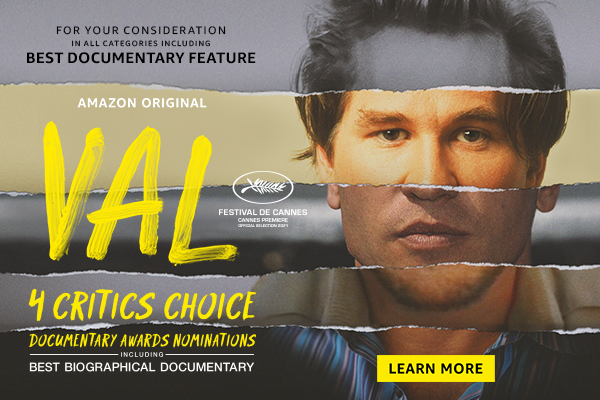
VAL is streaming now on Amazon Prime Video.
So the co-mingling of I.P.-driven toys is just transferring from the backyard to the metaverse. But in the old days, no one except the toymakers and the consumer product divisions of the I.P. owners were profiting off that play. In the future, it might be Mark Zuckerberg.
Donald Mustard, the creative director of Fortnite, had this funny tweet where he showed a Terminator riding the Silver Surfer’s surfboard, and he was talking about how incredibly strange that was. The truth is that no kid in a bathtub is paying attention to the sanctity of Ninja Turtles vs. Batman vs. Spider-Man. Their parents aren’t either. But, of course, every I.P. owner had this blissful view that every unit sold was played with on their own. But now content is being designed to mix. For Hollywood, part of that is relaxing the creative strings. We’re several years into that now. Marvel’s Kevin Feige is taking a more permissive approach to I.P. management and canonization, with Marvel’s Sony partnership and so on. Hollywood has always been a linear stream of pixels on your screen. That’s not where most kids are going. How you tell a story in a bi-directional environment is going to be king.
You’re saying that in order to compete in the metaverse, Hollywood needs to be more permissive with its assets in virtual and gaming environments.
Marvel, 12 years ago, had a model where 1.2 Marvel films came out per year. In 2019, that grew to three MCU films per year. Now we’re at the point where there are five films per year and six TV series. It’s effectively an always-on entertainment system. It’s very clear that the next frontier for integration is going to be video games. And that’s not going to be a tagalong story, it will be an ongoing, nonlinear story. You may watch a [Marvel movie], you will come home, Robert Downey, Jr.—or someone who isn’t Robert Downey Jr. but is live motion-capturing Robert Downey Jr. as Tony Stark—will run some sort of battle or conquest, and you and your friends will go along and save the day. And that will become integrated into the culture. It doesn’t mean that the frontier of Marvel is gaming. It will stay film and TV. What it means is: what is put on screen is translated into an environment, and the audience is brought directly along for the ride. And then you weave that into your story.
Disney in particular and the studios in general have a horrible track record with gaming. What will they need to compete here? Just hand it over to pros? Learn how to do it themselves? Or buy something big?
It’ll be a mixture. I’m empathetic to Bob Iger’s position on gaming. In 2019, he said, “We’ve started studios, we’ve bought studios, we’ve shut down studios. And there’s a lot of trauma that comes from shutting down a division, firing people.” But I think it was his biggest mistake. There’s an [impact in] saying, “We’re bad at this, we can’t compete.” It’s pessimistic. What if it was the reverse: “We must get good at this. I guarantee we will, it will just take time.” You might end up with a different outcome. Disney had no capability in video streaming. They did an acquisition [of BAMTech, in 2017], and five years later it’s among the best in class. There’s just so much opportunity.
If Disney invests there...
Jensen Huang, the C.E.O. of Nvidia, has made the point that everyone born today is a gamer. It’s impossible to believe that Walt Disney would say the fastest growing, most creatively ambitious and changing media category—the one that every generation adopts more often and more wholeheartedly—is one that it’s OK for us not to be good at. And instead we’re going to outsource the creative, outsource the live operations, outsource the customer relationship and majority of revenue, to a third party.
Especially when Netflix, which by most metrics will be Disney’s chief competitor for a long time, is diving into gaming.
The fact that Netflix is saying in 2021 “We are going to start this process through small acquisitions without direct revenue” is proof that it’s about commitment and desire.
ADVERTISEMENT 
Zuckerberg knows this is about more than gaming, it’s about an entire digital playing ground that will encompass how people interact, how they watch traditional media, engage with celebrities, talk to their boss, buy things, etc. How should entertainment companies be thinking about their role in the metaverse?
Good question. The internet today is estimated to be 15 to 20 percent of the world economy. Very little of that stems from entertainment, or media, or Hollywood. You might have an avatar of Batman or Robin that you wear to work, but that’s all marginal. The primary focus right now [for Hollywood] is actually the plumbing. Look at [Disney’s visual effects company] Industrial Light and Magic, which switched over in the second season of The Mandalorian to their own proprietary real-time rendering engine called Helios.
Yeah, I went to see Jon Favreau at the Playa Vista set—if you can call it a set, it was more like a warehouse with monitors and virtual cameras—and he showed me how it works. Pretty amazing.
This is actually a brilliant example of what happens when you have corporate mandates and conviction… and talent. The Mandalorian was the most important launch of Disney+; season 2 was the only major franchise release of 2020 because Marvel slipped to 2021. So the fact that after the first season was immaculately executed, they said, “Let’s do an enormous tech shift, and not just from Unreal to Unity, to our own tech,” that tells you what they’re doing. They developed their own real-time rendering engine, and they deployed it on their most important franchise. It’s about the pipeline of digital infrastructure and digital assets that is being created. This was essentially the modern equivalent of Marvel’s Atlanta Pinewood production process [the physical facility in Georgia where most of the Marvel projects are shot].
Where do you think high-level talent will fit into the metaverse? I’m not talking gaming talent, I’m talking actors, personalities, filmmakers, creators.
We just discussed how the cross-proliferation of media is going to extend into gaming, which means that just as talent deals have been expanded to incorporate television, that’s obviously going to need to expand. You look at Fortnite. There are certain characters in the Marvel universe that do have likeness to the actors we’ve seen on the big screen, some do not. We’re going to have more nuanced situations where you may have the likeness sold but you don’t do the performance. For example, you could easily see a situation where Marvel goes to Robert Downey, Jr. to purchase likeness rights, but then the live performance is not run by Robert Downey Jr., and in fact the vocal performance is being modulated to sound like Robert Downey Jr. but is not in fact Robert Downey Jr. That’s where you get into particularly difficult negotiations, but that’s where we are going.
And Robert Downey as a “performer” could potentially last forever in the metaverse.
Absolutely. Kevin Feige—this was in the Sony hack emails—said he would never conceive of rebooting Iron Man. Basically, that means that if the MCU is still running in 2035, Tony Stark’s Iron Man never returns except through the multiverse. So this is how the character and the performance could endure. But what happens when a Tony Stark skin is sold with the likeness of Robert Downey? You might have the RDJ version and the generic version, so Disney can actually A-B test how much of the value is coming from Robert.
Sure, the brilliance of the MCU characters is that most of them wear masks.
That’s certainly a perk for Disney in some regards. There’s an interesting example. Last year, Square Enix, the Japanese publisher behind Tomb Raider and Final Fantasy, released Marvel’s The Avengers. It was not a particularly successful game, but it was centered around the Disney definition of “The Avengers,” meaning the six Avengers that were in the Joss Whedon movie series. They look “uncanny valley” because they are designed to look like—but not look like—the actors we know. The audience found it really strange. The Mark Ruffalo character looks like Mark Ruffalo, and wears the exact outfit he wore in the Joss series, but it’s not him. Thor is a weird version of Thor. People complained to Square Enix, and they had to say the character selection and brand approval was not up to us, Marvel had to approve. So it’s an interesting case study. Marvel had been so successful saying “these are the Avengers” that efforts to say these are the Avengers but not the Avengers you know, actually turned consumers off.
Well, my interpretation of that is it’s good for talent because it means actors and their performances actually matter.
Right. But it tells you the extent to which all of these things are starting to intertwine.
It’s pretty clear to me that Disney+ will ultimately become the hub for everything Disney, from video to audio to shopping to theme park extensions to interactivity with friends through the Disney lens. Do you think Disney+ will be a metaverse portal?
I’ve always subscribed to that expectation. There was an interesting announcement the other day. Google’s cloud game streaming service, Stadia, which was not particularly successful, is becoming a white label, ie; BAMTech in the old days [meaning it provides services to lots of different customers]. As a result, you’re going to be able to play the new Batman: Arkham title, which comes from Warner Bros. Interactive, through your web browser. In that instance, that AAA, immersive, computationally rich video game is played just like a video file. It’s being streamed to you via a remote data site. There’s no reason why that can’t be delivered to you through the HBO Max app, except for the fact that HBO Max doesn’t have live. But any platform that does support live, like Hulu, could just as easily allow you to cloud game. That starts to simplify. If you want to create a way for Marvel fans to congregate in the Avengers tower, of course you’re going to want to do that through the Disney+ experience.
That brings us back to Zuckerberg, who has access to everyone on the planet for his metaverse. As does Apple and Google. Do you think content owners will forever be staring up as the giants dictate the terms of the future?
Technology over the past 20 years has generally enriched the value of good storytelling because you can reach more people, more often, with more varied experiences. The truth is we think of Disney as the most impressive of the old media giants, and its most profitable (typically) business—certainly its most defensible—is the most analog, and that’s the theme park. And yet the theme park is available to only a tiny fraction of Disney fans worldwide, effectively just the wealthiest, the most urban. It’s only open for a few hours a day, you can rarely go with all of your friends, and they have to be there with you. There’s a compelling argument that the metaverse, or any increased ability to immerse yourself in these fantastical environments, is only going to increase the value of these high-quality stories. It probably further exacerbates the gap between the Tier 1a and the Tier 1b and certainly the Tier 2 and 3 franchises.
If you worked in entertainment, would you be excited about or terrified of the metaverse?
I’d be excited. Look at what has happened since 2014. An extraordinary amount of M&A has happened [in entertainment], a category that some believe is going to have only a few winners. But for the most part, it has seen record prices for [streaming] strategies that have yet to come to fruition. In that period, any number of video game publishers could have been purchased. This is a fast-growing category that can change the dynamic. That means if you are in second or third place, struggling to get your franchise off the ground, struggling for oxygen in the face of Marvel, then by definition, any new opportunity is welcome, especially one that allows you to more directly interface with your fans and produce a differentiated entertainment experience, rather than just saying, “Let’s have our own cinematic experience.” That’s a good thing.
It feels like there’s an understanding now that Hollywood fucked up on digital distribution, totally missed it and is now playing catch-up. Because of that, there’s anxiety over missing what’s next.
The internet caught almost everyone off guard. Mobile caught most people off guard. The App Store came out in 2008, and it wasn’t until 2012 that Zuckerberg launched a native app on the iPhone. One of the reasons is that they spent four years going after the wrong mobile strategy. And, of course, it’s mobile that strongly affected the [Hollywood] studios. The difference in the metaverse is everyone is getting ahead much earlier. The fact that Facebook has 3 billion daily active users and Roblox only has 40 million, that tells you we are very early in that shift. So Hollywood is right to worry that they’re going to repeat the last mistake, but we are much earlier in this cycle, and everyone is much smarter, having gone through two already.
We will see if that’s true. Thanks Matt.
See you Sunday, Matt
Got a question, comment, complaint, or want to fight me over the fact that Peanut M&Ms are the best Halloween candy? Email me at Matt@puck.news or call/text me at 310-804-3198.
FOUR STORIES WE'RE TALKING ABOUT 
With the Chappelle uproar, Netflix has become an unwitting signpost in the culture wars. Some believe it may presage a turning point. MATT BELLONI 
Members of the intelligence community are increasingly convinced that the Russian government is behind the "Havana Syndrome." JULIA IOFFE 
In the middle of perhaps the most consequential scandal of his career, Mark Zuckerberg unveils his new vision for the metaverse. DYLAN BYERS 
The formative years of David Zaslav's career explain as much about the history of cable as they portend about the future of streaming. WILLIAM D. COHAN 
You received this message because you signed up to receive emails from Puck.
Was this email forwarded to you?
Sent to {{customer.email}}
Puck is published by Heat Media LLC.
For support, just reply to this e-mail. For brand partnerships, email ads@puck.news |


SHARE