Welcome back to What I'm Hearing...
Hello and Happy Halloween, a little earlier than usual because I’ll be trick-or-treating as Marshall from Paw Patrol.
Reminder: My emails are for members of Puck, our new media company focused on the power centers of Hollywood, Silicon Valley, Washington, and Wall Street. If this email has been forwarded to you, you can sign up for a membership here. Thanks.
Sponsored by Amazon Prime Video 
First, as we enter November of the Scariest Movie Year Ever, a couple topics more terrifying than that disgusting zombie baby on your neighbor’s lawn…
Who Won the Week Hwang Dong-hyuk– Netflix released another round of astounding Squid Game numbers, claiming the Korean writer-director’s dystopian series was watched by 142 million households globally, or nearly seven in 10 people who subscribe. Taking the unverified Netflix boast with the usual grain of salt, that’s pretty gigantic.
Now some news, and an update on everyone’s favorite multi-billion-dollar private equity play...

Kevin Mayer and Tom Staggs’ Blackstone Group-backed company is one of the suitors as Kevin Hart jumps on the private equity party bus. Go ahead and add Kevin Hart to the list of A-level talent jumping on the private equity party bus. Three sources tell me the actor-comedian-producer is in active talks to sell either all or a piece of his prolific company, and the suitors have lined up. Hart’s rep declined to comment.
It’s two companies, actually. Hart runs Hartbeat Productions, a film and television shingle, and Laugh Out Loud, his comedy brand focused on showcasing diverse comedians, and he’s in the process of combining them, along with other entertainment assets, to better position them for a transaction. One source tells me the merged company is projected to do $100 million in revenue in the next year, and while that wouldn’t be too surprising given how active and popular he is, these projections are always iffy. No word on the desired valuation, either, but LeBron James and Maverick Carter’s Springhill Entertainment, which recently said it will generate $100 million in the next year, was valued at $725 million in its latest funding round. Good for Kevin Hart.
Before you ask, yes, Kevin Mayer and Tom Staggs’ Blackstone Group-backed company is one of the suitors, though the conversations with the unnamed entity (really, guys? Still unnamed?) were described to me as “preliminary.” Their rep declined to comment.
At this point, who hasn’t had at least preliminary talks with Mayer and Staggs? It’s been three months since the Disney alums shocked Hollywood and guaranteed themselves a great table at Tower Bar by scooping up Reese Witherspoon’s Hello Sunshine in a deal that, at least on a CNBC chyron, valued the entity at $900 million. At the time, I wrote at length (here) about why that number isn’t really real but the business thesis might be—if they can use the P.E. cash to scale a bunch of similarly prolific, star-driven production companies by leaning into their ancillary businesses. Prestigious Kardashians, I called it.
Since then, the Reese announcement has been followed by a lot of Zooms, a lot of rumors, a lot of Kevin Mayer trash-talking in the deal community, and… nothing much else. Preliminary talks with Will and Jada Pinkett Smith’s Westbrook Inc. sputtered this week, which wasn’t a shock. Westbrook is barely two years old, and while it controls a great franchise in Jada’s Red Table Talk, its first film, King Richard, is an early Oscar frontrunner, and it does the “extra stuff” that makes P.E. investors swoon—like helping studios market to diverse audiences—it’s hard to project out what Westbrook will eventually be. Talks aren’t dead, and Mayer and Staggs are said to have shifted the conversation to a possible minority stake, rather than an outright acquisition, but that’s a flashy deal that, at least for now, isn’t happening.
One massive acquisition that’s more likely—or, at least, two sources close to Mayer and Staggs tell me it looks more likely—is Moonbug Entertainment, the London-based owner of CoComelon. Yes, that weird animated show that’s everywhere on YouTube Kids and appears in the Netflix top 10 every goddamned night. Moonbug is the darling of kiddie TV these days, thanks to the show’s crazy-strong performance during the pandemic, and the Journal reported this month that it’s seeking either a sale at a $3 billion valuation, or an I.P.O. When I saw that story, I doubted Mayer and Staggs would be able to score such a rich deal, but Blackstone is apparently on board (it might bring in partners, given the cost), and they’ve got an in.
Rene Rechtman, who founded Moonbug with John Robson in 2018 (a potential $3 billion valuation in just three years? Not bad for creepy nursery rhyme compilations!), previously ran international for Maker Studios, which Disney bought in 2014 in a deal that Mayer worked on. Rechtman then became head of non-linear media for Disney, so he knows Mayer and Staggs well. The hope is that the duo can convince Rechtman and Robson to sign on to their fledgling venture in lieu of going public, with the hope that the Mayer-Staggs company can grow and then I.P.O. itself in a couple years… at an astronomical number.
Sounds like a plan! Mayer and Staggs certainly need to do something, and fast. The skepticism in Hollywood about the viability of their model—using Blackstone’s money to roll up creator-driven companies with “communities” around them, then selling or going public—continues to grow. It’s not just that they’ve pursued everything from Scooter Braun’s company to Ben Silverman’s Propagate Content to several talent shingles, and only announced the Reese deal. Another problem: those $900 million headlines have created some wide eyes in town. One talent lawyer I talked to this week noted he has several clients who were interested in meeting Mayer after seeing the Reese news, but once one of those clients heard details of the pitch, they lost interest. The cash up front just isn’t as much as people might expect, especially when these are Hollywood people who possess an, um, inflated sense of their own worth. Plus, the talent is being asked to bet on two guys they don’t know, and to roll much of their equity into the new venture, like Hello Sunshine did. It’s easy to understand why so many are passing.
That’s how deal-hunting works, of course, and all Mayer and Staggs need is a few yeses to build momentum. They’re still talking to several outfits, including, I’m told, Matthew Segal’s ATTN media company, Brian Grazer and Ron Howard’s Imagine Entertainment, and a couple in the international space. But if they can’t close, how long will Blackstone earmark that multi billion-dollar war chest for its little Hollywood project? Dry powder might be plentiful these days, but at P.E. shops, it’s deploy or destroy. Money that’s just sitting around waiting for Kevin Hart to make up his mind is money that’s probably better spent elsewhere.
ADVERTISEMENT
Amazon Studios presents MY NAME IS PAULI MURRAY, A new documentary chronicling both the personal path and tireless advocacy of the social justice warrior whose work foreshadowed some of the most politically consequential issues of our time. From the directors of RBG, the San Francisco Chronicle raves the film is “jaw-dropping...an extraordinary documentary.” 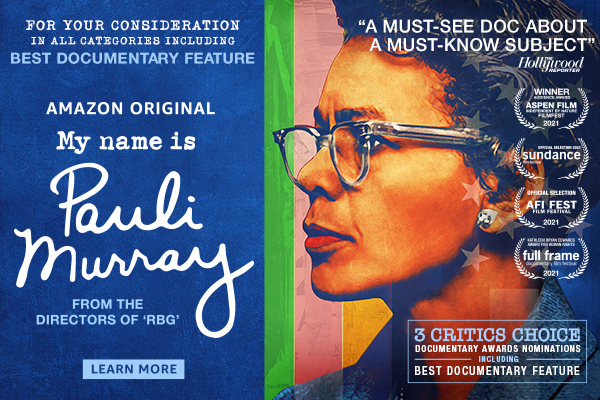
MY NAME IS PAULI MURRAY is streaming now on Amazon Prime Video.
Quote of the Week “She was my friend.” –Alec Baldwin, to a paparazzi reporter in rural Vermont, breaking his silence about Halyna Hutchins, the cinematographer he accidentally shot to death on the set of Rust.
Which leads us to…
Rust Blame Game: Let’s Follow the Money
How did Alec Baldwin end up in a shitshow movie like Rust?
You’ve probably asked, or been asked, a variation on that question, as horrible details emerge from New Mexico after the accidental killing of cinematographer Hayna Hutchins. But to indie film veterans, it’s pretty obvious what happened, because an entire industry has been built and propagated to squeeze costs, prioritize speed, and disincentivize oversight.
Who’s to blame? How about all of it: the penny-pinching financiers; the producers who elected not to pay for a completion bond; the vanity titles for people who don’t actually do anything; the lax on-set managers; the cheap hires and poor on-set conditions. Based on the financial incentives in indie film, this movie got made because Alec Baldwin was in it, and he was in it because there’s money to be made by a lot of different industry players in an ingrained system that often runs counter to safety concerns.
How? As just one example, indie producers often have deals that include “hold backs,” a common structure that means full fees are released only if there are no budget overruns. If that happened here (I don’t know, and the producers haven’t said), think about the incentives. Why spend extra to rectify a safety issue if it’s potentially coming out of your own pocket?
Also consider the position of the talent agencies. CAA, Baldwin’s agency at the time he booked the film, is incentivized to place aging “name” actors in dubious indies that pay decent fees for not a lot of work, and then sell those movies to thirsty distributors. On-set safety and working conditions for everyone except their clients are typically issues for producers to deal with, not agents.
Obviously CAA is not at fault here; this could have happened to any agency’s client, and that’s the point: it’s the system. Before he left for ICM in May, Baldwin had empowered CAA to make him money, and procuring downmarket films like Rust can lead to creative freedom and paydays not being offered by major studios, or even the more mainstream indies. The actor gets his “quote” (or a smaller fee plus big backend) and a cushy schedule; the financiers get a meaningful element to sell to a distributor who, at the very least, will have a famous face to put on a poster or a streaming service tile; and the agency can commission the actor’s fee and act as sales agent for the film, or invest in it through its finance arm.
Take a look at the titles on parade for this year’s American Film Market, kicking off virtually tomorrow. Many of them carry a business narrative similar to Rust’s. Some semi-marketable star surrounded by inexperienced cast and crew, all hoping for distributor sales to justify the tiny production budget. Streamers are the new direct-to-video, and their seemingly insatiable demand for product adds additional pressure to get these movies finished, and fast.
It hasn’t been revealed how much of Rust’s $6 million or $7 million budget went to Baldwin himself as an actor and a producer, with a “story by” credit on the script. But I’m betting it was a lot, and the shoot was scheduled only for 21 days, fast and cheap. Baldwin himself recently hinted that he’s reached the point in his career where he picks roles based on a paycheck-for-time-on-set calculus. “Whatever work I can find that allows me to stay home, that’s what I’m likely going to do,” he told THR in June while promoting Supercell, a similarly tiny indie whose international rights were being sold by Highland Film Group, the same outfit that handled foreign on Rust. Quick work, quick cash: speed, speed, speed.
That’s just how the system works. So, like the Harvey Weinstein situation, the financial incentives all aligned to keep the system churning along, until what’s increasingly looking like a totally foreseeable accident blows everything up.
ADVERTISEMENT 
My Reading List
The Feedback
The emails keep trickling in on last Sunday’s missive about Netflix’s Chappelle response and so-called “cancel culture.” There seems to be a generational divide on this issue, so I’ll present two takes, from younger and older, here:
“Your Netflix commentary is pretty gross! ‘Cancel culture’ is a term used by right wingers as a scare tactic to make people afraid and seek the comforting embrace of conservative ideals. A better term to describe what's going on is ‘Consequence culture.’ Dave Chappelle and Ted Sarandos' words have consequences, and they have to come to terms with those consequences, not ignore them and pretend that they don't exist. Netflix didn't take a stand against cancel culture; instead, they communicated, as they have always communicated, that they don't care if content on their service perpetuates harm, and they'll fire anyone who tries to point out the harm they're causing. Just like every other big tech company, Netflix is morally bankrupt and utterly craven and self-serving.” –an assistant
“What’s interesting about this is that comedy, long defended as the ability to say anything as long as it offends everyone equally, is no longer off limits—and it’s changed the face of comedy writing, not for the better. If you watch any of the classic, very funny old movies or series you remember fondly—anything by Mel Brooks, for example—they don’t get made today. A multi-Emmy nominated writer friend said in the writers rooms now, young women come in—largely inexperienced—and begin to lecture the veteran writers. She couldn’t take it anymore, and one day she just said, ‘Shut the fuck up.’” –An executive
On that note, have a great week, Matt
Got a question, comment, complaint, or a way to get the Paw Patrol theme song out of my head? Email me at Matt@puck.news or call/text me at 310-804-3198.
FOUR STORIES WE'RE TALKING ABOUT 
With the Chappelle uproar, Netflix has become an unwitting signpost in the culture wars. Some believe it may presage a turning point. MATT BELLONI 
Members of the intelligence community are increasingly convinced that the Russian government is behind the "Havana Syndrome." JULIA IOFFE 
In the middle of perhaps the most consequential scandal of his career, Mark Zuckerberg unveils his new vision for the metaverse. DYLAN BYERS 
The formative years of David Zaslav's career explain as much about the history of cable as they portend about the future of streaming. WILLIAM D. COHAN 
You received this message because you signed up to receive emails from Puck.
Was this email forwarded to you?
Sent to {{customer.email}}
Puck is published by Heat Media LLC.
For support, just reply to this e-mail. For brand partnerships, email ads@puck.news |


SHARE