Hello and welcome to What I'm Hearing...
For those new here, I’m Matt Belloni, a former entertainment lawyer and editor of The Hollywood Reporter. This email is part of Puck, our new media company focusing on Hollywood, Silicon Valley, Washington, and Wall Street.
If this was forwarded to you, sign up for a membership here. (Yes, we have group subscriptions, just email fritz@puck.news for details.) Thanks again for your support.
Now it’s time, after 19 long months, to finally discuss…
Sponsored by Amazon Prime Video 

Could ‘No Time to Die’ actually turn a profit? After sitting on a shelf for 18 months, experts outline the brutal math required to take MGM’s uber-expensive tentpole back into the black. I had lunch with a producer this week who casually spoiled the ending of No Time to Die. That’s a dick move under normal circumstances—we all know those people who spoil things simply as a flex to show they saw it early—but this one felt extra-dickish because obviously I’m planning to see this movie. Tomorrow afternoon, in fact.
I feel like we all are. My evidence is mostly anecdotal, but it’s backed up by NRG data showing two-thirds of people 45 and over are now comfortable going to theaters, up 14 points from August. Bond 25 may be the film that finally brings casual fans, Covid apprehensives, and Hollywood insiders back to the multiplex after a year and a half of streaming (and those precious screener links). Sure, there have been pandemic-era hits, and Venom: Let There Be Carnage’s $90 million domestic debut certainly indicated that young adults will show up, even for a schlocky sequel. But nobody in Hollywood actually cares about Venom: Let There Be Carnage. It’s not even name-brand Marvel; it’s Sony Marvel. I doubt Tom Rothman, the studio chief who greenlit the movie and whose bonus depends on its success, actually cares about Venom: Let There Be Carnage.
But No Time to Die is different. It’s Bond, for one, the most enduring of film franchises. Its audience skews older, whiter and more male, meaning squarely in the wheelhouse of Hollywood people. It’s the final turn for Daniel Craig, whose out-of-nowhere casting in 2006’s Casino Royale led to one of the industry’s great reboot success stories. Film insiders root for producers Barbara Broccoli and Michael G. Wilson, who have managed to maintain creative control of the Bond franchise despite decades of distributor shakeups, including MGM’s pending $8.5 purchase by Amazon. And, probably most importantly, the initial postponement of No Time to Die, from April 2020, served as the shit’s-getting-real moment when most of us first realized that the pandemic would upend the entire entertainment industry.
Now it’s finally coming out, and even the most jealous and cynical of Hollywood assholes want this movie to succeed. (Just ignore the image of Kevin Ulrich, the MGM board chair and hedge fund party bro, sitting in the Royal box next to William and Kate at the premiere last week.) A huge domestic opening in 4,400 theaters this weekend, following the strong $121 million debut in key markets like the U.K., would serve as a symbolic sign of rebirth, and a rebuke—at least temporarily—of the Barry Dillers and Rich Greenfields and others who have publicly predicted the demise of movie theaters in particular and Hollywood in general.
Enough pressure? MGM and Universal, which are distributing domestically and overseas, respectively, seem to have caught a break. Covid cases are in decline in the U.S., Europe, and elsewhere. And with the exception of Australia (where Bond’s release was postponed until November), theaters are largely re-opened in major markets. There was a time last year when MGM was aggressively trying to sell No Time to Die to a streaming service. (The numbers ended up not making sense, and it’s unclear whether the Broccolis would have signed off.) But now everything indeed seems teed up, or as teed up as possible, for theatrical success in this new normal.
But does that mean No Time to Die will end up profitable? Probably not, actually. At least not during its theatrical window. I spent some time this week talking to film finance and exhibition experts about the challenges these days of pushing super-expensive tentpoles into the black. It wasn’t easy before, but now? Even in a best-case scenario, No Time to Die likely won’t get there. Let’s do some quick math.
ADVERTISEMENT
Amazon Studios presents VAL. For over 40 years, Val Kilmer documented his own life and craft through thousands of hours of footage, from 16mm home movies to time spent in iconic roles for blockbuster movies. This documentary reveals a personal and sometimes-hilarious look at what it means to be an artist and a complex man. The Wall Street Journal calls Val a "a one-of-a-kind portrait of a one-of-a-kind artist who has remained devoted to his art." 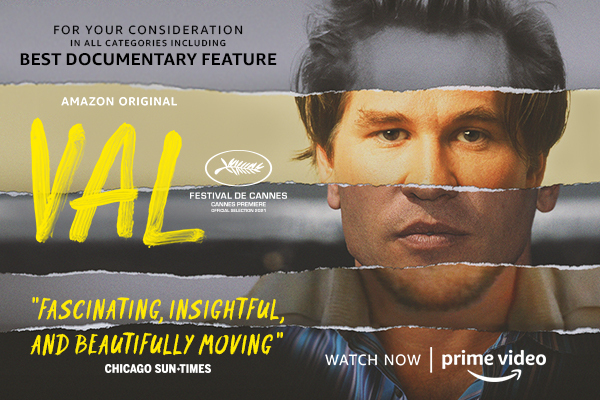
VAL is streaming now on Amazon Prime Video.
MGM is admitting a $250 million production cost on the film, though my sources say it’s closer to $280 million. Let’s split the difference and agree on $265 million, which would likely make it the most expensive Bond movie ever. (The five Craig pictures got increasingly more expensive, say sources, because his fee kept rising, 2012’s Skyfall showed that a Bond film could gross $1 billion, and the Broccolis upped the production values and cast name-brand villains like Javier Bardem, Christoph Waltz, and now Rami Malek, hot off his Oscar.)
MGM, which pays for global prints and advertising, is also admitting the P&A spend on No Time to Die is above the $153 million for Skyfall. (That number was revealed in the Sony hack.) So let’s generously say $160 million to market and release, though I suspect even ordinary inflation would take that number higher.
Then let’s add in an additional $40 million or so in what I’ll call “zombie marketing,” the money spent supporting the three aborted releases, in April and November of 2020 and in April of 2021. That figure is coming from a source close to the production, though it’s not exact, and MGM declined to confirm it and has not included these costs in its earnings reports. I use the zombie analogy because it was money spent on a “dead” release but it wasn’t totally dead; it was just waiting to come back to life. Those millions surely raised awareness of the film, which will likely pay dividends now, though it’s unclear how much it all helped. Theatrical campaigns don’t typically start and stop over a two-year period. This is all unprecedented territory.
What stayed consistent is the marketing blitz for No Time. MGM says all 17 partners that originally signed on—from Omega watches to Smirnoff vodka—have continued their deals to plug the film in lavish campaigns worth a total of $150 million. Heineken even used the down time to re-shoot an updated TV spot with Craig called “Worth the Wait” (though I happen to believe it’s a shocking betrayal of the character for Mr. Martini to drink such a watered-down beverage). Universal, a first-time Bond distributor—remember, Megan Ellison’s Annapurna was originally on board but ran into money problems, requiring a bailout from dad Larry—is also bringing some of Comcast’s “symphony” promotion on its various platforms to the effort overseas. In short, this movie is getting an A-level, global marketing push befitting a pre-pandemic Bond release.
But will it deliver A-level box office? It needs to. Adding up those expenses gets to nearly $500 million in sunk-in costs to release the film. And that’s not including the expense associated with it sitting on a shelf for a year and a half. If the cost of money is generally 4 percent or 5 percent, that’s more cash not used on other things.
But we’ll forget that and focus on what this thing needs to gross. These days, revenue splits with theaters aren’t exactly 50-50, as many still assume, especially overseas, where Bond movies generate more than 70 percent of their revenue. Splits in China can be especially dicey, and the last Bond, 2015’s Spectre, grossed $83 million there, making it the third largest market behind only the U.S. and U.K. Even without knowing the exact splits, the experts I asked think No Time to Die needs to get to about $800 million to break even.
Possible? Sure. The biggest pandemic-era movie is F9, which topped $700 million this summer, and that was when Covid anxiety was higher than it is now. F9, however, skews younger, and the previous Fast/Furious movie grossed $1.2 billion worldwide, so this one dropped a lot. To compare, here’s what Craig’s previous Bond pictures have grossed:
Casino Royale: $616.5 million (73 percent foreign) Quantum of Solace: $589.6 million (71 percent foreign) Skyfall: $1.1 billion (72 percent foreign) Spectre: $880.6 million (77 percent foreign)
So even if No Time to Die drops much less from its previous installment than F9 did, there’s little chance it would get to $800 million. Right now, it’s tracking behind Spectre, but prognosticators aren’t sure how much of that owes to uncertainty over last-minute ticket buyers. Venom 2 was tracking in the $60 million range and then popped big-time the day of release. Some optimists think No Time will do the same, and could even climb to $100 million this weekend, though its 163 minute running time is a hurdle.
If everything comes together and people show up, and it holds okay against tough competition in Halloween Kills and Dune, and China delivers as expected when it opens there on the 29th (another dicey proposition), then maybe No Time to Die can come close to matching Spectre. That’s a big maybe, and if Vegas allowed bets on this sort of thing, I would probably take the under on $800 million all-in. And I’m an optimist. Jeff Bock, the analyst at Exhibitor Relations, is less so. “This may be Bond’s toughest box office mission ever,” he told me this week.
And even $800 million might not cut it, at least from a profitability standpoint. Which is fine, I guess. MGM, Universal and the Broccolis know they are trying to salvage a bad situation, so even parachuting into the breakeven ballpark would be considered a win.
In fact, I’m less interested in whether No Time to Die turns a profit—after all, what is money to MGM’s likely new owner Amazon?—and more concerned with how its performance will impact future movies. There’s a good chance that Covid will linger as a concern for years to come, and streaming is already altering the value proposition of movies. If we are indeed entering a new normal of less big-budget moviegoing, the budgets on these A-level tentpoles will likely need to come down. Already, I’ve heard rumblings that the next Bond movie will almost certainly be cheaper, in part because it will introduce a new star but also because spending nearly $300 million on a movie doesn’t make much sense if you can’t guarantee something close to a billion-dollar theatrical gross. Even if it’s Amazon’s money.
If anything, that may be the legacy of No Time to Die. We waited a long time for this, so despite that dickish producer’s spoiler, tomorrow let’s enjoy what a quarter-of-a-billion-dollar spy movie looks like, because we may never see another one.
ADVERTISEMENT 
Hulu Unrest and the “Leveling” of Disney
The defection this week of Hulu leader Kelly Campbell to become president of NBC Universal’s Peacock streaming service has really brought out the disgruntled Hulu employees. Probably because I first broke the news on Twitter, staffers past and present quickly filled my DMs.
Since Disney took operational control in 2019, Hulu has become “toxic,” one mid-level executive said. “Total dysfunction,” messaged another, citing the layered management and the split of creative from distribution under Disney C.E.O. Bob Chapek’s re-org. A “brain drain” of executive talent and staff has ensued, noted two separate people. A lot of unhappiness and questions about the direction of the unit, it seems.
I wrote a month ago about some of the macro issues plaguing Hulu: It’s not global; it enjoys big demand for licensed content from its legacy media partners but still generates low demand for originals; there’s little long-term strategy because it’s mired in a dispute with partner Comcast over the value of the service and Disney’s decision to instead pursue Disney+ and Star growth overseas. I also wrote about some of the recent momentum at Hulu, including increased subscriber numbers and more commercial hits like Nine Perfect Strangers and Only Murders in the Building, with tons of premium adult-skewing content on the way from Disney suppliers. So I won’t elaborate on those plusses and minuses here.
But another, and possibly underrated, aspect of the unrest at Hulu is the recent “leveling” of employees that Disney has undertaken since the absorption of most of Fox in 2019. The titles, compensation, benefits, and duties of many Fox people didn’t match Disney, which is often true when companies acquire large businesses. Management consultants and H.R. experts then dive in and figure out the best way to “level” everyone into a cohesive organizational structure. Pretty standard.
However, that process recently concluded, and at Hulu, which functioned like a tech start-up, the changes were particularly pronounced. Employees who were used to stock options and annual bonuses were suddenly leveled into the structure of a century-old media company that doesn’t offer those perks as liberally. Specifically, I’m told, Disney agreed to pay a bonus to many employees for 2019, but ended that practice for 2020. And many—especially younger employees—suffered the equivalent of salary cuts. Health benefits also worsened for some. (A Hulu rep notes that some employees saw their compensation and benefits increase; the division rep declined to comment further.)
Longtime “Hulugans,” as they call themselves, have also complained about a distinct shift in company culture since creative and distribution were split. “Hulu people feel attacked by Disney leadership, and that Hulu and the culture that made it unique is dead,” one recently departed executive messaged me. Campbell, a Google alum who had spent four years at Hulu and about a year and a half in its president role, is said to have fielded the brunt of those company concerns. Insiders weren’t shocked she bailed.
The Disney leveling hasn’t just impacted Hulu, of course. A Disney lawyer I know, who had come over from Fox, told me a couple weeks ago that his compensation package had been trimmed in the leveling. (A Disney rep declined to comment on that when I asked.) I’m sure others will reach out after reading this, though again, this kind of streamlining isn’t unusual.
What should be concerning for Disney, though, is if the “brain drain” at Hulu has become a longer-term problem. That happens at acquired companies sometimes, with potentially significant ramifications. It didn’t seem to be a problem at Pixar or Marvel or even BAMTech, another tech company Disney acquired. Maybe retention bonuses are in order at Hulu?
See you Sunday, Matt
Got a question, comment, complaint, or a good topic we should discuss on the new Puck podcast The Powers That Be? Email me at Matt@puck.news or call/text me at 310-804-3198.
FOUR STORIES WE'RE TALKING ABOUT 
It’s an open question whether Peacock, or any streamer but Netflix, can make make an off-network show a hit—but NBC can certainly try harder. MATTHEW BELLONI 
For some, the 2016 election was the wake up call. For others it was the Jan. 6 attack on the U.S. Capitol. For most, it still hasn’t come. BARATUNDE THURSTON 
Will an internal upheaval become the trigger that leads Zuckerberg to change his company’s culture? Are you living on Mars? ALEX KANTROWITZ 
The China Conundrum Serious China watchers fear that businesses have underestimated the gravity of Xi’s “regulatory crackdown”—but privately worry that Washington isn’t responding with nearly enough nuance. WILLIAM D. COHAN 
You received this message because you signed up to receive emails from Puck.
Was this email forwarded to you?
Sent to {{customer.email}}
Puck is published by Heat Media LLC.
For support, just reply to this e-mail. For brand partnerships, email ads@puck.news |


SHARE