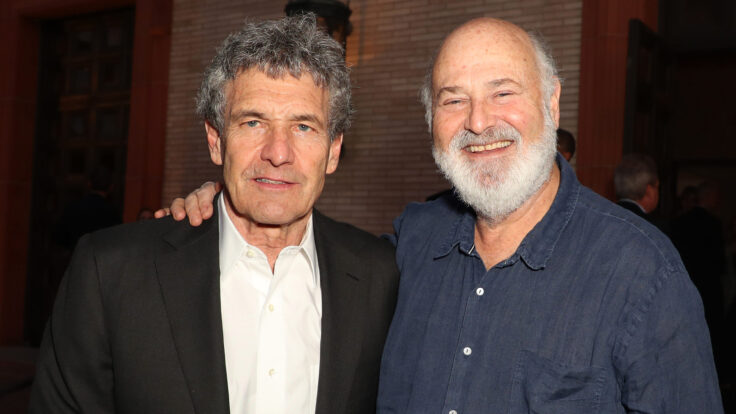
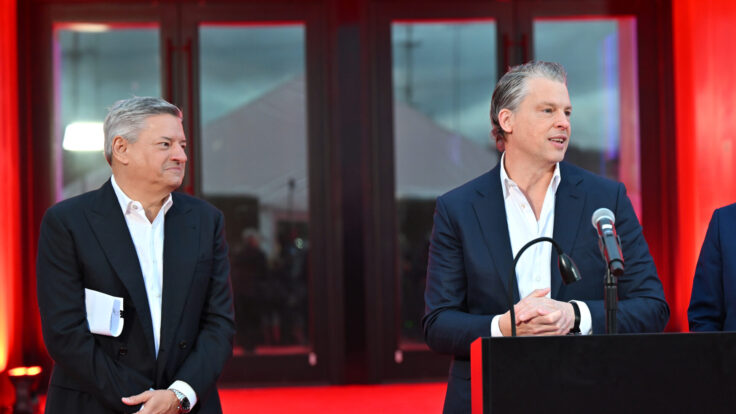
Welcome back to What I’m Hearing, flying home to L.A. after a great week at CinemaCon. Thoughts
and prayers to Disney talent and executives forced to fly commercial tonight because Donald Trump and his entourage are in Vegas and hogging the private jet runways. Godspeed.
Tonight, my inside reporting from CinemaCon, including a break in the “united” part of the theater industry’s Cinema United coalition as my friend Adam Aron goes rogue to [checks notes] endorse the studio-consolidating WarnerMount merger. Plus, highlights from my
Jon Favreau chat!
💫💫 P.S.A.: I’m excited to announce that super-showrunner David E. Kelley will be our Keynote Q&A at Puck’s Stories of the Season Emmys event on May 5 in L.A. Kelley is an actual TV legend, and he’s got a new show in Apple TV’s Margo’s Got Money Troubles, which marks his first collaboration with wife Michelle Pfeiffer, so it should be a great chat. Academy and guild members can attend by emailing
Fritz@puck.news.
Mentioned in this issue: Adam Aron, David Ellison, Michael O’Leary, Phil Tippett, Taylor Swift, Billie Eilish, Jon Favreau, George Lucas, Lynwen Brennan, Roy Choi, Sean Gamble, Tom
Rothman, Jim Cameron, Eduardo Acuna, Dave Filoni, Cory Booker, Kathleen Kennedy, and… Hot Tamales and blue raspberry Icees.
Not a Puck member yet? Just click here. Got a news tip or an idea for me? Just reply to this email, text me, or message me on Signal at 310-804-3198.
Let’s begin… |
- So,
who believes David Ellison NOW?: This is becoming comical. At CinemaCon today, the wannabe Warner Bros. Discovery owner stood onstage and gave theater proprietors his “word” that the combined WarnerMount studio would release 30 movies a year as 45-day theatrical exclusives, with at least 90 days before dropping on subscription streaming. His word, people. His word! Which, on one hand, is a very rich-guy thing to do. Ellison has pledged these same windows for months. But
now we should really believe him because when someone whose father is worth hundreds of billions of dollars looks you in the eye and gives you his word, how dare anyone be skeptical of the motives or long-term intentions that his word might entail (or, more likely, not entail)? But on the other hand, short of proposing government-enforced conditions of the merger or signing individual contracts with theater chains, what else can Ellison do? Either people believe him or
they don’t. He’ll either be forced to make concessions to get this deal approved—or, more likely, he won’t.
- And the inevitable theater blowup…: The whole thing has now ignited a big feud among exhibition leaders, even as they all played nice onstage at events during their big convention. Cinema United, the theater trade group, has spent most of this week vowing to fight Ellison’s $110 billion consolidation, with chief lobbyist Michael O’Leary
declaring onstage on Tuesday, “We believe this transaction will be harmful to exhibition, consumers, and the entire entertainment ecosystem.” Then today, my friend Adam Aron of AMC Theatres, the largest member of Cinema United, said the exact opposite—that he has a “favorable view” of the WarnerMount deal and would support it. Yeah… It’d be an understatement to say that those comments—which Aron somehow failed to mention to his trade group in advance
and instead teed up in the trades and tweeted—made his fellow theater owners choke on their Hot Tamales and blue raspberry Icees.
I’m told Cinema United convened an impromptu emergency meeting today to address the lack of, uh, unity. And backstage during the meet-and-greet before my talk with filmmaker Jon Favreau, I witnessed the fallout firsthand. O’Leary was polite but looked super pissed, and the tension among the leading exhibition C.E.O.s was palpable.
Regal’s Eduardo Acuna and Cinemark’s Sean Gamble appeared beyond annoyed about the mixed messaging at a crucial moment, as politicians like Cory Booker are trying to throw a wrench in the WarnerMount deal. Another theater owner I won’t name outright told me Aron is a “clown” and “a problem.” Still another suggested Aron, seeing the WarnerMount deal is likely getting approved, may have cut a side deal with Paramount for better treatment in exchange for a public endorsement, or at least caved to what
could soon become the industry’s biggest theatrical studio for preferred status in film-rental negotiations. (Both Paramount and AMC emphatically denied any secret deal.)
After all, while Aron has generally fallen in line with other theater chains, he went his own way on Taylor Swift, scoring the Eras Tour film directly from TSwift’s family before notifying his fellow exhibitors. Aron agreed to play Greta Gerwig’s upcoming Narnia film
from Netflix in AMC’s Imax theaters despite a brief 30-day window, infuriating Regal, which still has not said whether it will play the film. Despite years of railing against Netflix, Aron has lately been playing nice, hoping to get more releases like the recent KPop Demon Hunters and Stranger Things stunts. (Though I talked to several theater executives who attended Sunday’s big meeting with Netflix’s Ted Sarandos and called it a “waste of time” and left
believing Sarandos has no interest in meaningful theatrical releases now that he’s not buying Warner Bros. Shocker.)
When I pressed Adam on why he defied his fellow exhibitors and backed Ellison, he told me that after five months of talks with Paramount, which came to a head yesterday, he was won over when he found out what Ellison was actually going to say onstage today: Rather than simply talking ad nauseam about extending theatrical windows, Paramount is actually doing it
now. “Two weeks ago, they took Scream 7 to [premium video-on-demand] after 31 days,” he told me. “Fourteen of the past 16 Paramount movies went to P.V.O.D. in 30 days. Now that’s over.”
I confirmed that’s true. The Billie Eilish concert film and Scary Movie, Paramount’s next releases, will indeed adhere to the new 45/90 rule. With Disney long ago committing to 45/90, and Universal recently extending its P.V.O.D. window similarly
starting in 2027, bringing Warner Bros. under the Paramount policy would leave Sony Pictures as the last traditional studio holdout doing early P.V.O.D. drops, though Sony film chair Tom Rothman has said its new Netflix output deal requires a 120-day window for most first-run releases. The tide, in Aron’s view, is turning, and supporting Ellison will help bring back industry-wide windows. At least in the short term.
We can argue over whether those windows are
sufficient to protect the theatrical business that the studios now claim they believe in. (I actually think a minimum 120-day window to subscription services is necessary to reverse the decline in perceived value of Hollywood movies among people who have been trained by Netflix to expect a quick pipeline of titles to the home.) But at the same time, while Aron has a point, it’s usually bad business to just accept someone’s “word,” especially someone with an obvious incentive to say whatever it
takes to win support for a $110 billion merger. I doubt Ellison would do so in meetings with his vendors, producers, or even talent. If so, maybe Paramount should disband its business affairs department.
Cinema United seems to recognize the risk of being wrong about Ellison, as do the thousands of signatories on the anti-merger petition, even though, as Jerry Bruckheimer said on a CinemaCon panel I moderated on Tuesday, “That train has left the station.” Cinema United has
vowed to continue the fight against the merger, with O’Leary telling me today, “We remain open to tangible commitments that will ensure a vibrant global theatrical exhibition industry for years to come.” Tangible is the key word there, meaning: not David Ellison’s word.
|
|
|
|
A MESSAGE FROM OUR SPONSOR |
AI could help studios and producers move faster – but operational gains may be the least interesting implication. McKinsey’s latest research suggests the more important lesson comes from prior technology disruptions in Hollywood: new production tools can do more than lift productivity. They can change what gets made, shift who captures value, and alter the industry’s economics. The analysis suggests AI could affect roughly 20 percent of original content spend over the next five years, at a moment when media companies are
already facing slower growth, fragmented attention, and shifting viewing behavior. The question industry leaders should be asking isn’t whether AI will increase productivity in film and TV – it already is. The bigger question is what happens if AI starts to reshape the entertainment industry itself – and are you prepared? Learn More |
|
|
|
- Paramount’s
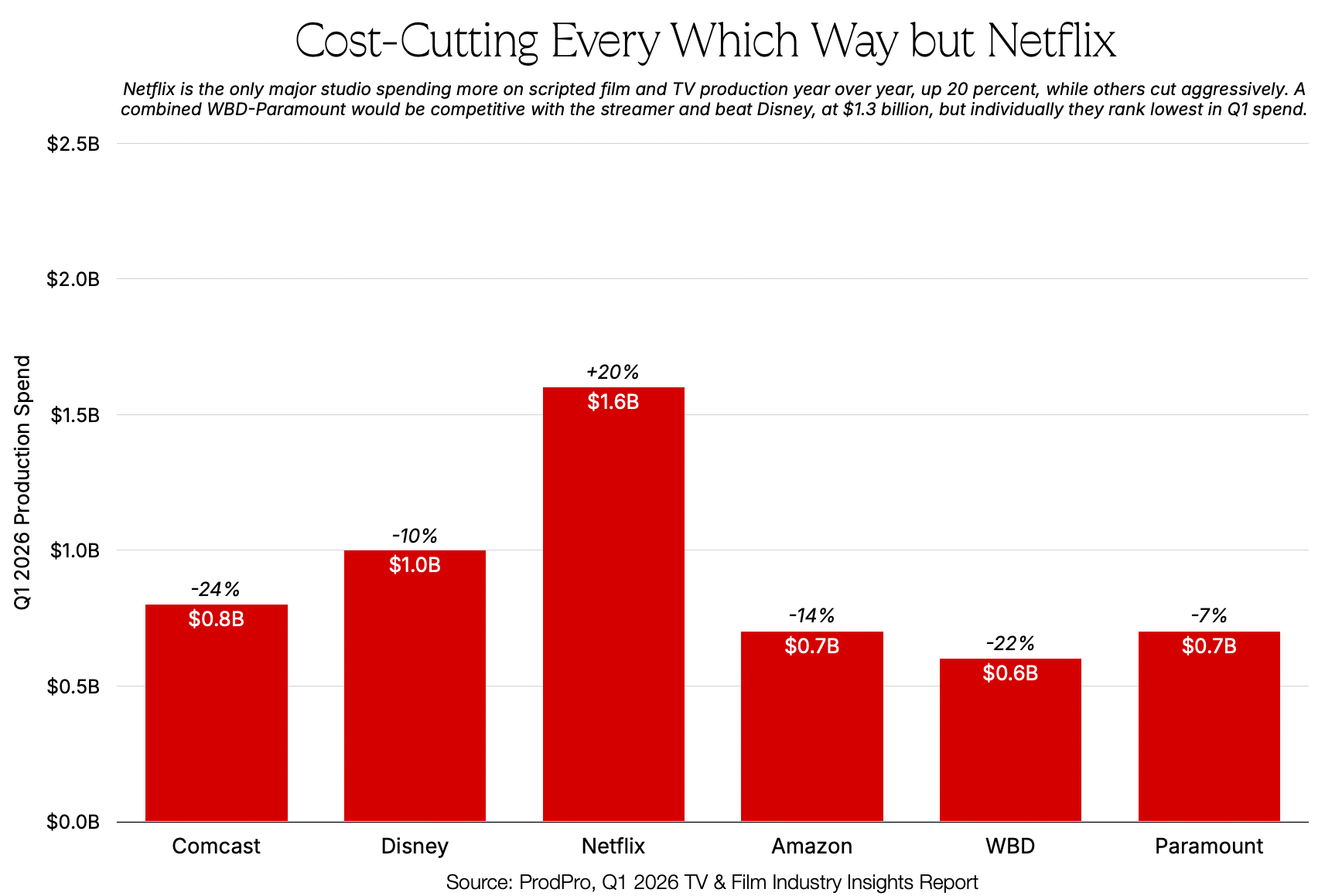
production spend isn’t growing: Speaking of Ellison, he’s been talking a lot about boosting his content budgets, but the reality is that his company’s production spend last quarter dropped by 7 percent compared to the same period last year, per ProdPro. Only Netflix increased its spend…
|
- Box
office over/under: Warner Bros.’s Lee Cronin’s The Mummy, a fun example of I.P. rights dictating a title, is still at about $12 million for the weekend, per NRG. But it has grown on other tracking services, so I’ll take the over.
|
Now for highlights from my Favreau chat… |
|
|
|
The Mandalorian creator, director, and food truck impresario talks about bringing
his Star Wars streaming hit to the big screen, his complicated relationship with A.I., his thoughts on Lucasfilm, and how he’s leaning into the whole “space opera thing.” |
|
|
|
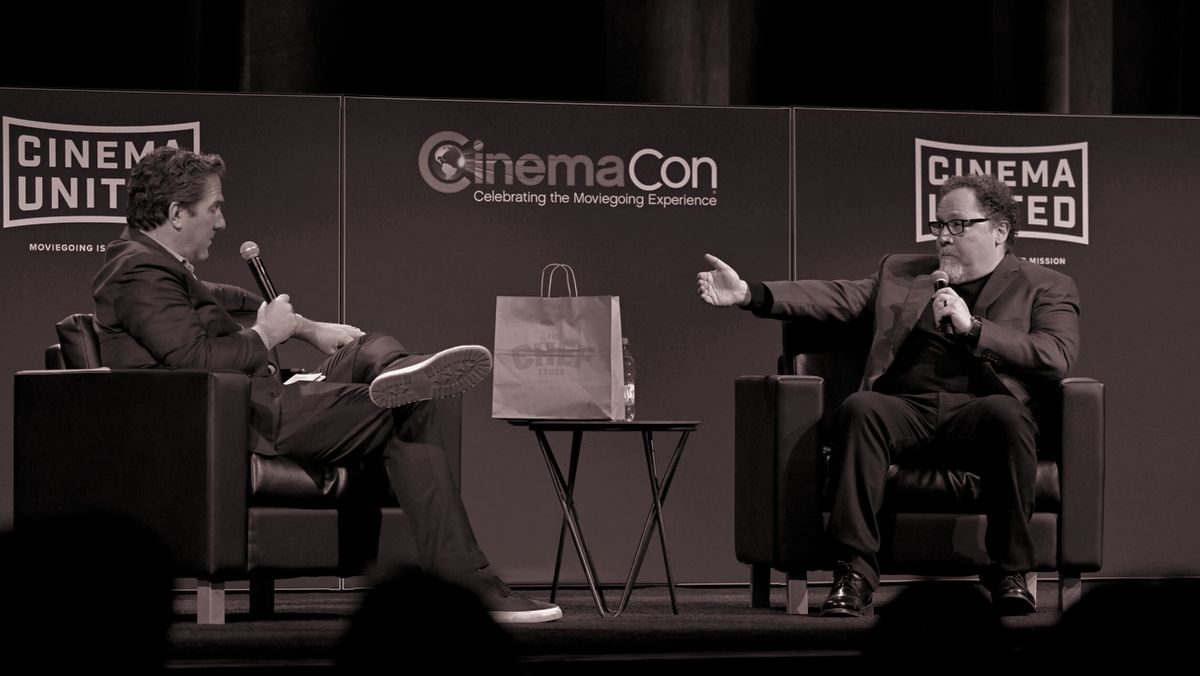
Walking onstage at CinemaCon today for its annual filmmaker Q&A in front of about 2,000 theater industry
professionals, Jon Favreau handed me a warm Cubano sandwich from Roy Choi’s Chef Truck at the Park MGM hotel, which was inspired by his hit 2014 movie. Before I could eat it, I had to think about it for 45 minutes as I talked with the veteran filmmaker, actor, technologist, and onetime movie theater usher. Luckily, Favreau is a great talker and treated the crowd to a mini-dissertation on the encroaching A.I. revolution, filming with the giant “Volume” of LED
screens that he pioneered, the exit of Kathleen Kennedy and new leadership at Lucasfilm, and, of course, bringing The Mandalorian from Disney+ to theaters on May 22 with The Mandalorian and Grogu. Some highlights from the conversation are below and you can watch or listen to the whole thing here… |
“Whatever Tells the Story the Best”
|
Matt Belloni: There’s a lot of confusion out there about your filmmaking
process. There are people that say, “Well, he doesn’t shoot on location. He doesn’t do practical anymore.” But that’s not really true. Take us through the process on this film.
Jon Favreau: You have to separate what we did for the streaming show and for [Mandalorian and Grogu]. We had months to do each season. This one, we had years.
But this is the first attempt to transition a streaming series to a theatrical movie. A lot of
pressure.
We knew it was gonna be a theatrical release. We knew we were gonna be working with Imax. We took the time to build vertical sets, to build practical sets. We did use some of the same [Volume] technology, but mostly for interactive light and for reflections, which are important when you’re on a stage so that everything’s not bluescreen. But we built jungles, we built tanks, we built pits, we built forests. And then we also shot out on location as well.
Not a lot,
and sometimes it’s a layer and you’re shooting part of that layer not in that environment and you’re compositing it together. But we use all technologies, whatever tells the story the best. We have a lot of miniature work. But we also have state-of-the-art C.G. sims that ILM is at the forefront of. So to us it’s a mixed bag. And we even have a sequence that we worked with [V.F.X. legend] Phil Tippett on: a fully stop-motion sequence in the film.
I was driving
around L.A. with my 10-year-old, and we saw the billboard. And I said, “Are you interested in that movie?” And he said, “Dad, that’s a show.” So…
We’ll be right back. (Laughter.)
So that’s the challenge here.
Yeah. So here’s the trick: You gotta deliver something that the audience enjoys, regardless of the medium. And in this case, what could we do that we couldn’t do before? We have to treat it like the first season and the first episode
of The Mandalorian, which is: Don’t assume anybody’s seen anything, but also make it clear to the people who’ve been with Star Wars for 50 years that this is something that is for them. We can’t forget that Star Wars hasn’t been in theaters for almost seven years. There are audience members who were not old enough to know Star Wars in the theater. We have to invite those fans in.
Was there a creative spark that said to you, “This is an
idea that is theatrical,” that is going to deliver what you just described?
Before the [2023] strike, we were writing a fourth season. And then like with the Dodgers, you get a tap on the shoulder in the bullpen. Do you want to pitch in the big game? We have been talking about doing something for the big screen with this for a long time. I thought it was gonna probably be some mixing of different media, like something for streaming and then having a theatrical component.
And then I finally got asked, “Would you be open to exploring these characters for the cinema?” You have to completely switch hats then.
It’s a different filmmaking style.
Completely different. Star Wars has always been about emotion, spectacle, humor, excitement, fun. If you think about it, when we first saw Star Wars, George Lucas dropped us right in the middle of a storyline, but I never felt like I was at a loss because I
understood who the good guy was, who the bad guy was, and he pulled me into that experience. I think he was influenced a lot by the cliffhangers of his youth, and we really lean into that kind of pulpy, fun, space opera thing. So I think anybody who’s a fan of sci-fi will be able to jump in. You have to think of Star Wars not just as a genre in and of itself, but as a lens for other genres. And so by going to what influenced George, that gets us to a feeling of consistency and
authenticity. |
You must get asked the A.I. question all the time. What is the most promising aspect of generative
A.I., and what is the scariest or worst possible scenario?
Movies have always been about the conversation between technology and storytelling. The real question is: is it different? Is this breakthrough in tech different enough in degree to actually be a difference in kind? In other words, is this just another innovation, or is this gonna change everything? |
|
|
|
A MESSAGE FROM OUR SPONSOR |
AI could help studios and producers move faster – but operational gains may be the least interesting implication. McKinsey’s latest research suggests the more important lesson comes from prior technology disruptions in Hollywood: new production tools can do more than lift productivity. They can change what gets made, shift who captures value, and alter the industry’s economics. The analysis suggests AI could affect roughly 20 percent of original content spend over the next five years, at a moment when media companies are
already facing slower growth, fragmented attention, and shifting viewing behavior. The question industry leaders should be asking isn’t whether AI will increase productivity in film and TV – it already is. The bigger question is what happens if AI starts to reshape the entertainment industry itself – and are you prepared? Learn More |
|
|
|
What do you think?
I’ve always been very thoughtful and slow in my adoption of new
tech. I was using stop-motion in Elf. I was using forced perspective. It wasn’t until Iron Man that I really embraced C.G.I., which was many years after Jurassic Park. And then finally by Jungle Book, I was like, “Okay, I understand this, let’s really lean into this tech.”
We’re not gonna be able to have one standard because different filmmakers draw the line at different places. But I do think that we need to have clarity about the spectrum of these
machine-learning tools. Do you treat generative A.I. the same way you treat rig removal for wire shots or segmentation when you want to separate a subject from a background? So I think that there’s a whole hierarchy of different technologies that we have to have a conversation about, and then have transparency as to what tools we’re using so that the audience understands what they’re buying—and then let them decide how we do this. And we have to figure out as an industry how not to undermine
what we’ve built over a century in this storytelling culture around cinema.
But are you cool with A.I.-generated scenes?
For what I’m doing now, I have not used that.
Have you scanned yourself for acting purposes so that A.I. will have you forever?
I have not, but Marvel has enough of them for me. And I’m younger in them, so I like those better.
How has your filmmaking process evolved with respect to technology over the
past, say, five years?
So the tech that I’m really leaning into now is more game engine. We were using Unreal Engine on the screens for the Volume. We use it for pre-vis, the things I’m collaborating with on the [Disney] parks. There used to be filmmaking, visual effects, gaming, and animation—four completely different trades, four different pipelines. Those stacks are starting to resemble one another and share innovation.
You’re the only filmmaker I know who’s
been able to keep all of his productions in LA. Reveal the secret right now for how you’ve done that.
You have to be responsible to the people who are hiring you to make sure that whatever resources they’re investing in your production are going to be a win for them. That means finding new ways to be responsible and innovative, often leveraging technologies that are developed by other people. A lot of what I’m using is stuff that Jim Cameron built. And often it’s
combining technologies or workflows that other people are using and optimizing them for either cost savings or for creative. When you go to a set, those shooting days—that’s the expensive part of the process. Iterating in the game engine and coming up with renders of pre-vis that you could evaluate editorially and get precise before you ever roll camera, that’s a trick they’ve been doing since Snow White.
You’re not shutting down streets or anything like
that.
No, and you don’t have trailers, you don’t have people. And then when you film, you use a union crew, the best people you can hire. Let’s get the most work done.
You have a long relationship with Dave Filoni, who is now running Lucasfilm with Lynwen Brennan. Is Lucasfilm going to change with new leadership?
There’s exploration going on—not just at Lucasfilm, but across the board—about how you meet the audience where they are. And what’s that
model? Is it for streaming or is it in the theaters? I think this is part of why I and a lot of filmmakers are here: because this is such an important moment.
There’s a Star Wars movie this year and next year. But we haven’t had one for seven years. Can theater owners expect Star Wars movies on a more regular cadence?
I mean, that’s not my job—
It kinda is,
though.
When I get in there, I do the best I can. I just concentrate on the things I have understanding and control over.
So there’s not a Mandalorian trilogy in the works? Presumably they would inform you if that were the case.
Right now this is about getting this to the screen. There’s tremendous benefit to tapping into something where there’s already real estate in your audiences.
Well,
but that’s a negative too. People have expectations for Star Wars, and the fans in the past have been pretty vocal about that. There were changes made between Episodes VIII and IX to address some of the fan responses, and it arguably didn’t help.
I’m very fortunate that the people at Lucasfilm are first and foremost fans of Star Wars. And so I find that if we talk something through, there usually aren’t big surprises of how the
audience is gonna feel. If you do your best job and people don’t feel it and don’t connect with it, it just doesn’t feel right. It’s just not satisfying. I think the people you’re talking about don’t know about Star Wars. We need to address that. We need to show them what’s cool about it. |
In the future, what percentage of movies do you think will utilize things like the
Volume?
It depends what the tool set of emergent technology related to machine learning is, right? Because there are tools that will be coming online that allow for quicker and less-expensive segmentation. Meaning you can film somebody and separate them from the background without having to have the Volume or a greenscreen. That is not resolved yet; it’s part of the larger conversation that needs to happen around technology, but I know that the capabilities are emerging. The
problem is everything gets dumped into the same basket, and that’s often paired with generative A.I.
When you look at the next five to 10 years of filmmaking, movies have to get cheaper, right?
All of that hinges on the conversations that all different facets of the industry have. There has to be a clearer conversation because there’s a lot of talking past one another and a lot of emotion. There’s so much great consumer-facing tech that could be utilized for
filmmaking in just the planning process. Forget about whether you show it in movie theaters on the big screen. That’s gonna help collapse costs, and it’s gonna also help you get more precise creatively.
This is what the animation industry has understood from the beginning. Get it right before you ever paint a cell. There is a scene cut out of Snow White, one scene that still is being talked about because it was on the cutting-room floor. Whereas in any live production, there’s
reshoots built in. To me, there are only a few ways to bring costs down. Visual effects could cost less, but more importantly, less shooting days. If you don’t shoot things you don’t put in the movie, that’s gonna save you a lot of money. And the planning process related to the technology of using game engine, pre-vis, all of these tools that are available to even an amateur filmmaker, will get you to understand your movie better so that when you hit the set, you’re much more focused and
precise.
How do you feel about the health of movie theaters going forward?
Well, I’m feeling good this year. |
See you Monday, Matt
Got a question, comment, complaint,
or a good skin cleanser to wash the Vegas off my face? Email me at Matt@puck.news or call/text me at 310-804-3198. |
|
|
|
Puck fashion correspondent Lauren Sherman and a rotating cast of industry insiders take you deep behind the scenes of this
multitrillion-dollar biz, from creative director switcheroos to M&A drama, D.T.C. downfalls, and magazine mishaps. Fashion People is an extension of Line Sheet, Lauren’s private email for Puck, where she tracks what’s happening beyond the press releases in fashion, beauty, and media. New episodes publish every Tuesday and Friday. |
|
|
|
Ace media reporter Dylan Byers brings readers into the C-suite as he chronicles the biggest stories in the industry: the future
of cable news in the streaming era, the transformation of legacy publishers, the tech giants remaking the market, and all the egos involved. |
|
|
|
Need help? Review our
FAQ page or contact us for assistance. For brand partnerships, email ads@puck.news.
You received this email because you signed up to receive emails from Puck, or as part of your Puck account associated with {{customer.email}}. To stop receiving this newsletter and/or manage all your email preferences, click here. |
Puck is published by Heat Media LLC. 107 Greenwich St., New York, NY 10006 |
|
|
|
|