Welcome back to What I’m Hearing, coming from the very back row of the Sony presentation at
CinemaCon in Las Vegas. I’m interviewing filmmaker Jon Favreau on Thursday and moderating the “think tank” panel with producers Jerry Bruckheimer and Emma Thomas, along with Cinema United’s Michael O’Leary, on Wednesday. Come say hello.
Sadly, I was not invited to Ari Emanuel’s 65th birthday party on Saturday at the $1,500-a-plate Noma pop-up at the Paramour Estate. But on the agency
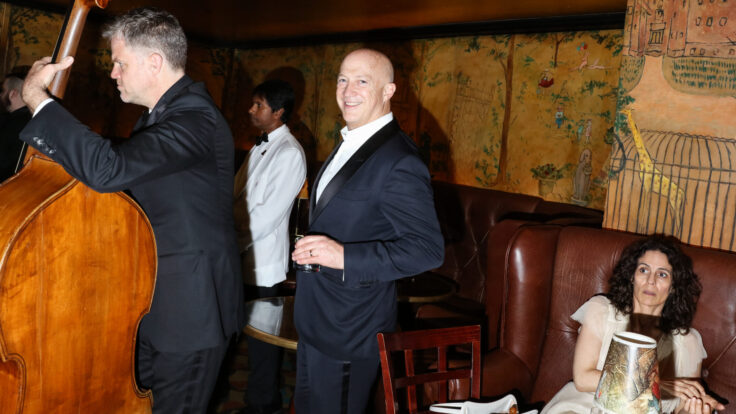
front, a number of people who attended a different party—the one CAA head Bryan Lourd threw for new Anonymous Content leader Darren Walker that I mentioned on Thursday—were quick to note an interesting guest I missed: Jeremy Barber. Yes, the UTA agent whose major client Greta Gerwig was just poached by Lourd attended a party a week later at the home of the guy who poached her. Turns out Barber is a close friend
of Walker, so it’s understandable—but man, I’m not sure I could bring myself to set foot in the lion’s den like that. Could you?
Anyway, tonight, Kim Masters is back with a look at how embattled producer Joel Silver (and others) keeps getting chances in Hollywood. Plus, an update on the artist formerly known as Kanye West.
Programming note: This week on The Town, Lucas Shaw and I
debated what Bill Ackman wants with Universal Music, Lorne director Morgan Neville addressed the SNL succession question, and lobbyist Michael O’Leary
unveiled a filmmaker council to support movie theaters. Subscribe here and
here.
Not a Puck member yet? Just click here. Got a news tip or an idea for me? Just reply to this email, text me, or message me on Signal at 310-804-3198.
Mentioned in this issue: Joel Silver, Anna Wintour,
Kanye West, Kendrick Lamar, Courtenay Valenti, Lauren Sánchez Bezos, Issa Rae, Tom Rothman, Ari Emanuel, Mark Wahlberg, David Zaslav, Ben Carlson, Robert Downey Jr., Eli Roth, Gus Van Sant, Shane Black, Mo Rhim, Bryan
Freedman, Don Pendleton, Peter Kang, Lily James, Ryan Kavanaugh, Pete Davidson, Beyoncé, Doug Liman, Patrick Wachsberger, Roeg Sutherland, Bob Iger, Sarah Schweitzman, Chris Woodrow, Raj Singh, Sue Kroll, Don Murphy, Megan
Colligan, Brendan Carr, Jennifer Lawrence, and… a boomer ego battle.
But first… |
Who Won the Week:
Chris Meledandri and Shigeru Miyamoto
|
Gotta be the lead Super Mario Galaxy producers for Illumination and Nintendo. Universal was sweating
the hold, but with $68 million domestic over its second weekend and $629 million globally, the sequel will almost certainly become the year’s first billion-dollar grosser and the biggest since Avatar 3. (Though after 12 days, Mario 2 is at $308 million domestic, well behind the $353 million of the first Mario, so it won’t get to that film’s $1.4 billion.)
Now to our music correspondent Dave Brooks… |
|
|
|
Ye’s Road Back Runs Through the ADL
|
The artist formerly known as Kanye West faces a choice only he could have
engineered: Grovel back to relevance, or bet millions on a stadium tour that probably won’t pencil out in the end. Promoters at Live Nation were impressed by West’s comeback shows earlier this month at SoFi Stadium in Los Angeles and are willing to reverse a company policy against working with the embattled rapper—but only, I’m told, if Ye takes meaningful steps to clean up his image. Specifically, executives want West to engage with a civil rights organization like the Anti-Defamation League
and issue a formal apology for years of antisemitic behavior, including a 2021 tweet threatening to go “death con 3 On JEWISH PEOPLE” and a song titled “Heil Hitler” released last May.
The ask is significant on both sides. For Ye, it requires a sustained, credible gesture of contrition. For the ADL, any involvement carries real reputational risk, but the upside is that a legit apology could reverberate across the culture. (The ADL declined to comment.) The stakes are high: Ye’s two SoFi
shows grossed $33 million in ticket sales, outperforming recent stadium runs by Beyoncé, Kendrick Lamar, and The Weeknd—a result that has Live Nation executives eager to book a full North American stadium tour. But they want to see considerably more from Ye before signing off on a global deal.
West’s recent track record in Europe illustrates why. His announcement as a triple headliner at London’s Wireless Festival triggered an immediate
sponsor exodus—Pepsi, Diageo, and PayPal all pulled out—before U.K. Prime Minister Keir Starmer denied him a visa to enter the country, forcing the cancellation of the July event. Festival Republic, the Live Nation unit that books Wireless, is now pursuing Ye for the return of his reported $11 million headliner fee. Remember, the company’s touring division cut ties with Ye in 2016 after he abruptly canceled the Saint Pablo Tour. He also owes AEG millions for canceling his 2022
Coachella appearance and failing to repay his advance.
Ye could theoretically tour his new Bully album without a major promoter, but the math is brutal. Most large venues are already locked up this summer for the World Cup, and operating without Live Nation or AEG means paying full freight to move, build, and strike his massive, sphere-shaped stage—a production that costs millions per city. Without a partner to absorb those costs and negotiate access, a profitable stadium run
becomes nearly impossible. His window is now. The SoFi shows proved the audience is still there. Whether West is willing to do what it takes to get back on those stages—or whether he even can—is the only question that remains. —Dave Brooks |
|
|
|
A MESSAGE FROM OUR SPONSOR |
AI could help studios and producers move faster – but operational gains may be the least interesting implication. McKinsey’s latest research suggests the more important lesson comes from prior technology disruptions in Hollywood: new production tools can do more than lift productivity. They can change what gets made, shift who captures value, and alter the industry’s economics. The analysis suggests AI could affect roughly 20 percent of original content spend over the next five years, at a moment when media companies are
already facing slower growth, fragmented attention, and shifting viewing behavior. The question industry leaders should be asking isn’t whether AI will increase productivity in film and TV – it already is. The bigger question is what happens if AI starts to reshape the entertainment industry itself – and are you prepared? Learn More |
|
|
|
“You tell them, ‘It’s not a show about a Black woman, it’s a show about class.’”
—Issa
Rae, talking about how to pitch projects amid the pullback in representation. “As icky as that might feel,” she added, “it gets the show sold.” |
4.4 percent
Share of eligible streaming shows that should have received performance
bonuses under the 2023 labor deals (most of them on Netflix). [Digital I/Bloomberg]
84 percent
Share of U.S. moviegoers who saw a film in Imax or another premium format in 2025, up from 71 percent in 2023.
[Fandango]
$160
Price for a full set (14) of the McDonald’s KPop Demon Hunters Huntrix Meal Photocards, included with meal purchase. The collaboration was estimated to have generated more than $100 million in sales in its first few days.
[eBay/MPN]
No. 7
Melania’s rank on the Nielsen top 10 streaming movies list in its first week on Prime Video, with 230 million viewing minutes, well behind Zootopia 2 (1.7 billion) and even the first Zootopia (381
million). [Nielsen]
Now here’s Kim on Joel Silver’s attempted return… |
|
|
|
The infamous movie producer had seemingly flamed out of the business until he recently
turned up on Sony’s new Executioner franchise, one of several (male) figures granted multiple opportunities despite bad behavior and worse judgment. |
|
|
|
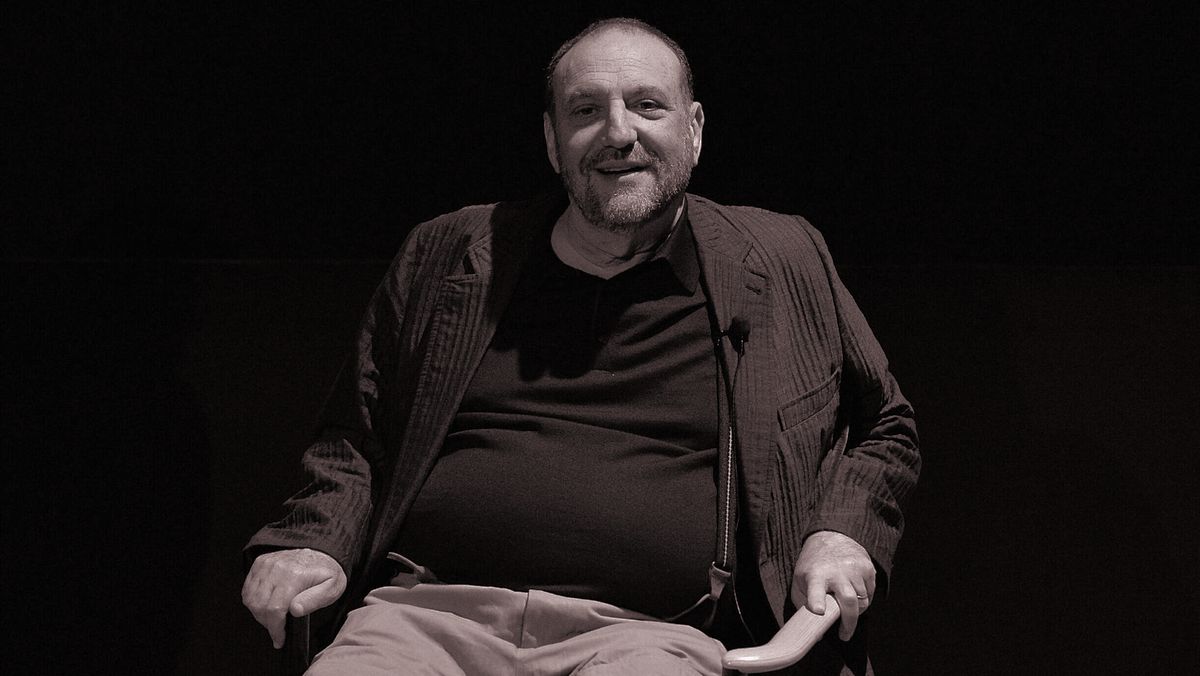
At a party the night before the Oscars, a group of veteran Hollywood insiders were idly wondering if anyone
had heard anything about Joel Silver. Once one of the town’s most successful and powerful producers, shepherding Warner Bros. franchises including Lethal Weapon and The Matrix, Silver was huge in every sense of the word—loud, foul-mouthed, wildly extravagant, and sometimes, allegedly, despicably underhanded.
Of
course, he eventually hit a cold streak but kept working, albeit on a much-diminished scale. He was somehow under the wing of Ari Emanuel, who stuck by Silver despite his unabated bad habits. Don’t ask me why. (“Ari can be loyal to people beyond human understanding,” said a colleague. “Loyal past the point of common business sense.”) The last time Silver was associated with a real hit was Sherlock Holmes, in 2009, and that was thanks to the loyalty of another Silver
friend, Robert Downey Jr. In 2023, Amazon MGM Studios bounced Silver from the remake of Road House (he had produced the 1989 original, too) and from last year’s poorly received Mark Wahlberg vehicle Play Dirty for his alleged verbal abuse of studio boss Courtenay Valenti and marketing chief Sue Kroll.
After that, Silver, now 73, seemed to go quiet. Town gossip held that Ari had finally had enough. (A
spokesperson for Emanuel declined to comment.) I’ve chronicled Silver’s adventures intermittently for years and had long wondered when he would play his last card. Was this finally it?
Anyway, no one at that pre-Oscars gathering had any idea what Silver was doing. But a couple of weeks after that party, I picked up a rumor that he had some kind of deal at Sony Pictures. That seemed surprising; I understand that Sony is hungry for a new franchise, but why would a thrifty tight-ship runner
like studio head Tom Rothman—who had experience dealing with Silver back in the day—want him in the mix? I inquired with Sony and was told that Rothman wasn’t aware of any such deal. Then, a couple of days later, The Hollywood Reporter said Sony was reuniting Silver with writer-director
Shane Black—a relationship dating back to the Lethal Weapon days—to adapt author Don Pendleton’s pulpy The Executioner novels.
Sony has international rights to the Executioner books, which follow the adventures of fictional sniper Mack Bolan. Thanks to ghost writers, more than 450 installments were published as monthly action-adventure paperbacks between 1969 to 2020. Producer Don Murphy’s Angry
Films acquired the domestic rights, which finally presented Sony with the opportunity to release any films around the world.
So who brought in Silver? One source told me that writer-director Black, an Executioner aficionado, insisted on it. Then someone in the Angry Films camp said it was the other way around—that Sony exec Peter Kang had said Silver was coming in at Rothman’s behest, and Silver then brought in Black. A source in Silver’s camp also thinks that’s
accurate.
But after one Sony source told me Rothman didn’t even know about the deal with Silver, this person said what really happened was that Silver phoned an unspecified executive at the studio and pitched himself for the project. Kind of sounds like a weird game of hot potato, but when I called to press for clarity, I was told the deal had never been finalized and Sony had that very day cut ties with both Silver and Black over money. However it happened, it seems Silver isn’t
being dealt in on The Executioner—but knowing him, I won’t be surprised if he turns up yet again with another card to play. |
Anyway, all the chatter about Silver’s ostensible deal got me wondering: What kind of flashing yellow lights
does it take these days to make people conclude that dealing with certain individuals might not be worth the pain? (I don’t want to pile on Jeff Shell here, but we saw what we saw.) |
|
|
|
A MESSAGE FROM OUR SPONSOR |
AI could help studios and producers move faster – but operational gains may be the least interesting implication. McKinsey’s latest research suggests the more important lesson comes from prior technology disruptions in Hollywood: new production tools can do more than lift productivity. They can change what gets made, shift who captures value, and alter the industry’s economics. The analysis suggests AI could affect roughly 20 percent of original content spend over the next five years, at a moment when media companies are
already facing slower growth, fragmented attention, and shifting viewing behavior. The question industry leaders should be asking isn’t whether AI will increase productivity in film and TV – it already is. The bigger question is what happens if AI starts to reshape the entertainment industry itself – and are you prepared? Learn More |
|
|
|
After all, producer Ryan Kavanaugh, who faded from the Hollywood scene in 2018 after a long
history of broken promises and litigation, has reportedly resurfaced with a film starring Pete Davidson and Casey Affleck, with Doug Liman directing.
One might think it should have aroused suspicion, back in 2003, when Kavanaugh’s Relativity Media claimed to have an algorithm that could predict the profitability of movies. I remember talking to Kavanaugh about his company in its heyday and thinking he sounded a lot like Master Thespian
(look it up, kids). The magic algorithm would have been great if it were real, but in fact, the company made many not-profitable movies before going bankrupt.
Maybe it’s fitting that Kavanaugh’s potential comeback film, Killing Satoshi, deals with the mysterious creator of Bitcoin (who may or may not have become less mysterious last week, with John Carreyrou and Dylan Freedman supposedly
unmasking him in the Times). And that, according to a casting notice, not only were locations for the film to be generated using artificial intelligence, but A.I. could be used to “change, add to, take from, translate, reformat or reprocess” performances. (The notice also warned that actors “may be sharing scenes with A.I.-generated
performers,” though apparently that didn’t happen.) A source told me that the talent had contractual as well as union protections regarding their performances, and Kavanaugh has said the production is being “very cautious, sensitive, and overly protective of our actors.” The film has no distributor yet, but Patrick Wachsberger’s foreign-sales company will be seeking deals at the upcoming Cannes film market in May. (Kavanaugh’s rep declined to comment.)
One distribution
company that probably won’t be around to release the project is Row K, born mere months ago, in August 2025, and now apparently teetering on the brink of oblivion. CAA co-heads of media finance, Roeg Sutherland and Sarah Schweitzman, and their team consulted on bringing this new company to life, with co-C.E.O.s Christopher Woodrow and Raj Singh at the helm. Woodrow’s previous gig, with the now-defunct Worldview Entertainment,
ended when he was canned amid allegations that he’d spent company money on everything from lotions and soaps to remodeling his mother’s house. Woodrow called those allegations “baseless.”
The remnants of Worldview sued CAA—whose media finance team was at the epicenter of that implosion—in 2018 for allegedly using the company as a dumping ground for unsellable projects, including Eli Roth’s The Green Inferno, Zach Braff’s Wish I Was Here,
and Warren Beatty’s Rules Don’t Apply. (The case settled in 2022.) But Sutherland’s team didn’t just jump back into business with Woodrow; CAA Media Finance helped invent Row K, serves as the company’s advisory partner, and represents it.
Row K quickly set about hoovering up Gus Van Sant’s Dead Man’s Wire; Maude Apatow’s promising directorial debut, Poetic License, which apparently it never paid for;
and a $100 million remake of Cliffhanger with Pierce Brosnan and Lily James, which happens to be a CAA package—though apparently that deal has not closed (and a CAA source denies that budget). But the Van Sant film tanked, bills went unpaid, and last month the three top executives—president Megan Colligan, C.R.O. Mo Rhim, and C.M.O. Ben Carlson—headed for the exit and retained attorney Bryan
Freedman. The company promised to take “a more measured, disciplined approach” going forward. (Woodrow didn’t respond to a request for comment.)
You could say that Sutherland et al. are doing the Lord’s work in laboring to find viable distributors for indie films—though a pricey remake of Cliffhanger doesn’t exactly sound like an art-house project. One producer observing all this questioned why CAA jumped back into business with Woodrow after the previous mess.
Another said it’s because “the business is desperate. I’m not an expert in business ethics,” this person added, “but that seems to me to be a little nutty.” (CAA declined to comment.)
“A little nutty” has always been the Hollywood way, and the myriad anxieties about pending megadeals and mass layoffs and whether Ryan Kavanaugh actually somehow found a way to produce a watchable movie with A.I.-generated locations and who knows what other machine-made elements aren't likely to make anyone
more sane in the immediate future. And maybe there’s comfort in knowing that some Hollywood veterans, at least, get a second act, and a third one, and a fourth one after all. |
Will today’s big open letter with 1,000 bold-faced names opposing the WarnerMount merger actually do
anything? Probably not, but it’s gonna make for some awkward pitch meetings if the deal does close. [N.Y. Times]
As I foreshadowed last week, both Brendan Carr and the Department of Justice are now doing the Murdochs’ bidding and investigating the NFL’s shift of games to
streaming. [Bloomberg]
Proxy firm Glass Lewis joined ISS in expressing “severe concerns” over David Zaslav’s pay package, concerns that will of course be ignored by the Warner Discovery board.
[Reuters]
The personal branding strategy behind Anna Wintour doing the cover of Vogue for Devil Wears Prada 2. [Guardian]
Serious question: What’s a bigger boomer ego trip, Wintour doing the cover of the magazine she ran for 37 years, or Bob Iger being named a “Disney Legend” weeks after he stepped down as C.E.O.?
Mubi’s loss of 1.2 million subscribers over its backer’s ties to the Israeli military is almost as shocking as the fact that it paid $24 million for the Jennifer Lawrence flop Die My
Love at Cannes last year. [WSJ]
At this point, who’s grosser, Lauren Sánchez Bezos, or the media outlets that continue to run long profiles of her? [N.Y.
Times] |
My Thursday reveal of Disney’s war on the upcoming Bob Iger book drew
pointed responses. Plus, a Cannes critique…
“We’re about to lay off 1,000 people and leadership is concerned about a stupid book? Bob did a lot of great things at this company, but his own vanity and need to be considered the savior of Disney followed him around like a dark shadow. That’s why he could never groom someone to replace him. That’s why he undermined Bob [Chapek] the first moment he could. That’s why he wanted so badly to run for
president. (I’m wondering if whatever is in this book is why he didn’t run.)” —A Disney employee
“After what we’ve been through with the [Trump/Stephanopoulos] settlement, it’s so deeply disturbing that the then-head of our company would resort to the same bullying tactics and use the president’s own lawyer!” —An ABC News employee
“I have about a thousand Charles Harder stories I could tell you but I don’t want to
get sued.” —A lawyer
“It’s very Trumpian of you to blame Cannes for the lack of American films on the Croisette. Our leader is a violent imperialist and our studios are now run by his allies and functionaries. The international film community is responding accordingly.” —A producer |
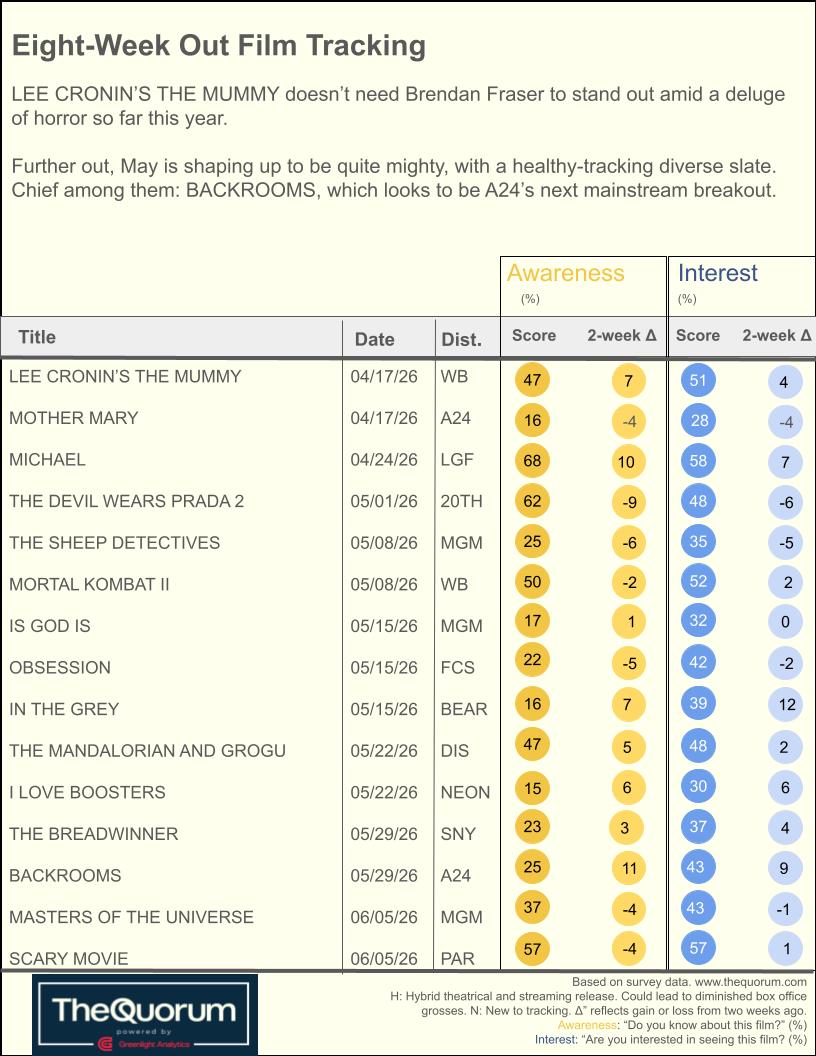
June’s Scary Movie reboot (Paramount/Miramax) is putting up strong numbers in the latest early
tracking chart from The Quorum… |
Have a great week,
Matt
Maya Tribbitt contributed research for this issue.
Got
a question, comment, complaint, or decent Vegas recs? Email me at Matt@puck.news or call/text me at 310-804-3198. |
Need help? Review our
FAQ page or contact us for assistance. For brand partnerships, email ads@puck.news.
You received this email because you signed up to receive emails from Puck, or as part of your Puck account associated with {{customer.email}}. To stop receiving this newsletter and/or manage all your email preferences, click here. |
Puck is published by Heat Media LLC. 107 Greenwich St., New York, NY 10006 |
|
|
|
|