 |
|
Happy Monday, I’m Eriq Gardner.
|
|
Welcome back to The Rainmaker, a private email about money, power, fame, and the legal realm, where it all comes together.
I just returned from a trip to L.A., where I took in a pretty crazy copyright trial and spoke to many Hollywood dealmakers about their pressing concerns. I also have been paying attention to Taylor Swift’s problem with deepfakes, which I discuss in this week’s edition. Also mentioned this week: the Murdochs, Mark Zuckerberg, Kat Von D, Vince McMahon, Changpeng Zhao, and LeBron James’ tattoo. (If someone else forwarded you this email, and you’d like to continue receiving this newsletter, click this link.)
But first…
|
|
|
- All or nothing: Few legal battles have such a wide range of potential financial outcomes as Smartmatic’s defamation lawsuit against Fox News. While the voting tech company is demanding $2.7 billion in damages, New York Superior Court Judge David B. Cohen recently granted Fox News the green light to pursue an anti-SLAPP counterclaim (in part, Cohen said, because of the unsettled argument that the “alleged damages are so extenuated from [Smartmatic’s] actual lost profits”). This means that if Smartmatic fails to show a legitimate basis for its $2.7 billion claim, it won’t just receive nothing—it may actually find itself on the hook for Fox’s legal expenses, too.
On the flip side, Cohen also decided that Smartmatic—which meticulously outlined the editorial influence wielded by owners Rupert and Lachlan Murdoch—can proceed with claims against Fox Corporation, Fox’s parent company, too. (That’s a reversal of the previous ruling of an appeals court.)
How much could Fox end up paying? Remember, the New York jury that just awarded E. Jean Carroll $83 million in her federal defamation suit against Donald Trump was drawn from a suburban, more bipartisan pool. The Smartmatic case is proceeding in state court, which draws jurors from the far more liberal New York City. Just something to take into account when prognosticating. In any event, this trial likely won’t happen until next year at the earliest.
- Zuckerberg in the hot seat: Tensions are rising in the Lone Star State as Texas gears up for a June trial against Meta over its alleged misuse of facial recognition software to clandestinely harvest user biometric data. As the courtroom face-off approaches, a judge has summoned Mark Zuckerberg for a deposition, prompting Meta to race up the appellate hierarchy in a frantic bid for an emergency intervention. Meta’s appeal is now with the Texas Supreme Court, tasked with swiftly determining if Attorney General Ken Paxton is needlessly harassing Zuck.
Meta’s legal team at Gibson Dunn has argued that the tech company is being unjustly singled out, and has dedicated considerable effort to unraveling how the state of Texas itself uses facial recognition. Despite Meta’s struggle to obtain documents from Texas law enforcement, the company has sought a workaround by subpoenaing Clearview AI, the state’s vendor—which has set off a separate skirmish, now playing out in New York.
|
 |
| The Taylor Swift Deepfake Complexifier |
| The White House is calling for new laws to prevent the scourge of A.I. pornography. But poking holes in Section 230, the legal heat shield surrounding Silicon Valley, may be harder than it seems. And Hollywood may want a word, too… |
|
|
|
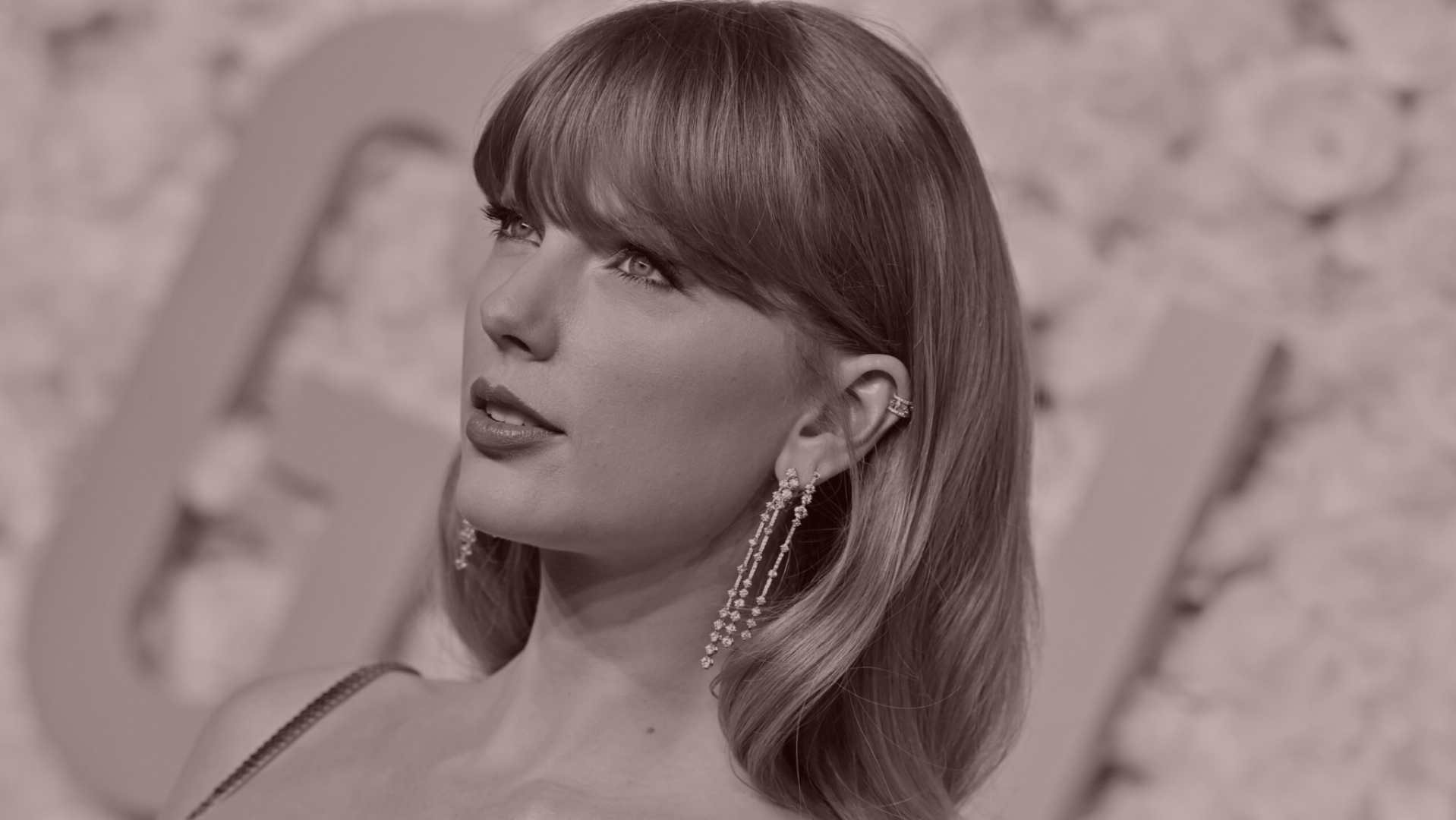
| If there’s any silver lining to Taylor Swift becoming the victim of A.I. pornographers, who began circulating explicit, so-called “deepfake” images of her on social media last week, it’s Swift’s remarkable ability to inspire pressure on Washington. On Friday, even White House Press Secretary Karine Jean-Pierre responded, in between questions about the war in Ukraine and the crisis at the border, calling on Congress to pass legislation that would crack down on abusive or unlawful A.I.-generated images. Jean-Pierre’s outrage was quickly echoed by SAG-AFTRA, the actors’ union, which fired off its own statement arguing that individuals’ likenesses need to be protected.
Swift’s predicament isn’t easy. She is reportedly contemplating legal action over those deepfakes, but her options are limited. While she possesses viable claims against the anonymous perpetrators, a lawsuit probably wouldn’t achieve much. Sure, she could possibly win money damages from the pornographers, if she could find them. But there are major roadblocks to her ability to compel takedowns and halt the dissemination of the images under Section 230 of the Communications Decency Act, which generally provides immunity to tech platforms that host user content.
There are a few exceptions to the Section 230 heat shield, including content that violates federal criminal law or intellectual property laws. Some states outlaw revenge porn, which may cause legal trouble for the creators of deepfakes, but probably not website operators hosting them. The I.P. carve-out might not apply, either. Right of publicity laws—which safeguard individuals from nonconsensual commercial exploitation of their images, voices, or likenesses—are recognized in some states, like California and Indiana, but not others. Is a person’s face covered by Section 230? There’s disagreement on that question, with courts splitting (see here and here).
Any new law on this front would be transformative. A federal right of publicity law, for example, would likely settle the debate surrounding Section 230 and probably mean that digital platforms would indeed be legally exposed when one of their users violates the image of someone else. While the First Amendment would be cited, major platforms like Twitter/X, Facebook, and YouTube would probably be compelled to take swift action in response to an influx of lawsuits and legal demands. This might even lead them to invest in better tools to proactively monitor and combat deepfakes, akin to their efforts addressing pirated movies and TV shows.
Of course, in Washington, the devil is in the details. Crafting a new law would require Congress to delineate what exactly gets protected and what doesn’t, which would inevitably invite vigorous lobbying from affected industries. For example, while most people agree that sexually explicit manipulations should be out of bounds, Hollywood studios want assurances that any new law against nonconsensual digital replicas has carve-outs for artistic expression. Consider the depiction of U.S. presidents in Forrest Gump, for example, because the Motion Picture Association certainly has. They believe deepfakes can enrich realism in filmmaking, and that these creations should enjoy First Amendment protections. (That’s one reason to pay attention to a new lawsuit over an A.I.-generated George Carlin routine.)
And Hollywood’s objections would be nothing compared to the lobbying and pushback from the tech giants, which will scramble to protect their favorite legal shield. If the past is any indication, expect arguments that messing with Section 230 will lead to increased censorship, decreased competition, and other harms. Tech giants will also aim to avoid any sort of takedown framework that’s reminiscent of their bumpy experiences dealing with content piracy. Maybe they’d rally around an A.I.-labeling bill as some sort of compromise, although adopting that, and going no further, would clearly be a terrific disappointment to SAG-AFTRA and others who see likeness simulation to be a personal and professional threat.
Those in favor of a federal likeness protection law are undoubtedly aware of the challenging road ahead, as well the potential influence that Taylor Swift could wield if she mobilizes her fandom. The question now isn’t whether Swift permits herself to be exploited, but how she chooses to respond. If she realizes a lawsuit will do no good, will she become the face of a political movement? Well, that would be a game-changer.
And now, for something completely different… |
|
|
| On Friday, Kat Von D was cleared of copyright infringement by a federal jury in Los Angeles. A talented tattoo artist who first hit it big on the TLC shows Miami Ink and LA Ink, Von D caught trouble for using a photo of Miles Davis as a reference when tattooing a man’s arm. After she flaunted her eye-catching creation to 10 million Instagram followers, she was dragged into court by Jeffrey Sedlik, who photographed Davis back in 1989. Remarkably, this peculiar case ended up before a jury, who delivered a win to Von D, likely to the overwhelming relief of the entire tattoo industry, which has overlooked licensing since, well… forever.
The trial piqued my interest, not just as the inaugural (and perhaps concluding) instance of human skin being the canvas for a copyright allegation, but also due to its impeccable timing. Mere months after the Supreme Court’s clarification of “fair use” in the Andy Warhol art case and amid the looming uncertainty of numerous lawsuits over generative A.I., the Kat Von D spectacle presented a rare chance to witness the application of legal principles that will shape more than just the future of tattoo parlors.
But right from jury selection, this trial defied my expectations thanks to the magnetic defendant. Almost all these jurors admitted knowing of Kat Von D—if not as a reality star then as a musician or a book author or the face behind a popular beauty line. Then there were the ones who were dismissed from jury duty after expressing such admiration for her they weren’t certain they’d be able to render judgment impartially. Meanwhile, when asked, the name “Miles Davis” generated head shakes of unfamiliarity.
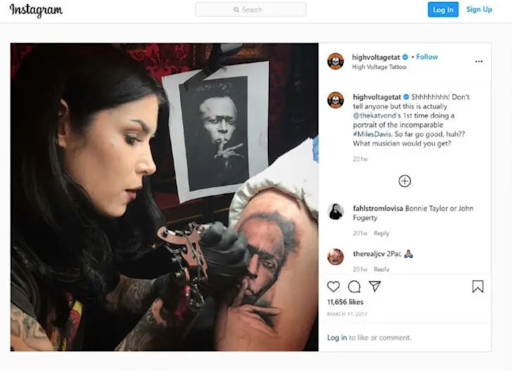
Usually, a copyright suit of the plagiarism variety centers on establishing the similarity of the artistic works and proving the alleged appropriator’s access. However, since Von D had posted an image of herself tattooing the man with Sedlik’s photo visibly in front of her (see below), neither side extensively delved into these aspects. Nor did the parties waste much breath discussing whether Von D made transformative use of the Miles Davis photo, as the judge had already declared she hadn’t before the trial commenced. |
|
|
| What was left to determine appeared to be whether Von D’s tattooing constituted a commercial use that had adversely affected Sedlik’s licensing opportunities. But that debate was muddied by the abstract stakes, juxtaposing one artist’s demand for respect against another’s freedom to express herself and to build a brand. After all, by 2017, when Von D copied the image of Davis, she had transitioned from charging for tattoos to giving them away for free to her friends. Sedlik’s attorney, Robert Allen, nevertheless attempted to argue there was still a promotional benefit to her using the photo: to attract followers on Instagram, which facilitated the sale of books, makeup, and other merchandise.
Honestly, the sheer occurrence of this trial was puzzling, given the relatively paltry financial stakes. Sedlik sought less than $50,000 in actual damages (potentially rising up to $130,000 in statutory damages if willful infringement was established). Allen candidly acknowledged to me during a break that this amount was less than the legal fees incurred for the four-day trial. Meanwhile, the pandemic had caused the closure of Von D’s tattoo parlor, and she voiced uncertainty about ever resuming tattooing. Clearly, both parties engaged in this legal battle more on principle than out of financial concerns, with perhaps a dash of publicity as a factor.
In the end, Von D and her attorney Allen Grodsky emerged victorious. Her witness stand performance was nothing short of virtuoso, showcasing a perfect blend of artistic acumen and legal naivety. It was easy to see how she had amassed such a huge following. In contrast, Sedlik, perhaps constrained by costs, opted not to call expert witnesses and ended up appearing as more of a payday-seeking bully. The trial unfolded as a clear victory for Von D, with the jury ultimately determining, probably to both sides’ surprise, that there wasn’t a sufficient similarity between the Miles Davis photo and Von D’s tattoo. Indeed, the jurors reached their verdict after just three hours of deliberation, prompting Von D to share hugs with a few of them afterward. |
|
|
- You may have heard about the bombshell sex-trafficking lawsuit against the WWE, but the full complaint from Janel Grant is worth reading. It’s pretty stunning in its details of alleged sexual abuse. Vince McMahon has already resigned as chairman of the TKO Group, but this situation is hardly over. There will be an important fight coming over the scope of the recently enacted Ending Forced Arbitration of Sexual Assault and Sexual Harassment Act. The discovery process might also go places.
- I don’t know quite what to make of this just yet, but U.S. News & World Report is looking to quash subpoenas from San Francisco City Attorney David Chiu relating to the methodology behind the publication’s Best Hospitals rankings. The magazine is represented by several notable Quinn Emanuel attorneys and presents this as a First Amendment issue. I’m betting we’ll hear more about this situation soon.
- One investigation that I think is getting perhaps too much attention is the F.T.C.’s scrutiny of Big Tech’s stake in upstart A.I. companies. The agency has issued 6(b) orders, which seems to point to a general study of the arena rather than a potential antitrust challenge to Microsoft’s investment in OpenAI.
- The U.S. really, really, really doesn’t want to let Binance C.E.O. Changpeng Zhao out of its sights. He’s pleaded guilty to violating money laundering laws and is awaiting sentencing. Around Thanksgiving, a judge rejected his bid to temporarily return to the United Arab Emirates, and this past week, the judge once again refused a visit, even after Zhao cited a medical emergency in the family and pledged to post billions of dollars in Binance stock to ensure his return.
- Finally, one last note about tattoos and copyright law: As Kat Von D emerged victorious, another tattoo artist quietly suffered a huge blow. James Hayden, the guy who inked LeBron James and other NBA stars, lost a good part of his suit against NBA 2K video game publisher Take-Two Interactive thanks to errors in copyright registrations. See the summary judgment here. Incidentally, I previously wrote about how Hollywood could have a looming A.I. headache with respect to omissions in registrations.
|
| That’s all for today. Hit me with any questions, tips, or comments. |
|
|
|
| FOUR STORIES WE’RE TALKING ABOUT |
 |
| The Jamie Switcheroo |
| JPMC’s executive shuffle, Paramount tea leaves, Elon’s stock rant. |
| WILLIAM D. COHAN |
|
 |
| Hit and Ronna |
| A close look at Trump’s R.N.C. arm twist. |
| TARA PALMERI |
|
 |
| Jon Stewart 2.0 |
| Observations on Stewart’s return to The Daily Show. |
| BARATUNDE THURSTON |
|
 |
|
|
|
|
|
 |
|
|
|
Need help? Review our FAQs
page or contact
us for assistance. For brand partnerships, email ads@puck.news.
|
|
You received this email because you signed up to receive emails from Puck, or as part of your Puck account associated with . To stop receiving this newsletter and/or manage all your email preferences, click here.
|
|
Puck is published by Heat Media LLC. 227 W 17th St New York, NY 10011.
|
|
|
|