 |
 |
|
Welcome back to What I’m Hearing+, live from Brooklyn as the writers strike enters its Month 4.
As my Puck partner Matt Belloni has been reporting, it now looks like the work stoppage may go on much, much longer. Last week, I put together a pain index with each of the major streamers. This week, a closer look at how Netflix, the most resilient of the bunch, is coasting on the eye-popping success of Suits—and why the numbers come with a bunch of asterisks.
|
|
|
| In the first four weeks after Suits landed on Netflix, in mid-June, the seemingly forgettable USA Network procedural—perhaps best known for starring Meghan Markle—set a record for a licensed show, with more than three billion minutes streamed, per Nielsen. All of a sudden, it seemed, Suits was the surprise hit of the season for Netflix, which picked up non-exclusive rights and worked its algorithmic magic. Incredibly, Suits beat Manifest, which set a previous record on Netflix, and the third season premiere of The Witcher, starring Henry Cavill. Over the weekend, in fact, Suits attracted twice the audience of Witcher, says Nielsen.
What’s going on here? Suits has benefitted from a number of key factors that lead to success in the streaming age. The show dropped eight seasons at once, giving viewers—including the millions of Royals fans who might not have seen the show before Markle married Prince Harry—a lot to watch. Netflix has industry-leading scale and a track record for transforming underwatched series into grand slams. Suits also received an immense boost from social media: interest started picking up on TikTok a few weeks before the show hit Netflix, and then skyrocketed once it was available. Netflix curation teams are increasingly savvy at exploiting these signals: When clips from Maid began recirculating on TikTok in May, long after it had retreated into the streaming ether, Netflix threw it back on the homepage and it quickly reappeared in the Top 10.
The three billion minutes viewed generated a lot of headlines. But what does that really mean when more than 120 episodes were all made available at once? (By comparison, The Lincoln Lawyer, also on Netflix, generated 1.4 billion view minutes in its first week on Nielsen’s Top 10, with just 15 episodes.) Discerning the truth about how and why a show is performing on streaming is tough but not impossible: it requires honing in on three key metrics. And Suits, in many ways, is a perfect illustration of how to measure success in this new age. |
|
A MESSAGE FROM OUR SPONSOR
|
 |
| Your favorite hit comedy is back! In a new season of Only Murders in the Building, murder takes center stage when actor Ben Glenroy is killed on the opening night of Oliver’s big production. On top of a new case to crack, our sleuthing trio’s relationship is put to the test. Will their friendship survive? Starring Selena Gomez, Steve Martin, and Martin Short, and guest-starring Meryl Streep, Paul Rudd, Ashley Park, and Jesse Williams. Check out the new season of Only Murders in the Building, new episodes Tuesdays, streaming only on Hulu. |
|
|
|
|
| Viewership is key to understanding performance, but in streaming, it’s only one of several metrics that matter. Just like with Pay TV, a streamer needs to perform on an acquisition, retention, and engagement basis. Cable providers accomplished this by offering a mix of live sports and premium entertainment, which drove acquisition; plus reruns of popular shows, like Friends or Seinfeld to promote retention; and news, daytime reality and game shows, which supported regular engagement. Services like Netflix and Max, while not bundles in the traditional sense, essentially operate the same way, combining different types of programming to acquire and then keep customers.
Which brings us back to Suits. Obviously, the show isn’t a huge acquisition driver for Netflix. It spent nearly a decade on cable before getting canceled in 2019, and it’s not even an exclusive—Peacock is also streaming the series, including a 9th season that’s not yet available on Netflix. In reality, data from Antenna suggests that while Netflix saw a small subscriber bump in the U.S. during the time period Suits debuted, it’s more likely due to its password sharing crackdown than the addition of an old USA series.
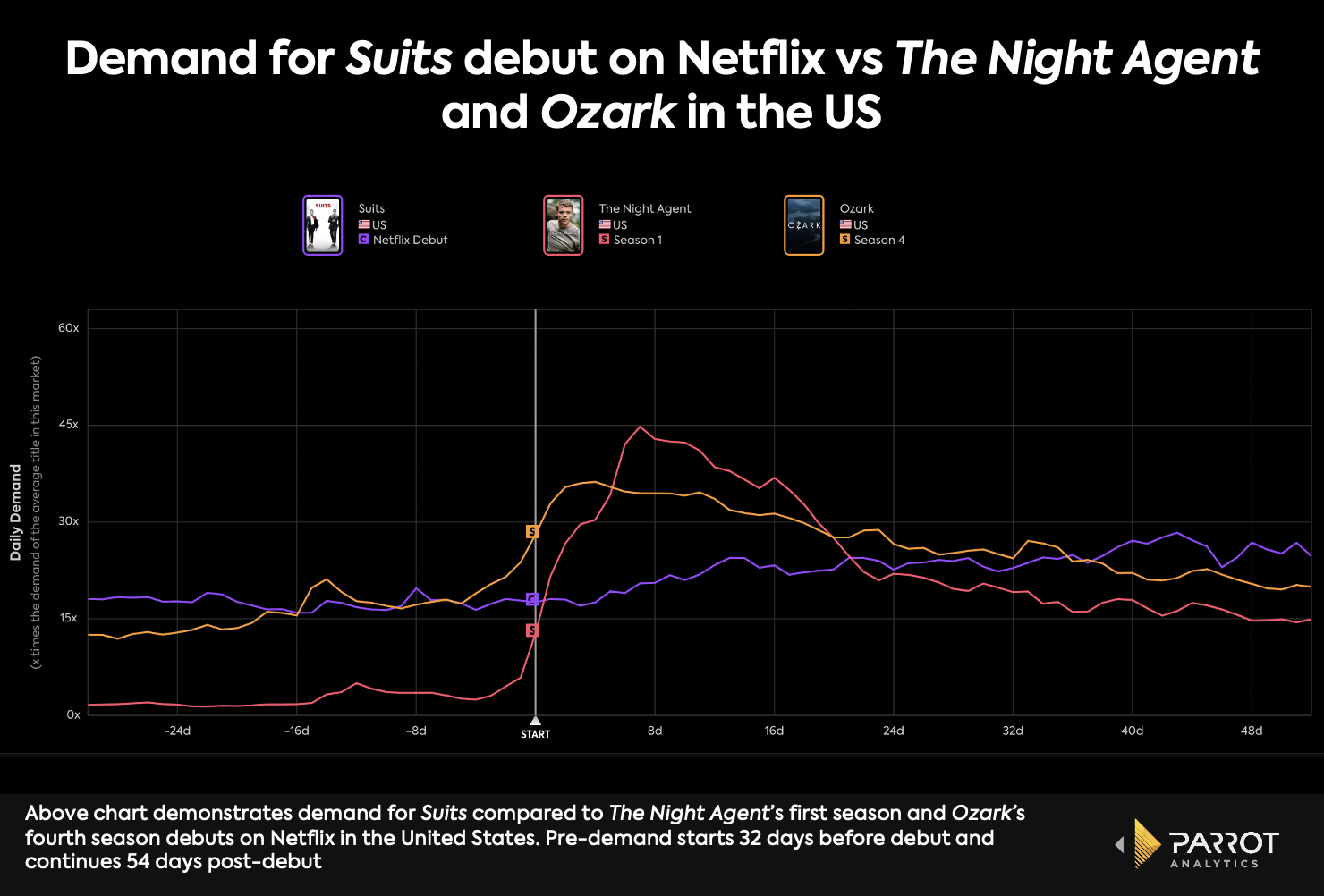
But Suits does appear to be creating real value for the platform on retention and engagement. Unlike many other Netflix shows, which have strong downward slopes in demand after the first couple of weeks, Suits has seen a consistent uptick in demand, according to Parrot Analytics, where I work as director of strategy. In the U.S., the first four seasons have remained in the Top 10 since debuting on Netflix in mid-June. That sort of sustained interest is extraordinary: The Night Agent and Ozark’s fourth season both dipped faster after their debut. |
|
|
| And while Suits hasn’t generated as many views in its first month as blockbuster originals like Bridgerton, Stranger Things, Wednesday, or even Black Mirror, it’s a very different kind of economic play. Most of those series are all $100 million-plus attempts at customer acquisition. Series like Suits can be licensed cheaply to keep subscribers engaged with Netflix after the binge-viewing of hot new series is complete.
Indeed, that’s the new formula for Netflix—it’s gone from hypergrowth to hyper-retentiveness in this new era of profit-minded operations. And that’s a better place to be. After all, it’s not actually sustainable to produce a Wednesday every week, as Ted Sarandos once cited as Netflix’s goal. Instead, Netflix needs more series like Suits—120 episodes of lean-back TV, ideally with a social media boost, strategically placed on the service during otherwise quiet periods, like summer. That shouldn’t be a shock to old school TV executives: The Suits audience overlaps with people also watching The Blacklist, The Big Bang Theory, How I Met Your Mother, and Young Sheldon, all similar-ish cable hits that are now available on-demand. But it’s an undeniable tactical shift from the peak streaming arms race era. |
|
|
| Of course, the success of Suits begs an obvious question: If this is precisely the type of hit programming that Netflix needs right now, why doesn’t Netflix simply create more shows like Suits? It’s a question that I hear frequently, and Joe Adalian at Vulture has also made strong arguments for why Netflix needs more long-running series.
Alas, the days of 12 episode-plus seasons are probably gone, at least on streaming. Netflix has made a few longer running shows, like Grace and Frankie (seven seasons), BoJack Horseman (six), and Orange is the New Black (seven). But why? On linear TV, syndication was often the holy grail, and the reason for a show to reach the five season mark. Netflix, with small exceptions like BoJack, which was licensed to Comedy Central because of deals between Netflix and BoJack production house The Tornante Co., doesn’t license its original content. |
|
|
| Part of this reluctance has to do with Netflix’s hit rates. Between 2019 and 2022, Netflix released 1,017 new TV series in the U.S., while HBO Max released 145, according to Parrot Analytics. Netflix had a stronger demand score on average (62 percent of series), but just one percent of all shows boasted an exceptional score (better than the .2 percent of all series in the U.S.). Meanwhile, 3.4 percent of HBO Max’s shows had an exceptional demand score. (Showtime had 1.8 percent, while Disney+ had 2.7 percent.) That means Netflix was making more than nine times more series than HBO (and Max) or Showtime, but they weren’t resonating as much with audiences.
This also boils down to pure Netflixonomics. Netflix invested in areas and genres that HBO or Showtime didn’t in order to scale beyond those singular brand names, including reality TV and kids programming. Also, simply put, Netflix doesn’t need the money: it’s the only profitable streamer, with $3.5 billion (and rising) in free cash flow, and it can address its retention problem through acquired programming. For Netflix, there’s no reason to license its own content to competitors, building up those other platforms, when its financial position is so much stronger.
Meanwhile, NBCU executives are addressing Peacock’s customer acquisition problem by sending Suits to Netflix, giving the company additional revenue to invest in new content and sports rights, and hopefully enticing some fans on Netflix to check out Peacock for Season 9. Unlike Netflix, NBCU needs additional revenue to close the gap between losses and streaming profitability—and it has the type of long running shows to do so. It’s why, as I said last week, I expect Disney to follow suit in some capacity if things get dire enough.
But unfortunately for NBCU and other legacy media companies in the same position, it’s easier for Netflix to license Suits than it is for Peacock to create Stranger Things. And that dichotomy is Netflix’s biggest advantage of all. |
|
|
|
| FOUR STORIES WE’RE TALKING ABOUT |
 |
|
 |
|
 |
|
 |
| Strike Setbacks |
| Is Hollywood’s labor dispute back to square one? |
| JONATHAN HANDEL |
|
|
|
|
|
 |
|
|
|
Need help? Review our FAQs
page or contact
us for assistance. For brand partnerships, email ads@puck.news.
|
|
You received this email because you signed up to receive emails from Puck, or as part of your Puck account associated with . To stop receiving this newsletter and/or manage all your email preferences, click here.
|
|
Puck is published by Heat Media LLC. 227 W 17th St New York, NY 10011.
|
|
|
|