 |
|
Happy Monday, I’m Eriq Gardner.
|
|
Welcome back to The Rainmaker, a private email about money, power, fame, and the legal system where they all collide.
This week, I’m discussing handbags. Yes, seriously—never before has there been a case that delves into the difference between a suitcase and a handbag, but then again, there’s never been a competition cop like Lina Khan. And then, there’s a buzzworthy dispute over Birkin bags. I’ll get to that too. (P.S. If this email somehow found its way to you, here’s a good chance to subscribe to Puck.)
🚨🚨 Programming news: This will be the last edition of The Rainmaker as a stand-alone newsletter. Starting next week, I’ll be taking over the Tuesday edition of What I’m Hearing, Matt Belloni’s franchise focused on the business of Hollywood, entertainment, and media. I’ll also continue writing across other franchises, such as Dry Powder, our Wall Street private email. Don’t worry, we’ll automatically update your subscription settings, so you don’t have to do a thing.
Meanwhile, I’m deeply grateful for the brilliant Rainmaker subscribers with whom I’ve had the pleasure of exchanging emails and banter these past few years. My email is still Eriq@puck.news, so keep shooting me tips and feedback. I’ll be off for Memorial Day, and back in your inboxes the following week.
Let’s get started…
|
|
|
- NCAA athletes’ billion-dollar blitz: This coming week could mark a pivotal moment for college sports as the NCAA board of governors convenes on Thursday to discuss potentially settling three major antitrust lawsuits from athletes over compensation. The proposed deal, as reported by various media outlets, is extremely ambitious: a $2.77 billion payout to former college athletes for past damages, plus a new revenue-sharing system aimed at present and future athletes. Smaller conferences and schools are already grimacing at their share of the cost, possibly obscuring a more critical question: What exactly are they getting in return?
Well, the end of those lawsuits, for one. But what NCAA president Charlie Baker really craves is stability, which has eluded the organization ever since the Supreme Court rejected amateurism as an acceptable shield against antitrust laws. Since the unanimous decision in the landmark NCAA v. Alston case three years ago, the organization has been embroiled in incessant litigation, and it surely hopes that striking a deal with legal foe Jeffrey Kessler will alleviate the headaches.
Alas, a settlement alone won’t ensure immunity from new antitrust challenges. To address this, Kessler and cohort Steve Berman are now talking up how the settlement includes an “objection procedure” whereby athletes will have an opportunity annually to express any grievances before a judge. Alas, I know many in the antitrust field who are skeptical at best, and dubious at worst, that this really will be effective in curtailing future litigation. With billions buying a semblance of peace in the college sports community, perhaps it will simply pave the way for something with more teeth—a new federal law, perhaps, or collective bargaining. Time will tell.
- James Dolan’s Desperado defense: Will the Supreme Court inadvertently determine the fate of Madison Square Garden C.E.O. James Dolan? It’s a possibility. Dolan is embroiled in a lawsuit alleging he sexually trafficked a massage therapist a decade ago while touring with his band, JD & The Straight Shot, as the opening act for The Eagles. One claim accuses Dolan of arranging a “chance” meeting between the therapist and Harvey Weinstein, who allegedly later assaulted her in his hotel room. (E. Danya Perry, a lawyer for Dolan, has previously denied the allegations and called them lies.) In an effort to dismiss an aiding and abetting claim, Dolan is pointing to a settlement entered a few years ago in the bankruptcy of The Weinstein Co. This agreement established a $19 million fund for Harvey Weinstein’s victims in return for a release from future claims. Dolan, a former TWC director, was one of the released parties.
The therapist’s lawyer is Doug Wigdor, who previously opposed the settlement, remarking, “If affirmed on appeal, this will go down as the worst settlement of all time.” (It was affirmed.) Now, Wigdor is pointing to developments at the U.S. Supreme Court and telling a New York federal judge overseeing the therapist case to wait a beat before deciding whether the Knicks owner is shielded from Weinstein-related claims. Wigdor is referring to the high court’s imminent ruling in a case over the controversial Purdue Pharma bankruptcy plan, which protects the David Sackler family from civil liability linked to OxyContin. The federal government has challenged the fairness of such a settlement. Wigdor suggests that if the justices find it overreaching, it could similarly impact the enforceability of The Weinstein Co.’s settlement release.
|
 |
| Haute Shots |
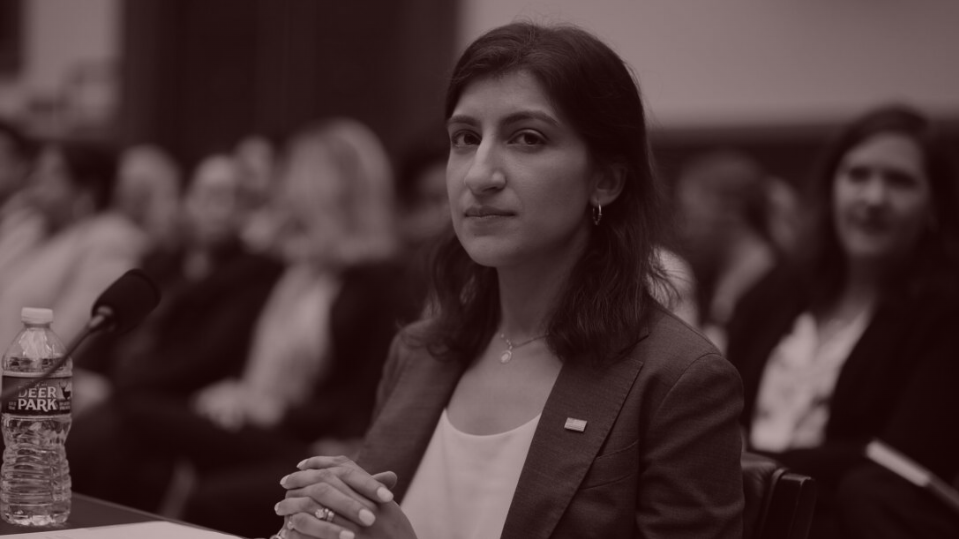
| Lina Khan’s ivory tower antitrust outfit is going to war with the fashion industry under an untested legal theory that there is such a thing as the “accessible luxury handbag” market—and that Tapestry’s $8.5 billion merger with Capri will destroy it. Industry insiders say Khan doesn’t have a clue. |
|
|
|
| Three years into Joe Biden’s presidency, his neo-Brandeis antitrust brain trust has much to celebrate. From thwarting mergers like JetBlue-Spirit and Adobe-Figma to cracking down on noncompetes and junk fees, they’ve made Wall Street Journal op-ed writers apoplectic. For a victory lap this Tuesday, they’ll take center stage at the Anti-Monopoly Summit at the Westin Hotel in Washington, D.C., where the headliners will be Assistant Attorney General Jonathan Kanter, chair of U.S. Council of Economic Advisers Jared Bernstein, and of course, F.T.C. chair Lina Khan. Attendees, if they have any sense of humor, might tote this season’s hottest antitrust accessory—a stylish, mid-priced handbag.
Last month, after all, the F.T.C. filed suit to block the $8.5 billion merger of luxury fashion conglomerates Tapestry and Capri, prompting all sorts of groaning and eye-rolling from the fashion industry, which contends that the très gauche antitrust crew doesn’t understand a thing about how the luxury business actually works. For starters, of course, the market features hundreds of brands, fickle consumer tastes, and a low barrier to entry. Nevertheless, the F.T.C. has determined that the corporate marriage of the Tapestry brands (Coach, Kate Spade, and Stuart Weitzman) with Capri (Michael Kors, Versace, and Jimmy Choo) is too haute to handle. The agency’s complaint highlights how these brands compete in everything from “clothing to eyewear to shoes,” but the real crux of the case revolves around what the feds are calling the “accessible luxury handbag” market.
What’s that? In a May 10 court brief, Tapestry demanded answers about this supposed market:
“Are bags priced at $75 from a brand like Lululemon in? Are handbags bought on discount at a Gucci outlet in or are they out? Is a men’s briefcase a handbag? What about a backpack? If a Kate Spade handbag is on sale for Mother’s Day at $60, is a handbag at a similar price point but made in China in or out? Or does the F.T.C. claim that only some specific brands are in the market and, if so, which?”
The stakes here are significant. Antitrust cases hinge on market definitions; without clarity on what’s included and what’s not, gauging a company’s dominance is nearly impossible. The F.T.C. claims that Tapestry and its legal team from Latham & Watkins are playing dumb—that “accessible luxury” is a term that Coach itself coined, two decades ago, and has since become a staple in the industry, denoting affordable, high-quality leather handbags that sit between low-end Chinese imports and ultra-expensive European brands. According to the F.T.C., if the Tapestry-Capri merger goes through, the combined entity would control more than 50 percent of this market, possibly leading the way to higher prices, fewer discounts and promotions, reduced innovation, and depressed employee wages and workplace benefits.
This merger challenge gives Biden’s regulators a prime election-year platform to demonstrate their consumer advocacy. While many of the administration’s high-profile antitrust efforts—especially against tech monopolies—may seem too abstract for voters, this case hits closer to home. Sure, amid the chatter about inflation at the grocery store, Lina Khan and her team are also suing to block Kroger’s $24.6 billion acquisition of Albertsons. But in terms of symbolism, nothing makes a statement like a chic handbag. |
|
|
| At F.T.C. headquarters on May 16, during a hearing meant to set the stage for what’s ahead, Tapestry gave a full-throated preview of its defense. While the case centers on a quintessentially modern business like fashion, it begins with the good ole tradition of quibbling over market definitions—like whether monopolization is happening in both the men’s and women’s handbag markets, or just the women’s. In his presentation, Latham partner Al Pfeiffer homed in on the broader theme of the defense: These F.T.C. troops simply don’t grasp the nuances of the business and can’t credibly argue this merger will harm the fashion industry.
From Tapestry’s perspective, their influence over prices is checked by how easy it’s become for new competitors to enter this market and attract customers. Pfeiffer told an administrative judge that massive advertising budgets are no longer crucial for success. These days, he said, any designer can become an influencer or hire someone savvy in social media. And sales hinge on staying trendy.
To punctuate this point, Pfeiffer pointed to the Michael Kors brand, which he claimed had lost its desirability among consumers. Efforts to elevate the brand through pricier offerings have flopped as the buying public has cooled on Kors. “The point of the merger is to rebuild the fallen Michael Kors brand,” he stated, underscoring a new strategy focused on more effective consumer engagement and enhanced value—a narrative they plan to expand on at trial. The F.T.C.’s lead attorney Abby Dennis anticipated these points and posed a poignant question in response: “If it’s so easy to scale to a billion dollars, it begs the question, ‘Why buy Michael Kors instead of building a new brand?’”
It’s obvious that the F.T.C. intends to send a message to those in the M&A world. Notably, European regulators, typically stringent in their scrutiny, have not raised alarms over the proposed Tapestry-Capri merger. Instead, the F.T.C. is flexing its muscles, standing alone against this deal. A victory here would not only assert the agency’s renewed vigor opposing so-called horizontal concentration, but also burnish Khan’s legacy after a pretty rocky start to her tenure. Early setbacks included failing to halt Microsoft’s acquisition of Activision and Meta’s buyout of the VR startup Within—events that precipitated a less-than-flattering New York article entitled “Lina Khan’s Rough Year.”
Since then, Khan has gone on a winning streak. In December, the conservative 5th U.S. Circuit Court of Appeals handed the F.T.C. a major victory in the Illumina-Grail case, prompting a separation of the companies. In January, her team got an early court order to halt IQVIA’s planned purchase of Propel Media, and in March, they coaxed Choice Hotels into dropping a $7 billion bid for Wyndham. Meanwhile, the agency has ambitiously moved to regulate cutting-edge fields, like facial recognition and artificial intelligence. This assertiveness has prompted Meta, Amazon, and other corporate giants to launch constitutional challenges to the F.T.C.’s power and independence.
As for the Tapestry-Capri case, battle lines are drawing tight, with courtroom clashes expected in September, when a federal judge will consider an injunction to prevent the merger’s completion. Notably, at last week’s hearing, it was revealed that the F.T.C.’s strategy doesn’t include querying Tapestry’s smaller rivals or its wholesale distributors for input; instead, the agency is grounding its case in broad economic arguments against consolidation writ large—a clear signal of its increasingly self-righteous, trust-busting swagger under Khan’s leadership. |
|
|
| Of course, Khan’s crusade isn’t the end of the legal headaches facing the luxury handbag industry. In March, as I’ve previously reported, French fashion house Hermès was targeted with a class-action lawsuit asserting that the producer of the famed Birkin bags—which retail in the low five figures and can be resold for multiple times that amount—is violating the Sherman Act. The allegation? Hermès allows customers to purchase its ultra-exclusive Birkin bags only if they first buy other products, like jewelry or scarves. Represented by attorneys Joshua Haffner and Shaun Setareh, the plaintiffs frame this as a clear-cut case of using dominance in one market to unfairly gain ground in another.
But exactly which markets are supposedly being improperly tied? Now that Hermès is represented by none other than Latham & Watkins, the discourse around market definitions is heating up. Christopher Yates, a San Francisco-based partner who’s also knee-deep in the Tapestry-Capri merger, surfaced the issue in a May 9 dismissal motion. Can a market realistically be defined solely around Birkin or Kelly handbags? Yates is doubtful, questioning whether consumers really have no substitutes. (Well, if you have to ask…) And what about the assertion that Hermès is linking everything from jewelry to shoes to perfume? To define all this ancillary stuff as a single market, Yates sniffs, “flunks both economics and common sense.”
Haffner and Setareh are set to respond on June 7, and maybe they’ll come up with something that convinces the judge to move the case forward. Then again, maybe their grievance really lies with how there’s any sort of market at all for, how shall we put it, less accessible luxury goods. If that’s their angle, they might do well to attend the Anti-Monopoly Summit later this week. While judicial skepticism over so-called “single-brand product markets” seems formidable, someone there just might have a smart idea about how to take on these Latham killjoys. |
|
|
| That’s it for this week. I’ll be away next week for the holiday, but keep comments and tips coming, and I’ll see you a week from Tuesday in What I’m Hearing. |
|
|
|
| FOUR STORIES WE’RE TALKING ABOUT |
 |
|
 |
| Zuck’s Gambit |
| Dissecting Meta’s plunge into A.I. |
| BARATUNDE THURSTON |
|
 |
|
 |
| $1B Art Flop |
| Chronicling a topsy-turvy week for the art market. |
| MARION MANEKER |
|
|
|
|
|
 |
|
|
|
Need help? Review our FAQs
page or contact
us for assistance. For brand partnerships, email ads@puck.news.
|
|
You received this email because you signed up to receive emails from Puck, or as part of your Puck account associated with . To stop receiving this newsletter and/or manage all your email preferences, click here.
|
|
Puck is published by Heat Media LLC. 227 W 17th St New York, NY 10011.
|
|
|
|