 |
|
Happy Monday, I’m Eriq Gardner.
|
|
Welcome back to The Rainmaker, a private email about money, power, fame, and, most of all, the law. (If you’re not already subscribed, click here to receive this weekly.)
A couple weeks ago, a judge issued a buzzworthy ruling that A.I.-authored work is not eligible for copyright protection, a case I had highlighted before it was even filed. Then, at the beginning of the year, I was one of the first to point to how A.I. would become a major source of friction in Hollywood’s labor talks. Today, a preview of the next big legal topic for the creative industry.
Also in this jam-packed edition: a sneaky upcoming trial for Selena Gomez and a landmark one for Google; Iger’s $150 million headache; Zuckberg’s new privacy fight; Trump’s deposition; Alec Baldwin’s Fifth Amendment rights, a $16 billion court victory, and the ousted Big Law attorney now fighting a social media star.
But first…
|
|
|
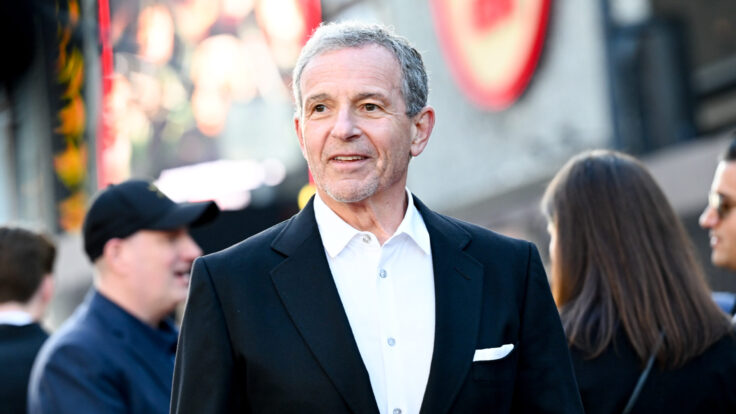
- A Disney Pay “Fantasy”: There’s a slow-burning legal grenade that may have gotten lost amid Disney’s battles with Ron DeSantis, film financiers, Hulu, Charter, copyright termination, and the like. I’m referring to the lawsuit brought by a group of female Disney employees following passage of California’s Fair Pay Act, which effectively lowered the bar for gender-based wage claims. The legal team representing the plaintiffs is now shooting for class certification, asserting that women being underpaid a combined $150 million at Disney is no coincidence. In fact, they contend, the likelihood of a pay gap this large occurring without discrimination is less than one in a billion.
In advance of a November 15 hearing, Disney just filed its response, telling a judge that class certification arguments “rest on statistical nonsense and factual inaccuracies.” Felicia Davis at Paul Hastings emphasizes how Disney is a highly diversified company and it doesn’t make sense to put female producers in the same bucket as, say, women working on cruises. The opposition (which can be read here) adds, “Plaintiffs falsely paint Defendants as a monolithic organization, with a regimented organizational structure, homogenous pay practices, and a small, centralized group making all pay decisions. This fantasy could not be further from reality.”
- Zuck Digs in on Privacy: Public outrage over tech privacy issues comes and goes, but Mark Zuckberg’s Meta appears to be taking the issue especially seriously after the Supreme Court’s Dobbs decision. Meta, a company that has weathered its share of privacy-related embarrassments over the years, has hired multiple AAA white-shoe firms to defend against a lawsuit that asserts that Meta’s user-tracking advertising code, called Pixel, provided to a telehealth startup formerly called The Pill Club, amounted to an illegal intrusion into private data, including prescription requests. TikTok is also entangled in this lawsuit, which emerged following an investigation by Stat and The Markup late last year.
That’s not the only health privacy case that Meta is facing. In fact, many of the attorneys involved in the aforementioned battle—Gibson Dunn partner Lauren Goldman, Cooley pro Michael Rhodes, etcetera—are also embroiled in a related case over university-affiliated healthcare providers that integrated Meta Pixel on their patient portals. On September 7, a federal judge in San Francisco gave anonymous plaintiffs the green light to proceed on claims of wiretapping, California’s invasion of privacy act, breach of contract, and unjust enrichment. You can peruse the ruling here.
|
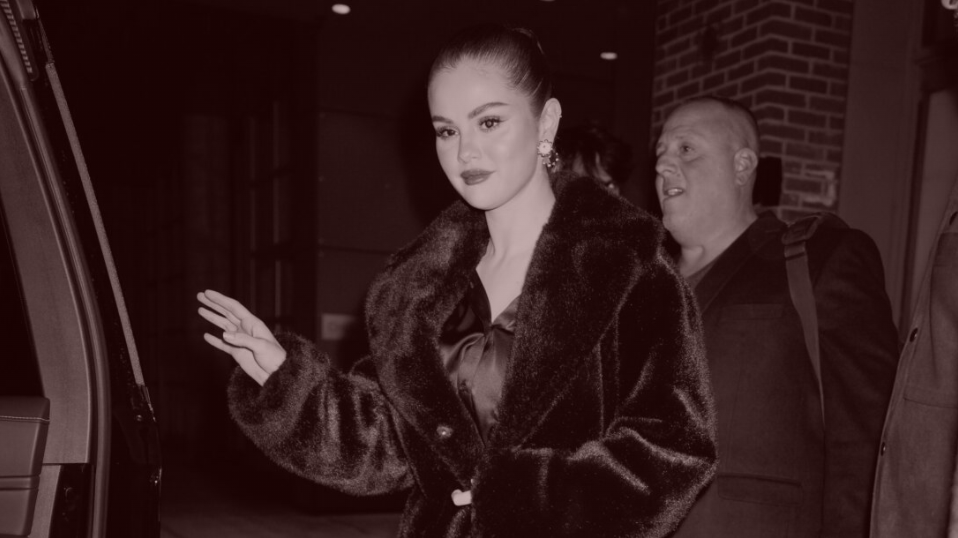 |
| Hollywood’s Digital Botox Dilemma |
| As the A.I. age beckons, three cases could make or break an emerging industry: Selena Gomez’s digital doppelganger, the Grammys fallout from a Drake deepfake, and a face-tuning legal trap. |
|
|
|
| A decade ago, the leaders of the Chinese company Forgame encountered a familiar business challenge as gamers shifted from playing web-based games, which Forgame specialized in, to more casual games on mobile. In response, C.E.O. Dongfeng Wang decided to open American and European divisions, leading to the 2017 launch of Clothes Forever: a Western-friendly mobile game that allowed would-be fashionistas to dress up globetrotting cultural icons like Kim Kardashian, Beyoncé, and Taylor Swift. A surefire hit. Just one big problem…
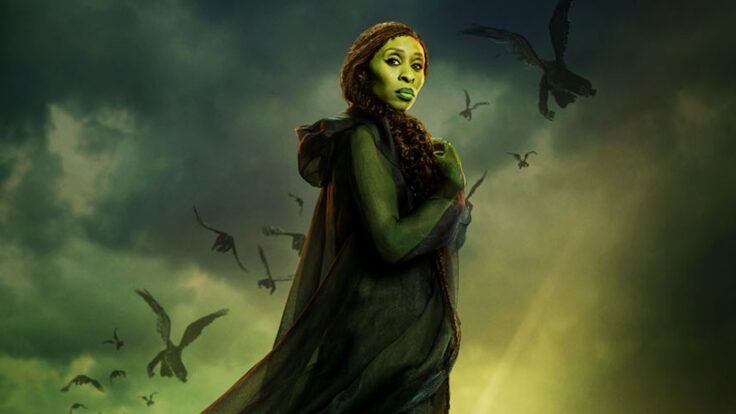
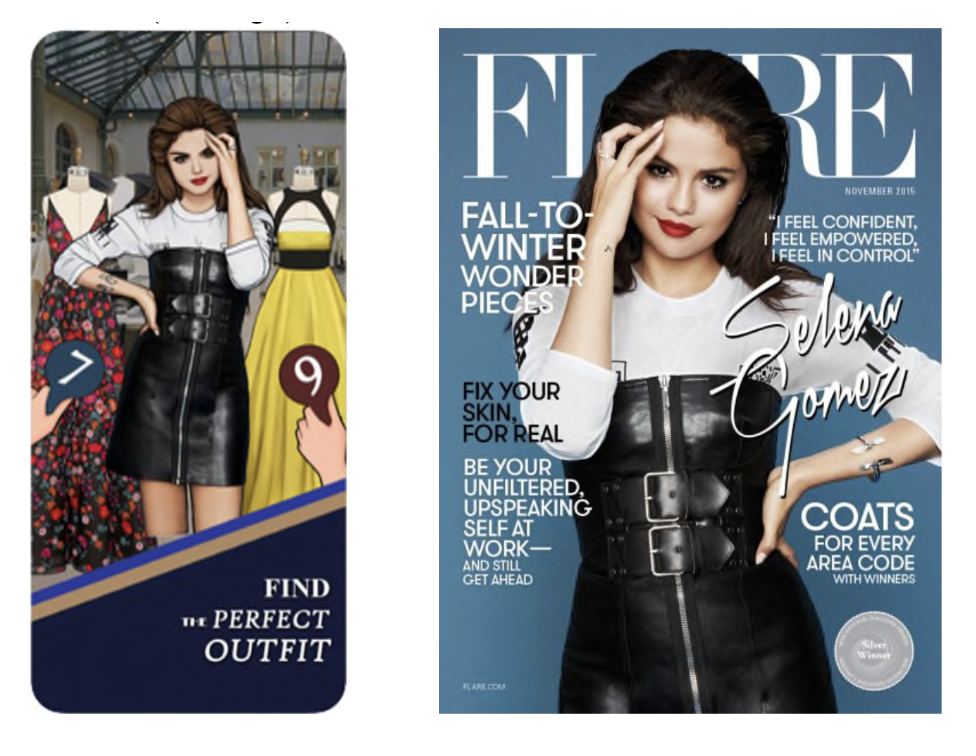
In 2020, the influential musician and actress Selena Gomez sued the company, alleging they ripped off her identity and likeness for the game. The case has flown under the radar, but the outcome of the Los Angeles trial, which begins Oct. 3, could be monumental. The star herself will testify, along with two experts who will discuss what top-flight brands like Adidas, Louis Vuitton, and Coach pay for her endorsement. The latest filing reveals that Gomez will be seeking at least $10 million in compensatory damages for the image below on the left. |
 |
| More importantly, the trial may be a taste of A.I. battles to come. After all, now that generative artificial intelligence is on the scene, it’s easier than ever to create content featuring the image or voice of a famous person. As Congress hears about the possible need for a federal anti-impersonation law to curb deepfakes, it appears likely that celebrities will turn to the patchwork of state laws dealing with digital doppelgangers. When they do, they’ll follow in the footsteps of Gomez.
While the Clothes Forever trial might serve as a harbinger, it’s by no means the first case involving celebrities upset by their portrayal in a game. The band No Doubt once sued over the inclusion of a Gwen Stefani avatar in Band Hero (the case ultimately settled, but not before creating First Amendment precedent). There were a series of cases pertaining to college athletes in video games—a legal campaign that put the NCAA on its heels and led to significant reforms. And who could forget the time that former Panamanian dictator Manuel Noriega sued the creators of Call of Duty: Black Ops II for including him in the game’s storyline? Perhaps less well-remembered is the fact that Rudy Giuliani appeared in court to successfully argue that Noriega’s right of publicity was outweighed by Activision Blizzard’s right to free expression. (Things took a turn for Giuliani after that.)
As for the Gomez suit, Wang’s attorney, Kenneth Linzer, is fighting back with two arguments: that Gomez didn’t file her suit within the statute of limitations, and that Wang can’t be held liable as a corporate officer. Gomez’s attorney Alex Weingarten believes he can show that Wang was an ongoing conspirator who stood to gain personally from the use of Gomez’s image. But Weingarten has yet to address one of Wang’s other affirmative defenses: that any use of Selena Gomez was transformative free speech.
My gut says the superstar will probably get a better reception than Noriega did, even without Giuliani in her corner, and will be favored to prevail in front of a jury. But you never know with these cases. |
| Hollywood’s Next Big A.I. Headache |
|
| Music industry watchers were left scratching their heads when Harvey Mason Jr., the C.E.O. of the group behind the Grammy Awards, said that Heart on My Sleeve, the viral A.I. song featuring uncanny deepfake renditions of Drake and The Weeknd, is “absolutely eligible” for a Grammy “because it was written by a human.” But after a backlash, he changed his tune. “Let me be extra, extra clear,” Mason stated in an Instagram video, a few days later. “Even though it was written by a human creator, the vocals were not legally obtained, the vocals were not cleared by the label or the artists, and the song is not commercially available, and because of that, it’s not eligible.”
Let’s cut Mason some slack; he’s no less enigmatic about the eligibility of A.I. works than the U.S. Copyright Office. You see, while the authorities have put their foot down on registering A.I.-authored work, they are open-minded towards the protection of A.I.-assisted human ingenuity. How to distinguish between the two? The Copyright Office had this to say a few full moons ago: “The answer will depend on the circumstances, particularly how the A.I. tool operates and how it was used to create the final work.”
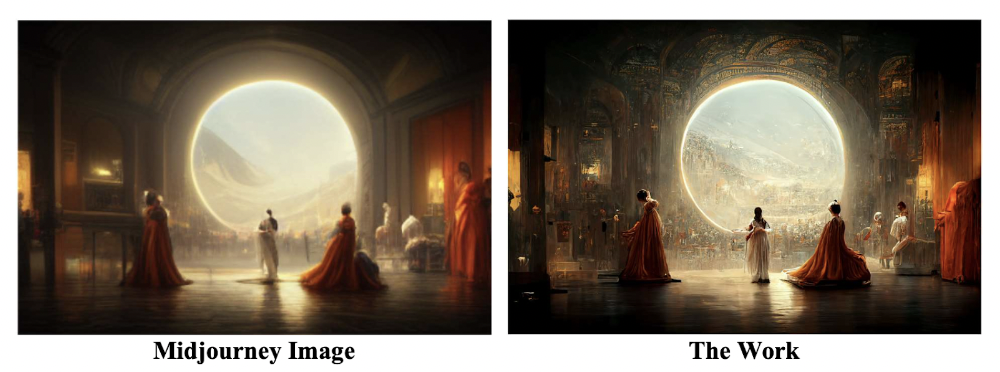
Okay… But does that mean Heart on My Sleeve can or can’t be copyrighted? Here’s where it gets interesting. On September 5, the Copyright Review Board gave Jason M. Allen’s artwork claim, titled “Théâtre D’opéra Spatial,” a firm thumbs-down. This exceptional decision peels back the curtain on thinking by the copyright traffic cops.
Allen had made headlines last year when it was revealed that he had used an A.I. product called Midjourney to bag a top prize at the Colorado State Fair, and a copyright examiner took notice. This examiner then shot off a message to Allen about his use of Midjourney and Allen came clean, admitting that he used the software to birth the initial version, then jazzed it up with some photo editing wizardry. He threw in a fun tidbit: it took him a whopping 624 prompts to coax Midjourney into spitting out the initial version. Unfortunately for him, the Review Board was less impressed with Allen’s creative contribution, especially when he refused to disclaim the A.I.’s “more than de minimis” role. The result? No copyright registration for him. |
 |
| Now, you might think the key takeaway here is the growing headache of registering A.I.-abetted works, but there’s a subtler, more devilish issue lurking for creatives. After all, much of the A.I. use that is infiltrating creative fields is going unnoticed, or is difficult to spot at first glance. Many blockbuster films, for instance, are tapping A.I. for special effects—not to mention digital botox to make actors look eternally youthful on screen. Screenwriters might also be getting a digital helping hand from chatbots in polishing their scripts.
The question for lawyers, of course, is whether this counts as creative input authorship. That’s up for debate, but the Copyright Office is now insisting upon disclosures in registration applications. Despite this requirement, I’ve scoured the records and see little evidence of studios fessing up (even though some astute entertainment attorneys are confessing to me their concerns). The lack of candor, albeit perhaps unintentional, could leave certain claims to ownership vulnerable to challenges—sooner or later—as copyright defendants sniff out omissions. Could Warner Bros. Discovery enforce a copyright claim, for instance, if it turned out that a new superhero’s visual design or backstory was partially generated by A.I.?
It’s hard to predict where all this goes. The TikTok sensation known as ghostwriter977 hasn’t applied for a copyright registration on Heart on My Sleeve just yet. But the real beat drop may land next year, when other songs nominated for a Grammy later spill the A.I. beans to the feds. |
| The First Mega-Trial of the A.I. Age |
|
| The Department of Justice is gearing up for a marathon trial, beginning Tuesday and lasting several months at least, with the singular goal of proving that Google is illegitimately maintaining a monopoly in search and related advertising markets. The forthcoming trial is being touted as the biggest antitrust showdown since the Microsoft case at the turn of the century, poised to make significant precedents and possibly introduce new guardrails for Silicon Valley amid an A.I. arms race.
According to the government, Google has amassed its formidable power through restrictive agreements that make it the default search engine for iPhones, Android devices, and most third-party web browsers. (Google pays Apple billions of dollars a year for this privilege.) Google, on the other hand, responds that those non-exclusive contacts are entirely legitimate, foster innovation, and that the government’s focus is overly narrow, neglecting to acknowledge its many competitors—Amazon for shopping, Expedia for traveling, TikTok and Instagram for recommendations.
While the case ostensibly centers around a search empire, the shadow of A.I. looms large. The government’s team, under the leadership of Kenneth Dintzer, will argue that Google’s ascent in A.I. isn’t mere happenstance. After all, building a potent A.I. requires training data, a resource that Google can amass due to its indexing dominance and user data vacuum machine. Meanwhile, Google’s formidable legal squad, led by John Schmidtlein of Williams & Connolly, may seek to undermine the notion of any unchallenged monopoly by highlighting burgeoning A.I.-powered chatbots as competition for Google’s search engine. Additionally, Google may showcase its investment in generative A.I. as evidence of progress in the marketplace. Notably, among the witnesses (the identities of most remain under wraps), is John Giannandrea, who spearheaded Google’s search product until 2018 before assuming the role of senior vice president of machine learning and A.I. strategy at Apple.
This trial will unfold in two distinct phases, with a liability phase followed potentially next year by a remedies phase. Because of the structure, there hasn’t been extensive discourse just yet of what the remedy would be if U.S. District Court Judge Amit Mehta concludes that Google has violated antitrust law. A monetary fine isn’t on the table, as the government is instead pursuing an equitable remedy that may guide Google’s future conduct. This might encompass the reformation of contracts or even the forced divestiture of assets. |
|
|
- Speaking of A.I. and likeness rights, a judge just gave the green light to a lawsuit challenging an app that allows users to swap their face with actors, musicians and athletes in popular entertainment. Not transformative, says the judge.
- Back in July, I focused on a trial where a judge had to decide whether Argentina had to pay $16 billion or merely $5 billion for seizing and nationalizing an energy company. Well, the judge decided on the larger figure—an extraordinary victory for litigation funder Burford Capital, which bought a huge stake in the outcome.
- Nobody is surprised anymore by anything that comes out of Trump’s mouth. Nevertheless, the 479-page transcript of his deposition in the fraud suit brought by the New York attorney general is now public, and features him comparing his properties to Renoir paintings and how he could sell his golf course to the Saudis. He’s trying to make some point about the floating valuation of his assets.
- Alec Baldwin is no longer facing criminal charges for the Rust gun tragedy, so does that mean the civil suits may proceed? No way, says his attorney. Not while the investigation continues and Baldwin faces an untenable choice of asserting his Fifth Amendment rights or losing the case. There’s certainly a lot of precedent to back up that assessment, although those other cases didn’t involve a defendant who gave a long interview with George Stephanopoulos.
- Finally, a new defamation suit that’s worthy of everyone’s obsession: In this one, ex-Greenberg Traurig partner Allan Kassenoff claims that TikTok influencer Robert Harvey, who has more than 3 million followers, delved into his divorce case and falsely portrayed him as an abusive spouse and father who took advantage of a corrupt matrimonial court, eventually culminating in the suicide of his ex-wife. The attention, he adds, caused him to lose his job and biggest client.
|
|
|
| That’s it for today. Look forward to seeing some of you at the anniversary party. |
|
|
|
| FOUR STORIES WE’RE TALKING ABOUT |
|
|
|
|
|
 |
|
|
|
Need help? Review our FAQs
page or contact
us for assistance. For brand partnerships, email ads@puck.news.
|
|
You received this email because you signed up to receive emails from Puck, or as part of your Puck account associated with . To stop receiving this newsletter and/or manage all your email preferences, click here.
|
|
Puck is published by Heat Media LLC. 227 W 17th St New York, NY 10011.
|
|
|
|