{{ 'now' | timezone: 'America/New_York' | date: '%b %d, %Y' }} |
|
|
Hi, and welcome to Line Sheet, finally settled in Paris. Has the U.S. government
shut down yet? Over here in France, there’s an air traffic control strike October 7-10. (I’m serious!) I’ll have more on this consequential Fashion Week soon, starting with tonight’s Saint Laurent extravaganza.
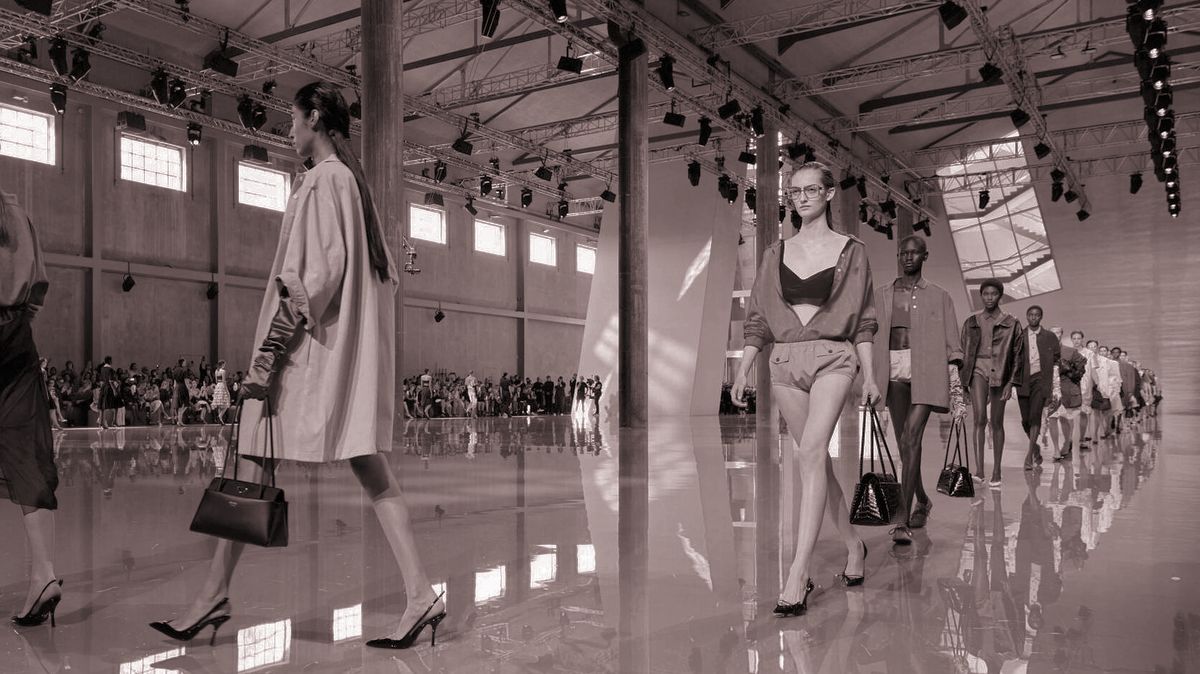
Today, though, let’s talk Milan. This season, I was particularly charmed by interesting, if not entirely successful, runways, new friends, and a better Airbnb. (I also had a great time at the Max Mara dinner. Thank you, Judgie.) Consolidation comes for us
all, but it’s really coming for Italian fashion as independent, family-run companies contemplate M&A, and the manufacturing business faces a complicated reckoning. More on that below, plus the latest on Silvia Venturini Fendi’s departure from her family’s house as Maria Grazia Chiuri waits in the wings. Also, I have a mini Milan shopping report.
Programming note: Tomorrow on Fashion People, The New York
Times’s Jacob Gallagher is back. Get excited. We rate the Milan shows, preview the Paris runways, and discuss why sneakers are uncool these days. Listen here and
here.
For those of you also in Paris: I went to see the new exhibit Virgil Abloh: The Codes in a 13,350-square-foot gallery in the Grand Palais. It features two decades of work from Abloh’s personal archive, but it really feels like walking through the past 30 years of pop culture history. I’ll write more tomorrow about the show, which runs
through October 9, but I can relay for now that it’s totally essential. Book your own tickets here. (Not for nothing, Sarah Andelman also built out a mini Colette populated with items designed by Abloh and friends.)
Mentioned in this issue: Demna, Gucci, Giorgio Armani, Brunello Cucinelli, Celine, LVMH, Kering,
Donatella, Dario Vitale, Miuccia Prada, Spencer Singer, Bottega Veneta, Alessandro Michele, Matthieu Blazy, Silvia Venturini Fendi, Jonathan Anderson, and more…
|
|
|
Two Things You Should Know…
|
- Chiuri
stays in the family: Given the apparent messiness of her exit from Dior, it was unclear what the future held for Maria Grazia Chiuri. Would the formidable and commercially successful designer stay at LVMH? Would she go to another group, or simply retire? After all, she has nothing left to prove, and she’s got other passions. (She’s currently restoring a theater in Rome.)
Well, it seems the powers that be at the group of groups got their wish: Chiuri is headed to Fendi, where
she’ll be able to live in Rome, and design for the same customer who loved her work at Dior. But it also seems that Chiuri will take over all of Fendi, including menswear, after today’s news that Silvia Venturini Fendi will step down as the house’s lone creative director and move into an emerita role. (Venturini Fendi, of course, began designing men’s and accessories for her family’s namesake in 1992. She’s had a great run for someone who didn’t have to stay around.)
After the
departure of Kim Jones last year, Venturini Fendi continued showing good women’s collections, including last week’s. (I loved the basketweave fur coat that looked like a potholder you’d make at summer camp.) Anyway, congrats to all, and to LVMH for keeping Chiuri in the family. Fendi will make a formal announcement soon—maybe even the next day or two. - Yes, I would indeed pay €300 for these scissors: I only visited three shops during my
time in Milan this past week: Prada (that was personal, shout-out to Beatrice), Dries Van Noten’s new beauty and accessories store on Via Brera, and J.W. Anderson’s revamped curiosities shop on Via Sant’Andrea. At Dries, the company’s in-house florist was rearranging flowers while a few customers drifted around the shoebox of a store, which was heavily populated (but not overstuffed) with perfumes, lipsticks, and a selection of accessories, mostly jewelry and handbags. The
Puig-owned label, whose creative director, Julian Klausner, will show his second women’s collection this week, has cornered the market for evening bags. The envelope clutches, created with archival fabric, are not too big, not too small, and not too obvious. They are also under €700, which makes them probably one of the most affordable and worthy designer bags available. (Dries is known for its sensible prices.)
Meanwhile, the revamped J.W.
Anderson store, now a curiosities shop, also aimed to sell delightful things in limited quantities—like a Lucie Rie–designed Wedgwood teacup and saucer, or a vintage English watering can—amid volume-driving loafer bags and novelty rugby shirts. Andrew Webster, the brand’s head of image—who also happened to be Anderson’s former boss at Prada and JWA employee No. 1—regaled us with a tale of the Stork Scissors, originally named to clamp a baby’s umbilical cord, which Anderson chose out of a book of 5,000 different Ernest
Wright styles. (It was nearly impossible to find the molds.) There were only 400 pairs produced. Perhaps €300 is just about right for a piece of history.
|
|
|
News and notes on the plots, whispers, key players, and dramatic twists during fashion week
in Milan. |
|
|
On the face of it, Paris is the center of the fashion industry. But if you want to know what’s really
happening to fashion right now, you have to go to Milan, where the drama is playing out in real time—from the crisis on the manufacturing floor amid a government crackdown on working conditions all the way to the runway. The week began with Demna’s debut at Gucci, and ended with a starry tribute to Giorgio Armani. In between were highs and lows, including
the scandal of Brunello Cucinelli’s alleged operations in Russia. In the background, of course, were perennial ruminations over the industry’s macroeconomic headwinds and the seeming impotency of any person or brand or group to combat them. Over dinners, at parties, on the sidelines of shows, the conversation was the same:
What used to work doesn’t anymore, and what used to be okay isn’t. |
|
|
I was bracing for Versace to be weak. After all, the company had previously confirmed that Dario
Vitale, the new designer, would be making his debut with an “intimate presentation” format instead of a runway show. Vitale, who most recently worked at Miu Miu, spent more than 20 years at the Prada Group—indeed, I’ve heard people refer to him as a “third son” of Miuccia Prada. (Not sure how accurate that is, but there’s no denying they were close.) Meanwhile, Versace, currently owned by Capri, is in the process of being acquired by the Prada Group, with the
deal likely to close by mid-October. The assumption was that there was an inclination on both sides not to do anything extravagant since everything was going to change in a month anyway. It all felt very precarious. |
Photos: Courtesy of Versace |
In the end, Vitale did a real show in the oldest museum in Milan, in a series of tiny rooms, which were
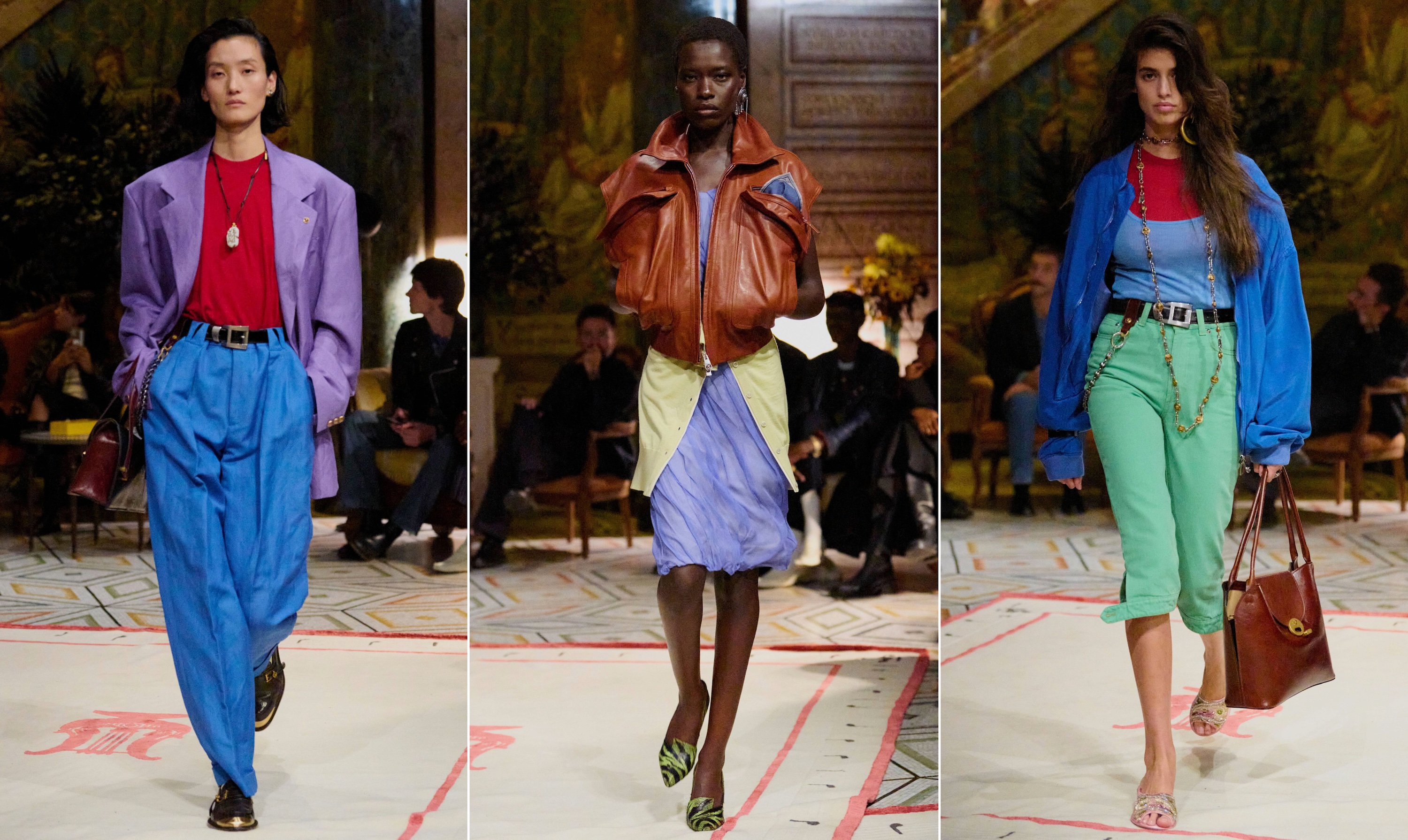
decorated with scenes from real life—including a bed made up with his very own sheets. As the models whipped around corners, I was startled by what I saw: an homage to the Gianni Versace of the 1980s, styled to the nines by the young talent Spencer Singer. (He typically dresses pop stars, not fashion models.) I was prepared to hate it, but instead I fell hard. It was so fresh, the fashion word du jour. I loved the teal capri
pants; the purple soft-shoulder blazer; the woven leather pumps with gathered fabric sticking out from the top; the striped, multicolored jeans; the chain wallet. Even the awkward crotch on the pants. (Sort of.)
I was reminded of Alessandro Michele’s polarizing debut at Gucci, which ruffled feathers for looking too much like a set of clothes pulled from a fancy-dress trunk. Vitale, on the other hand, created a film set with 1980s Milan as the backdrop.
Love it or hate it, Versace is multidimensional once again.
In a lengthy interview with reporters after the show, Vitale described his process in depth. I asked who picked the songs, and he responded that he did: “Every. Single. One.” I had a feeling. Everything about Vitale’s first go was studied and deliberate. I felt a pang of nostalgia when I heard “Everything She Wants” by Wham!, “Little Red Corvette” by Prince, and “Here Comes the Rain Again” by Eurythmics. Vitale
claims he’s not a nostalgic person, himself—sure, neither am I—but there’s something about all these kids born in the early 1980s coming up and leading houses that’s making me want to listen to Sheila E. on repeat.
In some ways, Vitale’s first Versace collection was less conversant with his alma mater, Miu Miu, and more in sync with Michael Rider’s first Celine collection, which reminded me of Willi
Smith’s New York. They’re channeling the look of their childhoods, and many of our childhoods. The question, of course, is whether Versace has the capability to sell this. Like many Italian companies, Versace has an excellent factory network, but it’s unclear whether they’ll be able to feed the current organization into the Prada machine fast enough to get the product to look right.
In this case, I would be less concerned about alienating the current customer—there are
ways to get around that—and more about satisfying the potential customer. It’s all quite complex and personal. Donatella Versace, the former designer and global brand ambassador, didn’t show up on Friday night or post about the show on social media, despite being known to admire the work of Vitale. (Miuccia Prada wasn’t there, either.) Here’s hoping whatever is happening behind the scenes gets sorted, because they have a hit on their
hands. |
The Versace show was a reminder that sportswear is really, truly taking over the world. And there’s no
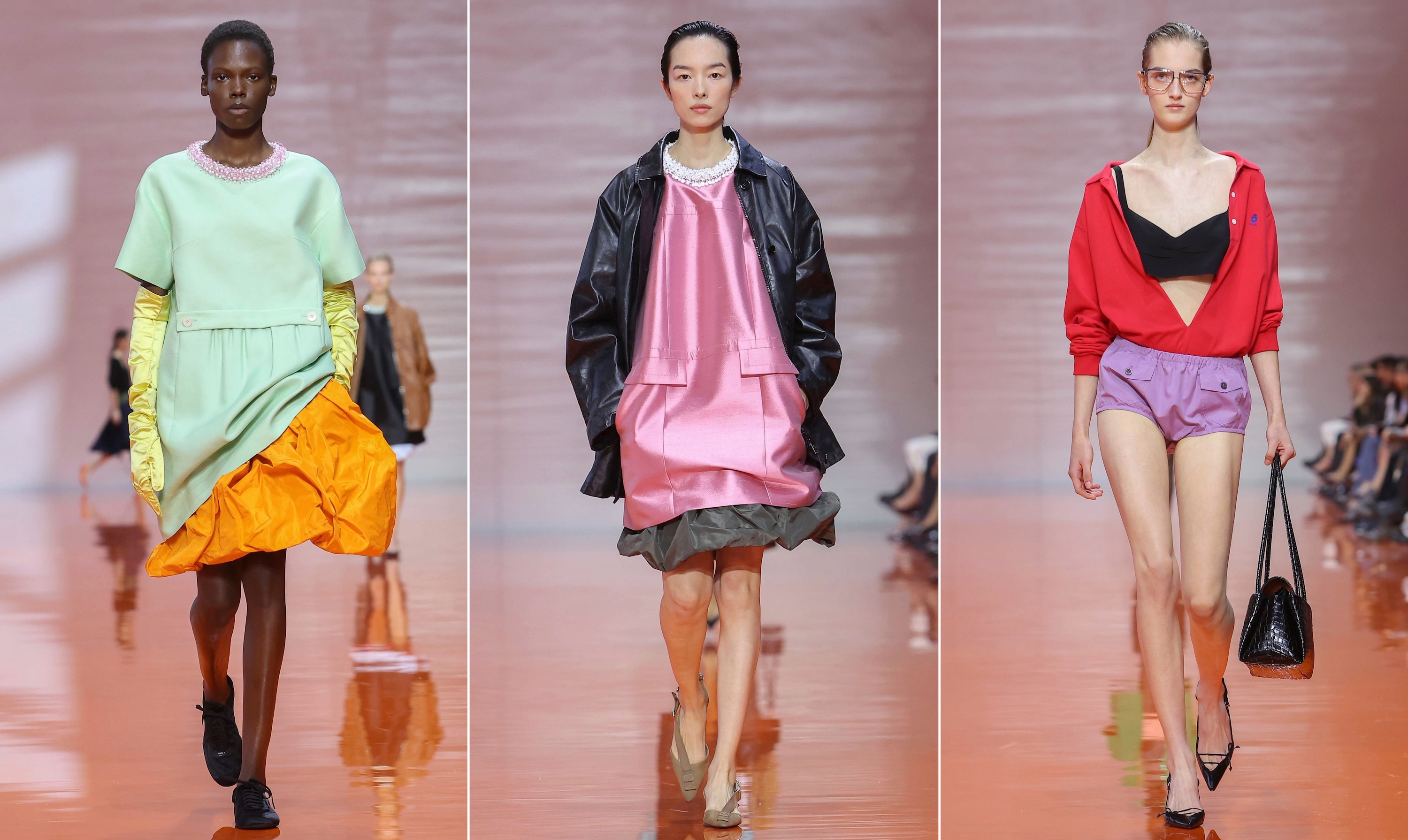
designer more aware of what’s happening in the “real world” than Miuccia Prada and Raf Simons, who expressed a desire backstage to show the “freedom of dress.” (No one dresses better than those two, by the way: Miuccia in an old Prada dress and orange beaded bandana; Raf in a crewneck sweater and office-park trousers.) |
Photos: Courtesy of Prada |
Simons noted that the world is so “hardcore” these days, and yet there’s still so much beauty. It seemed they
were trying to capture the play between the utilitarian and superfluous, the barn jacket worn with the opera gloves being the most obvious example. (The stylists loved to see it, and so did I. Also, damn, the colors. Nobody does it better.) I almost couldn’t believe they had the nerve to put that family crest on the pique polos; it could read so bougie, but they’re willing to make us uncomfortable. There was also a subtle nod to that tension on top of a vintage-style heel, the throat of
which was elasticized like a pair of cheap slip-ons from the five and dime. There’s a fine line between pleasure and torture, and they walk it time and again. |
|
|
The Prada Group remains on the up, and it seems that Kering is being viewed as a medium-term investment once
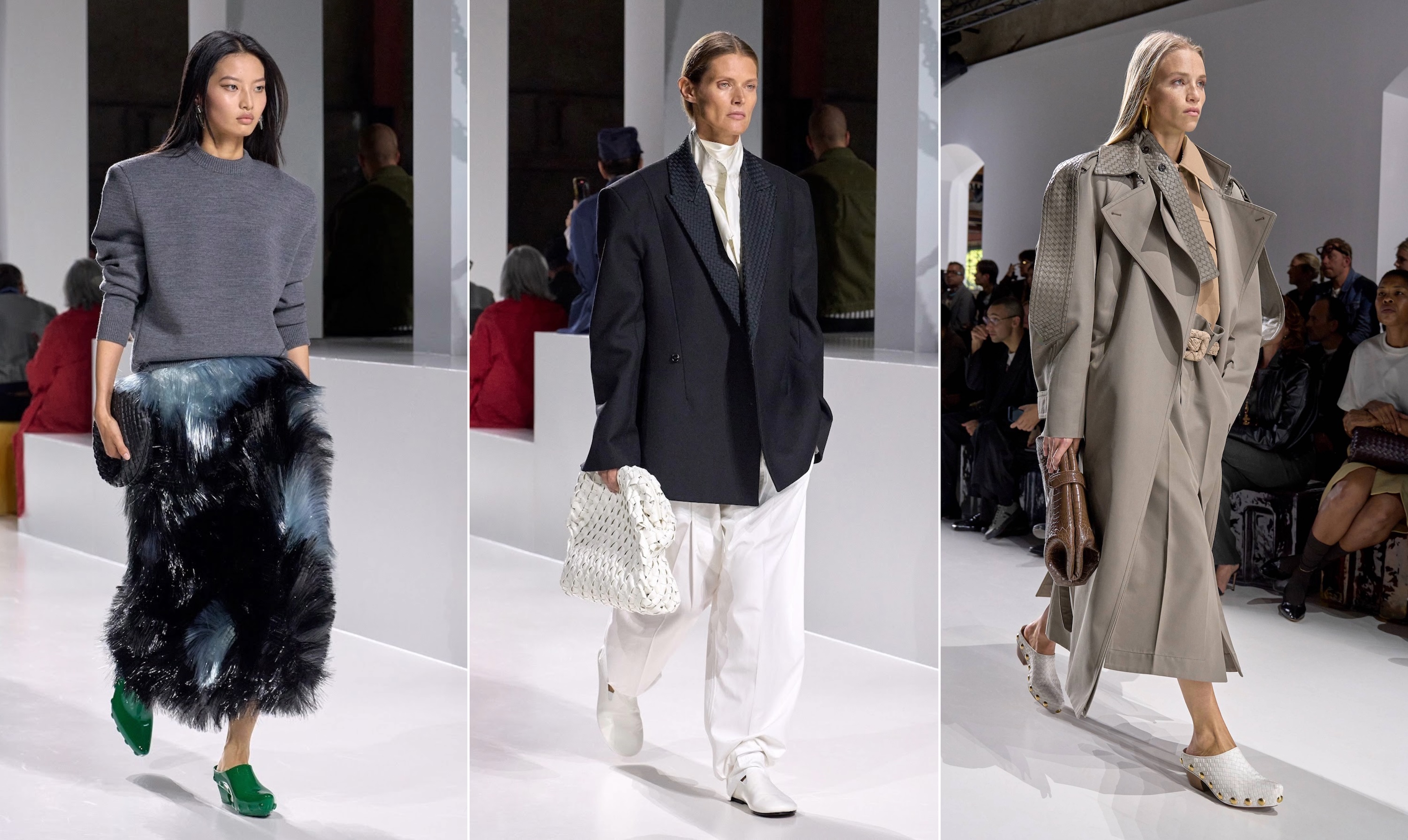
again, thanks to Demna’s “I got this” attitude—he delivered the goods, after all—and Louise Trotter’s respectable first showing at Bottega Veneta on Saturday night. Trotter is a real grown-up. She’s been running houses forever—Joseph, Lacoste, and most recently Carven—and knows what she likes and who she is as a designer. But she’s never been in the big leagues, a.k.a. LVMH or Kering, and so her world has suddenly broken open. I asked her how it felt to design her first
collection for Bottega Veneta, with access to more resources than she’s ever had before. “I’m in the candy box,” she said. “It’s been the most wonderful experience for me… the willingness to always say, Let’s try, let’s try, let’s try.” |
Photos: Courtesy of Bottega Veneta |
Her collection was grounded in tailoring—even the dresses sat on a canvas—and true to her personal aesthetic:
oversize suiting, everything low to the ground. While Matthieu Blazy’s Bottega Veneta was a pure fantasy—it lifted you up—Trotter brought it back down to earth. (Although it wasn’t entirely without play; folks swooned over the spiky skirts worn with spongy sweatshirts.) Trotter is not a directional designer. But what’s nice about that for Kering is that the customer overlap between Blazy’s idea and Trotter’s is likely quite high—ambassador Julianne Moore, who sat in the front row with her husband, convincingly wears both. I’d say Trotter’s challenge is that she has not been pushed technically before, and so many of the fabrics read as heavy. But this was a solid start, one that should help keep the momentum going at Bottega.
I didn’t stay in Milan for the Armani finale, an ode to both Milan and Pantelleria, one of Giorgio’s favorite islands. (It looked spectacular. Richard Gere was
there!) But I was able to make the Emporio Armani show on Thursday, where the runway simply stood empty for a moment—a fitting tribute to the late designer. The show, as always, was gorgeous, if indistinguishable from any others. Consistency was the genius, and albatross, of Armani.
Before his death, Armani saw the writing on the wall for independent Italian fashion brands, which is ostensibly why he arranged for his business to be sold. A lot of what this week came back to for
me was infrastructure. There is so much of it in Italy, but is it the right kind? Ferragamo can make a great pair of shoes, but can they support the efforts of Maximilian Davis, who designs elegant clothes for adults? (Consider the monocolor trench coats with printed silk paneling on the back.) At Moschino, I see another situation where there’s no there there for Adrian Appiolaza. Is he a good designer? Probably. But is there a lack of support around
him to be able to do something meaningful? (Founder Franco Moschino’s whole interrogation of the fashion industry needs to be entirely turned on its head.) Many of these storied houses remained in stasis as the world moved on, and Armani understood that. |
I can’t get enough of Rent the Runway founder Jenn Hyman’s TikTok posts.
We’ve entered a new era of executive branding. I hope to have Jenn on Fashion People to discuss. [Jenn on the Caastle scandal and weaponizing incompetency]
I once sat next to
Zadie Smith at a dinner and was so nervous that I didn’t once ask her, What are you working on? If I ever get another chance, I’ll tell her how much I liked this essay about writing essays. [The New Yorker]
The excerpt from Marisa Meltzer’s new biography of
Jane Birkin. [The Cut]
Unfortunately there is no sneaker that looks good anymore, as Becky Malinsky explains. I agree with Becky that the answer is a Western boot and a dance shoe in the summer. (Yes, I’m the friend Becky mentions who wore a pair of sneakers to a fashion
show this past run in New York and lived to regret it.) [5 Things You Should Buy]
Laura Reilly’s absolutely brilliant Magasin brand ranking is back. Love that a belt brand outshined some of our favorites.
[Part 1 and Part
2]
So smart to have Derek Blasberg profile the legendary Verde Visconti, who reveres her boss as much as the rest of us. “When she comes into a room, everybody goes bonkers. It’s incredible.” [W Mag] |
Until tomorrow,
Lauren
P.S.: We use affiliate links because we are a business. We may make
a couple bucks off them. |
|
|
Puck’s daily art market email, anchored by industry expert Marion Maneker, offers unparalleled access to the mega-auctions and
galleries, elite buyers and sellers, and the power players who run this opaque world. Wall Power also features Julie Brener Davich, a veteran of Christie’s and Sotheby’s, who provides unique insights into how the business really works. |
|
|
Puck founding partner Matt Belloni takes you inside the business of Hollywood, using exclusive reporting and insight to explain
the backstories on everything from Marvel movies to the streaming wars. |
|
|
Need help? Review our FAQ page or contact us for assistance. For brand partnerships, email ads@puck.news. You received this email because you signed up to receive emails from Puck, or as part of your Puck account associated with {{customer.email}}. To stop receiving this newsletter and/or manage all your email preferences, click here. |
Puck is published by Heat Media LLC. 107 Greenwich St, New York, NY 10006 |
|
|
|