|
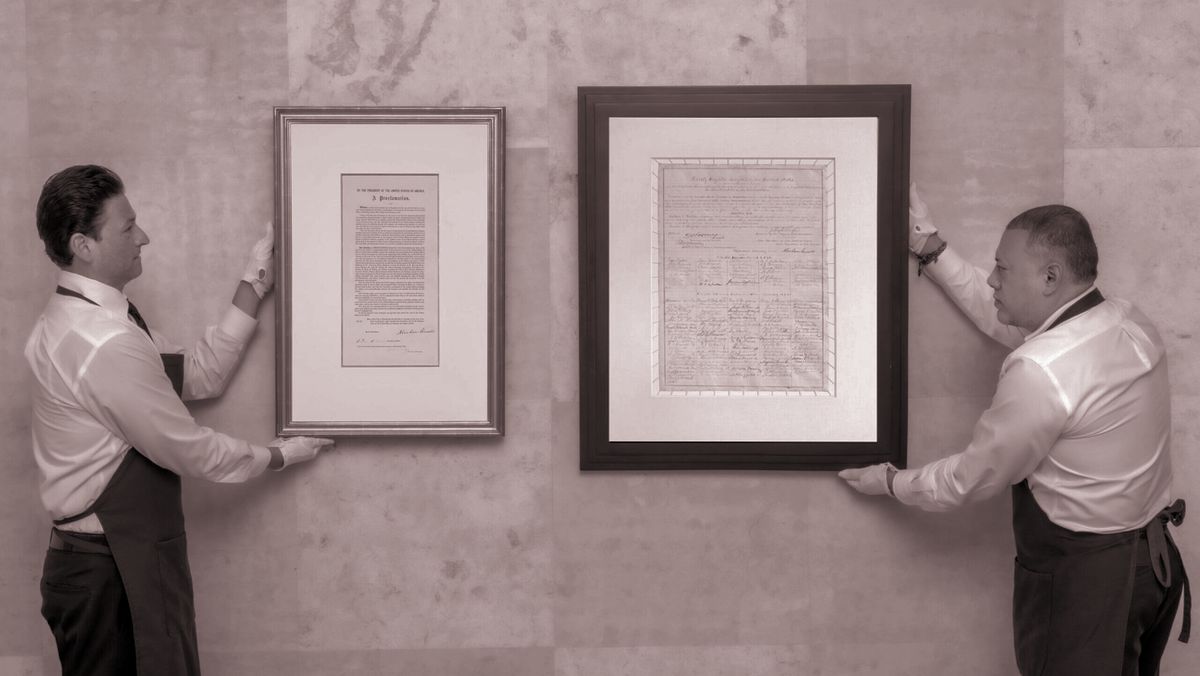
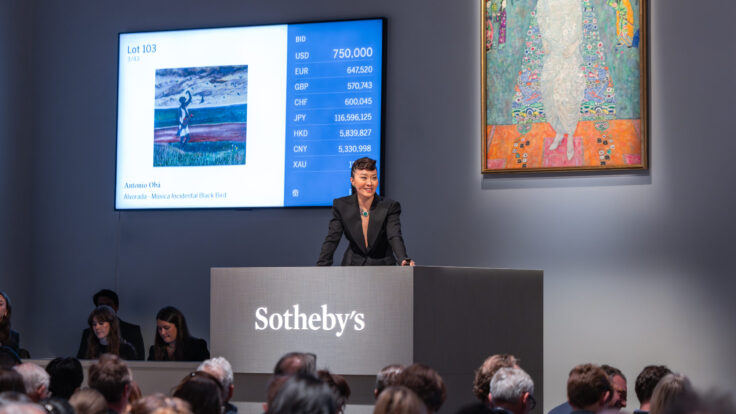
Welcome back to Wall Power. I’m Marion Maneker. Tonight, Julie Davich looks at the market for “freedom documents,” which seems to be accelerating as we move toward the semiquincentennial of American independence next year. On Thursday, Sotheby’s will auction two rare examples of such documents, signed by Abraham Lincoln himself: a copy of the Emancipation Proclamation, and one of the 13th Amendment, which together abolished slavery in the United States. History, and the documents that bring us into direct contact with it, is the subject of tonight’s newsletter.
But first…
|
- Love and Letters: I had held off on visiting the reopened Frick until its new show, Vermeer’s Love Letters, opened on Wednesday, hoping to avoid the crowds. But my strategy was no match for the incredible demand to see the newly expanded museum, and the new show will do nothing to ease the jostling and shuffling. Of the three dozen surviving works by Johannes Vermeer, only six depict the theme of love letters, a staple 17th century genre. This show unites three of these paintings: The Love Letter, from the Rijksmuseum in Amsterdam; Woman Writing a Letter, with Her Maid, from Dublin’s National Gallery; and the Frick’s Mistress and Maid. You can think of these works as the Sex and the City of a prosperous and thriving Holland: Through a popular medium, we get to see the drama-filled interior lives of well-dressed and sophisticated women.
|
|
Johannes Vermeer, The Love Letter (c.a. 1669-70), Rijksmuseum, Amsterdam. Photo: Courtesy of The Frick Collection
|
- Vermeer’s artworks repay close observation. Two people hovered inches from The Love Letter for so long during the press preview that an observant guard approached me to acknowledge how patiently I’d been waiting my turn. I appreciated that, but pointed out that lingering and close viewing were, indeed, what everyone was there to do. In each of these works, women are shadowed by their maids, who function as messengers, go-betweens, and intimate doppelgangers—and also help signal the emotional content of the scene depicted. In The Love Letter, for instance, the maid seems sympathetic and calming to her alarmed mistress; in Mistress and Maid, the well-dressed author of the letter seems to be having second thoughts prompted by her maid’s query (or, perhaps, mischief-making); in Woman Writing a Letter, the maid stares out the window while her mistress is absorbed in writing—perhaps daydreaming, but with her mouth slightly open as if about to drop an incendiary comment. In other words, these high-key works are intentionally filled with potential storylines.But if drama isn’t your thing, come to admire the way Vermeer paints light. Each of the women in these three paintings is wearing pearls—17th century bling—allowing Vermeer to paint subtle, shimmering accents that draw the eye and direct the viewer. In The Love Letter, a preposterously large pearl on the left ear of the central figure seems to sit at the dead center of the painting, which is composed from the viewpoint of an outer chamber. The pearl draws our eyes as powerfully as any zoom shot in a contemporary drama.
|
|
|
|
A MESSAGE FROM OUR SPONSOR
|
The first steps towards a masterpiece starts with a dream. The all-electric BMW i7 – the evolution of brilliance. Learn more at
BMWUSA.com
|
|
|
- Glenn Ligon at the Brant Foundation: I also finally made it over to see the Glenn Ligon show at the Brant Foundation Art Study Center in the East Village. (The trip doubled as an excuse to grab a late breakfast of an egg and cheese scallion pancake at the new outpost of Win Son Bakery. I’m still working my way through that menu.)
|
|
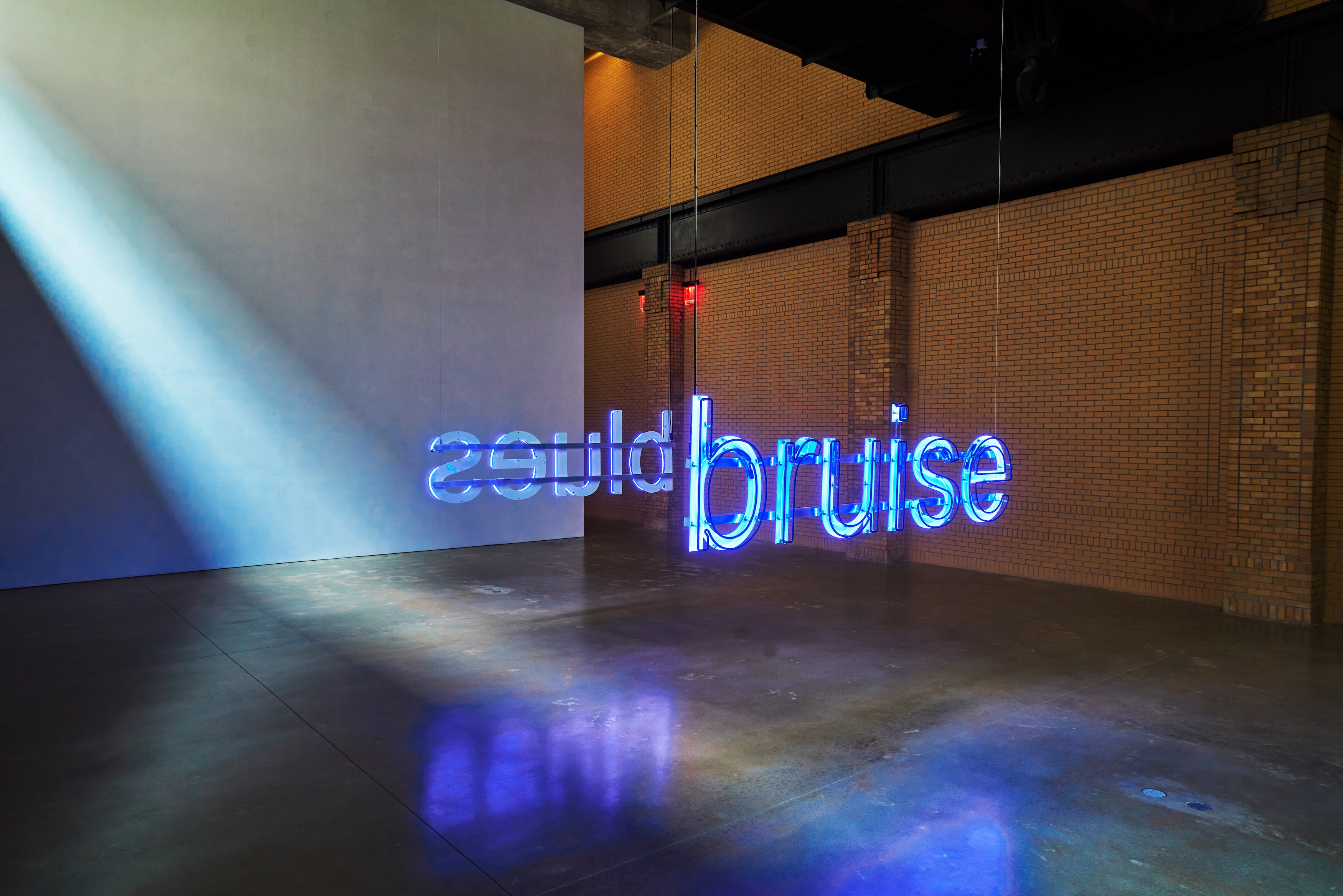
Glenn Ligon, Untitled (Bruise/Blues) (2014), The Brant Foundation, New York. Photo: Sean Keenan
|
- The sky-lit gallery at the top of a former electricity substation contains some of the artist’s haunting word paintings and two neons, including Rückenfigur, from 2009. That one is named for the figure-painted-from-behind convention most famously used in Caspar David Friedrich’s Wanderer, but here the image is the word “America” with some of the letters turned backward. Untitled (Bruise/Blues), from 2014, is in the main gallery below, and consists of back-to-back blue neons of the two words suspended in the darkened hall. There’s a multimedia work, Live, from 2014, in which seven video screens play staggered loops of a clip from Richard Pryor’s Live on the Sunset Strip comedy performance. Ligon’s works, especially the neons and video pieces, are more institutional than domestic, which means they’re better experienced over time. So if you can, try stopping by the Brant Foundation more than once. You’ll get more out of it.
|
- Murakami at Gagosian: It’s hard to figure out what to make of Takashi Murakami’s new show at Gagosian, JAPONISME → Cognitive Revolution: Learning from Hiroshige. Some of the show’s 121 paintings, which copy and embellish upon ukiyo-e prints and the impressionist paintings they inspired, are exact copies, down to the signatures, of works by Monet, Cézanne, van Gogh, and Whistler, or of ukiyo-e prints with occasional additions of characters from Murakami’s visual universe. Other works are Murakami’s distinctive reinterpretations of some of the more famous depictions of Mount Fuji.Whatever the show’s commentary on influence in art, it seems to be attracting viewers. When I walked in on a recent Thursday afternoon, the gallery had a healthy crowd that one Gagosian staffer—who also seemed to be helping a collector choose one of the small paintings—described as lighter than usual. My understanding is that sales to private buyers and institutions have been very solid, which is noteworthy, because Murakami’s art, while popular, isn’t at all cheap. The small paintings were described to me as “under $100,000,” and the larger works go for $1 million or more. Elsewhere, a recent Murakami show that originated at The Broad in Los Angeles is now at the Cleveland Museum of Art.
|
|
|
|
A MESSAGE FROM OUR SPONSOR
|
The first steps towards a masterpiece starts with a dream. The all-electric BMW i7 – the evolution of brilliance. Learn more at
BMWUSA.com
|
|
|
- Atsuko Tanaka at Paula Cooper: After I slipped out of Gagosian on 21st Street, I took a few steps down the block to Paula Cooper to see the gallery’s combined show of Yayoi Kusama and Atsuko Tanaka. The two artists, born three years apart, have some commonalities, and have traveled parallel paths through postwar contemporary art in Japan and through abstraction. That said, while taking nothing away from the Kusama portion of the show—check out what she was able to do with blank red-rimmed stickers—it seems like more of a device to raise the stature of Tanaka, who died in 2005.I had never seen a show of Tanaka’s work, but I’ve clocked her art scattered through fair booths and always stopped to take notice. She’s one of those artists who locked into a device—in this case circles connected by lines—and then spent a lifetime exploring it. Anyway, I was grateful for the opportunity to learn more about her. And you have until the end of the week to do the same. The show closes on June 27.
|
|
|
|
They’re actually worth many millions, and the market is heating up as the U.S. approaches its 250th birthday. On Thursday, Sotheby’s is selling rare copies of the Emancipation Proclamation and the 13th Amendment to the Constitution—both of them signed by Abraham Lincoln, himself.
|
|
|
As the U.S. approaches its 250th birthday next year, the market for American “freedom” documents has never been stronger. In 2021, Sotheby’s auctioned a historic first printing of the Constitution for $43.2 million, and this past October, Brunk Auctions sold an original printed, signed archetype of the Constitution for $11 million. Then, last month, Freeman’s Hindman had a sale of Lincolnia, including many manuscripts and documents from throughout Abraham Lincoln’s life, that doubled its presale estimate to make $7.9 million. Given the interest in the field and the growing scarcity of good material on the market, dealers and consignors have been eager to jump in.
This Thursday, Sotheby’s is selling rare copies of the Emancipation Proclamation, by which Lincoln ordered slavery abolished in the Confederacy in 1863, and the 13th Amendment to the Constitution, ratified in 1865 to ban slavery nationwide—both of them signed by President Lincoln, himself. The former is estimated at $3 million, and the latter at $8 million. It’s one thing to read transcriptions of historic texts, but it’s another to experience the original documents once held by those who made history happen. “They’re a way of physically manifesting the concept of freedom and how it’s achieved,” said Selby Kiffer, who has been a books and manuscripts specialist at Sotheby’s for more than 40 years.
Lincoln’s original, handwritten Emancipation Proclamation draft was destroyed in the Great Chicago Fire of 1871, but there are 27 known, full-text copies signed by Lincoln—those that remain from the 48 copies initially made for sale, at $10 apiece, at Philadelphia’s Great Central Fair, as part of a fundraising effort for sick and wounded Union soldiers. Most are in institutional collections, and Sotheby’s, which is selling one of the few still in private hands, is expecting a strong seven-figure result for this one.
|
|
|
The last auction price for this particular copy was $669,500, against an estimate of $600,000, achieved at Christie’s in the 2002 sale of the Douglass Campbell collection. The financier Steven Galbraith later purchased it, in a private transaction brokered by appraiser Seth Kaller, for the purpose of lending it to the National Constitution Center in Philadelphia, according to a 2007 press release. The loan was then extended through 2024.
There are fewer opportunities to buy this type of material than there were 30 years ago. That’s why the Freeman’s Hindman sale of Lincolnia did so well—it was a chance to buy items that had been off the market since the 1980s and 1990s. The current demand for “freedom documents,” Kiffer told me, transcends the traditional Americana or manuscripts markets, and attracts private American masterpiece collectors across categories, such as Ken Griffin, who bought the $43 million Constitution. Griffin announced last month that he’s loaning the document to the National Constitution Center—which is not a collecting institution—along with a copy of the Bill of Rights that he was not known to own. He’s also donating $15 million to fund a new Founding Principles exhibition, marking the institution’s largest renovation since 2003.
The 13th Amendment has also soared in the national consciousness in recent years, especially since Ava DuVernay’s award-winning 2016 documentary, 13th. After Congress passed the law on their second attempt, on January 31, 1865, and sent it to the states for ratification, “there was a feeling in Washington that this was a great moment in the nation’s history, and needed to be commemorated in some way,” said Kiffer. Lawmakers passed around manuscripts of the Amendment on vellum for one another to sign. “People were proud to put their names on this,” Kiffer added.
The version Sotheby’s is selling is one of only 15 of these copies, from February 1865, signed by Lincoln himself—just two months before he was assassinated. It’s one of only nine copies also signed by the senators and congressmen who passed the amendment. Only four of those copies are still in private hands, and this one has the most signatures of supporting legislators. Ink on vellum sometimes blurs, since it’s not absorbed the way it is on paper, but on this copy the text is sharp, distinct, and variably colored, adding visual interest. It was last sold at auction at Christie’s, also in 2002, from the Malcolm Forbes collection, for $721,000 against an estimate of $300,000. It then passed to the current consignor via private sale, as with the Emancipation Proclamation, also brokered by Kaller in 2007, according to the provenance in the catalogue.
Of course, this historic legislation would not exist without Lincoln’s previous executive order outlawing slavery in the Confederate states. As the Constitution Center’s then-president and C.E.O., Joseph Torsella, said when Galbraith loaned his copy to the institution nearly two decades ago: “With the possible exception of the Declaration of Independence, no document has had a more profound impact on the American vision of liberty. … It deserves to be seen by, and to inspire, generations to come.”
|
|
That’s all for today. See you on Tuesday.
M
|
|
|
Need help? Review our FAQ page or contact us for assistance. For brand partnerships, email ads@puck.news.
You received this email because you signed up to receive emails from Puck, or as part of your Puck account associated with . To stop receiving this newsletter and/or manage all your email preferences, click here.
|
|
Puck is published by Heat Media LLC. 107 Greenwich St, New York, NY 10006
|
|
|
|


_01JYCPTKNPCYSMWGH6606R9XJ5.jpg "The Love Letter")