The new Helene Schjerfbeck show at the Met offers a rare opportunity to see the work of a truly important artist, whose significance was obscured only by the fact that she lived in a small country far from the center of culture.
Unlike other Nordic modernists, Schjerfbeck developed her own idiosyncratic and introspective style without engaging with German expressionism.
Photo: Finnish National Gallery/Hannu Aaltonen
When I first heard about the Metropolitan Museum of Art’s new show on the life and career of Finnish artist Helene Schjerfbeck, I assumed it was a mere curiosity. It almost seemed like the punchline to a cruel joke about museum shows and their recent emphasis on obscure representation. Schjerfbeck, I was told, was the Finnish modernist painter—as if that designation were enough to draw visitors to the Met’s Lehman Wing.
But then I read the catalogue for Seeing Silence: The Paintings of Helene Schjerfbeck, which declares the artist’s relevance with a conversation between painter Elizabeth Peyton and the Met’s director, Max Hollein. I made two or three rounds (I lost count) through the exhibition’s octagonal galleries, which allow one to experience Schjerfbeck’s evolution again and again but discover something new each time. And I spoke to Janne Sirén, the director of the Buffalo AKG, who also happens to be a former art history professor and a descendant of Akseli Gallen-Kallela, the other great painter of Finnish national character. After all that, I began to understand that the Schjerfbeck show was something much more than I’d assumed. It is, in fact, a once-in-a-generation chance to see a truly important artist, whose significance was obscured only by the reality that she lived in a small country far from the center of culture, where they loved and kept her art.
Schjerfbeck came of age when Finland was experiencing a surge in national identity. In the latter decades of the 19th century, the country had become an autonomous grand duchy of the Russian Empire following 500 years of Swedish domination, and Finland’s government was determined to bring the nation into the mainstream of European culture. Identified early for her talent, Schjerfbeck belonged to a generation of Finnish painters—many of them women—sent abroad by the government to train in Paris. She was also commissioned to copy great works in Russia and Italy.
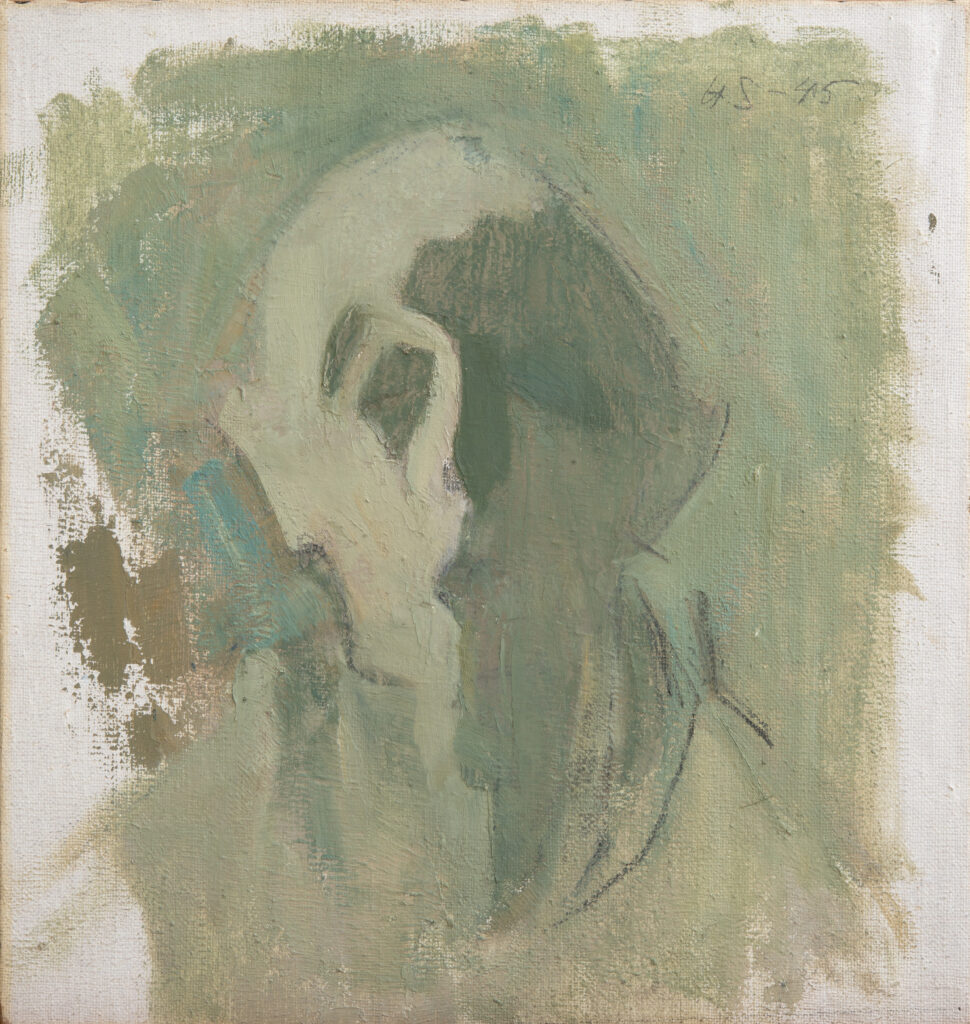
Helene Schjerfbeck. Self-Portrait, Light and Shadow (1945).Photo: Matias Uusikylä/Signe and Ane Gyllenberg Foundation
Helene Schjerfbeck. Self-Portrait, Light and Shadow (1945).
Her personality didn’t lend itself to a cosmopolitan life in Helsinki, but she was a central figure in what is called the golden age of Finnish art, from 1880 to 1910. Unlike other Nordic modernists, Schjerfbeck developed her own idiosyncratic and introspective style without engaging with German expressionism, as Norway’s Edvard Munch did. More to the point, she seems to exemplify the very Finnish concept of sisu, or determination in the face of adversity.
Schjerfbeck faced plenty of it. At the age of 4, a fall left her with a lifelong limp. An English artist who asked her to marry him reneged after learning that her father had died of tuberculosis, then thought to be hereditary. (She never married after that.) She was plagued by “neurasthenia,” or depression, and found that teaching left her exhausted. Then, beginning in 1897, she became her mother’s caretaker, and in 1902 moved to a town 30 miles from Helsinki with a milder climate and a sanatorium. She remained there for the better part of 25 years, not really isolated from the world of painters and the modernism exploding across Europe, but also not actively engaged in it. And yet, she was still able to create a distinctive and very personal form of modernism that resonated within the Nordic countries, and which still remains relevant to us here in New York today.
Schjerfbeck’s Evolution
The show at the Met is presented in roughly three sections. It begins with Schjerfbeck’s emergence as an artist painting Romantic themes from Finland’s history, and learning from the French realist painters Léon Bonnat and Jean-Léon Gérôme. You can see a whiff of Gérôme’s orientalism in Fête Juive; Sukkot; Feast of Tabernacles, a painting she made in the summer of 1883 to submit to the Paris Salon. Jules Bastien-Lepage was also an influence on her work, as you can detect in Clothes Drying, from 1883, which is also in the show. (Go upstairs to view Bastien-Lepage’s Joan of Arc, from 1879, to see what I mean.) Even though she was working in the realist vein, the paintings already show a defiance of convention: Clothes Drying was criticized for ignoring the elements of a standard landscape, and works she painted on a trip to Italy, along with a beautiful depiction of a manor house in Finland, show that she was already beginning to form her own ideas.
The second part of the show tracks her evolution in the years she was ostensibly isolated and caring for her mother. It’s here we see the beginning of Schjerfbeck’s interest in flattening her canvases and abrading the surface. The works after 1902 shown here display the influence of artists including James McNeill Whistler, Vilhelm Hammershøi, and, later still, El Greco, with Schjerfbeck painting mostly lone figures. More than that, they are strikingly cosmopolitan for an artist in remote Finland.
The culmination of this section is an enigmatic painting, The Tapestry, from 1914-16. Two figures, a man and a woman, stand in conversation. They appear to be on the shore of a lake with a small island in the distance—but a cabriole chair behind the woman, and the way her shadow plays on the water, suggest that the lake and island are part of the tapestry that gives the painting its name. The confusion is hardly the most interesting thing about the painting. The man’s stance creates a sinuous shape, forming a counterpoint to the woman’s erect posture and quizzical expression. I say quizzical, but it’s not all that easy to tell, because Schjerfbeck has sanded away the woman’s features, leaving only the suggestion of emotions or intent.
“Inner Autonomy”
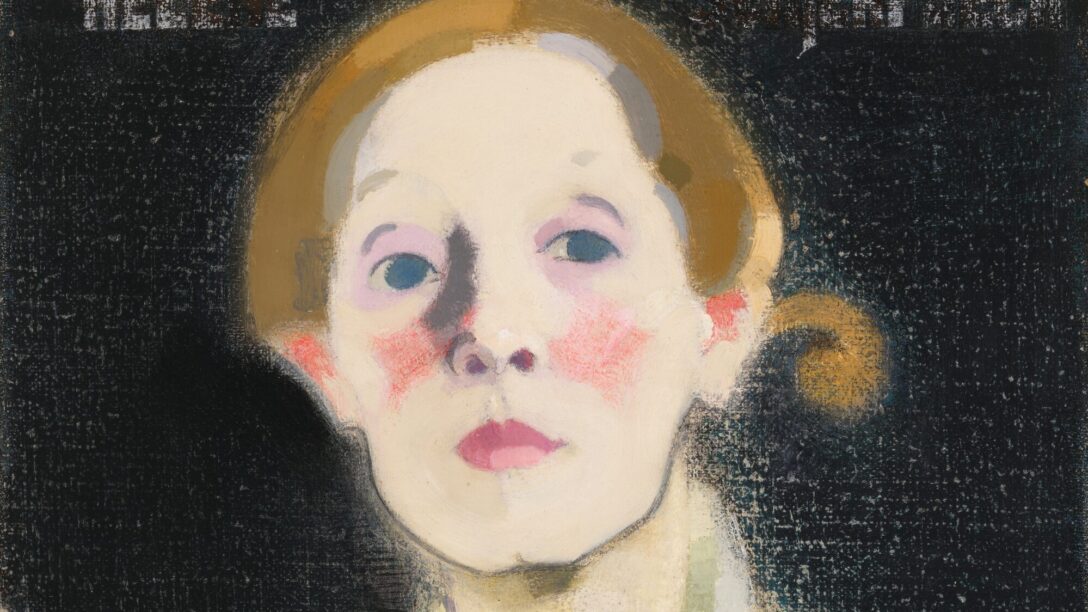
The final section of the show examines Schjerfbeck’s self-portraiture. She made 40 likenesses over her 70-year career, and 13 are included in the show. Around seven come from the 25-year period, from 1912 to 1937, when she had established herself as a national figure, and each features a similar sidelong glance from the artist.
One work, Self-Portrait with Black Background,from 1915, was commissioned by the Finnish Art Society for its boardroom—to be featured in a line of same-size self-portraits adding up to a pantheon of Finnish artists. Schjerfbeck, the only woman, was included at the suggestion of Gallen-Kallela, who would later become associated with Finland’s national character through his paintings of the Kalevala, Finland’s national epic, and through his exploits during the Finnish Civil War.
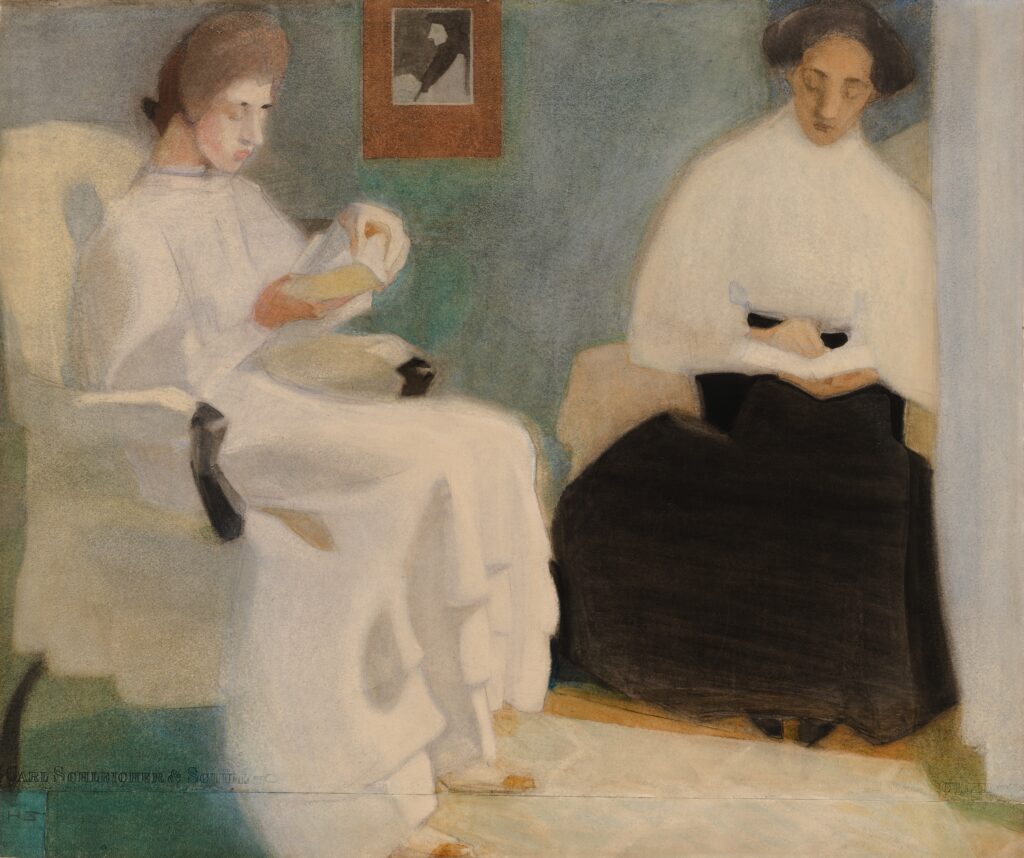
Helene Schjerfbeck. Girls Reading (1907).Photo: Finnish National Gallery/Hannu Aaltonen
Helene Schjerfbeck. Girls Reading (1907).
Both Gallen-Kallela and Schjerfbeck studied in Paris around the same time. As Sirén explained to me, both had to “release themselves from the constraints” of their training in the style of the French academy. But what made Schjerfbeck distinctive is that, after returning to Finland, she came to modernism on her own terms. Sirén explained that Finland had no artistic tradition for either artist to fall back on: Gallen-Kallela gravitated toward nature and national folklore, while Schjerfbeck turned more to the “growth of an inner autonomy.” As Sirén put it to me, she’s “much more a modernist exploring the inner world of human beings.”
It would take until after World War II for Schjerfbeck to become a household name in Finland, where her reputation is built on her perseverance. The show ends with a series of four self-portraits, from the 20 she made in the final few years of her life, that depict her skull-like, without sentiment or vanity, as she fades into death. Those final washed-out, tonal self-portraits seem to capture Finnish stoicism, or sisu, best.
Didn't get an email? Check your spam folder and confirm the spelling of your email, and try again. If you continue to have trouble, reach out to fritz@puck.news.
Didn't get an email? Check your spam folder and confirm the spelling of your email, and try again. If you continue to have trouble, reach out to fritz@puck.news.
Member Exclusive
Get access to this story
Create a free account to preview Puck’s full offering, including exclusive articles, private emails from authors, and more.