Welcome back to Wall Power. I’m Marion Maneker.
In tonight’s
issue, Julie Davich takes a look at the market for artists’ jewelry—wearable artworks, made by a wide range of artists, from Sonia Delaunay and Alexander Calder to Frank Stella and Rashid Johnson. Julie also follows up on the modernist ceramicist George Ohr’s sale late last week.
But first… |
-
What happened in Aspen: Aspen is no stranger to summer convocations. There’s the Aspen Institute, of course, as well as the Aspen Music Festival and the Aspen Security Forum. Just after the Second World War, there was the Goethe festival, which Walter Paepcke helped pull off before launching the International Design Conference in Aspen, which ran from 1951 to 2004 and was modeled on the Bauhaus philosophy of bridging the worlds of art and commerce.
The folks at
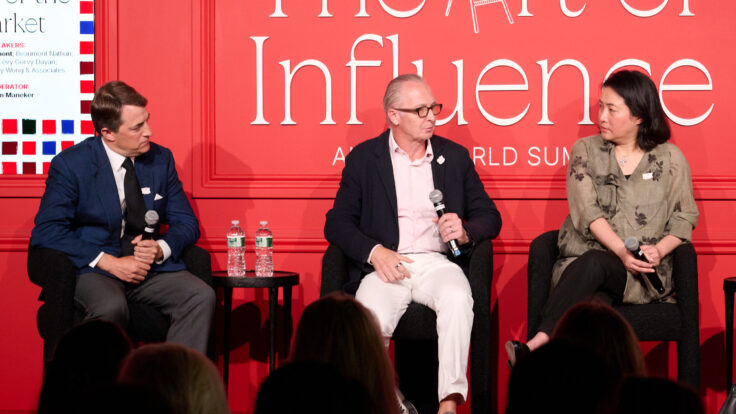
the Aspen Art Museum, which has been growing along with Aspen in recent years, just concluded their inaugural multiday festival of public talks called AIR, short for Art in Relation. With the support of collectors Don Kaul and Barbara Bluhm-Kaul, the event mixes artists with scientists, architects, and musicians; the lineup included Matthew Barney, Maya Lin, Issy Wood, Glenn Ligon,
Werner Herzog, Frida Escobedo, and the Pritzker Prize–winning architect Francis Kéré, among others. An invitation-only retreat for artists and thinkers preceded the public events.
When I spoke to Kaul on Saturday, he was very pleased with the way the event turned out after taking “a leap of faith” that the audiences would show up—though he was also a little exhausted from the nonstop socializing he’s done since arriving in Aspen a little
more than two weeks ago. Many of the speaking events had to be moved to larger venues due to demand, he told me. In part, that’s because of the growing interest in what is now seen as “Aspen art week,” including the Aspen Art Fair at the Hotel Jerome, which doubled the number of exhibitors in its second year to nearly 50.
Kaul pointed out that real estate in Aspen—a subject of real tension between locals and growth-minded folks, who want to come to town a few months out of the year—is
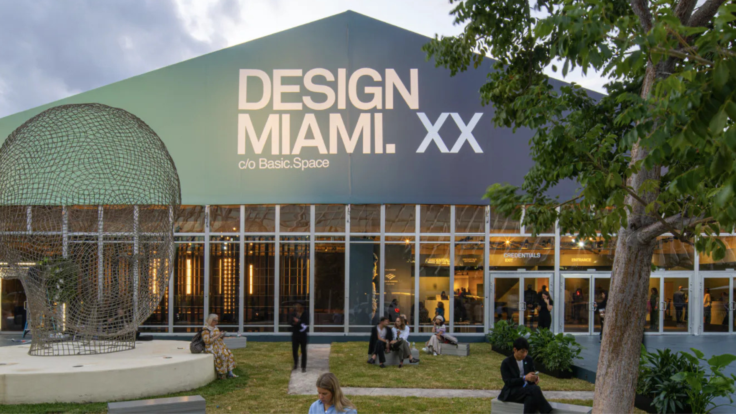
simply too expensive, even for galleries with long-standing ties to the former mining town. The Aspen Art Fair gives those galleries a cost-effective way to have a local presence, especially at a time when so many of the art folks are sure to be there. Design Miami is also getting in on the action: They held events at collector Jen Rubio’s house, and a “day of design” as part of their new In Situ program, which dovetails nicely with the themes in AIR. Jesse Lee,
C.E.O. of Design Miami’s parent company, also made it to Aspen for a couple of days. He, too, was encouraged by how well-attended his events were, and suggested there might be room to grow for both Design Miami and the range of “content” at art week.
|
|
|
A MESSAGE FROM OUR SPONSOR |
ALWAYS CONTEMPORARY
With a bold silhouette that conveys movement even at standstill, the Range Rover Sport
is striking from every angle.
EXPLORE |
|
|
-
And the Bridgemaker winners are…: Art Bridges, the Alice Walton–funded foundation that aims to improve the accessibility and visibility of art by facilitating museum loans, will announce three grants this week. Dubbed “Bridgemaker” prizes, the awards will give $50,000 to three institutions—the Peoria Riverfront Museum, the Hudson River Museum, and the Spelman College Museum of Fine Art—that have collaborated with Art Bridges to reimagine museum practices, elevate
diverse storytelling, and deepen community engagement through interdisciplinary programs. In addition to the monetary prize, the recipients will share works from their collections on Art Bridges’ digital platforms.
- Julie on Ohr’s new heights: The record for a work by George Ohr, the “Mad Potter of Biloxi,” was broken this past week in Rago’s sale of the Donald Hecht collection. Altogether, the sale of 20 works made
$1.08 million, almost three times the estimate of $383,500. Notably, 83 bidders registered for the sale, and about 10 to 15 percent of them were clients new to Rago. The collection represented some of the best examples of Ohr’s pottery, collected by the brother of Eugene Hecht, one of the foremost scholars of the ceramicist’s work.
The new Ohr record was set by a 10-inch vase, from circa 1895-1903, that is pink on one side and emerald green on the other, with two
asymmetrical, ribbon-like handles. It sold for $177,800 against an estimate of $50,000 to Rudy Ciccarello, the founder of the Museum of the American Arts and Crafts Movement (MAACM) in St. Petersburg, Florida, where the vase will soon be on view. He was one of three bidders who chased the vase above $100,000. The previous record for Ohr was $132,000, for a vase from the David Whitney collection that sold at Sotheby’s in 2006.
Other top prices from the
Hecht collection were for a volcanic vase with an in-neck twist that blew past its estimate of $25,000 to sell for $120,650, and an orange-and-pink sponged teapot—one of the potter’s best, David Rago told me—with a long spout that quintupled its estimate to sell for $76,200. One of the results that Rago was most pleased with was a 3½-inch-high, hand-manipulated vase in a green and ochre glaze that sold for $33,200 against an estimate of $5,000. “It’s a complete work of art,” he
told me, “regardless of size.” —Julie Brener Davich
|
|
|
Artists from Lalanne to Picasso have made jewelry, sometimes as one-offs for
friends and lovers, sometimes in larger numbers. Now, the niche field of artists’ jewelry is hitting its stride among buyers who might not splurge on a painting, but can spring for a pendant. |
|
|
The world auction record for a bronze sculpture by Claude Lalanne is about $5
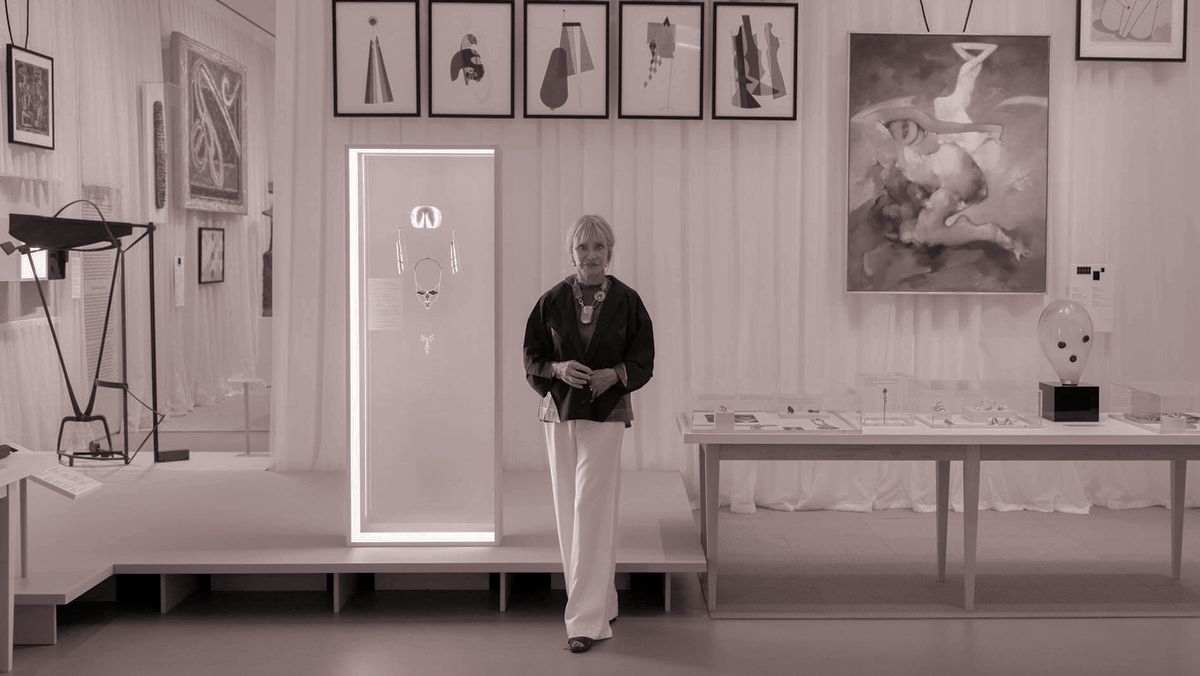
million—but for only $5,000, you can own one of her gilt bronze bracelets. The niche collecting field for artists’ jewelry is attempting to build market momentum, fueled in part by London dealers Louisa Guinness (of Louisa Guinness Gallery) and Didier and Martine Haspeslagh (of Didier Gallery). Meanwhile, the collector Diane Venet’s 40-year passion for collecting artists’ jewelry—not to be confused with art
jewelry, where jewelry itself is the artist’s primary medium—has led to a rich collection that she’s toured around the world, and which is currently on view at the Norton Museum of Art, in Palm Beach, where it’s attracting plenty of buzz.
The current market for artists’ jewelry consists largely of 20th century examples, ranging from mask pendants by Max
Ernst to bird pins by Georges Braque and colorful necklaces by Sonia Delaunay. These examples can all be worn, and cost a lot less than the works for which the artists are better known. The category has sputtered at
auction over the years, but many champions believe it could be poised for growth given current market trends: the rise in jewelry sales, strength in lower-price bands across the market, and a desire among collectors to own unique conversation pieces. “My clients are not ‘flash with their cash,’” Didier told me. “They’d never comment on how big a diamond ring is,
but they’ll comment on an artist piece. It’s a talking point that people can bond over.” |
|
|
A MESSAGE FROM OUR SPONSOR |
ALWAYS CONTEMPORARY
With a bold silhouette that conveys movement even at standstill, the Range Rover Sport
is striking from every angle.
EXPLORE |
|
|
Many category examples are one-offs, created by artists as gifts for friends and lovers. In fact,
Venet’s interest began when her husband, the sculptor Bernar Venet, wound a piece of silver into an engagement ring for her. She also told me about the time Frank Stella gave her a gold-painted steel necklace after her husband purchased four of his monumental sculptures for their foundation in the south of France. (Both the ring and the necklace are on view at the Norton Museum.) Picasso famously made jewelry for his lovers. And, just this past
week, Wright auction house in Chicago offered four Alexander Calder pieces—three pendants and a pin—consigned by his friend Margarett Sargent McKean, a distant relative of John Singer Sargent. (The pin sold best, for $35,560.) |
The current resurgence of artists’ jewelry started in the early 2000s, when Guinness held a
dedicated exhibition of examples by 20th century artists. (She has an upcoming exhibition devoted to surrealist artists’ jewelry opening next month.) Since then, prices have quadrupled—partly because of increased demand, but also because the price of gold has multiplied tenfold. Of course, the strongest growth has been driven by the popularity of specific artists as much as by growing interest in the category. Compression pendants by the Nouveau Réaliste artist
César—made by crushing pieces of jewelry the same way he crushed car parts into totemic sculptures—once sold for $10,000, said Didier, and can now sell for upwards of $100,000. In 2020, Celine partnered with César’s estate to issue limited edition replicas.
At the highest end of the market are Lucio Fontana necklaces for around $500,000, and at the low end are editions like a gold Robert Indiana Love ring for around $800.
Currently, the world auction record for a piece of artist’s jewelry is $2 million for a silver Calder necklace that sold at Sotheby’s, in 2013, from the collection of Philadelphia gallerist Hope Makler. Calder made about 1,800 pieces of jewelry in his lifetime, starting in the 1930s, for his wife and close friends.
Unlike painters who worked with jewelers to fabricate their designs, Calder did his own metalworking.
Some fluctuations in demand are driven by geography. The market for Calder is primarily in the U.S., partially because the Calder Foundation meets in New York to authenticate pieces, and it’s hard for European dealers to get there. In Italy, women favor Fontana pieces, and, in France, they opt for designs by Les Lalanne, the wife-and-husband duo of Claude and
François-Xavier, according to Didier. In November 2021, Sotheby’s Paris held a dedicated sale of 52 pieces of Claude Lalanne jewelry from the collection of her stepdaughter, Dorothée Lalanne, that made €911,106, against an estimate of just €157,400. The top
lot was a large version of her gold Ginkgo necklace, for €60,480 against an estimate of €7,000.
Context matters, too. Bonhams has offered some of the same Lalanne pieces alongside contemporary prints in its annual Limited Editions and Artists’ Jewelry auction in Paris, and they made a fraction of the
price—or didn’t sell at all. Meanwhile, Christie’s, Sotheby’s, and Phillips have sold numerous sculptural jewelry pieces by Calder in the six figures during their contemporary art sales, communicating to buyers that these pieces are on the same level as the best contemporary art. Christie’s had success with curated online sales, Art as Jewelry, in 2016 and 2017. The latter sale
of 26 lots made $414,375 against an estimate of $265,500. These aren’t huge numbers, but the category has growth potential as an entry point for new clients. |
For Didier, one of the keys to success in the category is selling artists’ jewelry that people will
actually wear, not simply put on display. “In our experience,” he said, “clients always buy to wear.” The material has to be compelling, too. In October 2022, Tiffany Dubin, the stepdaughter of former Sotheby’s owner Alfred Taubman, made a big to-do of an online sale she’d organized, which got full-page
feature treatment in the Times. But the works on offer, sourced mostly from the trade, didn’t support the hype. In the end, only 63 percent of the 160 lots found buyers. The few pieces that did perform well were mostly by Les Lalannes and the surrealists, like a pair of Dalí earrings, which hammered
for $176,400. |
|
|
Some enterprising artists are seizing the opportunity in the category to commercialize their work.
Guinness not only sells historical pieces, but also collaborates with numerous contemporary artists, like Anish Kapoor, Grayson Perry, and Sue Webster, on new creations. Similarly, Liz Swig (daughter of divorced mega-collectors Linda Macklowe and Harry Macklowe) started LizWorks to manufacture artists’ jewelry. Her collaboration style is a bit different, because she asks artists to work with
established forms that she has in mind, like a charm bracelet, signet ring, or cameo brooch. “I love the dialogue of the traditional and contemporary,” she told me. |
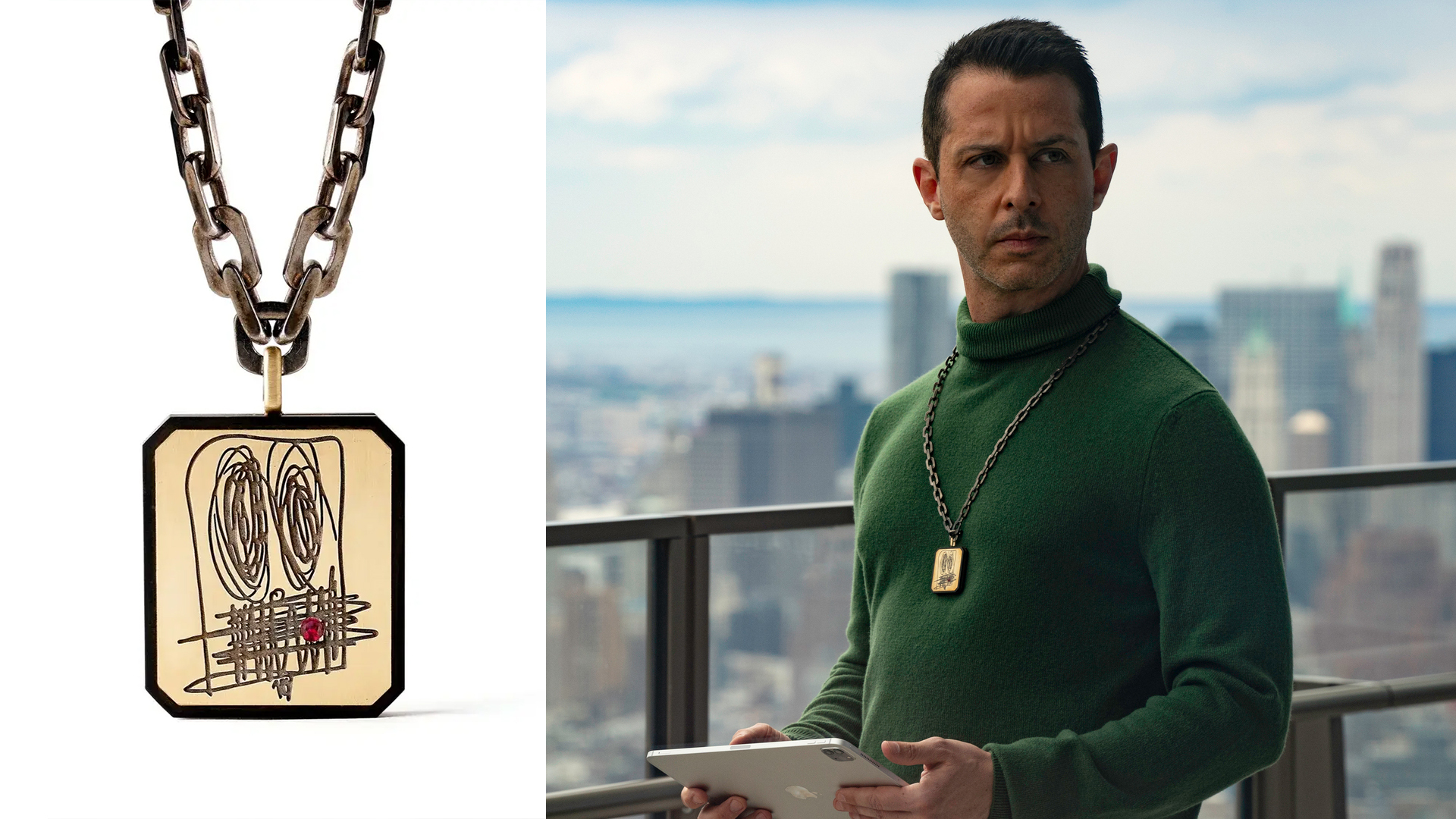
Jeremy Strong wearing a Rashid Johnson pendant (2020) by LizWorks. Photo: Macall Polay/Courtesy of HBO |
She started off in 2014 creating limited-edition sunglasses with Hiroshi Sugimoto
and Vik Muniz, and has since done jewelry collections with Robert Longo, Catherine Opie, and Cindy Sherman. In 2020, she did a collection with Rashid Johnson based on his Anxious Men series, which got a lot of attention when Jeremy Strong wore it in Succession.
Venet also encouraged many artists to create pieces of jewelry for her collection, including John
Chamberlain and Robert Rauschenberg. “They’re not decorative. They are works of art,” she said in a video promoting the Norton show, “and deserve to be presented in a museum.” Her daughter, Esther de Beaucé, is taking a similar approach at her contemporary art jewelry gallery, MiniMasterpiece, in Paris, where she is offering designs by Lee Ufan
and Andres Serrano.
But each, in their own way, is following in the footsteps of Diane Venet, who has been working to establish and build momentum for the artists’ jewelry market for decades, even if it has yet to achieve the prices set by non-wearable works. As Didier said, “Diane was the leader of us all.” |
Thanks, Julie.
I’ll be back on Tuesday.
M |
|
|
The ultimate fashion industry bible, offering incisive reportage on all aspects of the business and its biggest
players. Anchored by preeminent fashion journalist Lauren Sherman, Line Sheet also features veteran reporter Rachel Strugatz, who delivers unparalleled intel on what’s happening in the beauty industry, and Sarah Shapiro, a longtime retail strategist who writes about e-commerce, brick-and-mortar, D.T.C., and more. |
|
|
Puck founding partner Matt Belloni takes you inside the business of Hollywood, using exclusive reporting and insight
to explain the backstories on everything from Marvel movies to the streaming wars. |
|
|
Need help? Review our FAQ page or contact us for assistance. For brand partnerships, email ads@puck.news. You received this email because you signed up to receive emails from Puck, or as part of your Puck account associated with {{customer.email}}. To stop receiving this newsletter and/or manage all your email preferences, click here. |
Puck is published by Heat Media LLC. 107 Greenwich St, New York, NY 10006 |
|
|
|