{{ 'now' | timezone: 'America/New_York' | date: '%b %d, %Y' }} |
|
|
|
Hi, and welcome back to Line Sheet. I spent last night at the Victoria & Albert
previewing Schiaparelli: Fashion Becomes Art with a pretty incredible mix of people: A-listers like Chase Infiniti (she is amazing) and Daisy Edgar-Jones, as well as London insiders such as Serpentine Galleries C.E.O. Bettina Korek and newly minted ShopMy star Alison Loehnis. And many,
many private Schiaparelli clients. (I saw you, Lizzie Tisch.) Designer Daniel Roseberry held court at one table, owner Diego Della Valle at another, and C.E.O. Delphine Bellini at yet another. I’m going to write more about Schiaparelli’s position in the current fashion landscape tomorrow. There’s lots to contemplate.
I don’t know about you, but I’ve been anxiously awaiting Rachel
“Rachel@puck.news” Strugatz’s reporting on the potential combination between American beauty conglomerate Estée Lauder Cos. and Spanish firm Puig. It could be a strained marriage: Puig has such great brands and has been so smart about acquiring the right new properties; Estée Lauder is more challenged on both fronts. As always, Rachel has the goods.
Up top, I’m giving you a quick
rundown of who people want to see at T and who seems likely to have a chance. (No word on whether Sam Dolnick, the New York Times editor in charge of the project, agrees, but I will keep you updated.) Plus, Sarah Shapiro explains why Saks Global walked back (!) some of its store closures.
Also, I’m on Recho Omondi’s really great podcast, The
Cutting Room Floor, this week. I talked for a long time. Thank you to Recho! It was a good, thorough interview where we discussed everything from our mutual admiration of Teri Agins to why I never take photos with celebrities. (Even though I wanted to get a selfie with Chase Infiniti last night because she’s gonna be a big star and I was chuffed to get to sit next to her. But still, I resisted.) Listen and subscribe to The Cutting Room Floor
here.
Mentioned in this issue: Marc Puig, Tory Burch, the Lauders, Martha Stewart, the San Domenico Palace, Jenna Lyons, Manuel Puig, Hanya Yanagihara, Jo Ellison, Isabella Burley,
The White Lotus, Charlie Porter, Kristina O’Neill, Stella Bugbee, Elisa Lipsky-Karasz, Samira Nasr, Leah Chernikoff, Rachel Tashjian, Noah Johnson, Nick Haramis, Westchester, Stéphane de La Faverie, Thom Browne, and more… |
Two Things You Should Know…
|
- T
mag nom drop: A reminder that whoever replaces Hanya Yanagihara at T magazine will have to deal with a whole lot of bureaucracy—and that our modest proposal for The New York Times to consolidate all its style content under Stella Bugbee is unlikely to materialize because, as people inside have told me, that’s just not how the joint works. Anyway, there’s been plenty of speculation that the job
could go to a Brit, like How to Spend It’s Jo Ellison (her remit at the Financial Times is bigger, and this might not make sense), or Isabella Burley (the former editor of Dazed) or Charlie Porter (never gonna happen). Emily Tobin, the editor of The World of Interiors and a lesser-known hand of Anna Wintour, has also come up
in conversations, and feels a little more in the realm of possibility.
For the most part, the indie mag editors are out. Meanwhile, advertisers like the idea of Kristina O’Neill or Elisa Lipsky-Karasz, and wonder if Samira Nasr could be wooed from Harper’s Bazaar because it’s corporate and boring at Hearst, and also because T might be more her speed. (My guess is that the answer is no.)
Another
person suggested my dear friend, Bazaar executive editor Leah Chernikoff. She’s super smart and could do it; perhaps this mention will annoy her but also inspire her to apply. Rachel Tashjian should also push for the gig—there’s plenty of people who like her for it. I bet Highsnobiety’s Noah Johnson, fresh off that St. Moritz press trip, raised his hand. But in the eyes of many
staffers, it’s T editor-at-large Nick Haramis’s job to lose. I’m told Nick talked to Condé Nast about both Vanity Fair and GQ, and advertisers like him, and so does the team. If I were the Times, I’d give the job to Nick and make him report to Stella, who would push him to be creative and do interesting things. Basta!
|
|
|
|
A MESSAGE FROM OUR SPONSOR |
|
|
|

| Sarah Shapiro
|
|
- Saks Global’s zombie
locations: Saks Global reversed course on closing three locations in Simon Property Group malls: Neiman Marcus in Westchester, and two Saks Fifth Avenue locations in Sarasota and Palm Desert. The change, announced just two weeks after the initial closure plan was released, likely reflects a combination of renegotiated leases and the real costs associated with getting out of them. Anchor store departures can trigger cotenancy clauses, which give other lessees the right to reduce rent or exit
early, making an empty location expensive in ways beyond just the blank space.
Simon has a reason to negotiate here, as well. The pool of retailers capable of occupying a large format space keeps shrinking. Department stores are also favoring smaller footprints, à la Bloomie’s and Nordstrom Local. When reached for comment, a Saks Global spokesperson said, “We are pleased to share that our Saks Fifth Avenue Sarasota, Saks Fifth Avenue Palm Desert, and Neiman Marcus Westchester
stores will remain open following recent productive conversations with our landlords and further evaluation.” (Disclosure: Last year Saks Global sued Puck over our coverage of its debt management.)
|
|
|
|
And now, on to the main event... |
|
|
|
While the prospect of an Estée Lauder Companies–Puig megamerger has electrified the beauty
industry, plenty of questions remain—including whether the resulting $35 billion entity would pose an actual threat to the L’Oréal juggernaut. |
|
|
|
The beauty industry was aflutter this week following a Financial Times report that Puig and The
Estée Lauder Companies have entered negotiations to combine their respective portfolios and create a $40 billion beauty and fashion mega-giant. Within minutes of publication, both companies released identical statements confirming they’re “in discussions regarding a potential business combination,” and adding, of course, that no “final decision has been made, and no agreement has been reached.”
The hedge shouldn’t surprise anyone—parties get cold feet, discussions break down,
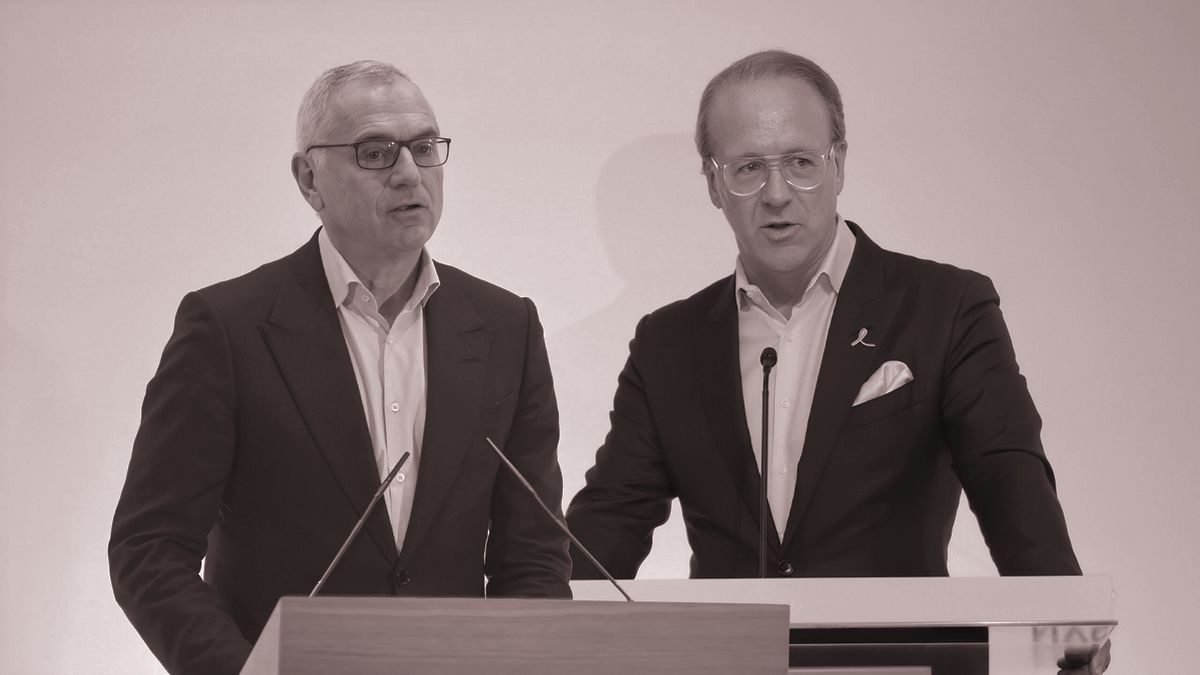
complexifiers emerge during endless diligence, etcetera, etcetera. However, I’m told the dual statements are essentially an unofficial confirmation that a merger agreement is near. “The intention is for it to happen,” a person with knowledge of the situation told me. Other insiders echoed the sentiment, and I was also told by a high-level source that Puig’s executive chairman, Marc Puig, whose 22-year tenure as C.E.O. ended last week, basically
confirmed the news at a leadership off-site this week at the San Domenico Palace in Taormina, the hotel where Season 2 of The White Lotus was filmed. (Spokespeople for E.L.C. and Puig declined to comment for this story.) |
|
|
|
A MESSAGE FROM OUR SPONSOR |
|
|
|
The market had a mixed reaction to the news: E.L.C.’s stock dropped nearly 8 percent Monday evening, while
Puig’s climbed more than 15 percent on Tuesday. At the moment, we don’t have much clarity about what the potential deal would look like—whether Lauder would acquire Puig, if it would be a joint venture, or whether they’d envision a more creative structure—but the response from Wall Street suggests that insiders believe the outcome will most likely be an acquisition by Lauder, and that the takeout premium will be high. A person familiar with the matter insisted that whatever happens will
be “structured as a merger, but the specific details of what that may look like are still being worked out.” (Many acquisitions, of course, are structured as reverse triangular mergers.) Either way, given that Lauder is three times the size of Puig, the former would probably have a controlling stake in the combined company.
There are also plenty of questions about timing: Lauder is in the midst of a highly scrutinized turnaround effort, and while the stock is up 6 percent from this time
last year, it’s down more than 30 percent year to date. “The issue is that Lauder needs to be operating better, and this deal feels premature because their turnaround plan is not complete,” a person with ties to Lauder told me. (Two others pointed out that Lauder’s artfully titled Profit Recovery and Growth Plan, which includes up to 7,000 layoffs, will be complete by the end of the fiscal year, on June 30.)
And yet Stéphane de La Faverie, the C.E.O. of The Estée Lauder
Companies, has recently dropped hints about the company’s return to M&A. There have been reports about its plans to divest a handful of properties, and Lauder recently announced that it would acquire the remaining 51 percent of Forest Essentials, an India-based Ayurvedic beauty brand that it first invested in almost 20 years ago. But no one saw something of this magnitude coming. |
I don’t think anyone expected a transformative merger of this size to come so early in de La Faverie’s
tenure, either. “It’s a massive cojones move by Stéphane,” said a person close to Lauder. “Frankly, that surprised me.” This person suggested that the real catalyst was L’Oréal’s nearly $5 billion acquisition of Kering’s House of Creed last October, along with the 50-year beauty licenses for Balenciaga, Bottega Veneta, and Gucci (once its current license with Coty expires in 2028). Left unchallenged, L’Oréal could have a veritable monopoly in the designer beauty license market. “Lauder
and Puig probably both feel they are too small to compete effectively with L’Oréal, and joining forces has some merit,” a Lauder insider said.
On paper, at least, the union makes sense strategically for both companies. It’s also been contemplated before. “William [Lauder] floated this a few years ago, and it was put on ice,” a person familiar with the Lauder family told me. The person with knowledge of the situation confirmed the talks had gotten
“serious,” but Ronald Lauder, William’s uncle, ultimately didn’t want the deal to go through—perhaps because he wanted his daughter Jane Lauder to be the next C.E.O. This person added that some of the Puig family was on board, although I’m told that vice chairman Manuel Puig was also not in favor of a deal.
Anyway, the prospective acquisition would give Lauder
command of a significant portion of the global designer fragrance market overnight. Sure, Tom Ford Beauty and Le Labo are strong fragrance brands with annual revenues of around $500 million and $400 million, respectively, but Puig owns a handful of fragrance franchises with revenues of around $1 billion, as well as three of the top 10 prestige fragrance brands globally. Puig would also boost Lauder’s struggling makeup cluster (with the exception of MAC) via the addition of
Charlotte Tilbury, one of the largest prestige makeup brands in the world, while also vastly expanding their presence in Latin America. Meanwhile, Lauder could give Puig massive exposure to both the Asian market and the travel retail channel, as well as its robust R&D capabilities in both skincare and makeup. |
|
|
|
The synergies are less clear on the fashion side, but there’s plenty to work with. In 2022, Lauder paid $2.8
billion for the Tom Ford brand in its entirety, although it relies on licenses for the fashion side. Puig operates its fashion in-house. And although its lines aren’t Kering- and LVMH-sized, they include some $400 million businesses, like Dries van Noten, and the Carolina Herrera diffusion line, which is even bigger and has a significant presence outside of the United States.
How all this nets out will partly depend on the ownership structure. In one scenario, the Puig family would become
significant shareholders of a new entity—or, according to Spain’s El Confidencial, even the largest shareholders. The person with knowledge of the situation speculated that, in this scenario, William Lauder may have to give up his controlling voting rights and “carry equal weight” with Ronald and the Puig family. No
matter what happens, the time and resources necessary for Lauder and Puig to digest this merger mean both parties may have to sit out additional M&A for a while.
In any case, the industry’s greatest concern is whether Lauder has the creative chops and executive talent to operate a combined Lauder–Puig portfolio. It would require a level of creative leadership that has been absent at the company since Leonard Lauder was running the show.
“On the makeup or skincare side, I’m not sure Lauder can manage a brand like Charlotte or MAC and not mess it up,” the person close to Lauder said. It seems like we’ll find out soon enough. |
Cooper Hewitt is honoring Tory Burch, Thom
Browne, Jenna Lyons, Target, Tiffany & Co., Martha Stewart, and plenty of other people at the Smithsonian National Design Awards Gala in May. [Inbox]
A pretty juicy and in-depth read about the respective Puig and Lauder family dramas surrounding a potential merger. Sabela is one of the most well-versed writers in all things Lauder, and co-wrote
that WSJ piece back in 2023. [Beauty Matter]
Violet Grey is going global.
[BoF]
I’m excited to see the first big retrospective on the Antwerp Six, which opens at MoMu, Antwerp’s fashion museum, on March 28. There’s no one better to tee it up than Eugene Rabkin. [Financial Times] |
Until tomorrow,
Lauren
P.S.: We use affiliate links because we are a business. We may make
a couple bucks off them. |
|
|
|
Need help? Review our
FAQ page or contact us for assistance. For brand partnerships, email ads@puck.news.
You received this email because you signed up to receive emails from Puck, or as part of your Puck account associated with {{customer.email}}. To stop receiving this newsletter and/or manage all your email preferences, click here. |
Puck is published by Heat Media LLC. 107 Greenwich St., New York, NY 10006 |
|
|
|
|