Hi, and welcome back to Line Sheet. I’m recovering from my now annual pilgrimage to Disneyland. One of the perks of raising a child in Southern California is the proximity to the Magic Kingdom. Nobody does brand experiences better, although I can’t envision my kid ever obsessing about one of the Disney franchises as much as he cares about Legos.
For today’s dispatch, we’re back on La Rive Gauche—this time at Kering, where Pierpaolo Piccioli was just named creative director of Balenciaga. I’m going to get into the strategy behind the appointment, and the broader changes at the parent company. (It is challenged, as we say.) Up top, I’m sharing notes on Chanel’s 2024 performance, and some thoughts on the pros and cons of a booming fine jewelry market. Finally, I’ve got a status update on Marco Gobbetti, the superstar C.E.O. who made previous stops at Salvatore Ferragamo, Burberry, Givenchy, and Céline.
Programming note: Tomorrow on Fashion People, I’m joined by designer and creative director Scott Sternberg. We’re gonna chat about Pierpaolo, Cannes, and sweatpants! Listen here and here.
For those of you with the Shoppies: I kicked off the weekend by attending a late-Friday afternoon party at Richard Christiansen’s magical Flamingo Estate, thrown by Burberry in celebration of the brand’s collaboration with Highgrove, the weekend home of Charles and Camilla. As I sat in a corner with Jen Brill, Jason “Doesn’t Pay for Puck” Stewart, Karolyn Pho, and The Ringer’s Amanda Dobbins—who lives minutes away from Christiansen’s Eagle Rock ish property, but had never before experienced its resplendent mixed-material interiors—my mind kept returning to The Trench, worn by dozens of Los Angeles–area influencers recruited by Burberry comms queen Blair Trader and her trusty sidekick Denise Woo.
Of course, that was the whole point. If you’ve been reading Line Sheet, you know that still-new Burberry C.E.O. Joshua Schulman must convince the world that everyone needs a trench coat in their closet. If I were you, I’d consider the Highgrove collection’s short, olive-green style, lined in a painterly silk floral, or a more traditional version with a special check. But also, it’s a good piece to buy on the secondhand market. Try this, this, or this.
Mentioned in this issue: Balenciaga, Pierpaolo Piccioli, Demna, Gucci, the Pinaults, Kering, Francesca Bellettini, Valentino, Jacopo Venturini, Alessandro Michele, Pieter Mulier, Jonathan Anderson, Chanel, Matthieu Blazy, Cartier, Marco Gobbetti, and many, many more…
|
|
|
|
A MESSAGE FROM OUR SPONSOR
|
For over a decade, self-portrait have been redefining contemporary fashion, delivering elevated designs and exceptional quality at honest price points. Founded by Han Chong in London, the brand’s unique and bespoke approach to communication, manufacturing and infrastructure has enabled it to craft beautifully made pieces that are accessible. From intricate lace and knit separates, to denim and eveningwear, self-portrait is committed to creating collections that are designed to be lived in - timeless but always relevant. As the brand continues to grow, its focus remains on thoughtful designs that speak to communities globally.
EXPLORE MORE
|
|
|
Three Things You Should Know…
|
- The Chanel tell: As I mentioned briefly last week, Chanel is getting ready to release its 2024 revenue numbers, and I’m told the company is set to report a sales dip of about 4 percent. (I’m caveating this by saying that books can be readjusted at the very last minute. A rep for the company did not comment.) This slight shrinkage shouldn’t surprise anyone. Last year, especially the final quarter, was incredibly challenging for the soft luxury industry, as evidenced by disappointing numbers at competitors, including Dior and Gucci.However, Chanel’s performance suggests that the consumer sees the brand not as a materials business (like Hermès or Loro Piana) or pure fashion (Alaïa) but rather something in the middle—a messy space that many have backed away from. Chanel is too expensive to be generic, and the company hired Matthieu Blazy to recalibrate the fashion part of the business. The accessories—especially the shoes—remain desirable, and it’ll be Blazy’s job to direct customers toward them. Fragrance and beauty is a more challenging market. Recall that Carolina Herrera’s Good Girl franchise surpassed Chanel’s Chance as the most popular fragrance line in the U.S.
- The (debatable) downside of hard luxury’s upward swing: While leather eventually disintegrates, a diamond is literally forever. At least that’s the lesson from Friday’s fourth quarter and full-year report from Richemont, where sales in the fine jewelry division rose 11 percent in the last quarter of its most recent fiscal year. The company cited strong performance at its marquee brand, Cartier, in particular.Cartier outshines its competitors in terms of execution, from the merchandising and design of its products to distribution and store experience. (The next best is probably its fellow Richemont stablemate, Van Cleef & Arpels.) But it’s clear from the exceptional performance at other big jewelry brands, including LVMH-owned Bulgari and Tiffany, that consumers currently rank big-ticket jewelry purchases as more justifiable than fashion or leather goods. Aside from certain styles from Hermès and Chanel, most handbags lose their value over the years, because simply using them causes decay. Fine jewelry, on the other hand, can be worn and go virtually unscathed.
One kinda bummer result in this evolution of consumer sentiment is that the big brands are moving to control more of the hard-luxury supply chain, especially in Italy, while boxing smaller, independent brands out of the top factories, contracting them for up to four years in some cases. It’s similar to what happened in soft luxury a decade or two ago. But in jewelry, there are even fewer factories with real expertise. Business is business, of course, and I don’t blame the factories for choosing big brands that can guarantee far more work at higher fees. But given that the majority of fine jewelry remains unbranded, let’s hope we can preserve the little variety that does exist.
- Where in the world is Marco Gobbetti?: I’m hearing that the executive, who exited Salvatore Ferragamo earlier this year, is slated to join another Italian, family-run company with high-fashion bona fides. (I’m told he’ll be filling a generational gap.) Gobbetti’s success at LVMH relaunching Céline with Phoebe Philo, and developing Givenchy with Riccardo Tisci, was somewhat undermined by his more recent (and more underwhelming) tenures at Burberry and Ferragamo. You could argue, though, that neither of those situations was really his fault. One thing is for certain: Gobbetti knows how to manage and work with pure creative talents.
|
|
|
|
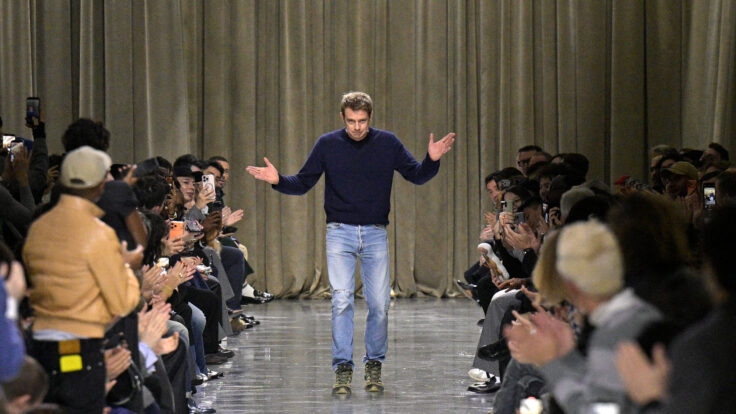
With the appointment of Pierpaolo Piccioli to succeed Demna at Balenciaga, Kering appears to be choosing stability—taking a second chance on a proven operator, rather than betting it all on an untested genius. It’s indicative of the risk-averse state of luxury these days, but also the growing pressures on the Pinault family, itself.
|
|
|
|
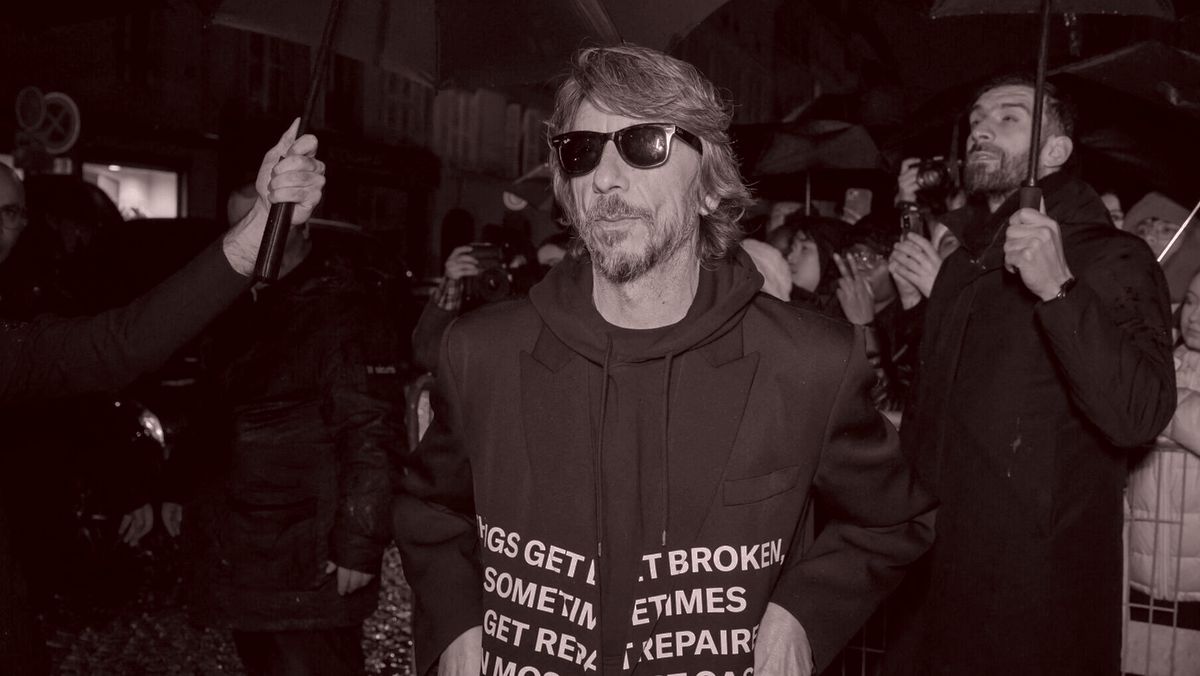
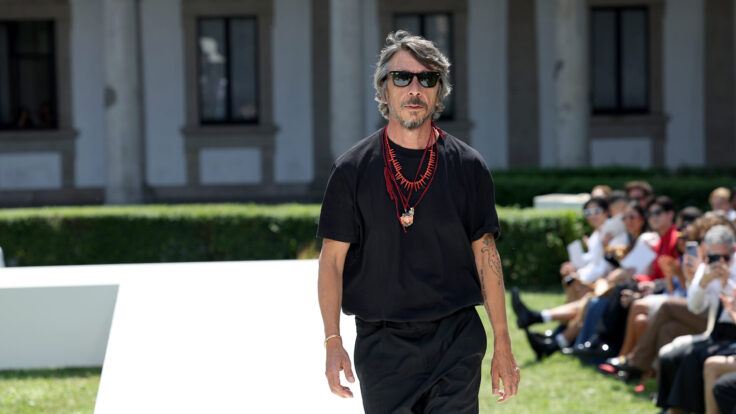
On Monday, the final round of this particular game of designer musical chairs came to a gentle conclusion. Balenciaga, the French couture house controlled by the Pinault family since 2001, named Pierpaolo Piccioli its new designer. He will succeed Demna, who is off to Gucci come July. Piccioli’s first collection will be shown in the fall, although the company has yet to communicate on that front.
In some ways, Piccioli is an obvious choice for Balenciaga. In others, he is very much not. Less than two years ago, Piccioli was unceremoniously cycled out of Valentino, which is part-owned by Kering, and where he’d spent the majority of his career. His final collection, shown just weeks before his departure, was rendered in all-black—an ominous display of mourning for a fashion house where he’d been designing since 1999.
|
|
|
|
A MESSAGE FROM OUR SPONSOR
|
The brand’s name was chosen to reflect the spirit of individuality and self-expression, creating pieces that empower customers to dress for themselves. This season, sharp tailoring, playful separates, and signature lacework embody that spirit, offering versatility and confidence for any occasion. The collection speaks to women who define their own style - uncompromising, expressive, and entirely their own.
DISCOVER THE COLLECTION
|
|
|
|
So if it wasn’t working at Valentino, why would Kering bring Piccioli back into the fold? The recycling of designers within a group is not unheard of—LVMH does it all the time. But this boomerang situation is probably indicative of the limited pool of capable talent at this stage in the industry’s trajectory. Today’s creative directors cannot be, for lack of a more elegant descriptor, a mess. They have to be creative, sure, but also proficient managers, too—overseeing everything from product design to the employee experience. Some act as a co-C.E.O., others are simply in service to the C.E.O., but they must understand that these are multibillion-dollar businesses, not pet projects. For a struggling company like Kering, it was safer to offer another chance to a proven number one than take a risk on an unproven number two.
|
|
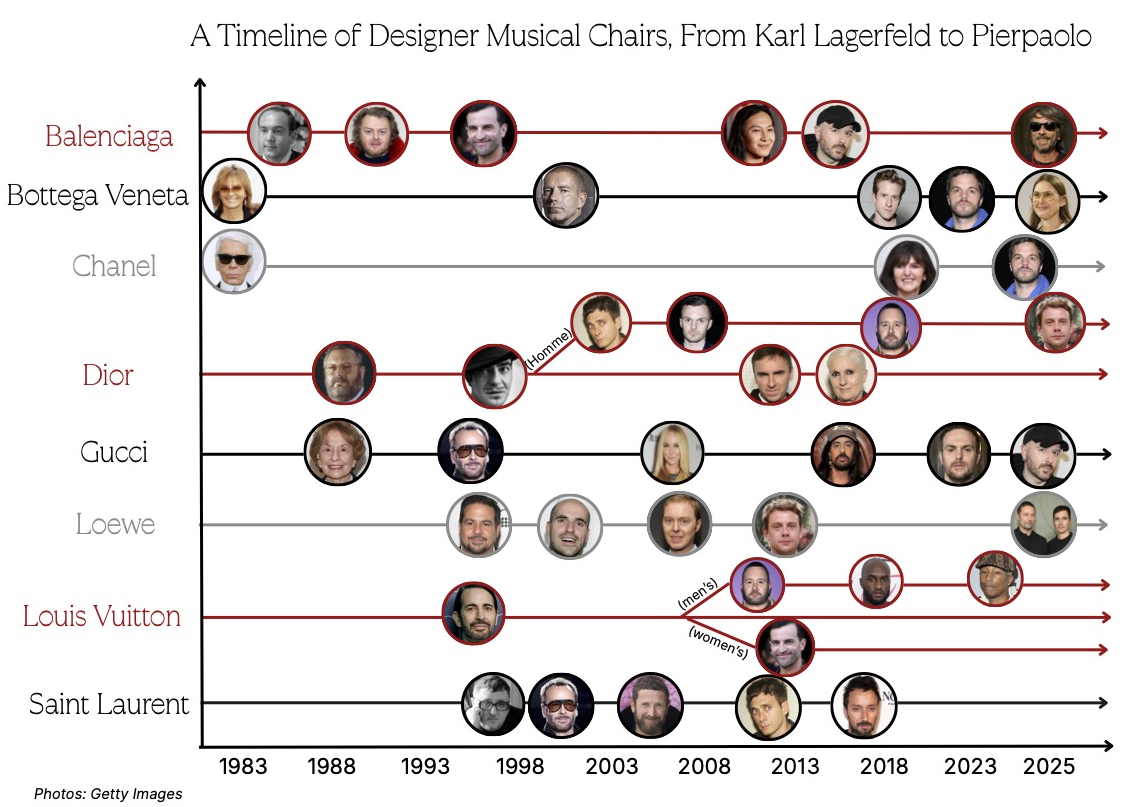
The birth of the modern luxury industry can be pegged to Lagerfeld’s appointment as creative director of Chanel in 1983. Note the cluster of assignments in the late 1990s, when the conglomerates were forming, then again in the first half of the 2010s, post-Great Recession, and then, finally, the recent surge, propelled by commodification at the top houses.
|
|
Regardless of how things ended at Valentino, Piccioli will likely bring stability to Balenciaga, especially on the ready-to-wear front. He already has a meaningful couture and ready-to-wear client base, many of whom will follow him to Balenciaga. He’s not a gifted accessories creator in the vein of his former Valentino co-designer, Maria Grazia Chiuri—or Alessandro Michele, for that matter—but that should be of little consequence given the right merchandising support. (Remember, the brand’s star merchandiser, Nathalie Raynaud, was just promoted to deputy C.E.O.) Piccioli also simply has the right attitude. In his note announcing the appointment, he went out of his way to thank outgoing designer Demna. When things like this happen, there are so many uncertainties for lower-rung employees—job security being the greatest—and knowing that the person coming in wants a peaceful transition can help with morale.
|
|
Everyone is wishing for the best, even if this isn’t quite a stock-moving announcement. (Balenciaga is a sub-$2 billion brand, after all, and the news was released about 30 minutes after Euronext trading closed.) Alaïa’s Pieter Mulier, an early favorite for the job, may have generated more of a spark if he had been appointed—not only does Mulier have a fast-growing ready-to-wear clientele, but he’s also been tremendously successful on the accessories front. Alas, it didn’t happen for multiple reasons. Meanwhile, I’m sure that Piccioli plans to bring in a good number of people from his Valentino team, adding further reassurance. “I hope, for the system, it works,” one C-suite luxury executive said to me late last week, when the speculation about Piccioli began to solidify. “Because we need things to be better in general.”
No one likely feels that sentiment more than Kering deputy C.E.O. Francesca Bellettini, who must turn the whole business around while facing both macro challenges and micro issues specific to the group. It’s easy to say that her boss, Kering C.E.O. and heir François-Henri Pinault, should have never let Michele leave Gucci, but I disagree. Michele’s time there was up, and revenue growth would have been tough even if he stayed. However, they should have hired a big name, not Sabato De Sarno, if they wanted Gucci to become a true competitor to Louis Vuitton. (In perhaps the greatest irony of this whole debacle, De Sarno was Piccioli’s number two at Valentino.)
In particular, they should have moved mountains to bring Jonathan Anderson to Kering, even by acquiring J.W. Anderson. The price tag would have been far less than what they’ve lost over the course of the past two years, both in terms of revenue and cultural capital. Even if Demna’s Gucci hits, it will be at least another two years before we see a real recovery at the group.
Anyway, as I’ve discussed the Kering saga with various stakeholders over the past week, one name that rarely surfaces has come to the fore: François Pinault, who became a white knight in luxury fashion when he brokered a deal with Tom Ford and Domenico De Sole to acquire Gucci, in 1999, ostensibly saving them from Bernard Arnault’s less desirable overtures.
|
|
|
|
Pinault, who is 88, has been out of the game for more than 20 years. As with nearly any succession, executives claim François was skeptical of his son’s abilities in the early days of the transition, but went on to benefit financially from François-Henri’s strategy of culling the business to create a pure-luxury strategic group. By 2018, François was worth $36 billion, in no small part because of the work that François-Henri did turning Gucci, Saint Laurent, and Bottega Veneta into profit machines. Now, however, some people say they sense François’ “frustration” as Kering continues to lose market share.
A source close to pretty much everyone involved said that while that may be true, François remains as removed from the daily operations as he always has been. Indeed, it’s all up to François-Henri to fix the business. After all, he is only 62 years old—downright young in C.E.O. terms—and his succession plans mostly include people outside of the family. His son François is getting his M.B.A. in the United States, and may someday be a candidate. But this isn’t like LVMH, where there are multiple children running significant parts of the family business.
Also, as with any personal relationship, I’m wary of outsider projection. For instance, you may all think you know who Bernard Arnault will be anointing as his heir, but my educated guess is that even he doesn’t know yet, and that the answer will be complex.
But there is no getting around the fact that Kering is in trouble. Groupe Artémis, the Pinault family office that also includes CAA and Christie’s, owns 42.3 percent of Kering, with 59 percent of the voting rights. François-Henri has the final say. For years, many analysts speculated that the company would need to merge with another firm (maybe Richemont) to increase its negotiating power in terms of real estate, supply chain, etcetera. Now, though, it’s possible that another scenario could play out. There is market speculation that Kering’s deal to wholly acquire Valentino, which must happen by the end of 2027, will take place sooner: either by the end of this year, or early 2026. Sources inside Kering said that’s unlikely, though, and that while the acquisition will definitely go through at some point, the group would like to wait until it has more cash on hand.
No matter when it goes down, there is a chance that the deal would include a share exchange, and Mayhoola—the Qatari investment vehicle that currently owns a majority stake in Valentino—could become a meaningful shareholder in Kering.
Without the proper infrastructure and industry network, Mayhoola has struggled to develop its fashion businesses as much as hoped. (In 2024, Valentino’s profits dropped 22 percent, while revenue declined about 3 percent, indicating that the group relied on discounting and off-price to manage slow sales.) A partnership with an actual strategic group, like Kering, would presumably make the operations part easier.
Perhaps financial support from Mayhoola is exactly what François-Henri needs to help build what he is surely hoping will be Kering’s next phase of growth. One of François-Henri’s best qualities, especially for the designers and executives working for him, has been patience. But he may no longer have the luxury of exhibiting it.
|
Best dressed at Cannes, so far: Rooney Mara in Givenchy, Joaquin Phoenix in Givenchy, Natalie Portman in Dior, Alexa Chung in Celine, Juliette Binoche in Dior, Alba Rohrwacher in Loewe, Jennifer Lawrence in this Dior in particular.
Robin Givhan talks to Anna Wintour about how this year’s Met Gala became an act of resistance. [ WaPo]
Recon on the Apple Watch, 10 years after its launch. (My personal observation: The Apple Watch trained a new generation of consumers to wear a watch every day. Many have since moved on, including me.) [ The New Consumer]
Workers at several of LVMH’s champagne houses (as well as Pernod Ricard) went on strike last week. [ Just Drinks]
|
And finally… Back in the magic kingdom of Hollywood, Team Puck is prepping for our Stories of the Season: Emmys extravaganza, happening tomorrow, May 20, at 5 p.m., right up the street from our Los Angeles headquarters. If you would like to hear from Parker Posey, John Mulaney, David Oyelowo, and a personal favorite of mine, Lauren Greenfield (the photographer and director behind Generation Wealth and Girl Culture), please email Fritz@puck.news and CC me.
Until tomorrow,
Lauren
P.S.: We are using affiliate links because we are a business. We may make a couple bucks off them.
|
|
|
|
An essential, insider-friendly Hollywood tip sheet from Matthew Belloni, who spent 14 years in the trenches at The Hollywood Reporter and five before that practicing entertainment law. What I’m Hearing also features veteran Hollywood journalist Kim Masters, as well as a special companion email from Eriq Gardner, focused on entertainment law, and weekly box office analysis from Scott Mendelson.
|
|
|
|
Join Emmy Award-winning journalist Peter Hamby, along with the team of expert journalists at Puck, as they let you in on the conversations insiders are having across the four corners of power in America: Wall Street, Washington, Silicon Valley, and Hollywood. Presented in partnership with Audacy, new episodes publish daily, Monday through Friday.
|
|
|
Need help? Review our FAQ page or contact us for assistance. For brand partnerships, email ads@puck.news.
You received this email because you signed up to receive emails from Puck, or as part of your Puck account associated with . To stop receiving this newsletter and/or manage all your email preferences, click here.
|
|
Puck is published by Heat Media LLC. 107 Greenwich St, New York, NY 10006
|
|
|
|