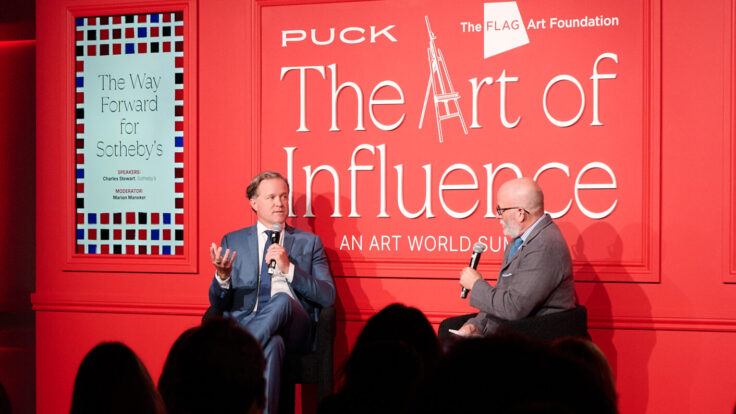
Welcome back to Wall Power. I’m Marion Maneker.
By now you’ve
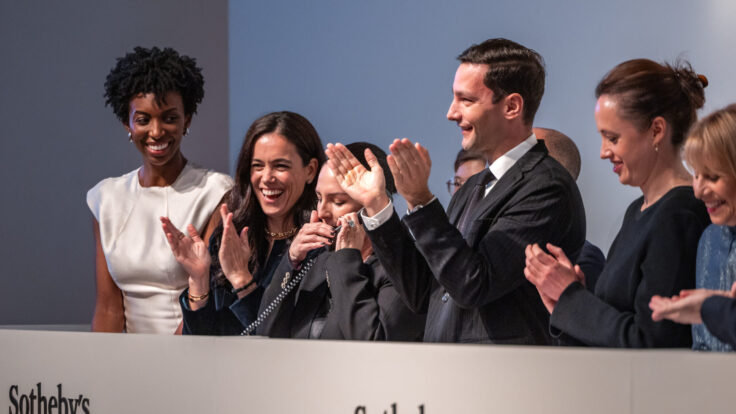
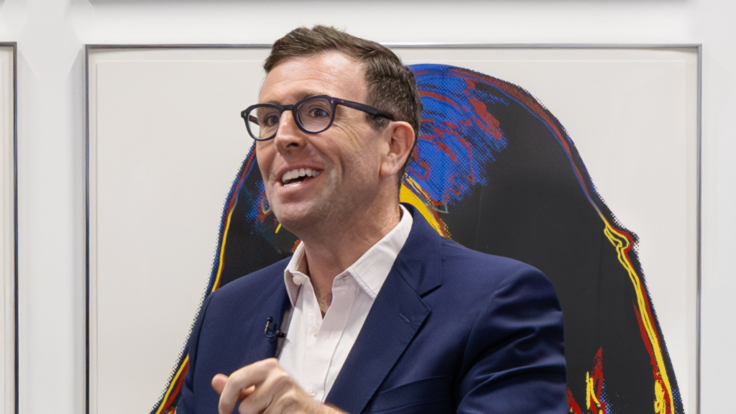
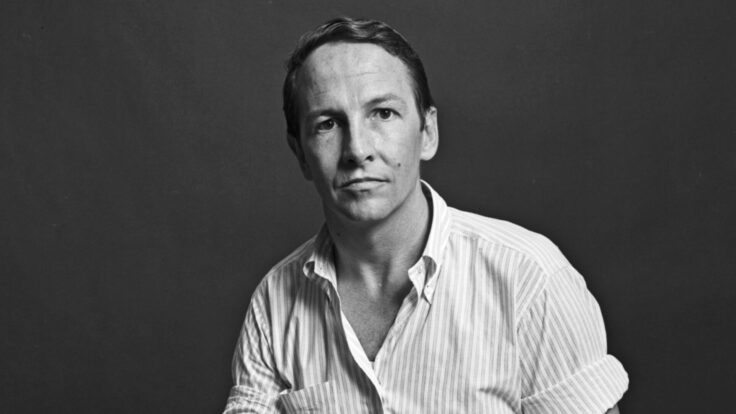
probably heard the news that David Schrader is leaving Sotheby’s and setting up a new secondary-market business, in partnership with art dealer Emmanuel Di Donna and Marc Glimcher’s Pace gallery. The New York Times rushed out their story on Monday night because there was just too much chatter in Miami to keep it quiet any longer.
The short version is that the newly formed Pace Di Donna Schrader galleries will
build on Di Donna’s gallery infrastructure and track record of market-leading exhibitions, along with Pace’s global footprint and network of 40 directors. And, of course, Schrader brings the sales muscle. PDS will look for a space on the Upper East Side with the hope of opening by midyear. I’ll give you the longer version below.
But first… |
-
FLAG x Serpentine prizes: The FLAG Art Foundation has announced a new prize for young artists in partnership with London’s Serpentine Galleries. The biennial award—to be granted five times over the next 10 years—will include £200,000 for each recipient, as well as a solo exhibition that debuts at either FLAG or Serpentine before traveling to the other venue. The first prize will be awarded in 2026 by a jury of curators, art historians, and artists, with a fall 2027 exhibition in London
that will travel to New York in 2028.
|
|
|
The Breguet Classique Souscription 2025 represents a reinvention of a timeless icon
– paying tribute to the original aesthetic, elevated by a contemporary perspective. Join Breguet in celebrating 250 years of horological excellence. |
The Breguet Classique
Souscription 2025 represents a reinvention of a timeless icon – paying tribute to the original aesthetic, elevated by a contemporary perspective. Join Breguet in celebrating 250 years of horological excellence. |
|
|

| Julie Brener Davich
|
|
- Mexico comes to
Meatpacking: Around the corner from the Whitney Museum, on Little West 12th Street, is a new showroom, K’ab Juun, dedicated to the craftsmanship of modern Mexico. (K’ab Juun means hand and unique in Mayan.) As hordes of Americans inundated Mexico City to visit Frida Kahlo’s house and the Museum of Anthropology, interior designer Ilana Goldberg saw an opportunity to bring her modern Mexican aesthetic north, and partnered with the
logistics and global supply veteran Dafna Puszkar to make it happen.
With its warm-hued walls and curved archways (and Laguna Cyprien products in the restroom), the gallery is more like an immersive environment—all that’s missing are Contramar’s tuna tostadas. Many of the furnishings are from Clásicos Mexicanos, a sort of Mexican Design Within Reach that reissues classic modern works, like Armando Franco’s midcentury cedar dining table ($18,500) and
chairs with woven palm seats ($4,900).
But where K’ab Juun really shines is its custom and limited-edition pieces. Standing sentinel at the rear of the gallery are a series of Aurum cabinets, made from wood covered in gold leaf and priced from $11,800 to $16,000, by Peca Estudio founder Caterina Moretti. Nearby is her Rito lectern/display cabinet, constructed from rosa morada wood atop a volcanic stone base, for $14,500. That complements Raúl de
la Cerda’s sculptural onyx bench, stool, and coffee table, created for Ónice studio, priced from $2,800 to $11,000; his smaller, double-walled resin vessels can be had for $1,000 to $1,300. It would all look perfect in a room with a $54.7 million Kahlo painting. - Listening to design: Adam Charlap Hyman and Laura Kugel have launched a new podcast, Handle With Care, about the decorative arts and design.
“The world of decorative arts is full of so many amazing stories,” Hyman explains in a teaser episode. “Without them, we will be worse off in terms of understanding how we got where we are.” The hosts recount how Yves Saint Laurent and Pierre Bergé brought them together: Hyman, an interior designer based in New York and Los Angeles, became infatuated with the couple through Christie’s sale of their collection in 2009, and sought out Galerie Kugel, which had
helped build it. Soon he met Laura, a sixth-generation Paris antiques dealer.
The first episode features an interview with photographer Dominique Nabokov, known for her intimate portraits of living rooms sans people, conveying her subjects only through the objects they chose to surround themselves with. The second features self-described ornamentist Pierre-Marie Agin, who started his career designing Hermès scarves and now has a gallery devoted to
pattern-making for floors, walls, and ceilings. In a future episode, French decorator Robert Couturier will explore the decorator-client relationship. So, although Hyman and Kugel joke that their podcast is about chairs, lamps, and curtains, it seems it’s really more about the psychology of interiors.
|
|
|
A gallerist, a dealer, and Sotheby’s head of private sales are joining
forces to meet the moment in the secondary art market and fill the space where deals are actually happening. |
|
|
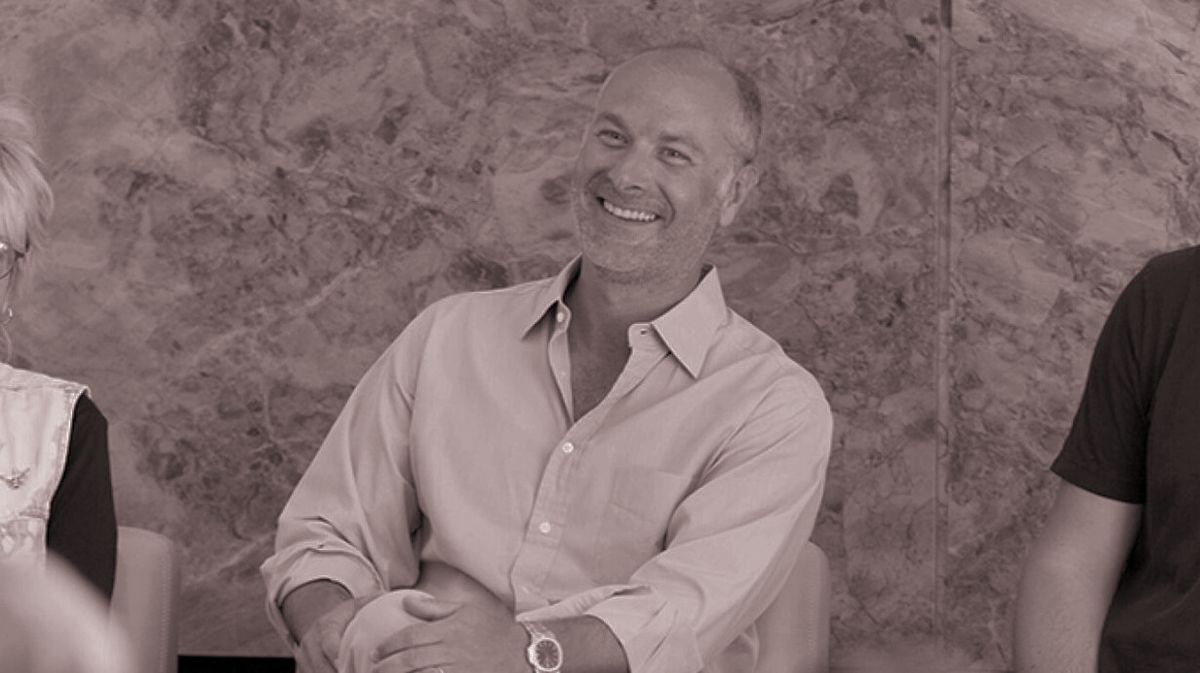
David Schrader, the soon-to-be former head of private sales at
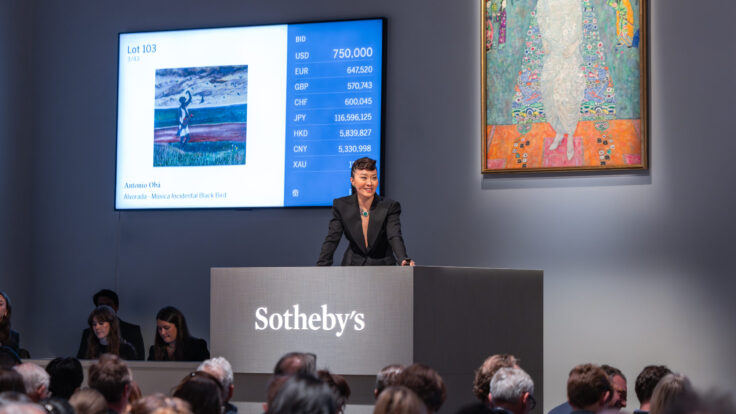
Sotheby’s, waxed reminiscent about last month’s impressionist day sale at the Breuer Building when I caught up with him recently, and he marveled at the sheer number of buyers in the day sales and the volume of business getting done. “The room was full,” he said, acknowledging the obvious: It had been a very long time since a day sale for impressionist and modern works had a room buzzing with quite so many bidders and buyers.
We’ve reached an inflection point in the market, as
buyers finally cycle from discovering young painters to ferreting out historical artists. Indeed, the demand for historical works now seems to be deeper than anyone imagined even a few months ago—and it has emerged quite suddenly, up and down the price spectrum. Last month, only seven of the top 50 artists by market share (or dollars spent) were alive—a big shift from recent years when Gerhard Richter, George Condo, Yayoi Kusama, and
Yoshitomo Nara populated the list. Among the living, Christopher Wool ranked highest, at 21, but was outranked by Piet Mondrian, René Magritte (despite his surprisingly slow season), Max Ernst, John Singer Sargent (!), Agnes Martin, Joan Mitchell, Marc Chagall, Fernand Léger, and Edvard Munch, among others. And
that litany of names doesn’t even crack the top 10. |
|
|
The Breguet Classique Souscription 2025 represents a reinvention of a timeless icon
– paying tribute to the original aesthetic, elevated by a contemporary perspective. Join Breguet in celebrating 250 years of horological excellence. |
The Breguet Classique
Souscription 2025 represents a reinvention of a timeless icon – paying tribute to the original aesthetic, elevated by a contemporary perspective. Join Breguet in celebrating 250 years of horological excellence. |
|
|
The market pivot explains why Schrader, dealer Emmanuel Di Donna,
and Pace’s Marc Glimcher will be going into business together next year as Pace Di Donna Schrader Galleries—a union announced last night in The New York Times. (For those of you following along at home: This probably explains those rumors, from back in March, about Sotheby’s and Pace getting into business together.) PDS, as the principals are already calling it, aims to fill a void in the secondary market as historic art returns to the forefront. In a market
where timing is everything, theirs couldn’t have been much better. |
When the art world was smaller, the very rich knew where to seek out a great work by one
of the few recognized masters. One of the features of the 21st century has been the profusion of so-called U.H.N.W.s, an acronym that roughly translates to “having more money than you know what to do with.” These days, the U.H.N.W.s don’t just collect Picasso, Monet, and de Kooning. The list of valuable historical artists has become longer than ever—and is likely to get longer still as tastes become more eclectic and collectors
search for ever more interesting stories.
Different parts of the market have adapted to this phenomenon in their own ways. The auction houses, with their global wingspan and armies of specialists and sellers, have spent the past several years building their private sales. In 2024, Schrader’s department at Sotheby’s made $1.4 billion in transactions—20 percent more than the previous year despite the downturn. Before that, the mega-galleries—Gagosian, David Zwirner, Hauser & Wirth, and
Pace—expanded for over two decades to serve the global collecting class that had emerged. Meanwhile, secondary market dealers had a harder time acquiring inventory, since owning it required tying up too much capital for far too long. Just ask the Wildensteins.
If you couldn’t scale, you had to get focused, like Di Donna did. He spent 15 years building a business known for the quality of its exhibitions, as well as the ways he could educate the very best collectors and
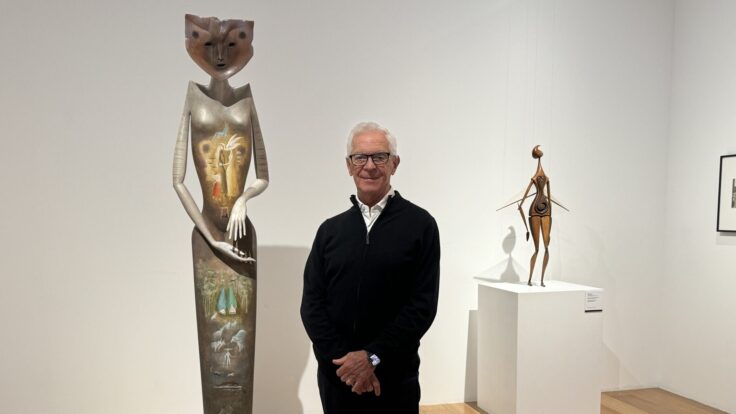
guide the broader tastes of the market. Surrealism is as close to Di Donna’s heart as it is to his business; he rode the cresting wave of interest in that movement by mounting shows that tantalized his collector base and attracted museum interest, culminating in the current Magritte and Lalanne show that has been getting so much attention this season. “Since I left Sotheby’s in 2010,” he told me on Sunday, “I didn’t want to be an advisor. I wanted to put my taste forward and
fill the gap in the market.”
But his expertise encompassed a wider range of art, and this move will likely tap into that. He also collaborated with Schrader on shows in Sotheby’s private selling spaces, and with Glimcher on a number of projects, including shows in Florida during Covid. “We do so much together,” Glimcher says of working with Di Donna. “We’re very close friends.” |
Working with friends is nice, but PDS is being built to meet the needs of the changing
marketplace and its prohibitive cost structures. As the secondary market seems poised to take off, the new firm appears to offer a solution to its limitations, and the lack of scale and efficiency we see in the primary market. “I have a big international platform,” Glimcher told me. “I want to use that platform to do the next-gen secondary business alongside the primary business.” |
|
|
To his point, Pace has 40 directors working out of offices in New York, London,
Berlin, Tokyo, Seoul, Beijing, Geneva, and—even though there’s no longer a Pace gallery space there—Hong Kong. PDS will help those directors source and sell secondary-market works. It will also have access to Pace’s 65-year sales history as well as the artist estates that the gallery represents.
Which is where Schrader comes in. A former salesman for J.P. Morgan, Schrader already spoke the hedge fund managers’ language and understood their mindset well enough to sell them art. In the nine
years since he joined Sotheby’s, he learned the art dealer’s worldview, as well.
He also showed he could activate a large and loosely organized sales force, harnessing hundreds of relationship managers who didn’t report to him. In his new role, he’ll continue feeding the client-facing folks at the auction house (and tap into their collectors’ supply) just as he plans to work with the Pace directors. At Sotheby’s, many of his counterparties for deals have been other dealers.
In
fact, what’s surprising about the international art market is that there is nothing like the public or private exchanges that exist for financial instruments like bonds. And since one of the prime directives of the art market is that no one wants to buy anything that’s already for sale, it makes sense to build an exchange privately, through word of mouth. “I believe volume begets volume,” Schrader told me. “If you have enough of it, not everything needs to be a huge margin deal.” The current
market’s “cost structures were built for a different moment in time,” he observed. What’s needed now is a “green field approach.” All it requires is a willingness to make sure everyone gets what they need. And if that means inventing a commission structure that makes more sense for these loose networks, Schrader will do so.
PDS will open its own gallery space on the Upper East Side some time next year, after Di Donna puts on his much-anticipated Salvador Dalí show. But
even once that space is up and running, using the infrastructure of Di Donna’s gallery staff initially, PDS will leverage Di Donna and Glimcher’s relationships with collectors and artists to expand its offerings. It’s no secret that there are many large collections that are, to put it delicately, reaching term. Another group of superfriends—Ed Dolman, Brett Gorvy, and Patti Wong—was announced earlier on the advisory side. PDS isn’t an advisory,
but it aims to address the same opportunity. There’s a ton of art in private hands, and now there’s an appetite in the marketplace for acquiring it. Let the games begin. |
That’s enough for today. By the time you get this, I hope to be several drinks into the
Miami party scene. But look out for all of the data on last month’s New York sales in the Inner Circle tomorrow. Upgrade here if you want to get the actionable information.
Speak to you then,
M |
|
|
The ultimate fashion industry bible, offering incisive reportage on all aspects of the business and its biggest
players. Anchored by preeminent fashion journalist Lauren Sherman, Line Sheet also features veteran reporter Rachel Strugatz, who delivers unparalleled intel on what’s happening in the beauty industry, and Sarah Shapiro, a longtime retail strategist who writes about e-commerce, brick-and-mortar, D.T.C., and more. |
|
|
Finally, a media podcast about what’s actually happening in the media—not the oversanitized,
legal-and-standards-approved version you read online. Join Dylan Byers, Puck’s veteran media reporter, and Julia Alexander, a longtime media analyst, as they sit down with TV personalities, moguls, pundits, and industry executives for raw, honest, sometimes salacious conversations about the business of media and its biggest egos. New episodes publish every Tuesday and Friday. |
|
|
Need help? Review our FAQ page or contact us for assistance. For brand partnerships, email ads@puck.news. You received this email
because you signed up to receive emails from Puck, or as part of your Puck account associated with {{customer.email}}. To stop receiving this newsletter and/or manage all your email preferences, click here. |
Puck is published by Heat Media LLC. 107 Greenwich St., New York, NY 10006 |
|
|
|