Welcome back to Wall Power. I’m Marion Maneker.
Tonight, Julie
Davich visits the Morgan Library in New York, where Lisa Yuskavage, the iconoclastic contemporary artist who paints voluptuous nudes in various small and large formats, is having a show of her works on paper. Many of these works were only recently rediscovered. Plus, Julie looks at the original Birkin bag prototype that Sotheby’s will sell later this month in Paris, with the expectation of making more than $1 million. That’s twice what any other Birkin bag has ever
garnered at auction. |
|
|
A MESSAGE FROM OUR SPONSOR |
Your weekly dose of wonder. Our global specialists are connoisseurs and market experts in 40 countries and
70 collecting categories. They will be your guides, exploring the significance and journey of an extraordinary work with those who know it best. LISTEN NOW |
|
|

| Julie Brener Davich
|
|
Jane Birkin, the British actress who became preposterously famous in France in the late
1960s and ’70s, sang with Serge Gainsbourg and even appeared as Brigitte Bardot’s love interest in Roger Vadim’s Don Juan (or If Don Juan Were a Woman). Despite all of that, as she told CNN in 2020, “When I’m dead,” people will possibly “only talk about the bag.” The bag, of course, is the famous Hermès Birkin bag, now the most sought-after status symbol in the secondary market for luxury items.
In 1981, Birkin was
on an Air France flight seated next to Jean-Louis Dumas, the family-controlled company’s chairman and artistic director at the time. As Birkin tried to stash her belongings over her seat, the wicker basket she was known to carry spilled its contents into Dumas’s lap. With Gallic charm, he offered to create a bag for her that would have pockets and be large enough to hold all her daily necessities. So she sketched out her own vision for this purse, based on the brand’s iconic
Kelly bag (created in the 1930s and named for Grace Kelly), on the back of the plane’s air-sickness bag. Using this prompt, and incorporating additional design elements from the house’s first bag, the Haut à Courroies, Dumas later made the leather prototype of what we now know as the Birkin. |
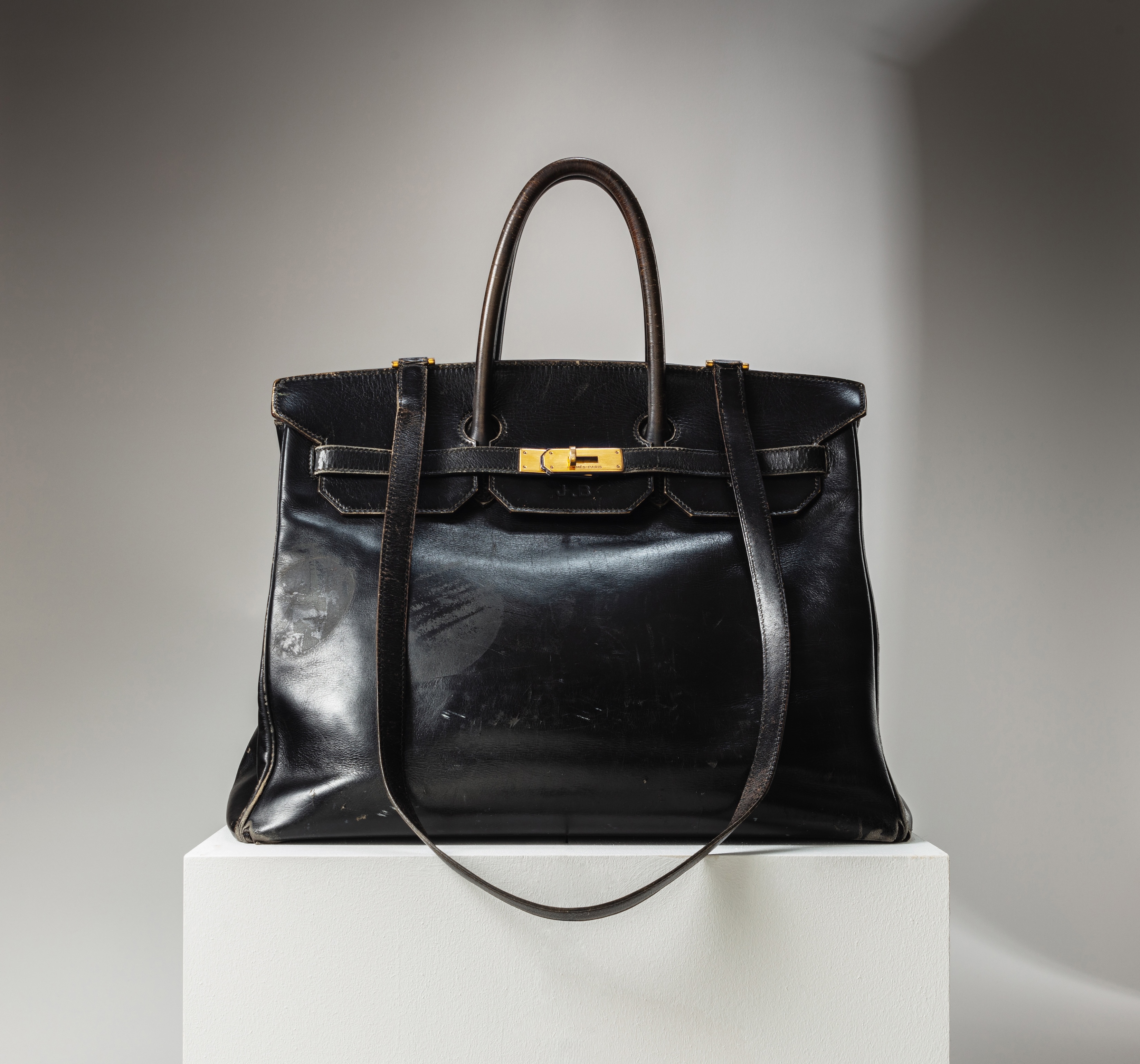
Hermès, the original Birkin crafted for Jane Birkin (1985). Photo: Courtesy of Sotheby’s |
Sotheby’s is auctioning that original
prototype in its Fashion Icons sale in Paris on July 10, during Couture Week, with “estimate on request,” but the house has compared it to Princess Diana’s “black sheep” sweater that sold for more than $1 million. By comparison, the most expensive Birkin ever sold at
auction was a $450,000 Diamond Himalaya model, made from Nile crocodile skin, with 18-karat white gold hardware and diamonds. But this original Birkin bag is more than just a luxury object—it’s a piece of fashion and cultural history. (Disclosure: I worked on the Birkin proposal when I was at Sotheby’s.)
Birkin donated it in the 1990s to a charity auction benefiting AIDS research, after which it ended up at a Poulain-Le Fur auction. That’s where the current consignor, Catherine
Benier—whose Les 3 Marches store the Times has called “the best-kept vintage secret in Paris”—purchased it in 2000 for an undisclosed sum. The bag was later displayed at MoMA, in 2018, and at the Victoria & Albert Museum in 2020; Sotheby’s exhibited it in Paris this past fall at the opening celebration of its new regional headquarters,
and again in Hong Kong this past spring. The house announced it was up for sale last month.
The prototype has several characteristics setting it apart from the design that ultimately went into commercial production—most noticeably a thin, nondetachable shoulder strap that doesn’t appear on any other model. The flap is embossed with the initials “J.B.,” and the hardware is gilded brass, rather than the usual gold-plated. It’s also a unique size, as deep as a Birkin 40, and as high and wide
as a Birkin 35. Jane Birkin, who died in 2023 at the age of 76, adorned it with stickers, as can be seen in several archival photographs. (They have been cited as forerunners of the bag charm craze.) They were removed sometime before Benier bought it, and only the outlines remain. |
|
|
Now, let’s get to the main event… |
|
|
Lisa Yuskavage’s work has been criticized as too overtly sexual, and the artist herself as a
“bad feminist.” But she sees the critical reception as a nuisance on her journey from working-class Philly to a Morgan Library & Museum show, which puts her works on paper alongside Thoreau’s journals and Bach’s sheet music. |
|
|
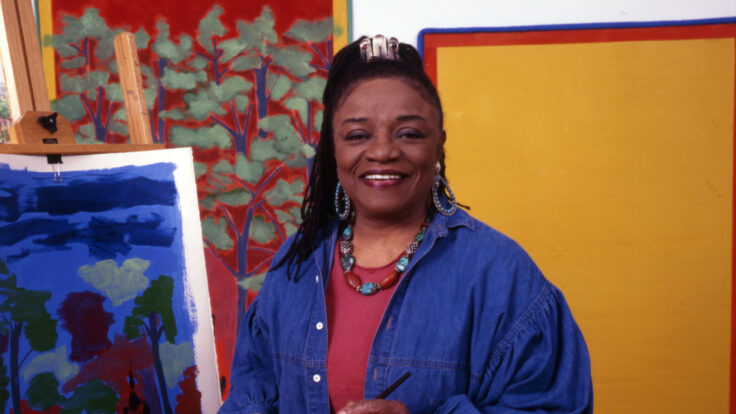
Lisa Yuskavage was sitting in the café at the Morgan Library & Museum
eating a smashburger, when two well-heeled women tucking into their dainty salads at the next table asked what she was doing there. Yuskavage, who was dressed down for the workday, told them she was on lunch break while installing her current show of about 40 career-spanning drawings. The women, clearly surprised by her answer, then asked what qualified her to have a show at the Morgan. Most artists of her stature might have crinkled up their greasy burger wrapper and tossed it at the
interlocutors, but Yuskavage just laughed as she recounted the story at the press preview. “I loved it,” she said.
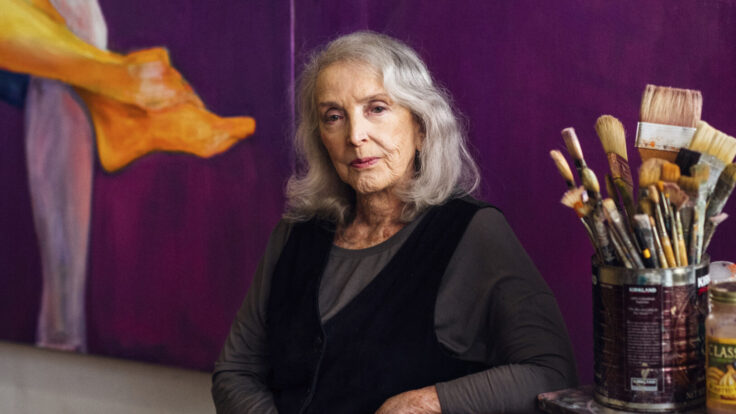
The 63-year-old artist, who grew up in working-class Philadelphia, has often been discounted. A lot has been written about the overt sexuality of her bubble gum–colored paintings of female figures with voluptuous breasts and cherubic faces—much of it negative, accusing her of being a pornographer and a “bad feminist.” And the museum doesn’t shy away
from the controversy in the exhibition, even quoting some of her critics in the wall text. But speaking at the Morgan this week, she likened the critical response to her work to a “flat tire”—in other words, just a small nuisance in her larger journey. |
|
|
A MESSAGE FROM OUR SPONSOR |
Available to listen on Apple Podcasts and Spotify. LISTEN NOW |
|
|
One key aspect of Yuskavage’s work that hasn’t been discussed as much, said Hanna Schouwink,
a partner at David Zwirner gallery who has worked with the artist for the past 20 years, is class. Her paintings reference high-low culture: She draws inspiration from Renaissance masters but depicts everyday characters, like her undergraduate roommate who liked to walk around bottomless. (Yuskavage went to the Tyler School of Art at Temple University before earning her M.F.A. from Yale.) Indeed, the show at the Morgan places her work alongside titans of Western cultural history—the Gutenberg
Bible, Thoreau’s journals, and Bach’s sheet music. In its way, it’s not only a middle finger to the ladies in the café, but to the philistines who dismissed her risqué subject matter and childlike visual language.
The show came together relatively quickly. A little over a year ago, Yuskavage’s digital archivist asked her about the contents of the flat file drawers in her studio, but the artist had no idea what was in them. It turned out that they held
more than three decades’ worth of drawings—about 500 in total. Schouwink came over to see them, and they both agreed the drawings deserved a museum show. The result marks the first time Yuskavage’s works on paper have ever been displayed together, about half from the artist’s own archive and half loaned from private collections. “When you see these, you get a sense of the range of media,” Schouwink told me. “It’s remarkable to understand the breadth of her practice.”
On view until
January, the show opened alongside exhibitions of works by Victorian photographer Julia Margaret Cameron and about Jane Austen—also feminists in their time at the top of their respective fields. Curated by Claire Gilman, the Morgan’s head of modern and contemporary drawings, it’s hung salon style in an intimate gallery, organized thematically and roughly chronologically, and features drawings made as studies as well as finished works. “This room
is a journey through my life,” Yuskavage said. |
The exhibition also showcases the artist’s sense of experimentation, beginning with a series of watercolors
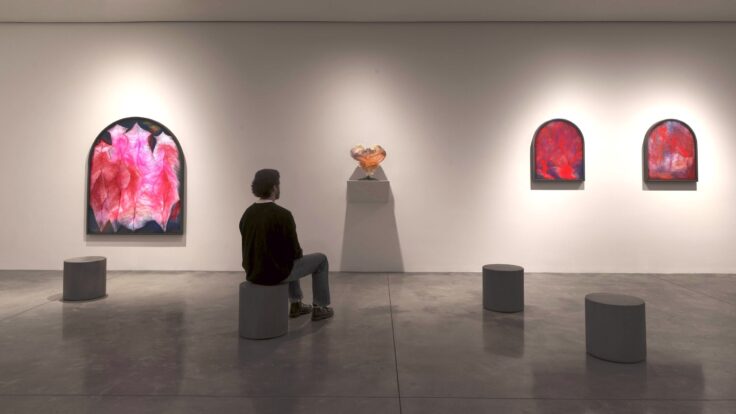
from the early 1990s, Tit Heaven. Yuskavage taught herself the medium in order to lead a class, and these works were done as demonstrations for her students. They depict breasts as imagined landscapes in the form of clouds or mountains. The next grouping comprises graphite sketches for her most well-known series of paintings, Bad Babies, also from the early 1990s, each of which depicts a (bottom) half-nude girl against a brightly saturated background. The wall text at the
Morgan explains that “the girls, while fictional, are distinctly working-class, like those with whom the artist grew up in North Philadelphia.” |
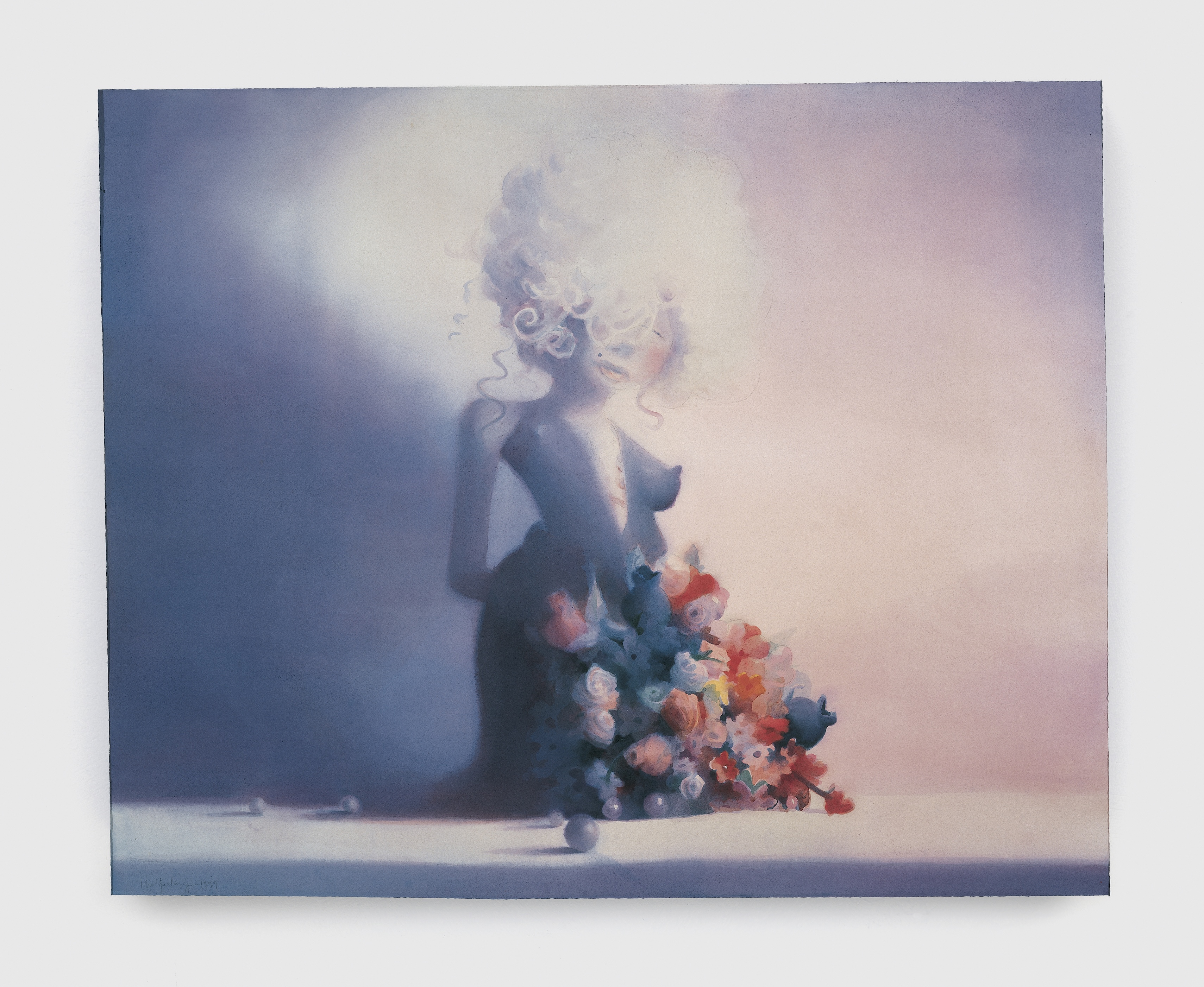
Lisa Yuskavage, Still Life Wearing a Wig (1999). Photo: Courtesy of David Zwirner |
In the mid-1990s, Yuskavage began her other most famous series, Bad Habits, inspired by Italian
Renaissance artist Tintoretto, who made wax figures to help him compose and light his scenes. Yuskavage created maquettes out of Sculpey clay, arranging them in different combinations and depicting them in various mediums, most dramatically in gouache on black paper. A cluster of about 10 works from the next decade or so highlights Yuskavage’s use of live models, as well as her continued exploration of different materials, from charcoal to distemper to ink, using more watery
ones for dreamlike compositions and more finite ones to draw from life. Asschecker, from 1999, is a gouache version of the 1999-2000 painting Night that set her auction record in 2007 when it sold for $1.4 million. The show ends with her most recent series of works, set in an artist’s studio, which was the subject of her recent show at David Zwirner in Los Angeles. |
|
|
Across town, at David Zwirner’s 20th Street gallery, the show Circa 1995: New Figuration in New York
features four paintings by Yuskavage from the mid-1990s, including two from her Bad Babies series. There is also one of her most iconic and oft-referenced paintings, Faucet. It’s a coincidence the two shows are up at the same time, but it’s worth taking advantage before the Zwirner show closes on July 17.
Schouwink said the gallery’s shows of her work have all been successful, but institutional exhibition support has been somewhat lagging. Though her works have been
placed in museum collections—including the Art Institute of Chicago, the Whitney, and MoMA—and the Rose Art Museum organized a traveling survey of about 25 works a few years ago, there is no career retrospective in process. With the upcoming publication of her monograph from Phaidon, and this intimate drawings exhibition at the Morgan, it will be easier for curators to see what a career retrospective could look like. “It’s just a matter of time,” said Schouwink. |
Thanks, Julie.
The Wall Street Journal’s Kelly
Crow posted a link on LinkedIn to her story about Ken Griffin buying the copies of the 13th Amendment and the Emancipation Proclamation for nearly $14 million and more than $4 million, respectively. Her post
started with the word, “Scoop!” But, of course, Wall Power readers know that Julie fingered Griffin as the buyer the night before. Whether Julie’s post pushed Griffin’s people to give the story to the Journal, or Crow was just waiting for Monday to publish, I couldn’t possibly say. But even though Puck
isn’t in the breaking news business—there’s an old saw in journalism about being faster than anyone better, and better than anyone faster (and we choose to be better)—you did hear it here first. That and $2.90 will get you on the subway.
We also told you on Sunday that the most valuable item of clothing once owned by Princess Diana—her “black sheep” sweater, mentioned above—sold at auction in 2023 for $1.1 million. The folks at Julien’s got in touch with us to say that they bested that
number slightly last year when they sold a Jacques Azagury gown for $1.14 million. (Duly noted.)
Meanwhile, I’ve been getting lots of texts and Instagram DMs about the New York Times’s story on Sunday outlining artist Emma Webster’s claims that she was duped into selling a painting for $55,000 to a person she
thought was Lady Gaga. Webster included a resale agreement, at least via an email understanding with the buyer. So she was surprised to see the painting appear in a Hong Kong auction. She managed to stop the painting from being resold, but now claims it’s her property and was stolen. The consignor, who bought the painting from an art advisor, objects to this characterization. This all raises far more questions than it answers.
Webster says she sold the painting before
Perrotin gallery began to represent her. But the Times never bothers to go through some basic details: Did she invoice the buyer? Who was invoiced, and where did the payment come from? The Times quotes Quinn Emanuel lawyer Luke Nikas, who has a specialization in the art world, as noting that California treats the impersonation element of the transaction as a misdemeanor, which could serve as the basis for a civil fraud claim. In other words, it’s not clear
there was a crime, and the F.B.I. is unlikely to get involved. That leaves Webster and her lawyer pleading their case in the court of public opinion, whose verdict is even harder to predict than that of a judge or jury.
Also, in case you missed it, the Times announced the new Ford
Foundation president will be Yale Law School dean Heather K. Gerken.
That’s it for today, folks. See you tomorrow in the Inner Circle.
M
|
|
|
The ultimate fashion industry bible, offering incisive reportage on all aspects of the business and its biggest players.
Anchored by preeminent fashion journalist Lauren Sherman, Line Sheet also features veteran reporter Rachel Strugatz, who delivers unparalleled intel on what’s happening in the beauty industry, and Sarah Shapiro, a longtime retail strategist who writes about e-commerce, brick-and-mortar, D.T.C., and more. |
|
|
Finally, a media podcast about what’s actually happening in the media—not the oversanitized,
legal-and-standards-approved version you read online. Join Dylan Byers, Puck’s veteran media reporter, as he sits down with TV personalities, moguls, pundits, and industry executives for raw, honest, sometimes salacious conversations about the business of media and its biggest egos. New episodes publish every Tuesday and Friday. |
|
|
Need help? Review our FAQ page or contact us for assistance. For brand partnerships, email ads@puck.news. You received this email because you signed up to receive emails from Puck, or as part of your Puck account associated with {{customer.email}}. To stop receiving this newsletter and/or manage all your email preferences, click here. |
Puck is published by Heat Media LLC. 107 Greenwich St, New York, NY 10006 |
|
|
|