|
Welcome back to Wall Power. I’m Marion Maneker.
Happy Memorial Day weekend. I’m on the water today, so Julie Davich is here to discuss the rising prominence of Native American artists in the mainstream art market centered on Chelsea. She also looks at abstract expressionist Mary Abbott’s reemergence at Schoelkopf Gallery, along with a show of other overlooked female 20th century artists at Lincoln Glenn Gallery.
|
|
|
|
A MESSAGE FROM OUR SPONSOR
|
The first steps towards a masterpiece starts with a dream. The all-electric BMW i7 – the evolution of brilliance. Learn more at
BMWUSA.com
|
|
|
 |
Julie Brener Davich |
|
Gallery Hopping with Julie
|
|
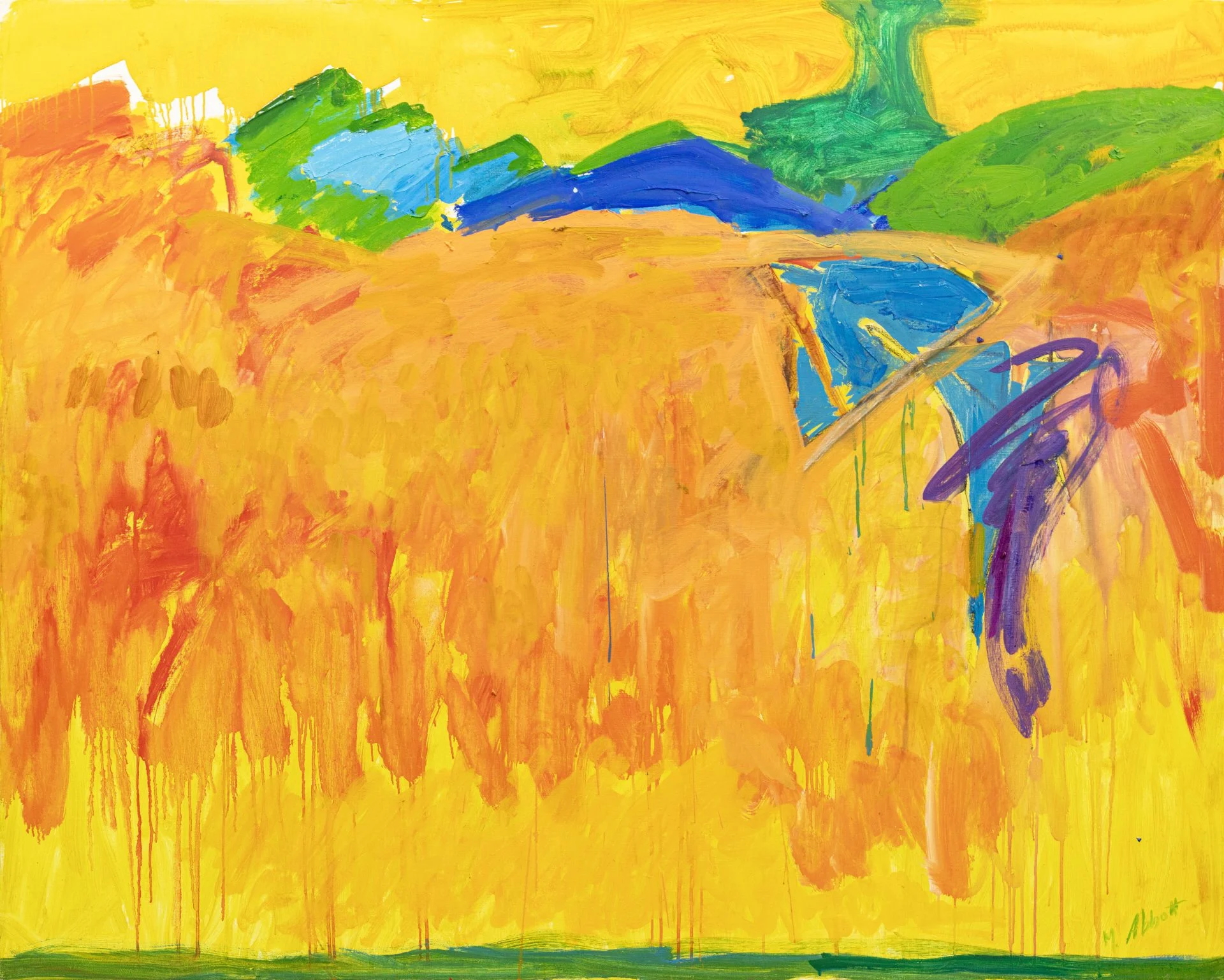
Mary Abbott, Untitled Abstraction. Photo: Courtesy of Schoelkopf Gallery/The Estate of Mary Abbott
|
A museum curator recently told Lincoln Glenn Gallery’s co-founder Doug Gold that “it would be great for someone to bring up Mary Abbott without mentioning de Kooning.” While the comparisons are inevitable given their 40-plus-year friendship (she called him the love of her life), I’ll do my best to tell you about her work without mentioning his. Schoelkopf Gallery is showing a major retrospective of the abstract expressionist’s career, with about 25 works spanning 1940 through 2002 (she died in 2019), half of which are already sold. Meanwhile, Lincoln Glenn is showing a couple of works on paper ($14,000 each) in a group show of overlooked female artists of the past century.
Born in 1921, Abbott eschewed her blue-blooded Upper East Side and Miss Chapin’s pedigree to attend the Art Students League and become a painter living in a cold-water flat on East 10th Street. Her neighbor, the artist David Hare, introduced her to the AbEx coterie, including Grace Hartigan, who became a close friend. Abbott hung out at Cedar Tavern and The Club, but detested Jackson Pollock. She was included in different group shows at the time, but unlike her male counterparts, didn’t benefit from consistent dealer representation. She married businessman Tom Clyde in 1950, and their extensive travels in Europe, and winters in the Caribbean, provided inspirations for her compositions, like the vibrant Palm Frond. Later in life, she was represented by McCormick Gallery in Chicago. “People are drawn to her palette but also her story,” Schoelkopf managing director Alana Ricca told me.
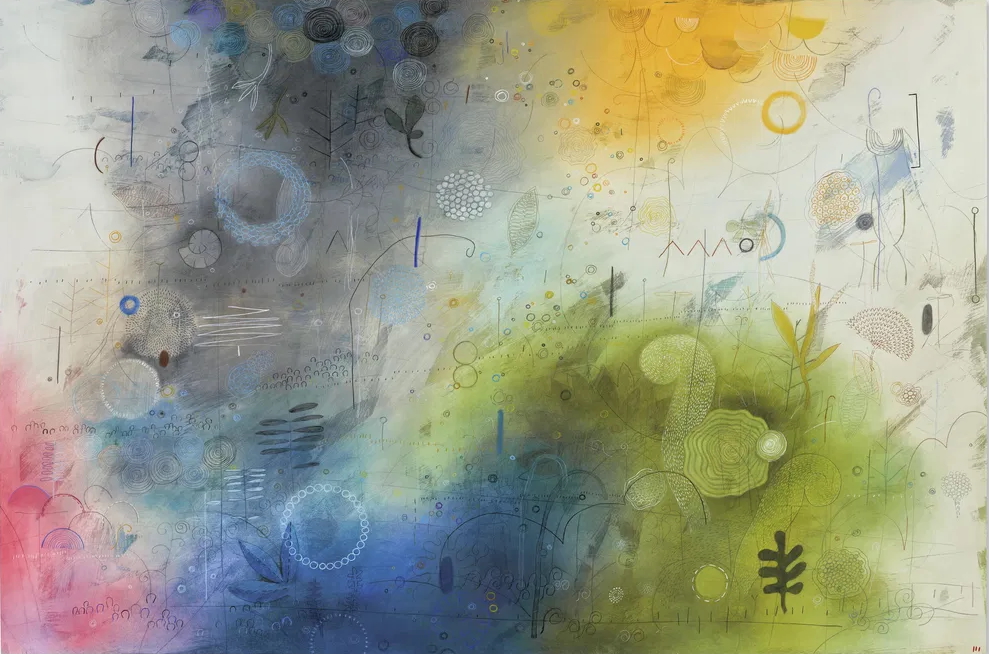
The Schoelkopf catalogue features about 60 of Abbott’s works. Compositions like Wave (1954) and Jungle Sun (1985) allude to the feeling of the subject as much as the subject itself. Black Swan, from 1956, could be a reference to Leda and the Swan, also depicted by Cy Twombly, another of her mentors. In an untitled self-portrait, painted in Southampton in the 1980s, her fragmented face peeks out from behind a vase of lilies. But, most often, Abbott employed pure abstraction that demonstrated her assuredness as a painter: Ricca said that one of the most asked-about compositions in the catalogue is a vibrant yellow untitled abstraction (shown above), with green grounding along the bottom that hints at landscape.
As the formal representative of Abbott’s estate, Schoelkopf has access to her archives as well as her studio, and is showing her paints, brushes, palette, and sketchbook alongside her paintings. It’s a special exhibition, on view through June 28. The group show at Lincoln Glenn, Herself, which includes works by Hartigan, Lynne Drexler, Sheila Hicks, Diana Kurz, Agnes Pelton, and Takako Yamaguchi, closes July 5.
|
|
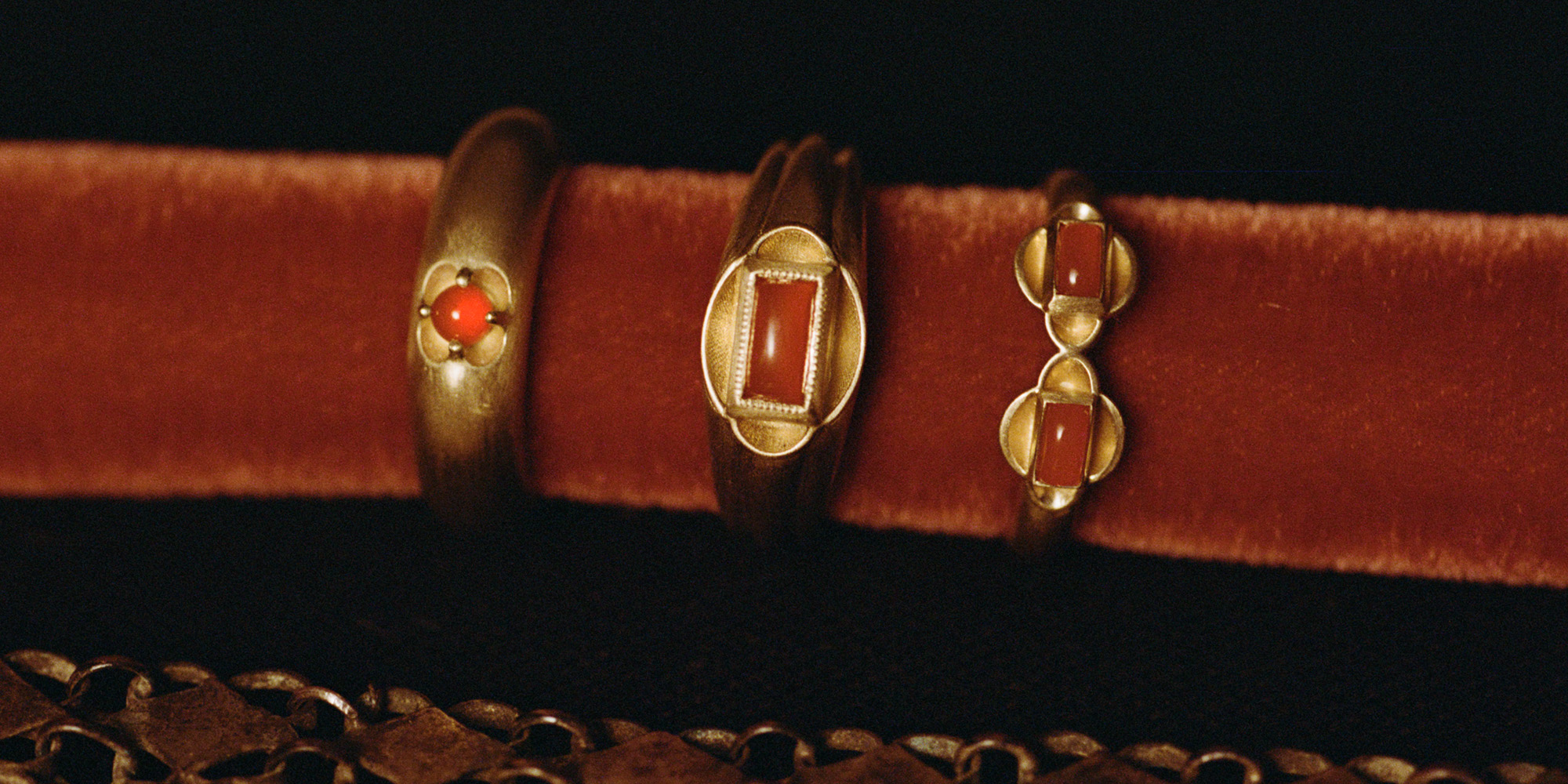
Subjects of Adornment, J.Hannah in collaboration with The Metropolitan Museum of Art. Photo: Courtesy of J.Hannah
|
The Met’s European paintings galleries, which reopened a couple years ago after a five-year renovation, inspired Jess Hannah Révész’s latest collaboration between the Met and her namesake brand, J.Hannah. She homed in on northern Renaissance portraits by Barthel Bruyn the Younger, Hans Memling, Lucas Cranach the Elder, and one lush 19th century French portrait by Jean-Auguste-Dominique Ingres as source material for her seven-piece collection of rings, earrings, and pendants. The jewels are available in gold and some in silver, with stone variations in sapphire, carnelian, and diamond. The Cranach painting depicts Judith triumphantly holding the severed head of Holofernes—the perfect gift if you want to send a message.
This is Révész’s second jewelry collection with the Met. Her previous, sold-out collaboration was inspired by carved stone amulets found in the tomb of the best-known female pharaoh, Hatshepsut. She also collaborated on nail polish sets using colors from the Met’s 2021 surrealism show and 2022 Tudors exhibition. Her new jewelry collection will be available online starting Thursday.
|
|
Last week’s auction of Abraham Lincoln memorabilia at Freeman’s Hindman, sold to benefit the Lincoln Presidential Foundation, doubled its presale estimate to make $7.9 million. The top lot was a pair of blood-stained gloves that Lincoln had in his pocket when he was assassinated. They sold for $1.5 million, almost double their estimate of $800,000, setting a new record for a Lincoln artifact. A handkerchief that was also in his pocket that fateful evening, estimated at $445,000, sold for $826,000 after a 10-minute bidding war. A “Wanted” poster for Lincoln’s assassin, John Wilkes Booth, and his conspirators sold for $762,500, or nine times its low estimate. The successful sale is a significant step toward helping the foundation pay off its debt from the 2007 purchase of the collection.
|
|
|
|
Two new gallery shows in Manhattan exemplify the kind of boundary-pushing work that Native American artists started making after the Standing Rock protests in 2016. Institutions have embraced the movement, so why hasn’t the market?
|
|
|
|
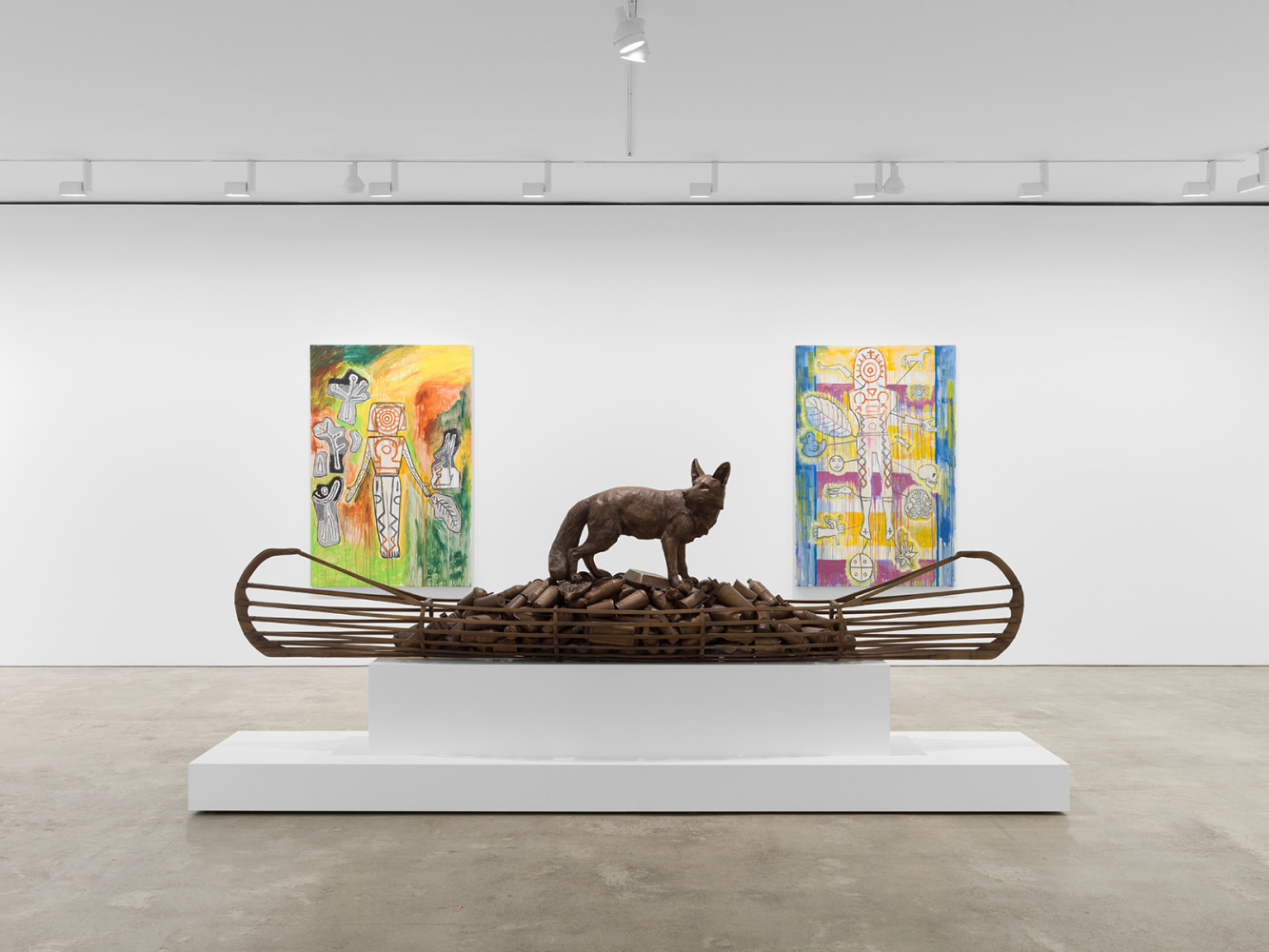
Right now, in adjacent galleries on West 20th Street, there are two noteworthy exhibitions of works by Native American artists. Garth Greenan Gallery is showing the final paintings that Salish and Kootenai artist Jaune Quick-to-See Smith made before she died, this past January, at age 85; and Hales Gallery has Cheyenne-inspired geometric paintings by 33-year-old Jordan Ann Craig. Two Chelsea shows might not seem like much, but it’s more market visibility than Native artists enjoyed a few years ago. “Every couple years, the canon opens up doors to marginalized people,” Cannupa Hanska Luger, another Greenan artist, told me. “Right now, it’s Native art.”
Quick-to-See Smith joined Garth Greenan’s stable in 2018. (“I just called her up,” he told me.) That year, her work appeared in the traveling survey, Art for a New Understanding: Native Voices, 1950s to Now, originated by Crystal Bridges, that sent modern and contemporary Native art on its current ascent. Since then, there have been countless solo presentations of Native artists at museums across the country. Last year saw another influential group exhibition at the National Gallery (curated by Quick-to-See Smith), while the Met, MFA Boston, National Gallery, and Brooklyn Museum, among others, have all hired dedicated curators in the category. Jack Shainman added Tewa artist Rose B. Simpson to his roster in 2021. Two Native artists—Dyani White Hawk, represented by Bockley Gallery, and Wendy Red Star, represented by Sargent’s Daughters—were named MacArthur Fellows in 2023 and 2024, and an expanded SITE Santa Fe is rebooting next month for the first time in seven years under influential curator Cecilia Alemani.
|
|
|
|
A MESSAGE FROM OUR SPONSOR
|
The first steps towards a masterpiece starts with a dream. The all-electric BMW i7 – the evolution of brilliance. Learn more at
BMWUSA.com
|
|
|
|
Yet, despite all this momentum, the appetite for Native art has largely stayed within the context of institutions. The market is gaining strength at galleries and small and medium auction houses, but Native artists have yet to be fully recognized at the very top of the market. “For some reason, the market isn’t on board,” a former global auction house specialist told me.
|
The Standing Rock Catalyst
|
|
A pivotal moment for Native art was the demonstrations against the Dakota Access Pipeline at Standing Rock in 2016. Until then, Native artists “used to exist in the minds of the general population as characters in a myth,” Luger told me. That changed when the American public saw Native people on their screens, in ways that went beyond film and TV stereotypes. The moment also gave artists the confidence to create the kind of boundary-pushing work that helped them move from specialized institutions, like the Museum of Contemporary Native Arts in Santa Fe and the Heard Museum in Phoenix, to mainstream ones. Previously, “the market was driving what Native artists produced,” said Luger. “To be able to survive, we had to use traditional materials that fit this quasi-romantic narrative.” Standing Rock was also the first time the hundreds of different tribes rallied together, which paved the way for group shows like the one at Crystal Bridges.
|
|
Installation view of Jaune Quick-to-See-Smith: Tierra Madre, Garth Greenan Gallery, New York (2025). Photo: Courtesy of the Estate of Jaune Quick-to-See Smith/Garth Greenan Gallery
|
|
Luger, born in Standing Rock and a member of the Three Affiliated Tribes of Fort Berthold, is now based in New Mexico. (We went to middle and high school together in Scottsdale, though we didn’t know each other.) A prolific multidisciplinary artist, he is one of six artists from that influential 2018 Crystal Bridges show who are now represented by Greenan, alongside Quick-to-See Smith, Melissa Cody, James Luna, Fritz Scholder, and Yatika Starr Fields.
Greenan has been a strong champion of their work. In 2023, he helped secure Quick-to-See Smith’s landmark retrospective at the Whitney, which was, remarkably, the first retrospective for a Native artist organized by the museum. The Stephen Friedman Gallery just announced it will be representing the Quick-to-See Smith estate in the U.K., starting with a show next month. The auction record for Quick-to-See Smith’s work is $642,600, achieved in a Christie’s 21st century evening sale for her 1994 painting, I See Red: Talking to the Ancestors—more than eight times its $80,000 low estimate. That was in 2022—before the Whitney retrospective.
|
|
|
|
Other Native American artists are also gaining recognition. At the 2024 Venice Biennale, which focused on outsider and marginalized communities, Quick-to-See Smith and Greenan were confident she would win the commission for the U.S. pavilion. Instead, it went to Jeffrey Gibson, a Choctaw/Cherokee artist and 2019 MacArthur Fellow, who is currently represented by Hauser & Wirth. But the breakout star of the 2024 Biennale was the now 68-year-old Diné (Navajo) artist Emmi Whitehorse, who is also repped by Greenan. Her colorful abstract paintings, which call to mind ancient pictograms, were the talk of the Arsenale.
|
|
Emmi Whitehorse, Sea Forager II (2024). Photo: Courtesy of Christie’s
|
|
In May 2024, right after the Biennale kicked off, Phillips sold a painting by Whitehorse for $177,800, nearly 15 times its estimate, to a European collector. Then, a couple months ago, a new auction record for Whitehorse was achieved when Sea Forager II sold at Christie’s for £300,000 ($390,000) against an estimate of just £120,000. The consignor had purchased it less than six months prior from the artist’s solo show at Greenan. “Her art is as much about Kandinsky as it is about the land and things we typically associate with Native people,” said Greenan, explaining the broad appeal of her work. Whitehorse is about to have a major museum retrospective, but the date hasn’t been announced yet.
|
|
Fritz Scholder, Four Indian Riders (1967). Photo: Courtesy of Freeman’s Hindman
|
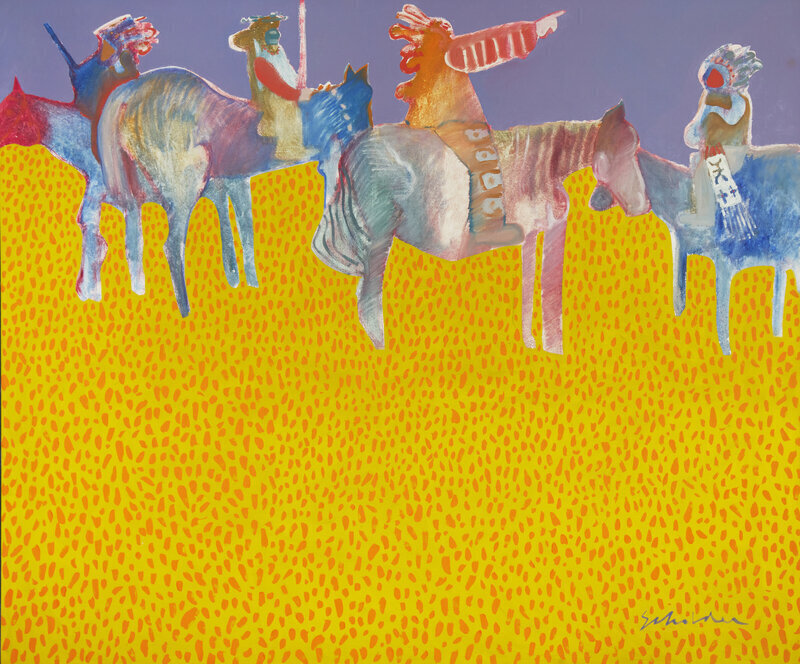
There are other artists from earlier generations whose profiles are on the rise. Last year, David Zwirner mounted a show in Los Angeles of 1950-1960s abstract paintings by Ojibwe artist George Morrison. In July, the Met is opening an exhibition of 25 works he made in New York at the height of the AbEx movement. Another is Fritz Scholder, a Luiseño painter and sculptor who studied under Wayne Thiebaud in the 1950s and was a teacher at the Institute of American Indian Arts in the 1960s. Bucking the larger trend, his Fauvist-style portraits have actually received more market attention in recent years than recognition by the major museums. In 2022, Hindman set a record for Scholder when Indian on Horseback sold for 10 times its $50,000 estimate in their Western art sale. Another of his paintings, Four Indian Riders (1967), sold last week in the house’s postwar and contemporary art sale for $476,750.
Smaller and medium auction houses are committed to this category, even if it has yet to be recognized at the very top of the market. Freeman’s holds biannual sales of Western and Native American art. Bonhams, which pioneered the secondary market for modern Native American art, driven in large part by the strength of Scholder’s market, has held dedicated biannual sales in the category since 2019. And last year, Phillips’ private sales team held a selling exhibition of about 120 works of contemporary Native art that deputy chairman Scott Nussbaum told me was “highly successful commercially.” He added, “We saw great enthusiasm and engagement with collectors who had not previously expressed interest in modern and contemporary Native American art.” Perhaps it’s a sign of things to come.
|
|
Thanks, Julie.
More on Tuesday,
M
|
|
|
|
The ultimate fashion industry bible, offering incisive reportage on all aspects of the business and its biggest players. Anchored by preeminent fashion journalist Lauren Sherman, Line Sheet also features veteran reporter Rachel Strugatz, who delivers unparalleled intel on what’s happening in the beauty industry, and Sarah Shapiro, a longtime retail strategist who writes about e-commerce, brick-and-mortar, D.T.C., and more.
|
|
|
|
Finally, a media podcast about what’s actually happening in the media—not the oversanitized, legal-and-standards-approved version you read online. Join Dylan Byers, Puck’s veteran media reporter, as he sits down with TV personalities, moguls, pundits, and industry executives for raw, honest, sometimes salacious conversations about the business of media and its biggest egos. New episodes publish every Tuesday and Friday.
|
|
|
Need help? Review our FAQ page or contact us for assistance. For brand partnerships, email ads@puck.news.
You received this email because you signed up to receive emails from Puck, or as part of your Puck account associated with . To stop receiving this newsletter and/or manage all your email preferences, click here.
|
|
Puck is published by Heat Media LLC. 107 Greenwich St, New York, NY 10006
|
|
|
|